



Purchase order funding bad credit South Africa is a real option for tender entrepreneurs who have won a government contract or received a purchase order but carry an impaired credit record. Sourcefin does not rely on a credit score alone. It assesses three pillars: trust, delivery capability, and whether the end buyer will pay. A judgment on your record does not automatically close the door.
Key Takeaways
- Purchase order funding bad credit South Africa is available through Sourcefin for deals from R250,000 upwards.
- Sourcefin uses a three-pillar risk framework: trust (client character), delivery capability, and end buyer payment certainty.
- A credit bureau review is part of the process, but it is used to understand your story, not to disqualify you automatically.
- Transparency about past credit issues significantly improves your application outcome.
- The deal is structured as a profit-share, not a loan, so you are not taking on traditional debt.
- Malarey used PO funding starting with R2.6 million to build a business that invested R320 million into a Rand Water project.
Can You Get Purchase Order Funding with Bad Credit? The Short Answer
South Africa has over 10.19 million consumers with impaired credit records, according to the National Credit Regulator’s Q3 2024 Credit Bureau Monitor. Many of those people are also running businesses, chasing tenders, and doing exactly the kind of work that grows the economy. A poor credit score does not mean a person cannot run a project well, manage a supplier relationship, or deliver on a government contract.
Purchase order funding operates on a different risk logic from a bank loan. A bank looks backward. It asks: what does your credit history tell us about you? PO funding looks forward. It asks: does this specific deal make sense? Can it be delivered? Will the buyer pay?
If you have explored your broader loans for bad credit South Africa options and found them limited, PO funding is often the most practical route for SMME owners with active tenders or purchase orders. The credit profile matters less than the deal itself.
Purchase Order Funding Bad Credit South Africa: The Three-Pillar Assessment
Sourcefin uses three distinct pillars when assessing any PO funding application. Each one carries weight. No single pillar automatically approves or rejects a deal.
Pillar One: Trust
The first question Sourcefin asks is simple: can we trust you? This is not about a number on a credit report. It is about character.
Sourcefin reviews personal and business bank statements. It runs a credit bureau check. But the purpose of that check is to understand what happened, not to stamp a rejection. A judgment from a failed business, a period of financial strain, a payment dispute that went legal, these things happen. What matters is whether you are upfront about them.
Applicants who explain their credit history clearly and honestly consistently fare better than those who say nothing and hope the bureau report goes unnoticed. Sourcefin is looking for people it can work with over many deals, not just one transaction.
Pillar Two: Delivery Capability
Sourcefin does not simply advance money and hope for the best. It has built an operational infrastructure specifically to help deliver deals. That includes over 2,000 pre-vetted suppliers, a China sourcing office with 65 employees, and in-house project management and supply chain teams.
When assessing a deal, Sourcefin looks at whether the goods or services can actually be delivered on time and within budget. If you have a credible supplier relationship and a realistic delivery plan, that carries significant weight, regardless of what your credit record looks like.
Pillar Three: End Buyer Payment
The third pillar is the one many applicants overlook. Sourcefin’s creditors team independently verifies that the end buyer, typically a government department, state-owned entity, or large corporate, has the budget and the history of paying suppliers. About 80% of Sourcefin’s portfolio is in the public sector, covering departments and SOEs like Rand Water and Eskom.
A strong end buyer makes a significant difference to how a deal is assessed. If the buyer is creditworthy and the order is confirmed, that reduces the overall risk profile of the transaction, which benefits you as the applicant.
Character Assessment: What Sourcefin Actually Looks At
Understanding what “character assessment” means in practice can help you prepare a stronger application.
Sourcefin will review your last three to six months of business bank statements and, in most cases, your personal bank statements too. It will pull a credit bureau report. It will have a conversation with you about your business, your track record, and the specific deal you are bringing to the table.
What it is looking for is consistency and honesty. Do your bank statements reflect a business that operates, even if it has had difficult periods? Does your explanation of any credit issues match what the bureau shows? Are you forthcoming about risks, or are you trying to hide them?
A past judgment or compliance issue does not automatically disqualify you. Context matters. Someone who had a judgment five years ago and has rebuilt their business is a different risk from someone with active, unresolved disputes. Sourcefin makes that distinction. Banks, with their conservative mandates and automated credit scoring, often cannot. That is not a failing on their part. Banks are built for stability. Sourcefin is built for speed and opportunity.
You can read more about how to approach getting business funding with bad credit in South Africa for a broader view of the landscape.
What to Prepare Before You Apply
A well-prepared application moves faster and signals that you are serious. Before you submit, gather the following:
- The purchase order or tender award letter – this is the foundation of the deal. Without it, there is nothing to fund.
- Company registration documents (CIPC) – confirms your legal entity is in order.
- SARS tax compliance status – a valid tax clearance certificate or compliance status document.
- Business bank statements (last 3–6 months) – shows trading activity and cash flow patterns.
- A brief written explanation of any credit issues – do not leave this to the bureau report alone. Write a short, honest summary of what happened and where you are now.
If you have a supplier already identified for the goods or services, include their details. Sourcefin can also assist with supplier sourcing through its own network, but coming with a credible supplier strengthens your position.
Government tender applicants should also read the tendering in South Africa complete guide for a broader understanding of the procurement landscape before applying for funding.
How the Profit-Share Deal Structure Works
Purchase order funding from Sourcefin is not a loan in the traditional sense. It is structured as a profit-share arrangement.
The formula works like this: tender value minus cost to deliver equals profit. Sourcefin funds the delivery costs, and in return, it shares in the profit generated once the project is complete and the buyer pays. You do not take on fixed monthly repayments. The structure is tied to the success of the specific deal.
This is important for SMME owners with impaired credit records. You are not adding another debt obligation to a balance sheet that is already under pressure. You are partnering with a funder on a specific, time-bound transaction. The risk is shared. So is the reward.
Costs vary based on deal size, duration, and complexity. For a clear picture of how a deal might work for your specific order, submit a funding application and Sourcefin will structure a proposal based on your actual numbers.
For a detailed breakdown of how PO funding compares to invoice discounting, read the PO funding vs invoice discounting guide for SMMEs. For broader context on invoice-side funding, see the SA invoice discounting pillar.
Deal Sizes: From R250,000 to Multi-Million Rand Contracts
Sourcefin funds deals from R250,000 at the lower end through to tens of millions of rands for large infrastructure and supply contracts. The R250,000 minimum exists because the operational overhead of managing a deal, supplier sourcing, project management, creditor verification, makes smaller transactions unworkable for both parties.
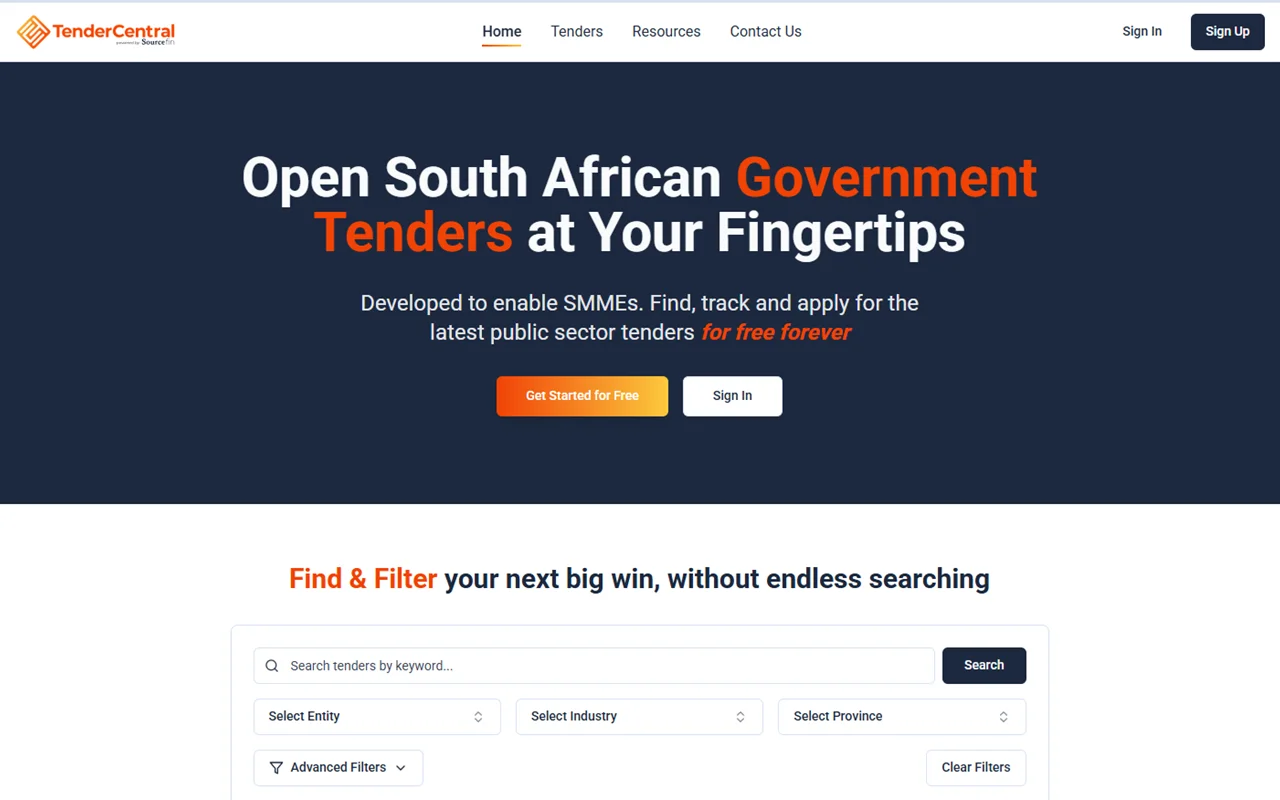
If your current tender is below R250,000, the tender funding options in South Africa overview covers a range of funding routes that may be more appropriate for smaller deals. Finding the right tender to fund is also easier with tools like TenderCentral, which aggregates government opportunities across South Africa.
For deals that qualify, Sourcefin has funded contracts in the R30 million-plus range across sectors including construction, infrastructure, logistics, and government supply.
Case Study: Muphrey and the R2.6 Million That Became R320 Million
Muphrey came to Sourcefin with a tender from Rand Water for wastewater infrastructure in the Vaal Basin, a project ultimately serving 1.8 million people. The business needed capital to start delivery. Sourcefin advanced R2.6 million to get the project moving.
From that initial advance, Muphrey’s business invested R320 million into the project over time. Rand Water then awarded a follow-on contract: an R868 million reservoir project in Germiston.
In Muphrey’s own words: “From the first 2.6 million rand that Sourcefin advanced in August of 2023, we have managed to invest about 320 million rand to date.”
This is what PO funding is designed for. Not to paper over financial problems, but to give capable businesses the capital to deliver on contracts they have already won. The credit history of the business owner at the start of that journey was not the deciding factor. The deal, the buyer, and the delivery plan were. For a complete picture of how purchase order funding works in South Africa, our pillar guide explains the model end to end.
Explore the full range of options at the Sourcefin purchase order funding service page to see how the process works from application through to delivery.
Sources & References
- National Credit Regulator – Credit Bureau Monitor Q3 2024
- SMEs South Africa – 2025 MSME Access to Finance Report (Finfind)
Frequently Asked Questions
Can I get purchase order funding in South Africa if I have a bad credit record?
Yes. Sourcefin does not rely solely on your credit score. It assesses three pillars: your character and transparency, your ability to deliver the order, and whether the end buyer will pay. A past judgment or impaired credit record does not automatically disqualify you. Context and honesty about your credit history matter more than a clean score.
What is the minimum deal size for purchase order funding at Sourcefin?
The minimum deal size is R250,000. Below this threshold, the operational costs of managing supplier sourcing, project coordination, and creditor verification make the deal unworkable for both Sourcefin and the client. Deals can range from R250,000 up to tens of millions of rands depending on the contract and buyer.
What documents do I need to apply for purchase order funding?
You will need your purchase order or tender award letter, CIPC company registration documents, a valid SARS tax compliance status, business bank statements for the last three to six months, and a brief explanation of any credit issues. Having a supplier identified for the goods or services also strengthens your application significantly.
Is purchase order funding a loan?
No. Sourcefin structures PO funding as a profit-share arrangement. Sourcefin covers the delivery costs and shares in the profit once the buyer pays on completion. You do not take on fixed monthly repayments or add traditional debt to your balance sheet. The structure is tied to the outcome of the specific deal.
How does Sourcefin assess the end buyer when reviewing a PO funding application?
Sourcefin’s creditors team independently verifies that the end buyer, typically a government department, SOE, or large corporate, has the budget and a track record of paying suppliers. About 80% of Sourcefin’s portfolio is in the public sector. A creditworthy end buyer reduces overall deal risk and can positively influence the assessment outcome.
Does Sourcefin help with sourcing goods and services for my tender?
Yes. Sourcefin has over 2,000 pre-vetted suppliers, a China-based sourcing office with 65 employees, and in-house supply chain and project management teams. If you do not yet have a supplier confirmed, Sourcefin can assist with sourcing as part of the funding arrangement. This is one of the key differences between Sourcefin and a traditional finance provider.
What sectors does Sourcefin fund through purchase order funding?
Sourcefin primarily funds public sector deals including government departments and SOEs such as Rand Water and Eskom. It has funded projects across construction, infrastructure, logistics, and government supply. Approximately 80% of its portfolio involves public sector buyers, though large corporate purchase orders are also considered on a case-by-case basis.