
FNB purchase order financing for manufacturing SMEs
How Purchase Order Financing funds raw materials, components and logistics on a confirmed manufacturing order, and how the FNB referral route works for SMEs.
On this page
Manufacturing purchase order financing in South Africa pays for the raw materials, components and supplier costs a manufacturer needs to fulfil a confirmed order before the customer pays. Through a referral arrangement, FNB can refer eligible manufacturing SMEs to Sourcefin, which assesses the deal, pays suppliers directly and is repaid from the customer's payment.
Key takeaways
- Purchase Order Financing (POF) funds the input side of a confirmed order: raw materials, components, packaging and logistics.
- Sourcefin pays suppliers directly and is repaid from the customer's payment for that delivery.
- Sourcefin's network of 2,000+ pre-vetted suppliers, local and global, can help where an input is hard to source.
- FNB refers and brings trusted banking infrastructure. Sourcefin assesses, decides and funds.
Why manufacturers run short on a confirmed order
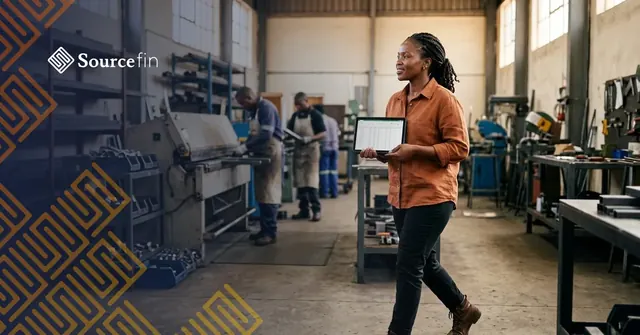
Manufacturing has a long gap between winning work and being paid for it. The order lands, and before anything ships your business has to buy raw materials and components, run production, pack and deliver. Only then does the customer's payment term start. The bigger and more valuable the order, the wider that gap becomes.
That is the opportunity to delivery problem in its purest form. The demand is real and confirmed, the factory can make the product, and the constraint is the working capital to buy the inputs. For a growing manufacturer, a single large order can be worth more than the cash the business normally carries.
What manufacturing purchase order financing pays for
POF is tied to the supply side of a specific, confirmed order. On a manufacturing deal, that typically means:
- Raw materials – steel, timber, fabric, resin, food ingredients or whatever the product starts as.
- Components and sub-assemblies bought in from other manufacturers.
- Packaging the customer specifies.
- Logistics – getting inputs to the factory and finished goods to the customer.
Sourcefin pays those suppliers directly rather than advancing a lump sum, so the funding goes exactly where the order needs it. Equipment purchases, factory expansion and general overheads are a different question. They are capital investment rather than order-level working capital, and sit with products built for them.
How it works on a manufacturing order
- The order is confirmed. A signed purchase order from a credible customer, with clear specifications, quantities and delivery terms.
- The referral or application. FNB business clients raise the deal with their Relationship Manager, who can refer it to Sourcefin.
- Sourcefin assesses the deal. The order, the customer, the supplier quotes for each input and whether your production capacity can meet the delivery date.
- Suppliers are paid. Sourcefin settles the input costs directly with your suppliers.
- You produce and deliver. Your business runs the order and ships to the customer.
- The customer pays. Sourcefin is repaid from that payment and your business keeps its profit.
The full journey, stage by stage, is in how FNB purchase order financing works.
What Sourcefin looks at on a manufacturing deal
The assessment follows the same deal-led logic as any POF application, with a few questions that matter more in manufacturing:
- The bill of materials. Clear supplier quotes for every input, so the funding requirement is defined.
- Lead times. Whether materials can arrive in time for production to finish before the delivery date.
- Production capacity. Whether your line, shifts and team can make the volume in the time available.
- Quality and compliance. Any certification or standard the customer requires, already in place.
- The customer. Whether the organisation that issued the order is verifiable and will pay on the agreed terms.
The four core questions behind every deal are set out in FNB purchase order financing eligibility.
Where the supplier network helps
Manufacturers often find that the hardest part of a large order is not the money but the inputs: a component with a long lead time, a supplier who cannot meet the volume, or a material that is cheaper elsewhere. Sourcefin works with a network of 2,000+ pre-vetted suppliers, local and global. Where it helps the deal, the Sourcefin team can support sourcing as well as funding it, which matters when the margin on an order depends on what the inputs cost.
Who the FNB referral route suits
Sourcefin's Purchase Order Financing is designed for businesses with a confirmed purchase order or tender, typically R250 000 or more in value. Sectors we commonly fund include construction, manufacturing, ICT, logistics, maintenance, cleaning services and public sector contracts, though we consider any sector with confirmed work. It is available with limited balance sheet support, where your business can demonstrate the ability to deliver.
A referral is an introduction. FNB can refer eligible business clients to Sourcefin for consideration for POF, and all assessments and decisions are made solely by Sourcefin. FNB does not assess, approve or fund applications, and a referral does not guarantee that funding will be offered. For the reasoning behind the route, see why FNB refers SMEs to a specialist funder.
For wider context on your sector, Statistics South Africa publishes monthly manufacturing production and sales figures, and the dtic lists incentives aimed at manufacturers' capital investment – a different need from funding a single order.
How to start
If your manufacturing business banks with FNB and has a confirmed order, raise that specific deal with your Relationship Manager. Detail on the route is on the FNB purchase order financing page, the background is in the Sourcefin and FNB referral arrangement, and when you are ready you can start your application.
Sources & references
- Statistics South Africa – manufacturing production and sales statistics.
- Department of Trade, Industry and Competition – incentives for manufacturers.
- FinMark Trust – FinScope research on access to finance.
Frequently asked questions
Can purchase order financing pay for raw materials for a manufacturing order?
Purchase Order Financing (POF) is designed to pay for the raw materials, components, packaging and logistics a confirmed manufacturing order needs. Sourcefin pays those suppliers directly rather than advancing a lump sum, and is repaid from the customer's payment once the order is delivered. The funding is tied to that specific order.
Does purchase order financing cover new machinery for a factory?
Purchase Order Financing (POF) is not designed for machinery. It funds the supply side of a specific confirmed order, such as raw materials and components. New equipment and factory expansion are capital investment, usually served by asset finance or development finance. The dtic also lists incentives aimed at manufacturers' capital investment.
What does Sourcefin look at on a manufacturing purchase order?
On a manufacturing purchase order, Sourcefin looks at the confirmed order, the credibility of the customer, supplier quotes for every input, lead times, and whether production capacity can meet the delivery date. Any certification the customer requires should already be in place. Sourcefin makes the credit decision independently, in line with its own credit and risk processes.

Sourcefin is a South African alternative finance provider that offers purchase order funding and invoice discounting to SMMEs, enabling businesses to fulfil confirmed purchase orders or tenders and unlock cash flow without collateral. Unlike traditional lenders or banks, Sourcefin also provides end-to-end support including supplier sourcing, logistics, project management, and risk oversight.