
Chuck Chilli Foods: Real SMME Funding That Delivered
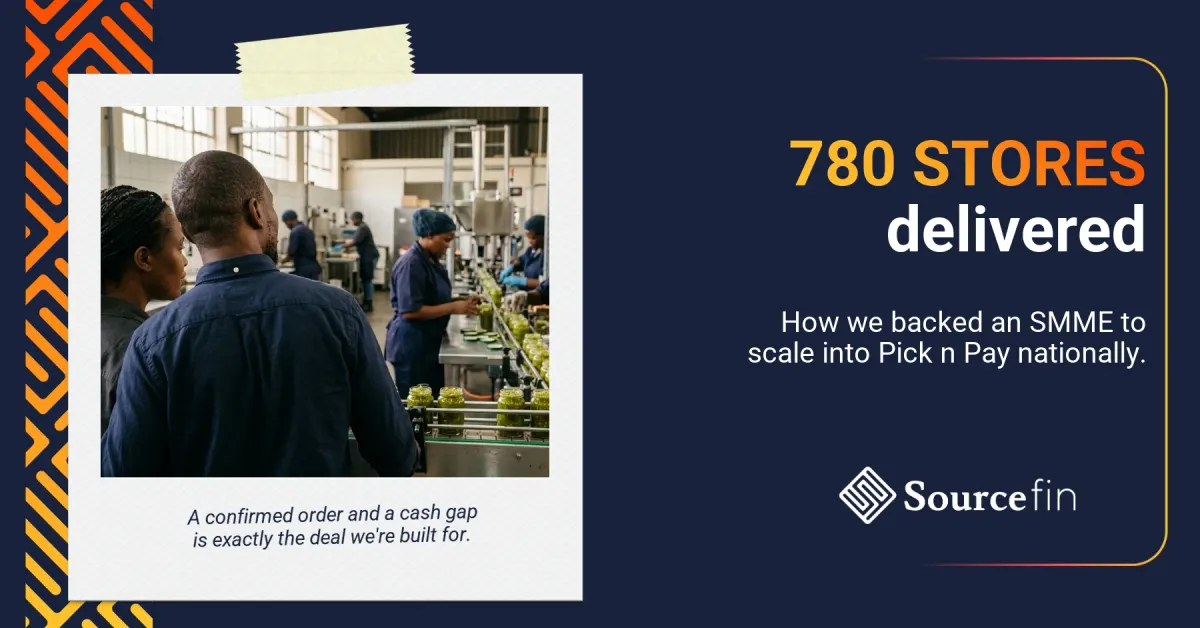
How Chuck Chilli Foods – a Black-owned SMME chilli relish brand – scaled into 780 Pick n Pay stores with Sourcefin's purchase order funding behind them.
On this page
- Key Takeaways
- From a domestic kitchen to 780 Pick n Pay stores
- The biggest order ever
- The problem isn't the bank. It's the mandate.
- A different shape of purchase order funding for Chuck Chilli
- What the deal makes possible for Chuck Chilli
- What this kind of deal asks of a funder
- If you're sitting on an order and a cash gap
- Frequently asked questions
Chuck Chilli Foods scaled from a 15,000-jar production cycle to a 35,000-jar Pick n Pay order in four weeks – with Sourcefin's purchase order funding behind them. This case study covers the order, the working-capital gap, and the deal that made the scale-up possible.
Key Takeaways
- Chuck Chilli received its largest-ever order: 35,000 jars to be delivered into two Pick n Pay distribution centres, supplying 780 stores nationally
- The previous production high was 15,000 jars across a three-week cycle – this order was more than double that volume in only four weeks
- The business had won a Gauteng Department of Agriculture and Rural Development (GDARD) Commercialisation Programme grant to fund a bigger facility and production scale-up – but the new capacity wasn't yet online when the order landed
- Sourcefin structured a purchase order funding deal around how Chuck Chilli actually buys – more than half of the funding requirement was raw vegetables priced daily across multiple suppliers
- The deal did not fit the standard purchase-order funding template, but Sourcefin backed the business after understanding it
From a domestic kitchen to 780 Pick n Pay stores
In 2019, Boikano Sikwane and Tshepiso Manyoha turned a chunky chilli relish they had been making for family and friends into a business. The product was unusual on a South African shelf – chunky rather than smooth, no artificial preservatives, no added salt or sugar, Halaal approved, with a tagline you don't forget: Beware the kick.
Five years on, Chuck Chilli is in a growing footprint of independents and national retailers across four provinces. And now, in 780 Pick n Pay stores.
This is the story of how that happened.
The biggest order ever
Earlier this year, Pick n Pay placed an order with Chuck Chilli Foods for 35,000 jars of chilli relish – to be delivered into two national distribution centres for onward dispatch to 780 stores.
It was the largest order Chuck Chilli had ever received. Their previous high was 15,000 jars across a three-week production cycle. This one needed more than double the volume, in four weeks.
It also came at a precarious moment. The business had won a Gauteng Department of Agriculture and Rural Development (GDARD) Commercialisation Programme grant to fund a move into a larger facility and a significant production scale-up. New equipment was on its way – but it wasn't due to arrive until after the order needed to be in stores. That meant producing 35,000 jars on a manual line designed for less than half that volume, and finding the working capital to do it.
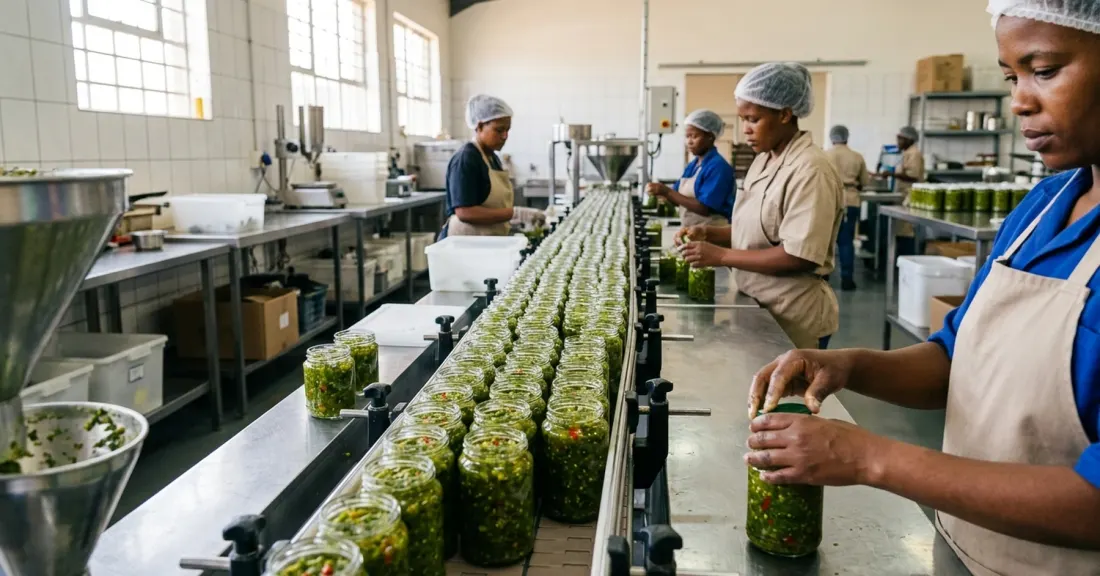
"The hardest part when the order came in was funding the development. We were still on a manual process because we were waiting for equipment that would have made life easier – but the equipment was delayed by a month, and the order was also due in a month. It's our biggest order ever, and it's going to make such a big difference. We couldn't afford to lose it."
– Tshepiso Manyoha, Co-founder, Chuck Chilli Foods
The alternative would have meant going back to Pick n Pay and asking to reduce the order – producing in smaller batches, stretching delivery, and frustrating a buyer who had just committed to putting Chuck Chilli in 780 stores. Not a real alternative.
"Finding funding through Sourcefin really, literally saved our business."
– Tshepiso Manyoha, Co-founder, Chuck Chilli Foods
Tshepiso is candid about what scaling into retail does to margins.
"Your margin goes very quickly from about 50% to just about 15%."
– Tshepiso Manyoha, Co-founder, Chuck Chilli Foods
The problem isn't the bank. It's the mandate.
This is where most stories about SMME funding turn into a complaint about banks. Ours isn't going to.
Banks are built for stability. They underwrite businesses across cycles, against audited financials and durable security. That mandate serves the economy – it isn't the framework for backing a single set of retailer orders inside a four-week window, on a production line that hasn't quite caught up to demand.
Chuck Chilli didn't need to argue with a bank. They needed a partner whose actual job is exactly that shape of deal. For an explainer of how this funding type works in practice, see purchase order funding made easy by Sourcefin.
A different shape of purchase order funding for Chuck Chilli
Most purchase order funding follows a clean three-step shape. The funder pays the supplier. The supplier delivers to the customer. The customer pays the funder.
Chuck Chilli's deal didn't fit that shape, and that mattered.
Producing 35,000 jars of chilli relish isn't a single-supplier transaction. More than half of the funding requirement was raw vegetables – chillies, onions, green beans, green peppers – priced on a daily basis. Add packaging, labels, glass, and the labour to produce manually at over twice the previous volume. None of it sits with one supplier on a fixed quote.
The deal needed flexibility – the ability for Chuck Chilli to negotiate prices on the day, with multiple suppliers, while keeping the production line moving.
"What was different with Sourcefin is that most purchase-order funding is set up for clean B2B – buy from supplier, deliver to customer. Ours wasn't going to work like that. Veggies are more than 50% of what the funding was needed for, and we negotiate prices daily. We needed the freedom to do that. Even for Sourcefin, it was admittedly a new way of doing things – but they made it possible. Big ups to Yuval, who came back with several approaches and worked through them with us until we were both comfortable with the risk and the structure."
– Tshepiso Manyoha, Co-founder, Chuck Chilli Foods
The deal didn't fit Sourcefin's typical mandate, and it didn't follow the standard purchase-order funding template. But the business was sound, the opportunity was real, and the right answer was to structure the deal around how Chuck Chilli actually buys – not to force the business to fit a template that didn't work for them. The shape of the transaction is the easy part. The shape of the partnership is the harder one – and the more important one.
For another example of how this approach plays out across a different sector, see our construction case study.
What the deal makes possible for Chuck Chilli
The headline – 35,000 jars delivered into 780 Pick n Pay stores – matters less than what sits underneath it.
National reach for a brand that, only a few years ago, was being cooked in a domestic kitchen. A team that can now hire ahead of demand instead of catching up to it. Capacity to engage merchandising partners and run in-store promotions. And a proof point that opens the door to the next retailer conversation.
"What's now possible that wasn't a month ago? National reach. A sustainable business that can afford its new capacity, its new labour force, and growth. We can start hiring more people, working with merchandising partners on promotions, and really playing the big game, the long game properly. Other retailers will open up because we've now proven our capacity. And having Sourcefin in our books means direct access to funding the next time we need it."
– Tshepiso Manyoha, Co-founder, Chuck Chilli Foods
There's also, quietly, the next round of growth. Chuck Chilli has exports in negotiation. The team expect to outgrow their current facility sooner than originally planned. More rounds of funding are ahead.
What this kind of deal asks of a funder
Funding a purchase order is technically simple and operationally hard. The shape of the transaction is the easy part. The work is in the relationship – knowing the founders, understanding how the business actually buys, and being willing to build a deal structure that fits the real world instead of forcing the real world into a template.
For Chuck Chilli, that meant the deal got done, the order shipped, and a brand that started in a domestic kitchen is now on shelves in 780 stores.
If you're sitting on an order and a cash gap
If you have a confirmed purchase order from a credible buyer and the working capital to fulfil it is the thing standing in the way, that's the shape of deal Sourcefin is built for. Talk to us early – the sooner the deal is in front of us, the more room there is to structure it around how your business actually works.
Apply for funding here and a Sourcefin team member will walk you through the options that fit your situation.
Sources & References
Chuck Chilli Foods. Official company site – product range, brand story, and stockists. chuckchilli.co.za
StartUp Magazine South Africa. "Black-Owned SME Chuck Chilli Seeks To Provide A Unique Sauce To The Market." April 2024. startupmag.co.za
Full episode transcript
Edited for readability. Watch the full episode on YouTube.
The obsession with chilli and the origins of Chuck Chilli Foods
Tshepiso Manyoha: Your margin goes very quickly from about 50% to just about 15%. Very quickly once you – but it's too late. The train has left the station. You can't renegotiate prices. That's how growth happens. You get to a certain level, you start from there again as the base. But every time your base is growing, your orders per month are growing. What doesn't grow is your cash flow. You're talking to these guys and they say, here's an order, we need 15,000 bottles. You're going from a week where in a good week you make less than 1,000 to making 15,000. These guys are saying you'll get paid 30 days from statement, which means literally after we deliver, it might take up to 60 days to get paid. And that money you made at that margin is all gone. You're starting from scratch. And if you don't meet the delivery date, you're shifting your payment by a month. So we had that type of stress.
Jedd Harris: Tshepiso, amazing to have you. I've heard a lot about Chuck Chilli Foods and the journey with Sourcefin, and I would love to hear in your words, what is the obsession with chilli?
Tshepiso Manyoha: I think chilli always brings out the best and the worst in people. You either like it a lot or you don't like it at all. Very few people are in between, which is why even our flavours, everything's hot, but it's just different levels of heat. For me personally, it was the fact that there was nothing else that had the heat with the nice aroma and flavour that Chuck Chilli has.
Jedd Harris: I'm sure the audience is super interested. What a weird way to start an interview, talking about chilli. But I think chilli has become a big part of your life.
Tshepiso Manyoha: Yes. Something that started as a "this is so amazing, we need to get everybody to try it" to actually having a 400-square-metre factory seven years later, says a lot about how much people actually liked it. It's hard. There are a lot of chilli products out there, but to get to one where you can make such traction, it says something about how people have onboarded it into their dishes and their homes.
Jedd Harris: So let's rewind. Was Tshepiso always a chilli man, or what is the background story?
Tshepiso Manyoha: Back in 2018 to 2019, my background had always been in IT strategy consulting. I met Boikano Sikwane while travelling in Nigeria, and then we met again in South Africa at one of my friend's functions, who actually turned out to be a cousin. That's when I got my first introduction to the product. She was making it for family gatherings. I took some and I liked it. I asked her to make a batch, took it to the office where I was working at the time, and a box of 24 was finished within a day.
People wanted more. The idea came because I had a background running a few startups and had been involved in business development. I approached her to say, why don't you let me do the commercials and let's see how it goes. Immediately, the main thing was working out of a garage. The first thing you get when you try and sell any food product is they want to know if you have your certificates. Approaching the Department of Health, they'll tell you immediately they can't certify you in your garage. So you have to find a space. It very quickly became clear that the only way this thing is going to scale is if we do all these steps. It was a big learning curve.
We were trying to get into flea markets. It was a hit at flea markets. Individually owned Spars were easy to approach. Then came the realisation that we need to get this tested and have a proper logo. We had to have money to get a lab to test it, rent a place, and produce enough to pay the rent while hoping we would land a chain store where the revenue would cover the costs. When you're making and supplying a few, it doesn't make sense on paper. From the beginning, it wasn't about getting rich. It was a great product with the potential to become a household brand. We started with renting at Riversands Incubation Hub. From there, we started entering every competition, approaching every retailer, learning what they need, and knocking on doors. That's when we got our first break with Food Lover's Market.
Testing the market and finding the perfect flavour
Jedd Harris: You've said so much there, and I want to unpack a few things. You're a professional in IT, and you literally bit into something that changed the trajectory of your life. Tell us a little bit about that experience. Take me back to the first moment you put Chuck Chilli in your mouth. It must have been a powerful taste to have changed course. It's not a side hustle; there's proper time, sweat, and money invested into this.
Tshepiso Manyoha: You have an expectation when you come from traditional chakalaka and atchars. Very rarely do you find something that brings it all together with a lot of heat, aroma, and a strong addictive taste. Chuck Chilli has that taste where the first time you think it's a lot, then it settles down and you realise you can take it and it's actually nice. We have three flavours: mild, medium, and hot. Most people will have the mild and think it's too hot, but within weeks they are going for the original medium, and then the hot. It's got that taste that keeps you wanting. Even to this day, when I eat it, I'm sweating. My sinuses cannot handle it that well, as opposed to my business partner who can eat a big spoon and have no reaction.
That's where we got the slogan "Beware the Kick" because we wanted something synonymous with what it is. People were mistaking it for an atchar, but it's very clear it's a chunky chilli. I always knew it was going to take up a lot more time because I got so drawn into the passion and the learning. I like building things. There was so much from my consulting and my MBA that I had to apply. My MBA knowledge was never challenged as much as from 2019 till now. Some concepts are proven completely wrong when it comes to small businesses. You have to wing it, learn, and do what really works for that situation.
Jedd Harris: Another thing entrepreneurs do is get so passionate about a product that they invest time and money, put it out to market, and the market doesn't receive it the way they expect. What you mentioned earlier – taking a crate to the office and it being gone within a day, then going to flea markets – you were testing the product-market fit right up front. Was that planned, or did you want to test it before you went to market?
Tshepiso Manyoha: It was definitely a happy accident. It helped that we had a lot of people get excited about it. We did not intend for the branding to feel so familiar, but when people taste it, they want that taste because the blend of spices is traditionally linked to what we consume. The reception from markets played the biggest role because it became clear our biggest challenge was just getting people to taste it. Once people tasted it, eight out of ten either bought it or knew somebody they wanted to get it for. That was the encouragement to keep pushing. We've never tinkered with the logo or the way it looks since then. It's really just been exposure at flea markets, and friends and family who love it and post about it. People found it in a store in Zimbabwe, and we had never distributed there. Somebody had liked it enough, bought a lot, and went and sold it over there.
During COVID, Takealot is what kept us afloat because that was the only channel we had access to. People were seeing it for the first time, randomly selecting it, and buying it. Now we are at a point where we need to push to the next stage and deal with big boy problems. You have to talk to national buyers, think about export, and set up a full-on production line because there is only so much you can do by hand.
Scaling production from a garage to a fully-fledged factory
Jedd Harris: I want to ask a few questions to take the audience on the journey with you. You met Boikano at a family function, tasted it, and she was making it literally out of her garage. It's that fairy tale story of a small business that comes out of a garage and makes it nationally and soon internationally. What was the journey from the garage to a fully-fledged production line? One pot and a few bottles is one thing, but churning out 15,000 to 35,000 jars a month requires consistency, scaling, and a system. What were some of the lessons you learned to make Chuck Chilli consistently good?
Tshepiso Manyoha: At the beginning, I was still in full-time employment. During the day, Boikano would be with some temps we would get to chop the chillies. The one thing that made it unique was how we cut the chillies, which has been one of our major costs to maintain consistency. We had people hand-chop the chillies to the rings and chunkiness that we wanted to maintain. In the evenings, we would cook, bottle, and label – just the two of us mostly. We knew if we cooked three pots, we were going to make so many bottles. We had everything stacked up in a garage off a gas cooker. We were printing our labels at PostNet, buying bottles at the Consol shop, and buying veggies at the market.
At that scale, the cost of making one bottle is very high. We were giving away a lot of tasters and trying out restaurants and Spars. At some point, we realised we were never going to make enough fast enough and we were never going to get the compliance. To get into retail, you need a certificate of acceptability and a food safety management system. We couldn't do that where we were. We decided to make the investment and move, paying the rent out of pocket mostly. Food manufacturing is not a high-return, high-margin business. We realised early that the only way this business would start making money was when the volumes got to a certain stage.
We started applying for grants, asset assists, and enterprise and supplier development programmes. Everywhere we went, we walked around with a bottle hoping to introduce it to a new customer. That approach became the backbone of how we went to market. It takes so much to keep making a product when you're not drawing a salary, but you just have this gut feeling that this thing can grow into something big. The early years were driven by passion and protecting this baby because it had the potential to outlive us.
Landing the first major retail order with Food Lover's Market
Jedd Harris: When did you first taste the chilli?
Tshepiso Manyoha: 2018. We formally got into a space around March 2019. Then 2020, COVID hit. During that time, we started talking with Food Lover's Market. We entered their competition, were shortlisted, and went through their programme. We were in the top ten. We didn't win, but one of the buyers liked it so much. Three months later, a buyer gave us a call and said, I want you guys on the shelf. That's when our first big order happened in 2021.
Jedd Harris: So you had three years of grinding and pushing through COVID. A lot of small businesses no longer exist because of COVID, so it's amazing you pushed through. Talk me through that first order. How many bottles was it? What does it look like distributing at a flea market versus receiving an order from Food Lover's Market?
Tshepiso Manyoha: At the time, we would make between 300 and 500 units per production. That would have required about two days of chopping prior to that. We had about three people and were making about 10 to 15 boxes in a week for flea markets. Then these guys say they need 15,000 bottles. You're going from a week where you make less than 1,000 to needing to make 15,000. I punched the numbers and said we would need four weeks to do that. They prefer 14 days for their replenishment cycle. We were in this small factory, and we couldn't believe it. We thought they would start us with five stores, but they said we were going national all at once, delivering to two distribution centres – one in Centurion and one in Cape Town. This was our first time delivering our product in pallets. We had to figure out how to store it, how to get it chopped fast enough, and how to comply with traceability for the food safety system. You have to be able to trace a specific batch number back to the oil and veggies used.
Navigating retail margins, compliance and cash flow challenges
Jedd Harris: Does Food Lover's Market tell you all of the requirements upfront?
Tshepiso Manyoha: They give you a standard. The standard at the time was HACCP, which is like an ISO or SABS standard. We had gotten some training in the years building up to that, so we were aware, but never at this scale. There were painful lessons. You can't just deliver to a distribution centre; you have to use a specific pallet from a specific supplier who requires a credit record. You realise your pricing was based on a certain margin, but now you have distribution centre costs, rebates, merchandising costs, and advertising costs. Your margin goes very quickly from about 50% to just about 15%. The train has left the station and you can't renegotiate prices. You literally have to find ways to cut costs – cheaper bottles, labels, boxes, and getting veggies straight from farmers.
We had a week to get our act together. We needed to find youth to employ to chop. We had all the quotes, but we were told we'd get paid 30 days from statement. The money to run this production never stopped. We tried borrowing funds from friends and family, and were introduced to purchase order financing and invoice discounting. We also learned there are no guarantees. We had shelves fall one day and lost many bottles. You have to protect yourself in transit because the retailer only pays for product received safely at the distribution centre.
The initial order was just our foot in the door. You do this big order and then it's quiet because it takes months for the systems to kick in a reorder. That money you made is all gone, and you're starting from scratch. That's how growth happens. Your base of orders is growing, but your cash flow doesn't grow because your overheads increase. I was employing permanent people because I needed them to stay in the company for the certification processes. We decided to go for the premium market, making a high-quality product. We will never be a product that competes on price unless we lower the quality, which we won't do. Our recipe has not changed.
Jedd Harris: Take me to the time you first saw the product on the shelf.
Tshepiso Manyoha: It was a Spar in Midrand. Getting in there and seeing a whole level of the product with pricing and a barcode, and watching how people respond to it, was a very proud moment. It felt like we were making a mark.
The 75-day cash flow cycle of a major retail order
Jedd Harris: You spoke about the production cycle and cash flow. You mentioned Food Lover's Market would only pay you once you delivered the jars to the distribution centre, 30 days from statement.
Tshepiso Manyoha: Yes. That means if I deliver product on the 14th of that month, I can only send a statement on the 1st of the following month. And 30 days from then is when they will pay.
Jedd Harris: So let's take you through the cash flow cycle. You get a life-changing order and they give you four weeks. For those four weeks, you're paying new staff, buying bottles and labels, and cash is flowing out.
Tshepiso Manyoha: I don't have any credit with anybody, so it's cash on delivery.
Jedd Harris: The labourers wanted to be paid weekly. You're not pulling a salary. You've got 28 days of production. Let's assume you deliver to the distribution centre in the middle of the month. You've got another 15 days, plus 30 days. So it's 75 days from receiving the order where you have to maintain operations before you get paid. You don't get paid based on how the product performs on the shelf; you make the money for the units you delivered.
Tshepiso Manyoha: Momentarily. But there are other things like shelf allowance. If that product sits on their floors and expires, you either take it back or they deduct and credit their account on your next orders. The initial order is a challenge because they carry a lot of risk too. Food Lover's Market was the first to carry us at that level.
It was scary and very slow at first. Everybody is still trying to get their act together in-store. You are scrambling to make sure it's on the shelf. We didn't have a merchandiser. In some places, they would just fill the whole shelf with the mild flavour, not knowing there are three flavours. Then the sales start coming in, averaging two or three units a week. You do some promos and suddenly things start moving. It was really between three and six months after being in that store that we started getting replenishment orders. We had to raise funds to do marketing. We would drive to KwaZulu-Natal to do all the stores there, or have people doing tastings in Gauteng. People liked interacting with the founders and liked that it was an emerging, unique product. We still focused on getting our facilities to produce the quality we want and distributing ourselves. We couldn't find an outsourced manufacturing process that kept our consistency without adding artificial preservatives. Sticking to our guns has kept us unique.
A life-changing Pick n Pay order and partnering with Sourcefin
Jedd Harris: It's a compelling story. To differentiate yourself in that way gives people a bigger reason to support Chuck Chilli Foods. The first order was clearly successful. I think where the story begins with Chuck Chilli Foods and Sourcefin was when another life-changing opportunity came your way from Pick n Pay for 35,000 units. Talk me through the emotions when an order like that comes through.
Tshepiso Manyoha: That single order was bigger than what we had made to that point in a single year. It came just as we moved to a new 400-square-metre factory. The amount of money we needed was a lot bigger. We were advised to tell them to order small batches over a long period, but we knew from Food Lover's Market that unless you go big, your growth will always be slow. We wanted to create a deficit and have more orders than we could produce. We needed somebody to allow us to maximise our capacity. Yeah, we started with our bank, we started with FNB, we're like, okay, here it is, guys. [...] And I think it was in that first week where FNB said, okay, we're going to refer you guys to Sourcefin.
We had so many applications out, and we were expecting people to say the order was too risky because our margins were low. Our machines were delayed in a container coming from China, so a lot of overheads had to be loaded. We had to get other people to chop for us. Purchase order financing usually relies on a predictable market, and for us, it was none of those. The price of veggies changes every week. It was June, which is the worst month for chillies because they are scarce. We knew we weren't going to meet the delivery date running normal shifts, and if you don't meet the delivery date, you shift your payment by a month.
What brought us hope was the questions Yuval would ask. In the first meeting, I was not very hopeful. But the conversation went a very different way. It was about wanting to see us grow to the next level and giving us options that worked for our situation. The interest rate we got was the best out of all of them. The steps he suggested to manage the risk helped us. The ability to have drawdowns meant we could produce the first batch and check that our maths was matching before committing all the money. We had other challenges, like three days with no electricity where we had to get generators. I spoke to Yuval every day and he understood our challenges. He helped us negotiate with suppliers to elongate payment terms, which kept our interest obligations to a later stage. A lot of funders will never make you aware that the more you draw down upfront, the more interest accumulates. For a small business, that difference was a couple of people's salaries. It was great being with somebody who said, let's try and see how we can do it.
Jedd Harris: I think there's a lot out there around banks and being unable to help, or maybe there's even sometimes narratives or considerations around banks not necessarily wanting to look at something differently. You know now that there's a relationship between FNB and Sourcefin. There's a referral arrangement. So, if they can't support or if they can't help, they're all about help, they would then obviously have a channel where they could send you to another funder that could potentially help. I've gone to so many FNB branches, I've met so many FNB relationship managers and business bankers, and they truly care about the SMEs and the clients that they serve. [...] So, I think the reality is banks are eager. There's a lot of passion around SMEs. And it's nice to start seeing the traditional lending sector, FNB, starting to play closely with the alternative lending sector like Sourcefin.
Now, what you said there, Tshepiso, around Yuval – I told you before this, I don't think you knew, but I think you were one of his first deals. He just arrived at Sourcefin. He was eager to impress and eager to support SMEs. I think he took the notion of open-minded funding to heart. We say it a lot, open-minded funding means we look at the opportunity, we don't look at the history. [...] At Sourcefin, the emphasis is placed on the opportunity. And that's why when you said the types of questions we ask, we're not saying we see this debit order bounced. The question is, how can we unlock this opportunity? And if we do, how are you and I going to journey in this partnership together? It's amazing to hear that's the experience you had, and you were clearly looked after by Yuval.
Tshepiso Manyoha: The feeling was you were with somebody that wanted to see you succeed because they came up with ideas about how to efficiently do certain things. It was the first time where the risk was not the only thing. Other institutions tend to be very conservative. The main thing that became important to manage that risk was us as Chuck Chilli Foods. They could see we were investing our time and consistently trying to push the envelope. Retailers don't give you letters of intent guaranteeing they will buy a certain amount; they just give you trading terms. Getting somebody like Sourcefin who is happy to help you prove yourself in that space was the petrol we needed to get over that hill. We've just supplied our first pallet to Dubai now.
How fit-for-purpose funding drives business growth
Jedd Harris: We've got a phrase we use at Sourcefin called fit-for-purpose funding. If you went to a bank for an overdraft, they aren't bringing the speciality of helping you deliver, pack a truck, or pay suppliers. When you went to Sourcefin, you're not only getting the funding, you're getting someone that's done this before and is walking the journey with you. You might be paying a little bit more, but you're getting that value-add that's priceless. You're increasing the chance of successfully delivering.
After the deal, all we heard in Sourcefin was Chuck Chilli Foods. We struck up a bit of co-branding with the Sourcefin secret sauce, which is proudly Chuck Chilli. We take this to our conferences and tell the story. This bottle is funding in action. Yuval told me he felt your passion and vision. The first question we ask at Sourcefin is, can we trust you and do we back you? A lesson to SMEs is to back yourself and be passionate. If you can tell a story like that to an open-minded funder, they've got no choice but to back you.
The future of Chuck Chilli Foods and advice for entrepreneurs
Jedd Harris: What is the ultimate vision of Chuck Chilli Foods? And what is the most important piece of advice you wish you heard when you started in 2018?
Tshepiso Manyoha: In the next year, we are seeing more large orders. There are two large retailers we're talking to and it's looking very good. Having been able to deliver builds credibility. We want to become a national brand. When people go to any retailer in South Africa, they must be able to say, why is Chuck Chilli not here? We've got a few new products coming, including a proper liquid sauce and different sizes. We are looking forward to growing our team so Boikano and I can focus on sales and food safety. The next growth area is the export market. We're finalising our food safety certification to export anywhere in the world.
In terms of advice, people buy from people. As an entrepreneur, you have to believe in and love what you're doing first before people will buy from you. The commitment and belief in the product means everything. When tough times come, if you are not fully clear on what you're doing, you are likely to walk away. The belief in what this product can become has kept us going.
Jedd Harris: Have you managed to pay yourself a salary yet?
Tshepiso Manyoha: There have been moments, but it's not consistent. We are more focused on paying the business. When we get to a point where we can pull a proper salary, we need to bring somebody in to free us to work outside the business. We have a big factory and more than R5 million in assets that we need to sweat. We are very close to paying ourselves decent salaries.
Jedd Harris: It's been a pleasure. If you haven't yet, please try some chilli. I start hiccupping, and apparently there's a kick.
Tshepiso Manyoha: Beware the kick. Thank you, Jedd.
Frequently asked questions
Who is Chuck Chilli Foods?
Chuck Chilli Foods is a Black-owned South African food manufacturer founded in 2019 by Boikano Sikwane and Tshepiso Manyoha. The company produces a chunky chilli relish with no artificial preservatives, no added salt or sugar, Halaal approved, and distributed through independents and national retailers across four provinces.
What did Sourcefin do for Chuck Chilli?
Sourcefin provided purchase order funding to help Chuck Chilli fulfil its largest order ever – 35,000 jars of chilli relish to be delivered into two Pick n Pay distribution centres, supplying 780 stores. The deal funded raw vegetables, packaging, glass, labels, and the labour to produce manually at over twice the previous monthly volume in only four weeks.
Why couldn't a bank fund this kind of order?
Banks underwrite businesses across cycles against audited financials and durable security. That mandate doesn't fit a single set of retailer orders inside a four-week delivery window, especially when production capacity is still scaling. A purchase order funder is built specifically for this shape of deal.
Why was this deal different from typical purchase order funding?
Most purchase order funding follows a clean three-step shape: funder pays supplier, supplier delivers to customer, customer pays funder. Chuck Chilli needed flexibility – more than half of the funding requirement was raw vegetables priced daily across multiple suppliers, plus packaging, labels, and manual production labour. Sourcefin structured the deal around how the business actually buys, not a standard template.
Can my SMME apply for similar funding from Sourcefin?
Yes. If you have a confirmed purchase order from a credible buyer and the working capital to fulfil it is what's standing in the way, that's the shape of deal Sourcefin is built for. Apply through the funding application page and a Sourcefin team member will walk you through the options.

Sourcefin is a South African alternative finance provider that offers purchase order funding and invoice discounting to SMMEs, enabling businesses to fulfil confirmed purchase orders or tenders and unlock cash flow without collateral. Unlike traditional lenders or banks, Sourcefin also provides end-to-end support including supplier sourcing, logistics, project management, and risk oversight.