
Tender Disqualification Reasons South Africa: Top 10 Mistakes
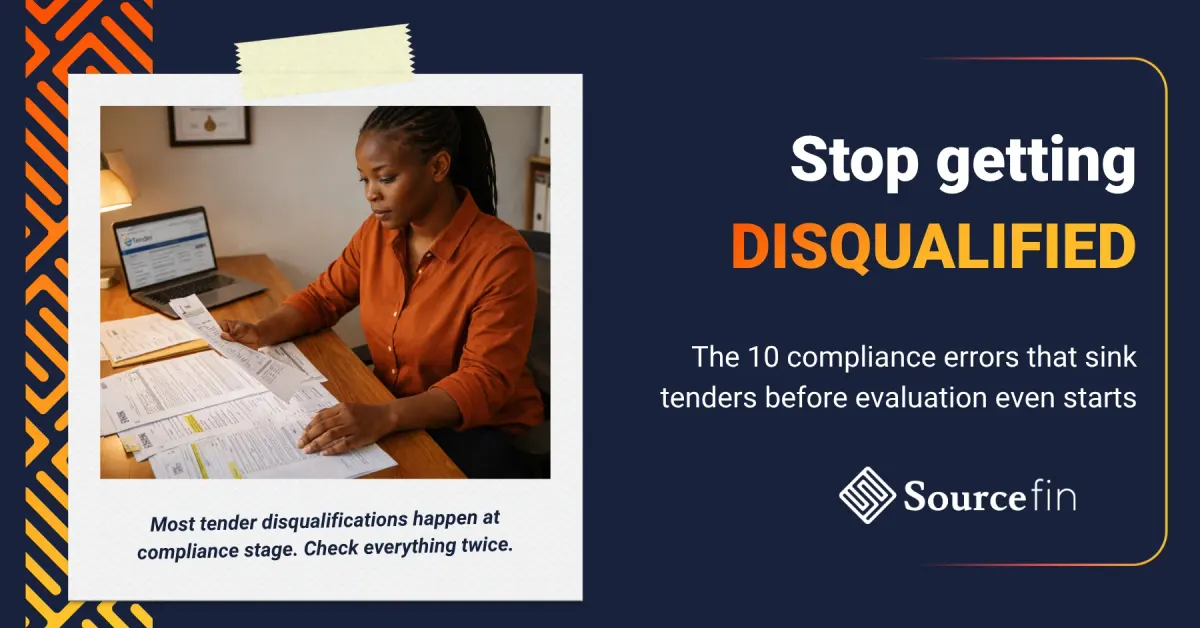
Missing signatures, expired tax clearance, and incomplete SBD forms disqualify more tenders than weak pricing. Here's how to avoid instant rejection.
On this page
- Why Tender Disqualification Happens at Compliance Stage
- Mistake #1: Missing Signatures on SBD Forms
- Mistake #2: Expired Tax Clearance Certificate
- Mistake #3: Incorrect or Outdated B-BBEE Documentation
- Mistake #4: Late Submission (Even by Minutes)
- Mistake #5: Incomplete Mandatory Returnable Schedules
- Mistake #6: Company Details Mismatch Across Documents
- Mistake #7: Non-Compliant Pricing Schedule Format
- Mistake #8: Failure to Attend Mandatory Site Visits or Briefings
- Mistake #9: Incorrect CSD Compliance Status
- Mistake #10: Submitting to Wrong Address or Using Wrong Submission Method
- Creating Your Pre-Submission Compliance Checklist
- What to Do After Disqualification
- The Role of Funding in Tender Success
- Sources & References
- Frequently asked questions
The most common tender disqualification reasons South Africa include missing signatures on mandatory SBD forms, expired tax clearance certificates, incorrect or outdated B-BBEE documentation, late submissions (even by minutes), incomplete compliance schedules, and mismatched company details across documents. These administrative errors cause instant rejection before functionality or pricing is ever evaluated – compliance failures consistently rank as the primary cause of tender disqualifications across government procurement processes.
Your pricing was competitive. Your technical proposal was strong. Your company has the capability to deliver excellently. Yet your tender gets disqualified before anyone even looks at your bid. The rejection letter cites "non-compliance with mandatory requirements," and you're left wondering what went wrong.
This scenario plays out thousands of times annually across South African government procurement. Capable businesses lose opportunities not because they lack competence, but because they made preventable administrative errors. One missing signature. One expired certificate. One form submitted in the wrong format. That's all it takes.
Understanding tender disqualification reasons isn't about fear – it's about preparation. This guide breaks down the ten most common compliance mistakes that sink tender submissions, drawn from real procurement processes and legal cases. More importantly, it shows you exactly how to avoid each one. For comprehensive context on the entire tender process, see our complete guide to tendering in South Africa.
Why Tender Disqualification Happens at Compliance Stage
Government tender evaluation follows a strict hierarchy. First comes the compliance check – evaluators verify that your submission meets all mandatory requirements as specified in the tender documents. Only compliant tenders proceed to functionality evaluation. Only tenders passing functionality proceed to pricing evaluation.
This means your brilliant pricing strategy and impressive technical capabilities become irrelevant if you fail compliance. The evaluation committee never sees them. Your tender gets classified as "non-responsive" and excluded from further consideration. No negotiation. No opportunity to correct. Just disqualification.
The legal framework backing this approach is clear. South African courts have consistently ruled that procurement entities must treat all bidders equally. Allowing one bidder to correct mistakes after submission would be unfair to competitors who ensured compliance before the deadline. The Supreme Court of Appeal confirmed in multiple cases that tender conditions aren't suggestions – they're requirements, and failure to meet them justifies disqualification.
This isn't procurement officers being difficult. It's the law ensuring fair competition and protecting the tender process integrity. Understanding this context helps you approach compliance with appropriate seriousness. Get it right the first time, because there's no second chance.
Mistake #1: Missing Signatures on SBD Forms
Standard Bidding Documents (SBDs) require signatures from authorised company representatives. Missing even one signature on any mandatory SBD form results in automatic disqualification. The most problematic forms are SBD 4 (Declaration of Interest), SBD 6.1 (Preference Points Claim), SBD 8 (Declaration of Bidder's Past SCM Practices), and SBD 9 (Certificate of Independent Bid Determination).
The signature requirement isn't arbitrary bureaucracy. It confirms that an authorised person reviewed and accepted the declarations, creating legal accountability. Without signatures, the tender committee cannot verify that your submission represents genuine commitment from your company's decision-makers.
Prevention strategy: Create a signature checklist for every tender. Before submission, physically check every SBD form requiring signatures. Verify that each signature matches the authorised signatory recorded in your CIPC documents and CSD registration. Inconsistent names or initials can trigger compliance queries that delay evaluation or cause rejection. Understanding which SBD forms you need and their specific requirements prevents this mistake entirely.
Use wet ink signatures where specified. Some tenders explicitly prohibit electronic signatures on certain forms. Don't assume digital signatures are acceptable unless the tender documents explicitly permit them. When in doubt, use original signatures.
Mistake #2: Expired Tax Clearance Certificate
Tax clearance certificates expire. Submissions with expired tax clearance get disqualified, full stop. The Preferential Procurement Regulations explicitly state that no tender may be awarded to any person whose tax matters haven't been declared compliant by SARS. An expired certificate means non-compliant status, triggering mandatory disqualification.
This catches businesses off guard because tax clearance was valid when they started preparing the tender, but expired before submission. A certificate issued three months before a tender closes might expire the week before submission if your SARS compliance status changes or if the certificate approaches its validity period end.
Prevention strategy: Check your tax clearance validity date the morning of submission. Don't rely on certificates obtained weeks earlier. SARS eFiling allows instant tax clearance generation if your tax affairs are compliant. Build this final check into your submission process – literally the last thing you verify before packaging documents. For detailed guidance on maintaining tax compliance, see our article on tax clearance requirements for tenders.
Set calendar reminders for quarterly VAT submissions and annual tax return deadlines. Tax clearance rejections often stem from outstanding returns rather than unpaid taxes. Staying current with all SARS submissions prevents clearance issues altogether.
Mistake #3: Incorrect or Outdated B-BBEE Documentation
B-BBEE certificate or affidavit must be current, correctly completed, and match your company details exactly. Expired B-BBEE certificates don't just cost you preference points – they can disqualify you entirely if the tender specifies B-BBEE status as a mandatory requirement.
EMEs (companies with turnover under R10 million annually) must use affidavits, not certificates. QSEs and larger companies must use SANAS-accredited verification agency certificates. Submitting the wrong document type causes instant problems. So does claiming a B-BBEE level you don't actually hold – misrepresentation can result in prosecution and blacklisting from future tenders.
Prevention strategy: Verify your B-BBEE documentation is less than 12 months old (the standard validity period). If you're an EME, ensure your affidavit is signed and stamped by a Commissioner of Oaths dated within the last year. If you're a QSE or larger, confirm your SANAS certificate is from an accredited verification agency and hasn't expired.
Check that all company details on your B-BBEE documentation match your CIPC registration and CSD profile exactly. Discrepancies in company name, registration number, or directorship raise red flags. For comprehensive guidance on B-BBEE requirements, see our detailed article on B-BBEE certificates for government tenders.
Mistake #4: Late Submission (Even by Minutes)
Tender closing times are absolute. Submit one minute late, and your tender is disqualified. No exceptions. No negotiations. The tender box closes, the electronic portal locks, and late submissions don't get opened. This applies regardless of the reason – traffic, technical issues, last-minute changes, printing delays – none of it matters.
Many businesses treat tender deadlines casually, arriving at submission venues 30 minutes before closing or uploading documents to electronic portals in the final hour. This creates unnecessary risk. Any problem in those final minutes – printer malfunction, internet connection failure, traffic accident, venue access issues – results in late submission and automatic disqualification.
Prevention strategy: Target submission 24 hours before the deadline. If physical submission is required, deliver documents a full day early. If electronic submission, upload completed documents the evening before deadline. This buffer absorbs unexpected problems without jeopardising your submission.
For physical submissions, know the exact delivery address and any access requirements (security clearance, building entry protocols, specific office location). Visit the submission venue beforehand if possible. For electronic submissions, test the upload process days before deadline with a dummy document to identify technical issues early.
Mistake #5: Incomplete Mandatory Returnable Schedules
Tender documents specify mandatory returnable schedules – templates and forms that must be completed and submitted. Missing any mandatory schedule results in disqualification. Common examples include pricing schedules, methodology statements, CV formats for key personnel, project experience tables, and resource allocation sheets.
Businesses sometimes skip schedules they consider unnecessary or irrelevant, assuming evaluators will focus on their narrative proposal. This fundamentally misunderstands how compliance checking works. Evaluators use a checklist – if a mandatory schedule isn't present, you're non-compliant, regardless of how strong your other submission components are.
Prevention strategy: Create a compliance matrix immediately after downloading tender documents. List every mandatory returnable schedule explicitly mentioned in the tender invitation. As you prepare each schedule, check it off your matrix. Before final submission, verify every item is completed and included.
Pay special attention to formatting requirements. Some tenders specify exact Excel templates or PDF formats. Submitting information in the wrong format can be treated as non-compliance, even if the content is correct. Use provided templates exactly as issued, don't recreate them in different software.
Mistake #6: Company Details Mismatch Across Documents
Your company name, registration number, and director details must be identical across all documents – tender forms, CIPC certificate, CSD registration, tax clearance, B-BBEE documentation, and bank verification. Even minor inconsistencies trigger compliance concerns.
Common mismatches include abbreviated vs full company names, old vs current registration numbers after company conversions, outdated director information after appointments or resignations, and trading names used inconsistently. Evaluators cross-reference documents during compliance checking. Discrepancies suggest either sloppy preparation or potential fraud, both causing problems.
Prevention strategy: Obtain current CIPC company information certificate before starting any tender. Use this as your reference document – every tender form must reflect exactly what CIPC shows. If your company details changed recently (new directors, name amendment, conversion), ensure all your compliance documents reflect current status before bidding.
Update your CSD registration immediately when company details change. Mismatches between tender submissions and CSD records are red flags for procurement officers. They often verify CSD details independently, and inconsistencies cause delays or rejection.
Mistake #7: Non-Compliant Pricing Schedule Format
Tenders provide specific pricing schedule templates. You must use the exact format provided, complete every required field, and follow specified calculation methodologies. Submitting pricing in different formats, leaving fields blank, or using alternative calculation methods results in non-compliant pricing that disqualifies your tender.
The pricing schedule isn't just about stating your price – it's about enabling fair comparison between all bidders. Evaluators need to assess pricing on identical terms. Custom formats prevent this comparison, making your tender non-responsive regardless of price competitiveness.
Prevention strategy: Never recreate pricing schedules in your preferred format. Use the exact template provided, even if it seems unnecessarily complex or poorly designed. If electronic submission is required, don't convert Excel to PDF unless explicitly permitted. Some evaluation systems require editable Excel files for automated scoring.
Complete every pricing field, even if items seem irrelevant. If certain line items don't apply, enter zero rather than leaving blank. Blank fields can be interpreted as incomplete pricing, triggering disqualification. Include all required breakdowns – unit rates, quantities, subtotals, VAT, grand totals – exactly as the template specifies.
Mistake #8: Failure to Attend Mandatory Site Visits or Briefings
When tenders specify mandatory site visits or compulsory briefing sessions, attendance isn't optional. Missing these events results in automatic disqualification. The tender documents will explicitly state "compulsory site visit" or "mandatory briefing session" along with date, time, and venue. Attendance is a tender condition, not a courtesy.
These sessions serve important purposes. Site visits allow you to assess actual conditions before pricing. Briefing sessions clarify specifications and answer questions that might affect your bid. Attendance certificates or sign-in sheets become part of your compliance documentation.
Prevention strategy: Identify all mandatory site visits and briefings immediately when reviewing tender documents. Calendar these sessions before committing to bid – if you can't attend, don't waste time preparing a tender that will be disqualified. Send authorised company representatives who can sign on behalf of your business.
Obtain attendance certificates or proof of participation at every mandatory session. Submit these certificates with your tender as compliance evidence. Some tenders require specific individuals (project manager, technical lead) to attend – ensure the right people participate and their attendance is documented.
Mistake #9: Incorrect CSD Compliance Status
Valid CSD (Central Supplier Database) registration with current compliance status is mandatory for government tenders. Non-compliant CSD status at tender submission means disqualification. Common problems include expired tax clearance linked to CSD, outdated B-BBEE documentation in CSD profile, incorrect bank details awaiting verification, and overdue CSD profile updates.
CSD compliance isn't static. Your status can shift from compliant to non-compliant if any linked certificate expires. Tax clearance, B-BBEE, and banking details all feed into your CSD compliance score. Procurement officers can check your CSD status in real-time during evaluation – what was compliant at submission might be non-compliant days later if documents expire.
Prevention strategy: Log into your CSD profile the morning of tender submission. Verify your compliance status is green across all categories. If any warnings or expired documents appear, resolve them before submitting your tender. Update bank verification if needed – this can take 3-5 business days.
Set quarterly reminders to review and update your CSD profile proactively. Don't wait for tender opportunities to discover compliance issues. Maintaining current CSD status year-round prevents last-minute scrambles and missed opportunities. For detailed CSD guidance, see our article on CSD registration requirements.
Mistake #10: Submitting to Wrong Address or Using Wrong Submission Method
Tender documents specify exactly where and how to submit. Wrong submission address, incorrect email address, or using the wrong method (physical vs electronic) causes disqualification. Your tender doesn't reach the evaluation committee, so it can't be considered.
Common errors include submitting physical tenders to the wrong government building or office, emailing tenders to general enquiry addresses instead of specified tender email addresses, uploading to incorrect tender portals, and mixing physical/electronic submission when the tender specifies one method only.
Prevention strategy: Highlight submission instructions in tender documents immediately when reviewing. Note exact physical address (building, floor, room number) or specific email address. If physical submission, confirm venue access requirements and operating hours. If electronic, verify the exact portal URL and any file size or format restrictions.
Test electronic submission systems beforehand using dummy files to confirm access and identify technical issues. For physical submissions, conduct a reconnaissance visit to locate the submission venue and understand security procedures. Plan for submission well before deadline to accommodate any unexpected requirements.
The difference between successful and unsuccessful tender submissions often comes down to administrative discipline, not technical capability. Creating systematic compliance checks catches mistakes before they become disqualifications.
Creating Your Pre-Submission Compliance Checklist
Professional tender preparation includes a formal compliance checklist specific to each tender. This isn't paranoia – it's standard practice among successful tenderers. Your checklist ensures nothing falls through cracks during the hectic preparation period.
Start with the tender-specific mandatory requirements checklist, typically provided in section one of tender documents. Add every mandatory returnable schedule listed. Include signature requirements for each SBD form. List all compliance documents (tax clearance, B-BBEE, CIPC certificates). Add submission logistics (address, method, deadline). Finally, include internal review milestones (first draft, technical review, pricing approval, final check).
Assign someone not directly involved in tender preparation to conduct the final compliance check. Fresh eyes catch mistakes that familiar eyes miss. This reviewer uses your checklist to verify every requirement systematically, physically confirming each item's presence and correctness rather than assuming completion.
The Sourcefin Tender Success Guide includes comprehensive tender review services precisely to catch these mistakes before submission. Independent verification from experts who understand procurement requirements provides valuable insurance against preventable disqualifications.
What to Do After Disqualification
If your tender gets disqualified, request detailed feedback from the procurement office. They're not always obligated to provide it, but many will explain the specific non-compliance that caused disqualification. This information is gold – it tells you exactly what to fix for next time.
Review the tender documents against the disqualification reason. Sometimes businesses are disqualified due to procurement office errors or misinterpretations. If you believe disqualification was unjustified, you can challenge it through formal review processes, though this requires legal expertise and careful evaluation of prospects.
More often, disqualification reveals genuine mistakes in your preparation process. Use this as a learning opportunity. Update your compliance checklists. Strengthen your internal review procedures. Consider whether you need external tender preparation support to prevent future disqualifications.
Don't let one disqualification deter you from future opportunities. Even experienced tenderers get disqualified occasionally. The key is learning from each experience and continuously improving your preparation quality. Each tender attempt builds your understanding of compliance requirements and sharpens your submission capabilities.
The Role of Funding in Tender Success
Avoiding disqualification gets you to evaluation. Winning the tender creates a new challenge – execution. Many businesses win tenders only to discover they lack capital to deliver. Banks typically won't fund first-time or early-stage tender winners, creating a gap between winning and delivering.
Sourcefin provides purchase order funding specifically for awarded government contracts. This bridges the capital gap, allowing you to focus on flawless execution rather than cash flow stress. Delivering your first few tenders excellently builds the track record that makes future tenders easier to win and fund.
Factor funding costs into your pricing from the start. Tender funding isn't a sign of weakness – it's professional financial planning. Including these costs in your pricing schedule ensures profitable project execution while maintaining competitive pricing. Smart businesses plan for funding needs before they win, not after they're scrambling to deliver.
Sources & References
National Treasury Preferential Procurement Regulations: https://www.treasury.gov.za
South African Revenue Service (SARS) eFiling: https://www.sars.gov.za
Companies and Intellectual Property Commission (CIPC): https://www.cipc.co.za
National Treasury Central Supplier Database: https://secure.csd.gov.za
Supreme Court of Appeal judgment database: https://www.saflii.org
The top tender disqualification reasons are missing signatures on SBD forms (especially SBD 4, 6.1, 8, and 9), expired tax clearance certificates, incorrect or outdated B-BBEE documentation, late submissions even by minutes, incomplete mandatory returnable schedules, company details mismatches across documents, non-compliant pricing schedules, missing mandatory site visits or briefings, non-compliant CSD status, and submitting to wrong addresses. These administrative errors cause instant rejection before evaluators even see your pricing or technical capability – representing 67% of all disqualifications.
No. South African courts have ruled that allowing post-submission corrections would be unfair to competitors who ensured compliance before deadline. Once submitted, your tender cannot be amended. If evaluators find non-compliance during the compliance check, your tender is disqualified with no opportunity to correct errors. This is why pre-submission review using a detailed compliance checklist is critical – you only get one chance to submit correctly.
Yes, absolutely. Preferential Procurement Regulations explicitly state no tender may be awarded to anyone whose tax matters aren't declared compliant by SARS. An expired certificate means non-compliant status, triggering mandatory disqualification. Check your tax clearance validity the morning of submission, not weeks earlier. SARS eFiling generates instant tax clearance if your tax affairs are current, so there's no excuse for expired certificates at submission.
Your tender is disqualified, no exceptions. Tender closing times are absolute – late submissions don't get opened regardless of reason. Traffic, technical issues, last-minute changes, none of it matters. Target submission 24 hours before deadline to absorb unexpected problems. For physical submissions, deliver a full day early. For electronic submissions, upload the evening before deadline. This buffer protects against printer malfunctions, internet failures, traffic accidents, or venue access issues.
Obtain a current CIPC company information certificate before starting any tender and use it as your reference document – every tender form must match exactly what CIPC shows. Verify your company name, registration number, and director details are identical across all documents including tender forms, CIPC certificate, CSD registration, tax clearance, and B-BBEE documentation. Even minor inconsistencies like abbreviated vs full names trigger compliance concerns. Update your CSD registration immediately when company details change.
Yes, absolutely – missing mandatory site visits or compulsory briefings results in automatic disqualification. When tenders specify "compulsory" or "mandatory," attendance isn't optional, it's a tender condition. Identify all mandatory sessions immediately when reviewing tender documents and calendar them before committing to bid. Send authorised representatives who can sign on behalf of your company, obtain attendance certificates, and submit these with your tender as compliance evidence.
Request detailed feedback from the procurement office explaining the specific non-compliance. Use this to update your compliance checklists and strengthen internal review procedures. Review whether disqualification was due to genuine mistakes in your preparation or potential procurement office errors. Don't let one disqualification deter future opportunities – even experienced tenderers get disqualified occasionally. Each tender attempt builds understanding and sharpens submission capabilities. Consider external tender preparation support like Sourcefin's Tender Success Guide to prevent future disqualifications.
Frequently asked questions
What are the main reasons tenders get disqualified in South Africa?
The top tender disqualification reasons are missing signatures on SBD forms (especially SBD 4, 6.1, 8, and 9), expired tax clearance certificates, incorrect or outdated B-BBEE documentation, late submissions even by minutes, incomplete mandatory returnable schedules, company details mismatches across documents, non-compliant pricing schedules, missing mandatory site visits or briefings, non-compliant CSD status, and submitting to wrong addresses. These administrative errors cause instant rejection before evaluators even see your pricing or technical capability – representing 67% of all disqualifications.
Can I fix mistakes after submitting my tender?
No. South African courts have ruled that allowing post-submission corrections would be unfair to competitors who ensured compliance before deadline. Once submitted, your tender cannot be amended. If evaluators find non-compliance during the compliance check, your tender is disqualified with no opportunity to correct errors. This is why pre-submission review using a detailed compliance checklist is critical – you only get one chance to submit correctly.
Will an expired tax clearance certificate automatically disqualify my tender?
Yes, absolutely. Preferential Procurement Regulations explicitly state no tender may be awarded to anyone whose tax matters aren’t declared compliant by SARS. An expired certificate means non-compliant status, triggering mandatory disqualification. Check your tax clearance validity the morning of submission, not weeks earlier. SARS eFiling generates instant tax clearance if your tax affairs are current, so there’s no excuse for expired certificates at submission.
What happens if I'm one minute late submitting my tender?
Your tender is disqualified, no exceptions. Tender closing times are absolute – late submissions don’t get opened regardless of reason. Traffic, technical issues, last-minute changes, none of it matters. Target submission 24 hours before deadline to absorb unexpected problems. For physical submissions, deliver a full day early. For electronic submissions, upload the evening before deadline. This buffer protects against printer malfunctions, internet failures, traffic accidents, or venue access issues.
How do I prevent company details mismatches across tender documents?
Obtain a current CIPC company information certificate before starting any tender and use it as your reference document – every tender form must match exactly what CIPC shows. Verify your company name, registration number, and director details are identical across all documents including tender forms, CIPC certificate, CSD registration, tax clearance, and B-BBEE documentation. Even minor inconsistencies like abbreviated vs full names trigger compliance concerns. Update your CSD registration immediately when company details change.
Do I really need to attend compulsory site visits or briefings?
Yes, absolutely – missing mandatory site visits or compulsory briefings results in automatic disqualification. When tenders specify “compulsory” or “mandatory,” attendance isn’t optional, it’s a tender condition. Identify all mandatory sessions immediately when reviewing tender documents and calendar them before committing to bid. Send authorised representatives who can sign on behalf of your company, obtain attendance certificates, and submit these with your tender as compliance evidence.
What should I do if my tender gets disqualified?
Request detailed feedback from the procurement office explaining the specific non-compliance. Use this to update your compliance checklists and strengthen internal review procedures. Review whether disqualification was due to genuine mistakes in your preparation or potential procurement office errors. Don’t let one disqualification deter future opportunities – even experienced tenderers get disqualified occasionally. Each tender attempt builds understanding and sharpens submission capabilities. Consider external tender preparation support like Sourcefin’s Tender Success Guide to prevent future disqualifications.

Sourcefin is a South African alternative finance provider that offers purchase order funding and invoice discounting to SMMEs, enabling businesses to fulfil confirmed purchase orders or tenders and unlock cash flow without collateral. Unlike traditional lenders or banks, Sourcefin also provides end-to-end support including supplier sourcing, logistics, project management, and risk oversight.