
Tendering in South Africa: Ultimate Beginner's Guide 2026
Tendering in South Africa explained: find opportunities, navigate requirements, avoid disqualification mistakes. Complete guide for SMMEs seeking growth.
On this page
- Key Takeaways
- Why Bother With Tenders? The Opportunity for South African SMMEs
- Getting Your Business Tender-Ready
- Finding the Right Tenders for Your Business
- Understanding the Tender Evaluation Process
- Crafting a Winning Tender Response
- Common Mistakes That Lead to Disqualification
- Understanding Tender Funding – From Winning to Delivering
- After You Submit – What Happens Next
- Building Your Tender Track Record
- Resources and Next Steps
- Sources and References
- Frequently asked questions
Tendering in South Africa involves registering your business with the Central Supplier Database, obtaining B-BBEE certification and tax clearance, finding relevant tender opportunities through government portals, preparing compliant bid responses with all required Standard Bidding Documents, submitting before deadlines, and securing tender funding to deliver once awarded. Success requires understanding compliance requirements, avoiding common disqualification mistakes, and having access to working capital.
If you're a small business owner in South Africa looking to expand through government contracts, tendering can feel like navigating a maze blindfolded. The regulations seem endless, the paperwork overwhelming, and the compliance requirements confusing. But here's the truth: thousands of South African SMMEs successfully win and deliver government tenders every year. The difference between those who succeed and those who give up? Knowledge, preparation, and the right support.
This guide strips away the complexity and walks you through the entire tendering process – from getting your business ready to bid, through to securing the funding you need to actually deliver. Whether you're bidding for your first R250,000 municipal contract or scaling up to multi-million rand provincial tenders, this is everything you need to know.
Key Takeaways
- Register on the Central Supplier Database (CSD) before applying for any government tender – it's mandatory and free
- B-BBEE certification gives you preference points that can make or break your bid competitiveness
- Missing documents, unsigned forms, or late submissions lead to automatic disqualification regardless of your pricing
- Winning the tender is only step one – you need access to working capital to pay suppliers and deliver
- The 80/20 or 90/10 points system means price isn't everything – your B-BBEE status significantly impacts your score
Why Bother With Tenders? The Opportunity for South African SMMEs
Government procurement in South Africa represents billions of rands in opportunities every year. From infrastructure projects and IT services to stationery supplies and cleaning contracts, public sector entities at national, provincial, and municipal levels need goods and services from private suppliers. This is where your business comes in.
The beauty of government tenders is that they're designed to be accessible to small businesses. National Treasury's preferential procurement framework actively encourages participation from SMMEs, particularly those that are black-owned. About 80% of government tenders go to businesses with fewer than 50 employees. These aren't just small contracts either – tender values range from a few hundred thousand rand to multi-million rand infrastructure projects.
Beyond the financial opportunity, winning government contracts builds your business credibility. Delivering successfully on a municipal tender opens doors to provincial work. Provincial success leads to national opportunities. Each completed contract strengthens your track record, making it easier to win the next one. You're not just earning revenue – you're building a reputation that compounds over time.
But let's be honest about the challenges. The tender process is bureaucratic, competitive, and unforgiving of mistakes. Late submissions get rejected. Missing documents disqualify you. Non-compliance with specifications means your bid won't be evaluated. And even when you win, you need cash upfront to pay suppliers before the government pays you 30, 60, or 90 days later. These are real obstacles, not imaginary ones.
The good news? Every one of these challenges has a solution. Understanding the process, preparing properly, and partnering with the right funding provider transforms tendering from an intimidating gamble into a strategic growth channel. That's what this guide is about – giving you the knowledge to compete and win.
Getting Your Business Tender-Ready
Before you can bid on any government tender, your business needs to meet certain baseline requirements. Think of this as getting your paperwork sorted before you can play the game. Skip any of these steps and you're automatically disqualified before anyone even reads your proposal.

First up is company registration. You need to be a registered legal entity – typically a private company (Pty Ltd) or close corporation (CC). Sole proprietors can't bid on most government tenders. If you haven't registered your business yet, this happens through the Companies and Intellectual Property Commission. You'll need your company registration certificate, CIPC documents showing active directors, and your company registration number for all tender applications.
Next comes Central Supplier Database registration. The CSD is a single national database that all government departments use to verify supplier information. From April 2016, it became mandatory – if you're not registered on CSD, government entities legally can't do business with you. Registration is free and happens online at the CSD portal. You'll need your company registration documents, tax clearance certificate, bank account details, and valid email address and cellphone number. The system verifies your information with SARS, CIPC, and the Department of Home Affairs, so everything needs to be legitimate and up to date.
Your tax clearance certificate is non-negotiable. This document from SARS confirms you're compliant with your tax obligations. No tax clearance means no tender participation. You apply through SARS eFiling, and the certificate is typically issued within a few days if your tax affairs are in order. Keep it current – tax clearance certificates expire, and an expired certificate disqualifies your bid just as quickly as not having one at all.
B-BBEE certification deserves special attention because it directly affects your competitiveness. South Africa's preferential procurement system awards points based on your B-BBEE status level, and these points can determine whether you win or lose. If your annual turnover is below R10 million, you're classified as an Exempt Micro Enterprise and need a sworn B-BBEE affidavit (not a certificate). This affidavit states your level of black ownership and is signed by a Commissioner of Oaths. It's valid for one year.
For businesses with turnover above R10 million, you need a proper B-BBEE certificate issued by a SANAS-accredited verification agency. The certificate shows your B-BBEE level (1 to 8), with Level 1 being the best. A 100% black-owned EME automatically qualifies as Level 1. A 51% black-owned EME qualifies as Level 2. These levels translate directly into preference points on your tender bid – more on that later.
Your company bank account details need to be verified and registered on CSD. Government payments go directly to this account, so the details must match your company registration exactly. Personal bank accounts won't work – it needs to be a business account in your company's registered name.
Finally, gather your supporting documents. Most tenders require proof of relevant experience (references, completion certificates from previous clients), proof of insurance (professional indemnity, public liability depending on the work), and sometimes industry-specific registrations like CIDB grading for construction work. Organise these into a digital folder so you can access them quickly when tender opportunities arise.
Getting tender-ready takes time – typically two to four weeks if you're starting from scratch. But once these documents are in place, they're reusable across multiple tender applications. It's an upfront investment that pays dividends every time you bid.
Finding the Right Tenders for Your Business
With your documentation sorted, you're ready to start looking for tender opportunities. But here's where many businesses waste time – they either can't find relevant tenders, or they bid on everything hoping something sticks. Neither strategy works well.
Government tenders are advertised through several channels. The National Treasury's eTender portal is the main platform for national and provincial government tenders. Municipalities often advertise on their own websites or through tender bulletins published weekly. State-owned enterprises like Eskom, Transnet, and Rand Water have their own procurement portals. Each entity has its own system, which can make finding opportunities feel like searching multiple haystacks for needles.
This is where tender notification services become valuable. Platforms like TenderCentral aggregate tender opportunities from across government and make them searchable in one place. Instead of checking dozens of different websites daily, you get relevant tenders delivered to you based on your industry and capabilities. The time saved alone makes these services worthwhile, and many offer free access to basic listings.
When evaluating tender opportunities, focus on fit first. Can you actually deliver what they're asking for? Do you have the required experience, equipment, or capacity? A R5 million infrastructure tender might look attractive, but if you've only ever delivered R500,000 projects, you're probably not ready yet. Bid on tenders where you can demonstrate genuine capability to deliver – growing gradually is smarter than overreaching and failing.
Pay attention to tender values and your funding capacity. If you need to pay suppliers upfront but the tender value is R2 million, where's that capital coming from? Understanding your financial constraints before bidding saves you from winning tenders you can't actually deliver. We'll cover tender funding in detail later, but at the search stage, be realistic about what you can handle.
Location matters more than you might think. A Johannesburg-based business bidding on a Cape Town tender needs to factor in travel costs, accommodation for site visits, and local logistics. Sometimes the best opportunity is closer to home where you can manage the work efficiently without the overhead of distance.
Read the tender specification carefully before deciding to bid. Some tenders have mandatory requirements that disqualify you immediately if you don't meet them – for example, requiring bidders to be CIDB Grade 5 or higher for construction work. Don't waste time preparing a bid if you don't meet non-negotiable criteria.
Finally, track tender closing dates religiously. From the day a tender is advertised to the closing date, you typically have two to four weeks to prepare your response. That sounds like plenty of time until you realise you need to compile technical proposals, get pricing from suppliers, complete multiple Standard Bidding Documents, and have everything signed and submitted before the deadline. Late submissions are rejected – no exceptions, no sympathy. Build a system for tracking closing dates and working backwards to ensure you submit on time.
Understanding the Tender Evaluation Process
Before you start writing your tender response, understanding how your bid will be evaluated gives you a huge advantage. Government tender evaluation follows a structured process designed to be fair, transparent, and compliant with procurement regulations. Knowing the rules helps you play the game better.
The first stage is responsiveness or compliance evaluation. Here, tender evaluators check that your submission includes everything required and meets all mandatory conditions. Missing documents, unsigned forms, incorrect pricing schedules, or late submissions get you disqualified immediately. Your bid doesn't even progress to the next stage. This is why attention to detail matters so much – a missing signature can eliminate an otherwise excellent proposal.
Tenders above a certain value threshold (typically R500,000 for most organs of state, R200,000 for municipalities) use the 80/20 or 90/10 preference points system. This is where your B-BBEE status becomes crucial. Under the 80/20 system, 80 points are awarded for price (the lowest qualifying bidder gets 80 points, everyone else gets proportionally fewer), and 20 points are awarded based on B-BBEE status level. Under the 90/10 system, it's 90 points for price and 10 for B-BBEE.
Which system applies depends on the tender value. Tenders below R50 million typically use 80/20. Tenders above R50 million use 90/10. The tender documents tell you which system applies – read them carefully.

Here's how the points translate: A Level 1 B-BBEE contributor gets the full 20 points (or 10 points under 90/10). Level 2 gets 18 points. Level 3 gets 14 points. Level 4 gets 12 points. Levels 5 through 8 get progressively fewer points, with Level 8 (non-compliant) getting just 3 points. These points are added to your price score to get your total.
This means you don't need to be the cheapest bidder to win. If your price is slightly higher but your B-BBEE level is significantly better, you can still score more total points than a cheaper competitor with weaker B-BBEE status. This is deliberate policy – government procurement actively favours businesses that contribute to transformation.
Some tenders include a functionality evaluation before price is even considered. Functionality criteria assess your technical capability, experience, proposed methodology, and qualifications of your team. Each criterion is scored, and you need to achieve a minimum threshold (typically 60% or 70%) to proceed to the price evaluation stage. Fail to meet the functionality threshold and your bid is disqualified regardless of how competitive your pricing is.
After points are tallied, the highest-scoring bidder wins the contract. Evaluation committees present their recommendations to accounting officers or bid adjudication committees for final approval. This approval process adds time between bid closing and contract award – typically 30 to 90 days, sometimes longer for complex tenders.
Unsuccessful bidders are notified after the award. If you lose, don't be discouraged – request feedback on your bid. Evaluation reports often highlight where you lost points, giving you valuable intelligence for your next application. Losing is part of tendering; learning from each loss improves your future success rate.
Crafting a Winning Tender Response
Your tender response is your pitch to government. It needs to be compliant, competitive, and convincing. This section covers the practical work of putting together a bid that gets you shortlisted and scored highly.
Start by reading the entire tender document thoroughly. Not skimming – actually reading every page, every requirement, every specification. Highlight mandatory requirements in one colour, optional items in another, and submission deadlines in a third. Create a checklist of everything you need to include. This upfront investment prevents costly mistakes later.
Standard Bidding Documents (SBDs) are the backbone of government tender submissions. These are prescribed forms that every bidder must complete. The most common are SBD 1 (Invitation to Bid – your agreement to the terms), SBD 4 (Declaration of Interest – confirming you have no conflicts of interest), SBD 6.1 (Preference Points Claim Form for B-BBEE), SBD 8 (Declaration of Bidder's Past Supply Chain Management Practices), and SBD 9 (Certificate of Independent Bid Determination – confirming no collusion).
Each SBD form has specific instructions. Follow them exactly. If it says sign in blue ink, use blue ink. If it requires company stamp, include the stamp. If certain sections need to be completed by your tax practitioner or auditor, get them completed by the right person. These forms might seem bureaucratic, but they're legal documents – incorrect completion leads to disqualification.
Your pricing schedule needs precision. Include all costs – labour, materials, transport, overheads, profit margin. Break down the pricing clearly so evaluators can see exactly what they're paying for. If the tender allows for alternative pricing or optional items, price those separately. Never leave pricing sections blank or incomplete – it flags your bid as non-responsive.
Competitive pricing is important, but don't underprice to win. If your pricing doesn't cover your actual costs plus reasonable profit, you'll struggle to deliver profitably. Government payment terms are often 30 to 90 days after completion – you need to factor in the cost of working capital during that period. Winning an unprofitable tender is worse than not winning at all.
Your technical proposal demonstrates capability. Include relevant project references (ideally similar work for similar clients), CVs of key personnel (highlighting qualifications and experience), your company profile (history, structure, facilities), and your proposed methodology (how you'll deliver the work). Use clear language, not jargon. Write for someone who knows the subject but isn't an expert in your specific field.
Supporting documents need to be current and certified where required. B-BBEE certificates or affidavits must be valid (check expiry dates). Tax clearance must be current. Company registration documents must match your registered company details exactly. Identity documents of directors need to be certified copies if the tender requires them. Missing or expired documents disqualify you.
Presentation matters more than you think. A well-organised bid with clear section dividers, numbered pages, and logical structure makes evaluators' lives easier. They're often reading dozens of bids – making yours easy to navigate creates a positive impression. Bind your submission properly (comb binding or similar), label the cover clearly with tender number and name, and include a table of contents if the submission is lengthy.
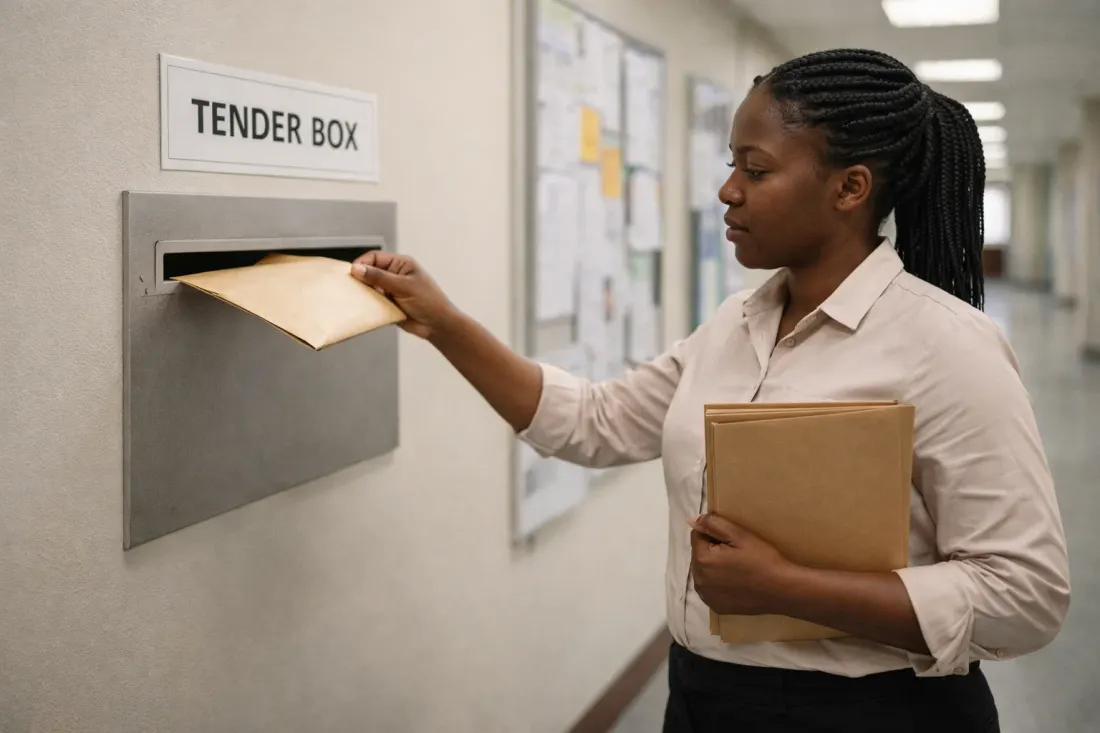
Before submission, do a final compliance check. Go through your checklist item by item. Have you signed everything that needs signing? Are all required documents included? Is your pricing complete? Have you answered every question in the tender document? This final review catches mistakes that could disqualify you.
Submit early if possible. Don't wait until the last hour before closing time. Technical issues happen – printers jam, traffic delays you, systems crash. Submitting a day early eliminates these risks. Late submissions aren't accepted – arriving at 14:05 when the deadline was 14:00 means your bid won't be opened. All that work wasted because of five minutes.
Keep copies of everything you submit. If there are queries or disputes later, you need proof of what you submitted. Take photos of your sealed submission, keep electronic copies of all documents, and get a receipt or reference number when you submit (most tender boxes have sign-in sheets or officials issue stamped acknowledgments).
Common Mistakes That Lead to Disqualification
Even experienced businesses make tender mistakes. The difference between winning and losing often comes down to avoiding easily preventable errors. Here are the most common disqualification triggers and how to avoid them.
Missing signatures disqualify more bids than you'd expect. SBD forms require authorised signatories – typically directors or members with signing authority. Every page that needs a signature must be signed. Every declaration must be signed. Some forms need signatures from both the bidder and a Commissioner of Oaths or company secretary. A single missing signature makes your bid non-compliant. Before sealing your submission, check every signature block.
Expired documentation is another frequent killer. Your tax clearance certificate has an expiry date. Your B-BBEE certificate or affidavit has a validity period (typically one year). If these documents are expired at bid closing date, your bid is non-responsive. Check dates carefully – a certificate expiring two days after closing might be acceptable, but one expired two days before closing isn't. When in doubt, get a fresh certificate.
Incomplete pricing schedules flag your bid as non-responsive. If the pricing schedule has 15 line items and you've only priced 14, that's incomplete. If sections are blank or marked "N/A" where prices are required, that's incomplete. If your pricing doesn't match the format specified (for example, they want prices per unit but you've given a lump sum), that's non-compliant. Price everything the tender asks you to price, in the format specified.
Non-compliance with specifications is more subtle but equally fatal. If the tender specifies minimum qualifications for project managers (say, a professional engineering degree and 10 years' experience) and your proposed project manager has only seven years' experience, you're non-compliant. If they specify particular materials or brands ("or approved equivalent") and you propose something different without following the approval process, you're non-compliant. Read specifications carefully and meet them exactly, or follow the prescribed process for seeking approval of alternatives.
Late submissions are the most unforgiving disqualification. Tenders close at specific times – often 11:00 or 14:00 on the closing date. The tender box is locked at that time. If you arrive after closing, your submission isn't accepted. No exceptions. South African courts have consistently ruled that tender closing times are mandatory and material – authorities have no discretion to accept late bids. Plan to arrive early. If submitting electronically through the eTender portal, don't wait until the last hour – system delays or technical issues aren't accepted as excuses.

Collusion or anti-competitive behaviour disqualifies you and can get you blacklisted. This includes discussing pricing with competitors before bid closing, submitting coordinated bids with other companies, or any form of bid rigging. SBD 9 (Certificate of Independent Bid Determination) requires you to declare that your bid is independent. False declarations here can lead to criminal charges, not just disqualification.
Failure to attend compulsory briefing sessions disqualifies you if the tender specifies attendance as mandatory. Some tenders require site visits or clarification meetings. If attendance is listed as compulsory, it means compulsory – non-attendance makes your bid non-responsive. These sessions also give you critical information about the project that might not be in the written tender documents. Make attendance a priority.
Submitting incorrect company details causes problems. Your bid must use your registered company name exactly as it appears on CIPC and CSD. If your registered name is "ABC Construction Proprietary Limited" but you submit as "ABC Construction" or "ABC Pty Ltd", that's a mismatch. Banking details must match your registered company exactly. Directors listed must be current and match CIPC records. These seem like small details, but they matter – evaluators verify your information against official databases.
Not keeping B-BBEE claims consistent trips up many bidders. If you claim Level 2 B-BBEE status on SBD 6.1 but your attached certificate shows Level 3, that's a discrepancy. If you claim 100% black ownership but your CIPC documents show otherwise, that's a false claim. Exaggerating your B-BBEE status is fraud – it can get you blacklisted, prosecuted, and barred from future government work. Claim only what you can prove with valid documentation.
The pattern here is clear: attention to detail prevents disqualification. Create checklists, have someone else review your submission before you seal it, and never rush the final assembly. Winning a tender is hard work; getting disqualified for preventable mistakes is heartbreaking.
Understanding Tender Funding – From Winning to Delivering
Winning a tender creates a wonderful problem: you need capital upfront to pay suppliers, but government only pays you 30, 60, or 90 days after you've delivered. For many SMMEs, this cash flow gap is the difference between seizing opportunity and watching it slip away.
Traditional banks struggle to help here. They want collateral, they want proven cash flow history, and they're risk-averse about government contracts. For a newly registered company or a small business without assets, bank funding isn't realistic. This is where purchase order funding becomes critical.
Purchase order funding (also called tender funding) is specifically designed for businesses that have won contracts but lack the working capital to deliver. Instead of looking at your credit history or demanding collateral, funders assess the opportunity itself. Is the purchase order legitimate? Is the end buyer (government department or SOE) able to pay? Can the work be delivered profitably? If the answers are yes, funding is possible. For the full breakdown, see the South African PO funding pillar.
Here's how it works in practice. You win a R2 million tender to supply equipment to a municipality. The municipality issues a purchase order. You approach a tender funder with the PO. The funder verifies the PO is legitimate, assesses the municipality's payment ability, and structures a funding deal. The funder pays your suppliers directly – let's say R1.5 million in supplier costs. You deliver the equipment to the municipality. The municipality pays the R2 million invoice (likely 60 days later). From that payment, the funder is repaid their R1.5 million advance plus an agreed fee or profit share. You keep the remaining profit.
This model works because the risk assessment focuses on the opportunity, not just your business. Even if your company is only three months old with limited bank statements, a solid government PO from a creditworthy buyer can be funded. This is fundamentally different from traditional lending – you're being funded based on the contract you've won, not your past financial history.
The best tender funders do more than just provide capital. They offer sourcing support – helping you find quality suppliers at competitive prices, sometimes from networks you wouldn't have access to otherwise. They provide logistics coordination – managing the supply chain from factory to delivery site. They offer verification services – checking that the goods match PO specifications before delivery, reducing your risk of rejection. This comprehensive support means you're not just getting money; you're getting a partner who helps you deliver successfully.
For SMMEs considering their first government tender, knowing that funding is available changes the calculation completely. That R5 million infrastructure contract stops being a fantasy you can't afford and becomes a realistic growth opportunity. You can bid confidently, knowing that if you win, you'll have the capital to deliver.
Tender funding isn't free – there are fees or profit-sharing arrangements involved. But the alternative is turning down opportunities because you lack capital, which means zero growth. The right funding partner helps you deliver contracts you'd otherwise miss, building your track record and capacity for even bigger opportunities. For more guidance on navigating tender opportunities with the right financial support, explore our tender success guide for South African SMMEs.
One important consideration: choose funding partners who understand government procurement. Payment terms from government can be unpredictable – the agreed 60 days might stretch to 90 or 120. A funder familiar with public sector delays builds this into their structure and doesn't panic when payments take longer than expected. Experience matters here.
Beyond tender funding, invoice discounting helps with cash flow after you've delivered. If you've completed the work, submitted your invoice, but need cash before the government pays, invoice funding advances you up to 75% immediately. When the government eventually pays, you receive the balance. This keeps your business liquid while waiting for payment, allowing you to take on new work without cash flow constraints.
After You Submit – What Happens Next
You've submitted your tender on time with everything required. Now comes the waiting. Understanding what happens after submission helps manage expectations and prepares you for the next steps.
Tender opening typically happens immediately after closing time. For physical submissions, authorised officials open the tender box in public, record who submitted, and verify that submissions are sealed properly. For electronic tenders via the eTender portal, the system logs all submissions received before the deadline. Tender opening creates a record of who participated – this information is sometimes published, though detailed bid contents remain confidential during evaluation.
Evaluation begins within days of closing. For small, straightforward tenders, evaluation might take two to three weeks. For large, complex tenders with multiple evaluation criteria, the process can take two to three months. Evaluation committees comprise officials with relevant technical expertise, procurement specialists, and sometimes external evaluators for specialised work.
During evaluation, committees might contact you for clarifications. If something in your bid is unclear or needs verification, they'll phone or email requesting additional information. Respond promptly – delays can count against you. Clarifications are typically minor (confirming a date, explaining a technical detail) rather than opportunities to fix major errors. Material changes to your bid after submission aren't allowed.
Site visits or presentations sometimes form part of evaluation, particularly for high-value or complex tenders. If you're shortlisted, you might be invited to present your proposal, demonstrate capabilities, or allow evaluators to inspect your facilities. Prepare thoroughly for these – they're opportunities to reinforce your bid's strengths and address any concerns evaluators might have.
Once evaluation is complete, the committee presents recommendations to the bid adjudication committee or accounting officer for approval. This governance layer ensures procurement decisions are properly authorised. Approval can add several weeks to the process – senior officials need time to review recommendations, and meetings need to be scheduled.
Award notifications go to successful and unsuccessful bidders simultaneously. If you win, you'll receive a formal award letter stating contract value, scope, duration, and next steps. If you're unsuccessful, you'll receive a notification (often just a short email or letter) confirming you weren't selected. Award letters for government contracts are usually sent by email these days, though some organs of state still use registered mail for official notification.
After receiving an award letter, contract finalisation happens. The organ of state prepares a formal contract document incorporating your bid and their award conditions. Review this carefully before signing – ensure pricing, scope, and timelines match what you bid. If there are discrepancies, raise them before signing. Once both parties sign, you're legally bound to deliver.
If you lose, request feedback. Government procurement regulations require organs of state to provide reasons for unsuccessful bids if requested. Feedback might highlight where you lost points (price, B-BBEE, functionality), or identify non-compliance issues. This intelligence is valuable for improving future bids. Don't take it personally – tendering is competitive, and even strong bids sometimes lose to stronger ones.
Debriefing sessions are sometimes offered for high-value tenders. These are formal meetings where evaluators explain the evaluation process, scoring, and outcomes. Attend if invited – the insights you gain help refine your approach for next time.
Throughout the post-submission period, patience is essential. Chasing evaluators daily doesn't help and can create negative impressions. A polite enquiry every few weeks asking for a progress update is acceptable, but understand that evaluation takes time. Use this waiting period productively – prepare for potential delivery if you win, and continue pursuing other opportunities.
Building Your Tender Track Record
Your first tender win is the hardest. After that, each successful delivery makes the next win easier. Building a tender track record is strategic – it's about creating a history of successful delivery that makes you progressively more competitive.
Start with tenders you can realistically deliver. A R500,000 contract might not be glamorous, but delivering it successfully gives you a reference, demonstrates capability, and generates profit to reinvest. Small wins build confidence and capacity for bigger opportunities. Trying to jump straight to R10 million tenders without proven delivery history is possible but much harder – evaluators favour bidders with relevant experience.
Document everything from your successful contracts. Get completion certificates from clients. Keep proof of delivery, invoices, and payment records. Take photos of completed work (with client permission). Collect testimonial letters from satisfied clients. This documentation becomes your portfolio for future bids – the evidence that you can deliver what you promise.
Specialise rather than diversify in the early stages. If you deliver IT equipment successfully, bid on more IT equipment tenders. Build a reputation in a niche before expanding into adjacent areas. Specialists with proven track records in specific categories win more consistently than generalists trying to bid on everything. Depth beats breadth when establishing credibility.
Maintain relationships with organs of state you've supplied. After delivering a municipal contract successfully, stay in touch. When new relevant tenders arise, you'll hear about them. Your past performance gives you credibility for future work. Government buyers prefer known, reliable suppliers to unknown quantities. Your track record becomes your competitive advantage.
Learn from every bid, win or lose. After each tender, do an internal review. What went well? What would you improve? If you lost, what was the reason? If you won, what made your bid successful? This continuous improvement mindset sharpens your tendering capability over time. The businesses that win consistently aren't lucky – they're learning and improving with every bid.
Network with other tender participants. Join industry associations, attend tender training workshops, and connect with businesses doing similar work. You'll learn what's working for others, hear about upcoming opportunities, and sometimes find collaboration partners. Tendering isn't purely competitive – sometimes joint ventures or subcontracting arrangements help everyone win bigger work than they could handle individually.
Keep your documentation current. Don't let your tax clearance lapse. Renew your B-BBEE certificate or affidavit before it expires. Update your CSD profile every three months (this improves your ranking in the database). Stay registered with relevant industry bodies. Being tender-ready all the time means you can respond quickly when the right opportunity appears, rather than scrambling to update paperwork and missing deadlines.
Finally, treat every contract as if your reputation depends on it – because it does. Deliver on time, meet specifications, communicate professionally, and handle problems transparently. Your reputation in government procurement circles spreads. Delivering badly on one contract can close doors for years. Delivering excellently opens them.
Resources and Next Steps
You now understand the tender process from start to finish. The difference between staying stuck and actually winning comes down to taking action. Here's what to do next.
If your business isn't tender-ready yet, prioritise the basics: company registration, CSD registration, tax compliance, and B-BBEE documentation. These are foundational – everything else builds on them. Allocate two to four weeks to get this sorted properly. Don't skip steps or cut corners.
Once you're compliant, start searching for relevant tenders. Use platforms like TenderCentral to find opportunities matched to your capabilities. Apply filters by industry, location, and value range. Set up alerts so new tenders come to you rather than requiring daily searches. Spend time learning what tenders in your sector typically require – this familiarisation accelerates your bidding process.
Start small and build progressively. Your first tender should be something you're confident you can deliver even if everything goes slightly wrong. Price it to include contingency. Deliver it excellently. Use that success as a springboard to bigger opportunities. Sustainable growth beats risky overreach.
Address the funding question early. If you don't have R500,000 sitting in your business account to pay suppliers upfront, how will you fund delivery when you win? Research tender funding options before you win, not after. Understanding what's available and what funders require helps you bid more confidently. When that PO lands in your inbox, you want to move fast.
Consider getting professional help for your first few bids. Tender consultants and business development services can review your submissions, help with pricing strategy, and ensure compliance. Yes, they charge fees, but the investment in getting your first win is often worthwhile. Once you understand the process, you can handle subsequent bids in-house.
Join tender training workshops if they're available in your area. SEDA (Small Enterprise Development Agency), local business chambers, and industry associations often offer free or low-cost tender training. These sessions demystify the process and connect you with others navigating the same journey.
Most importantly, start. Tendering feels daunting until you submit your first bid. That first submission teaches you more than any guide can. You'll make mistakes, you'll learn, and you'll improve. The businesses winning government contracts consistently today all started with a first bid that probably wasn't perfect. The difference is they submitted it instead of letting complexity paralyse them.
Government procurement in South Africa represents genuine opportunity for small businesses willing to learn the rules and meet the requirements. The process is structured, the criteria are published, and the playing field – while not perfectly level – favours businesses that prepare properly and deliver consistently. You can do this.
Sources and References
This guide synthesises information from official government sources, procurement legislation, and South African tender documentation standards. Key references include:
- National Treasury: www.treasury.gov.za – Preferential Procurement Regulations (2017) and procurement policy framework
- Department of Trade, Industry and Competition: www.thedtic.gov.za – Broad-Based Black Economic Empowerment Act (No. 53 of 2003), Codes of Good Practice, and B-BBEE verification guidelines
- Central Supplier Database: secure.csd.gov.za – Registration requirements, supplier information verification, and CSD documentation
- Companies and Intellectual Property Commission: www.cipc.co.za – Company registration, compliance requirements, and B-BBEE certificate applications for EMEs
- South African Revenue Service: www.sars.gov.za – Tax compliance status system, eFiling portal, and tax clearance requirements for tender applications
- Public Finance Management Act (PFMA) and Municipal Finance Management Act (MFMA) – Legislative framework governing public sector procurement and financial management
- Government tender bulletins and eTender portal documentation – Official tender advertising channels and submission procedures
- National Small Business Chamber – Tender participation research and SMME support initiatives
Information on tender funding solutions and practical SMME guidance draws from Sourcefin's experience supporting South African businesses in delivering government contracts, combined with industry best practices in alternative finance for SMMEs.
Yes, you must be registered on the Central Supplier Database (CSD) before you can apply for any government tender. CSD registration is free and mandatory for all government suppliers. You'll also need a registered company (Pty Ltd or CC), valid tax clearance certificate from SARS, and B-BBEE certification (either an affidavit for businesses under R10 million turnover or a certificate for larger businesses). Without these baseline documents, your tender bid will be automatically disqualified regardless of your pricing or capability.
The 80/20 and 90/10 systems refer to how tenders are scored in South Africa's preferential procurement framework. Under 80/20, 80 points are awarded for price (lowest bidder gets 80 points, others get proportionally fewer) and 20 points for B-BBEE status. Under 90/10, it's 90 points for price and 10 for B-BBEE. Tenders below R50 million typically use 80/20, while tenders above R50 million use 90/10. Your total score (price points + B-BBEE points) determines the winner, which means you don't always need to be the cheapest bidder to win if your B-BBEE status is strong.
Government payment terms typically range from 30 to 90 days after you've delivered and invoiced, though some departments take longer. This payment delay creates a cash flow challenge for SMMEs – you need to pay your suppliers upfront to deliver the work, but only get paid months later. This is where tender funding or invoice discounting becomes essential. Tender funding provides the working capital to pay suppliers and deliver the contract, while invoice discounting unlocks cash tied up in unpaid invoices while you wait for government to pay.
Late tender submissions are not accepted under any circumstances. If the tender closes at 14:00 and you arrive at 14:05, your bid will not be opened or evaluated – all that preparation is wasted. South African courts have consistently ruled that tender closing times are mandatory requirements with no room for discretion. There are no exceptions for traffic, technical issues, or any other reason. The best practice is to submit at least one day early to avoid any last-minute problems. Plan your submission timeline working backwards from the closing date to ensure you finish with time to spare.
Yes, newly registered businesses can apply for government tenders as long as you meet the basic requirements: company registration (Pty Ltd or CC), CSD registration, valid tax clearance, and B-BBEE certification. However, many tenders require proof of previous experience or references, which can disadvantage new businesses. Start with smaller tenders where experience requirements are less strict, deliver successfully to build your track record, then progressively bid on larger opportunities. The key challenge for new businesses is often funding – you need working capital to deliver the contract even if you win. Alternative funders assess the opportunity itself (the purchase order and end buyer) rather than just your company's history, making funding accessible even for businesses without lengthy track records.
SBD stands for Standard Bidding Documents – these are prescribed government forms that every tender applicant must complete. The most common are SBD 1 (Invitation to Bid), SBD 4 (Declaration of Interest), SBD 6.1 (Preference Points Claim for B-BBEE), SBD 8 (Declaration of Past SCM Practices), and SBD 9 (Certificate of Independent Bid Determination). Each form has specific requirements – signatures must be in the right places, declarations must be accurate, and completion must follow the instructions exactly. Missing signatures, incorrect information, or incomplete SBD forms lead to automatic disqualification. These forms might seem bureaucratic, but they're legal documents that government uses to verify your compliance, prevent corruption, and ensure fair competition.
Your B-BBEE level directly translates to preference points that are added to your price score. Under the 80/20 system (most common for tenders under R50 million), a Level 1 B-BBEE contributor gets 20 points, Level 2 gets 18 points, Level 3 gets 14 points, and so on down to Level 8 which gets only 3 points. This means a bidder with strong B-BBEE status can win even if their price is slightly higher than competitors with weaker B-BBEE levels. For Exempt Micro Enterprises (turnover under R10 million), 100% black ownership gives you Level 1 status, while 51% black ownership gives Level 2. These levels can make the difference between winning and losing, which is why B-BBEE certification should be a priority for any business serious about government tenders.
Frequently asked questions
Do I need to be registered to apply for government tenders in South Africa?
Yes, you must be registered on the Central Supplier Database (CSD) before you can apply for any government tender. CSD registration is free and mandatory for all government suppliers. You’ll also need a registered company (Pty Ltd or CC), valid tax clearance certificate from SARS, and B-BBEE certification (either an affidavit for businesses under R10 million turnover or a certificate for larger businesses). Without these baseline documents, your tender bid will be automatically disqualified regardless of your pricing or capability.
What is the difference between the 80/20 and 90/10 tender points system?
The 80/20 and 90/10 systems refer to how tenders are scored in South Africa’s preferential procurement framework. Under 80/20, 80 points are awarded for price (lowest bidder gets 80 points, others get proportionally fewer) and 20 points for B-BBEE status. Under 90/10, it’s 90 points for price and 10 for B-BBEE. Tenders below R50 million typically use 80/20, while tenders above R50 million use 90/10. Your total score (price points + B-BBEE points) determines the winner, which means you don’t always need to be the cheapest bidder to win if your B-BBEE status is strong.
How long does it take to get paid after delivering a government tender?
Government payment terms typically range from 30 to 90 days after you’ve delivered and invoiced, though some departments take longer. This payment delay creates a cash flow challenge for SMMEs – you need to pay your suppliers upfront to deliver the work, but only get paid months later. This is where tender funding or invoice discounting becomes essential. Tender funding provides the working capital to pay suppliers and deliver the contract, while invoice discounting unlocks cash tied up in unpaid invoices while you wait for government to pay. For a wider walk-through of the model, see the South African invoice discounting pillar.
What happens if I miss a tender closing deadline?
Late tender submissions are not accepted under any circumstances. If the tender closes at 14:00 and you arrive at 14:05, your bid will not be opened or evaluated – all that preparation is wasted. South African courts have consistently ruled that tender closing times are mandatory requirements with no room for discretion. There are no exceptions for traffic, technical issues, or any other reason. The best practice is to submit at least one day early to avoid any last-minute problems. Plan your submission timeline working backwards from the closing date to ensure you finish with time to spare.
Can I apply for tenders if my business is less than a year old?
Yes, newly registered businesses can apply for government tenders as long as you meet the basic requirements: company registration (Pty Ltd or CC), CSD registration, valid tax clearance, and B-BBEE certification. However, many tenders require proof of previous experience or references, which can disadvantage new businesses. Start with smaller tenders where experience requirements are less strict, deliver successfully to build your track record, then progressively bid on larger opportunities. The key challenge for new businesses is often funding – you need working capital to deliver the contract even if you win. Alternative funders assess the opportunity itself (the purchase order and end buyer) rather than just your company’s history, making funding accessible even for businesses without lengthy track records.
What are SBD forms and why are they so important?
SBD stands for Standard Bidding Documents – these are prescribed government forms that every tender applicant must complete. The most common are SBD 1 (Invitation to Bid), SBD 4 (Declaration of Interest), SBD 6.1 (Preference Points Claim for B-BBEE), SBD 8 (Declaration of Past SCM Practices), and SBD 9 (Certificate of Independent Bid Determination). Each form has specific requirements – signatures must be in the right places, declarations must be accurate, and completion must follow the instructions exactly. Missing signatures, incorrect information, or incomplete SBD forms lead to automatic disqualification. These forms might seem bureaucratic, but they’re legal documents that government uses to verify your compliance, prevent corruption, and ensure fair competition.
How does my B-BBEE level affect my chances of winning a tender?
Your B-BBEE level directly translates to preference points that are added to your price score. Under the 80/20 system (most common for tenders under R50 million), a Level 1 B-BBEE contributor gets 20 points, Level 2 gets 18 points, Level 3 gets 14 points, and so on down to Level 8 which gets only 3 points. This means a bidder with strong B-BBEE status can win even if their price is slightly higher than competitors with weaker B-BBEE levels. For Exempt Micro Enterprises (turnover under R10 million), 100% black ownership gives you Level 1 status, while 51% black ownership gives Level 2. These levels can make the difference between winning and losing, which is why B-BBEE certification should be a priority for any business serious about government tenders.

Sourcefin is a South African alternative finance provider that offers purchase order funding and invoice discounting to SMMEs, enabling businesses to fulfil confirmed purchase orders or tenders and unlock cash flow without collateral. Unlike traditional lenders or banks, Sourcefin also provides end-to-end support including supplier sourcing, logistics, project management, and risk oversight.