
Tender Funding South Africa: Options for Awarded Contracts
Won a tender but lack execution capital? Purchase order funding provides upfront cash based on your awarded contract, not your credit history or track record.

On this page
- Why Traditional Banks Won't Fund Tenders
- Purchase Order Funding: Capital for Execution
- Invoice Discounting: Immediate Cash After Delivery
- Comparing Your Funding Options
- What Funders Look For in Tender Funding Applications
- The Application Process: What to Expect
- When Funding Gets Declined: Common Reasons
- Building Relationships with Alternative Funders
- Factoring Funding Costs Into Your Pricing
- Sources & References
- Frequently asked questions
Tender funding South Africa options primarily include purchase order funding (upfront capital based on your awarded contract to pay suppliers and execute delivery) and invoice discounting (immediate cash against unpaid government invoices after delivery). Unlike traditional bank loans that assess credit history and require collateral, alternative funders like Sourcefin evaluate the contract itself – providing rapid funding within 48-72 hours for viable government tenders and purchase orders.
You've won the tender. The contract is signed. Government has officially awarded you a R500,000 supply contract. This should be a celebration moment – except you don't have R300,000 to purchase inventory, pay suppliers, and execute delivery. You approach your bank for funding, confident that a confirmed government contract provides sufficient security. They decline. "No track record," they say. "Too risky."
This scenario plays out daily across South African SMMEs. Capable businesses win legitimate opportunities they cannot execute because traditional lenders won't bridge the capital gap between contract award and payment receipt. Banks assess your past, not your future. They want collateral, established relationships, and proven track records. Government contracts – especially first or early-stage tenders – don't meet their risk criteria.
Alternative funding exists precisely for this gap. Tender funding solutions evaluate the opportunity itself rather than your credit history. If the contract is legitimate and the client creditworthy (government departments generally are), funding becomes possible even without traditional banking qualifications. This guide explains your options, how each works, and which solution fits different tender scenarios. For context on the complete tender process, see our guide to tendering in South Africa.
Why Traditional Banks Won't Fund Tenders
Understanding why banks decline tender funding helps you avoid wasting time pursuing dead-end applications. Banks operate on collateral-based lending models. They need tangible security they can claim if you default – property, equipment, inventory, established accounts receivable. An awarded tender contract, even from government, isn't recognised as sufficient collateral in traditional banking frameworks.
Banks also assess your business's historical financial performance. They want multiple years of audited financials showing consistent profitability, strong cash reserves, and established customer relationships. First-time tender winners have none of this. Even businesses with solid private sector track records struggle because government contracting represents new territory with different risk profiles than their existing operations.
The timeline mismatch creates additional problems. Tender execution might require R300,000 upfront with payment arriving 60-90 days after delivery. Banks willing to lend would structure this as working capital finance requiring monthly repayments starting immediately. You'd be repaying the loan while still waiting for government payment, creating cash flow pressure that makes execution difficult and loan defaults more likely.
Alternative funders structure deals differently because they understand tender economics. Repayment comes directly from government payment, not from your cash flow. The contract itself provides security rather than traditional collateral. Your track record matters less than the contract's legitimacy and the client's creditworthiness. This fundamentally different approach makes tender funding viable where bank loans aren't.
Purchase Order Funding: Capital for Execution
Purchase order funding provides upfront capital to execute awarded contracts before client payment arrives. When government awards you a tender and issues a purchase order, alternative funders advance the capital needed to pay suppliers, purchase inventory, cover manufacturing costs, and manage delivery logistics. You execute the contract using funded capital, deliver to government, invoice for payment, and repay the funder when government pays.
How it works practically: You submit your awarded purchase order to the funder along with supplier quotations and delivery specifications. The funder verifies contract legitimacy, assesses government department creditworthiness, and evaluates supplier capability. Once approved (typically 48-72 hours), the funder pays your suppliers directly or provides capital for you to purchase required goods and services. You execute delivery, invoice government, and when government payment arrives, the funder receives their advance plus agreed fees, and you keep the profit margin.
What makes purchase order funding different from loans: It's not debt on your balance sheet. There are no monthly repayments draining your cash flow. The funding is tied specifically to the contract opportunity – you're not borrowing against your business generally, you're funding a specific deal. Approval depends on contract strength and client creditworthiness rather than your credit score or financial history.
Sourcefin's purchase order funding is structured as partnership rather than transactional lending. We don't just advance capital – we provide sourcing support, supplier negotiations, logistics coordination, and delivery management. This comprehensive approach increases execution success rates, which benefits both your business and ensures contract completion that enables repayment.
Invoice Discounting: Immediate Cash After Delivery
Invoice discounting in SA converts unpaid government invoices into immediate working capital. After you've completed tender delivery and invoiced government, invoice discounting provides immediate cash flow rather than waiting 30-90 days for government payment. When government eventually pays, the funder receives their advance plus fees, and you receive the remaining invoice balance.
This solution works when you've already funded execution yourself but need cash flow during the payment waiting period. Many businesses complete tenders using existing capital, credit facilities, or supplier payment terms, then find themselves cash-strapped waiting for government payment while facing other operational expenses or new contract opportunities.
How invoice discounting differs from purchase order funding: Invoice discounting happens after delivery, while purchase order funding happens before. Invoice discounting assumes you had execution capital already, it just accelerates payment you're owed. Purchase order funding provides execution capital you didn't have. Both solve cash flow problems but at different points in the contract lifecycle.
Understanding government payment terms makes invoice discounting's value clear. Government departments typically pay 30 days after invoice submission (in theory), but 60-90 days is more realistic (in practice). Some payments stretch beyond 90 days due to bureaucratic delays, approval hierarchies, and month-end processing cycles. Invoice discounting eliminates this waiting period, giving you immediate access to earned revenue.
The Sourcefin approach to invoice discounting includes verification services that confirm invoice legitimacy and delivery completion before advancing funds. This protects both parties – you get fast payment, and we ensure the invoice will be paid by government. Our relationships with procurement officers can sometimes accelerate government payment processing, reducing the overall financing period.
Comparing Your Funding Options
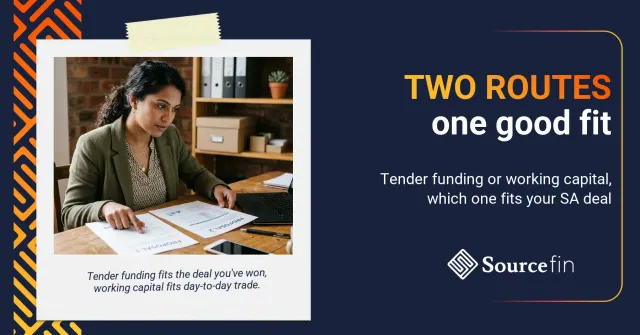
Choosing between purchase order funding and invoice discounting depends on your specific situation. If you've won a tender but lack execution capital, purchase order funding is your solution. If you've completed delivery but need cash while waiting for payment, invoice discounting fits better. Some contracts might use both – purchase order funding for execution, then invoice discounting if government payment delays extend beyond expectations. For broader context, see the wider PO funding pillar for SA SMMEs.
Cost structures differ between options and depend on several factors. Purchase order funding pricing is influenced by deal size (larger contracts typically receive more favourable rates), contract duration (shorter execution timelines reduce costs), client creditworthiness (government departments with strong payment records), and complexity of execution. Invoice discounting rates are calculated based on the time period invoices remain outstanding and the advanced amount. Both approaches cost more than traditional bank loans but remain viable because bank loans simply aren't available for tender opportunities.
The approval process differs slightly. Purchase order funding requires contract verification, supplier validation, and delivery logistics assessment before approval. Invoice discounting requires invoice verification, delivery confirmation, and government department payment history review. Purchase order funding takes slightly longer to approve because execution planning is involved, while invoice discounting can approve faster since delivery is complete and only payment verification remains.
Repayment timing matters significantly. With purchase order funding, repayment happens when government pays you after delivery – typically 60-90 days from execution completion. With invoice discounting, repayment happens when government pays the invoice – typically 30-90 days from invoice submission. Neither option requires repayment from your operating cash flow, which distinguishes them from bank loans that demand monthly payments regardless of client payment status.
What Funders Look For in Tender Funding Applications
Alternative funders assess opportunities differently than banks, but they're not careless. Approval depends on several key factors. Contract legitimacy tops the list – funders verify that the purchase order or tender award is genuine, comes from a real government department, and follows proper procurement procedures. Official documentation, proper signatures, and verifiable contact information for procurement officers all matter.
Client creditworthiness ranks second. Government departments generally qualify as creditworthy clients because they're funded by taxpayer revenue and legally obligated to pay legitimate invoices. However, some departments have better payment track records than others. Funders consider historical payment performance when evaluating risk. National departments typically pay more reliably than some municipal entities, though this varies.
Your capability to deliver matters more than your track record. Funders assess whether you understand what the contract requires, have relationships with capable suppliers, and can manage delivery logistics. First-time tender winners can secure funding if they demonstrate clear execution plans and realistic understanding of what delivery involves. Industry experience in your sector counts more than government contracting history.
Profit margins influence approval decisions. Funders need assurance that your pricing includes sufficient margin to cover their fees while leaving you profitable. Contracts priced at cost with minimal markup create problems – there's no buffer for unexpected costs or funding fees. Healthy margins (20-35% typical for supply contracts) make funding viable for both parties.
The Application Process: What to Expect
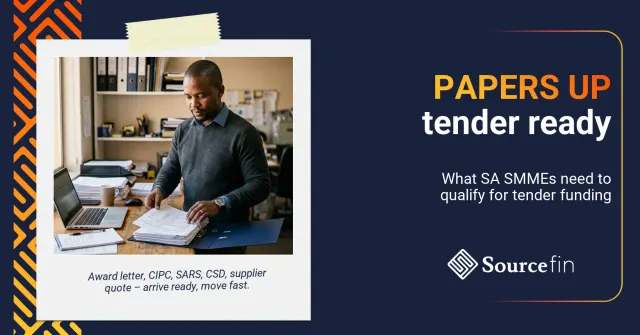
Applying for tender funding follows a straightforward process. Start by submitting your purchase order or tender award documentation along with basic business information – company registration, tax clearance, B-BBEE status, director details. Include supplier quotations showing your sourcing plan and delivery timeline. The initial submission takes 15-30 minutes for organised businesses with documents ready.
The funder typically conducts due diligence in as little as 48 hours. This includes verifying contract legitimacy with the issuing department, assessing supplier capability, reviewing delivery logistics, and evaluating your business's capacity to manage execution. They might request additional documentation or clarifications during this phase. Responsive communication speeds approval – answer queries promptly and provide requested information quickly.
Once approved, you receive a formal funding proposal outlining advance amount, fee structure, repayment terms, and delivery milestones. Review this carefully. Understand exactly what the funder will pay, what they won't cover, when payments happen, and what your obligations are. Ask questions about anything unclear. Reputable funders welcome questions and provide transparent explanations.
After accepting the proposal, execution begins. For purchase order funding, the funder pays suppliers according to the agreed plan. For invoice discounting, funds are transferred to your account upon invoice verification. Throughout execution, maintain communication with your funder – they're invested in your success and can provide support when challenges arise. Their experience with tender delivery often provides valuable guidance.
When Funding Gets Declined: Common Reasons
Not every tender funding application approves. Understanding common decline reasons helps you assess opportunities realistically before applying. Insufficient profit margins top the decline list. If your tender pricing includes minimal margin and funding costs consume most of it, the numbers simply don't work. You'd deliver the contract without meaningful profit, creating no incentive for either party.
Questionable contract legitimacy causes immediate declines. Purchase orders missing proper signatures, tenders awarded through irregular processes, or contracts from unverifiable departments raise red flags. Funders won't advance capital without confidence that the contract is genuine and enforceable. Always verify your tender documentation is complete and official before applying.
Unrealistic delivery timelines create problems. If you've committed to 30-day delivery but your suppliers need 60 days, execution will fail. Funders assess whether your timeline aligns with supplier capabilities and contract requirements. Overpromising to win the tender creates delivery problems that funding can't solve.
Poor communication during application raises concerns. Delayed responses to queries, incomplete documentation submission, or vague answers about execution plans suggest you're not prepared for successful delivery. Funding execution risk, not just contract legitimacy. If they're uncertain about your capability to manage the project, they'll decline regardless of contract quality.
Building Relationships with Alternative Funders
Your first tender funding application establishes a relationship with the funder. Successful execution on that first deal makes future funding easier, faster, and often more favourable on pricing. Funders value reliable partners who deliver contracts successfully, communicate proactively, and treat funding relationships professionally.
Deliver flawlessly on your first funded tender. Meet delivery deadlines, maintain quality standards, keep the funder informed of progress, and ensure clean handover to the client. This track record makes you a preferred client for future opportunities. Subsequent applications might approve in hours rather than days, and larger contract funding becomes accessible.
Use tender funding strategically, not desperately. Apply when you've won legitimate opportunities you can execute successfully with funding support. Don't apply for every tender hoping funding compensates for weak bids or unrealistic pricing. Funders recognise businesses that apply strategically versus those throwing applications everywhere hoping something sticks.
The Sourcefin Tender Success Guide provides end-to-end support beyond just funding – helping identify suitable tenders, prepare compelling bids, understand evaluation criteria, and manage delivery execution. This comprehensive approach increases your tender success rate, which means more fundable opportunities and stronger funder relationships over time.
Factoring Funding Costs Into Your Pricing
Smart tenderers include funding costs in their pricing from the start rather than discovering after award that margins don't accommodate financing. When preparing tender pricing schedules, calculate your full execution costs including supplier payments, logistics, overhead allocation, and financing fees. Add your target profit margin on top of total costs, not just direct costs.
Funding costs vary based on contract size, duration, client payment history, and execution complexity. These are legitimate business expenses, just like transport costs or insurance. Government expects businesses to factor their financing needs into pricing – they're not subsidising your cash flow challenges, but they are paying market rates that include normal business costs.
Price competitively but realistically. Winning tenders with unsustainable margins creates execution problems and unprofitable work. Better to lose a tender that can't be delivered profitably than win work that damages your business. Alternative funders often review tender pricing before you submit and can provide feedback on whether your margins accommodate funding costs comfortably.
Understanding how to build your tender track record includes pricing strategies that ensure profitable execution. Each successfully delivered contract strengthens your position for future opportunities, making funding easier and eventually making traditional banking relationships viable as your track record grows.
Sources & References
Sourcefin Purchase Order Funding: /purchase-order-funding/
Sourcefin Invoice Discounting: /invoice-discounting/
National Treasury Payment Guidelines: https://www.treasury.gov.za
Companies and Intellectual Property Commission: https://www.cipc.co.za
South African Revenue Service: https://www.sars.gov.za
Purchase order funding provides upfront capital BEFORE delivery to pay suppliers and execute the contract – you use it when you've won the tender but lack execution capital. Invoice discounting provides immediate cash AFTER delivery while waiting for government payment – you use it when you've completed the work but need cash flow during the 30-90 day payment waiting period. Purchase order funding enables execution; invoice discounting accelerates payment you're already owed.
Banks operate on collateral-based lending requiring property, equipment, or established assets as security. An awarded tender contract isn't recognised as sufficient collateral in traditional banking frameworks. Banks also assess historical financial performance requiring multiple years of audited financials, which first-time tender winners don't have. The repayment timeline mismatch creates additional problems – banks want monthly repayments starting immediately while you're still waiting for government payment 60-90 days after delivery.
Tender funding costs are determined by several factors including deal size (larger contracts typically receive more favourable rates), contract duration (shorter timelines reduce costs), client creditworthiness (government departments with strong payment records get better rates), and execution complexity. For invoice discounting, costs are calculated based on the time period invoices remain outstanding. While higher than bank loan rates, these costs remain viable because bank loans simply aren't available for tender opportunities, especially for first-time winners. Factor these financing costs into your tender pricing as legitimate business expenses alongside transport and insurance costs.
Yes. Alternative funders like Sourcefin evaluate the contract opportunity itself rather than your tender track record. Approval depends on contract legitimacy, government department creditworthiness, your capability to deliver, and sufficient profit margins. First-time tender winners secure funding regularly if they demonstrate clear execution plans and realistic understanding of delivery requirements. Industry experience in your sector counts more than government contracting history.
Initial assessment typically takes 48-hours after submitting your purchase order, supplier quotations, and basic business documents. The funder verifies contract legitimacy, assesses supplier capability, and evaluates delivery logistics. Once approved, you receive a formal proposal outlining advance amount and terms. After accepting the proposal, execution begins – for purchase order funding, suppliers get paid according to plan; for invoice discounting, funds transfer to your account upon invoice verification.
Reputable funders conduct due diligence on government department payment history before approving funding. National government departments and established provincial departments generally pay legitimate invoices reliably, though timing varies. Funders build this risk assessment into their approval process – they won't fund contracts from departments with poor payment records. If payment issues arise, experienced funders like Sourcefin have relationships with procurement officers that can help resolve delays and accelerate processing.
Absolutely. Calculate full execution costs including supplier payments, logistics, overhead allocation, AND financing fees when preparing tender pricing schedules. Add your target profit margin on top of total costs, not just direct costs. Funding costs are legitimate business expenses that government expects businesses to factor into pricing. Winning tenders with unsustainable margins that don't accommodate financing creates execution problems and unprofitable work – price realistically for successful delivery.
Frequently asked questions
What is the difference between purchase order funding and invoice discounting for tenders?
Purchase order funding provides upfront capital BEFORE delivery to pay suppliers and execute the contract – you use it when you’ve won the tender but lack execution capital. Invoice discounting provides immediate cash AFTER delivery while waiting for government payment – you use it when you’ve completed the work but need cash flow during the 30-90 day payment waiting period. Purchase order funding enables execution; invoice discounting accelerates payment you’re already owed.
Why is it unlikely for to banks fund my awarded government tender?
Banks operate on collateral-based lending requiring property, equipment, or established assets as security. An awarded tender contract isn’t recognised as sufficient collateral in traditional banking frameworks. Banks also assess historical financial performance requiring multiple years of audited financials, which first-time tender winners don’t have. The repayment timeline mismatch creates additional problems – banks want monthly repayments starting immediately while you’re still waiting for government payment 60-90 days after delivery.
How much does tender funding cost in South Africa?
Tender funding costs are determined by several factors including deal size (larger contracts typically receive more favourable rates), contract duration (shorter timelines reduce costs), client creditworthiness (government departments with strong payment records get better rates), and execution complexity. For invoice discounting, costs are calculated based on the time period invoices remain outstanding. While higher than bank loan rates, these costs remain viable because bank loans simply aren’t available for tender opportunities, especially for first-time winners. Factor these financing costs into your tender pricing as legitimate business expenses alongside transport and insurance costs.
Can I get tender funding if I've never won a government contract before?
Yes. Alternative funders like Sourcefin evaluate the contract opportunity itself rather than your tender track record. Approval depends on contract legitimacy, government department creditworthiness, your capability to deliver, and sufficient profit margins. First-time tender winners secure funding regularly if they demonstrate clear execution plans and realistic understanding of delivery requirements. Industry experience in your sector counts more than government contracting history.
How long does tender funding approval take?
Initial assessment typically takes 48-hours after submitting your purchase order, supplier quotations, and basic business documents. The funder verifies contract legitimacy, assesses supplier capability, and evaluates delivery logistics. Once approved, you receive a formal proposal outlining advance amount and terms. After accepting the proposal, execution begins – for purchase order funding, suppliers get paid according to plan; for invoice discounting, funds transfer to your account upon invoice verification.
What happens if government doesn't pay my invoice?
Reputable funders conduct due diligence on government department payment history before approving funding. National government departments and established provincial departments generally pay legitimate invoices reliably, though timing varies. Funders build this risk assessment into their approval process – they won’t fund contracts from departments with poor payment records. If payment issues arise, experienced funders like Sourcefin have relationships with procurement officers that can help resolve delays and accelerate processing.
Should I include funding costs in my tender pricing?
Absolutely. Calculate full execution costs including supplier payments, logistics, overhead allocation, AND financing fees when preparing tender pricing schedules. Add your target profit margin on top of total costs, not just direct costs. Funding costs are legitimate business expenses that government expects businesses to factor into pricing. Winning tenders with unsustainable margins that don’t accommodate financing creates execution problems and unprofitable work – price realistically for successful delivery.

Sourcefin is a South African alternative finance provider that offers purchase order funding and invoice discounting to SMMEs, enabling businesses to fulfil confirmed purchase orders or tenders and unlock cash flow without collateral. Unlike traditional lenders or banks, Sourcefin also provides end-to-end support including supplier sourcing, logistics, project management, and risk oversight.