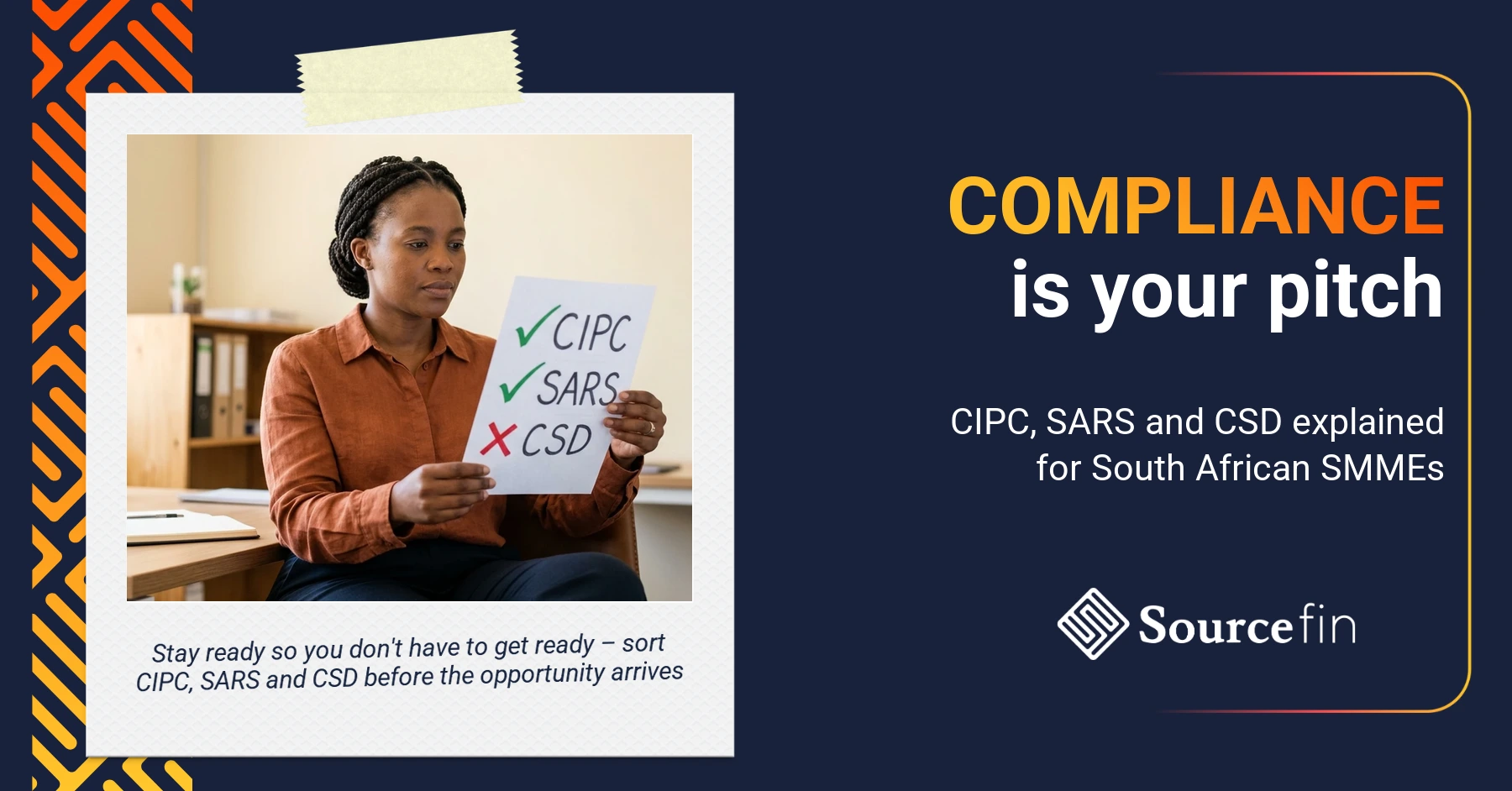

SMME compliance in South Africa means keeping three registers current before you approach any funder or government department: CIPC (your legal identity), SARS (your tax standing), and the CSD (your supplier profile). As business coach Lerato Mathodlana puts it on The Great Enabler Podcast: “Funding doesn’t fund hopes and dreams. They fund structure. They fund credibility. They fund profit-bearing businesses.” Compliance is not a box-ticking exercise – it is your pitch.
Key Takeaways
- 30% of tender bids are disqualified on compliance alone – before anyone reads the price or the proposal
- CIPC registration and annual returns are the starting point – lapse them and you lose your legal trading status
- SARS compliance is a real-time signal, not a historical record – it can change any day
- CSD is your supplier profile for all government procurement – without it, municipalities and state entities cannot legally consider your bid
- All three systems cross-verify each other automatically – a gap in one surfaces across all three
- Alternative funders like Sourcefin also check CIPC and SARS compliance as part of their assessment process

From Hope to Execution: What This Conversation Is Really About
Lerato Mathodlana is a business coach, entrepreneur, and one of the most direct voices in the South African SMME space. She is tired of motivation. She is not interested in fluff. And she has strong feelings about the word hope when it comes to small business.
In this episode of The Great Enabler Podcast – powered by Sourcefin – Lerato sits down for a wide-ranging conversation that covers everything from naming your company to navigating a tender committee. But the thread running through all of it is the same: most South African SMMEs are not failing because the system hates them. They are failing because they are not ready.
“My goal is to move people from hope,” she says early in the conversation. When pressed on why that word affects her so strongly, her answer is clear: “We have been overly motivated. We have to now tap into execution. Strategy without execution is just wishful thinking.”
The episode’s title – Instead, GUARANTEE Business Funding – draws a deliberate line. The conventional approach is to apply and hope. The approach Lerato is advocating is to build a compliance position so clean that funders and procurement offices have almost no justification to say no.
SMMEs are routinely described as the backbone of South Africa’s economy – and with good reason. They host over 60% of the country’s workforce. Yet 70 to 80% of them don’t survive past the five-year mark. The gap between the potential and the reality is not a mystery to Lerato. “We are building survivalist businesses,” she says. “There is no succession plan.”
The 30% Problem Nobody Talks About
Before the episode gets into CIPC, SARS, and CSD specifically, Lerato makes one of its most important statements – a number that deserves to sit at the centre of every SMME’s planning.
“30% of businesses who bid get disqualified on a compliance level. That is the first way they can actually filter all of you and say – okay, we want to deal with serious people.”
This isn’t a compliance failure that happens after your bid is assessed. It happens before anyone reads your pricing. Before anyone evaluates your experience. Before anyone considers whether your proposal is any good. Three out of ten businesses are removed from consideration before the competition even begins – purely because their paperwork isn’t in order.
For context: the 2025 South African MSME Access to Finance Report, which analysed over 10,000 funding applications submitted to 315 lenders, found that 85.6% of applicants are micro-enterprises with annual turnover below R1 million. (Source: FinFind/African Bank, 2025.) These are not bad businesses. They are businesses that haven’t yet solved the compliance problem – and that problem is costing them access to South Africa’s estimated R350 billion funding gap. (Source: Business Report, January 2026)
“Compliance gives you the first step of credibility,” Lerato says. Not the last step. The first.
CIPC: Registering the Business Is Not Enough
The Companies and Intellectual Property Commission is where every formal business journey begins. Lerato walks through the registration process clearly: you go to the Biz Portal, reserve up to three company names at R50 per name, receive an approval, and register your private company. The process typically takes two to three days.
One thing that surprises many new business owners: as soon as you register, SARS knows about it. “Because of these tech integrations, it’s an automatic registration,” Lerato explains. “You’ll receive an SMS saying here’s your tax reference number for your entity.” You are now accountable to both systems from day one.
But registration is only the beginning. The more common failure point – the one that quietly destroys funding opportunities for established businesses – is the annual return.
What is an annual return, and what happens if you miss it?
Every private company must file an annual return within 30 business days of the anniversary of its incorporation date. The filing covers director details, address, financial year-end, beneficial ownership, and operational status. The cost is roughly R100 – a symbolic amount that signals to CIPC that you still intend to trade.
“That’s all an annual return is,” Lerato explains. “It’s the renewal of your status. That’s why when you miss it, you’ll literally be deregistered – because they’re under the assumption that you have no intention to use this company anymore.”
A deregistered company cannot hold a bank account, cannot bid for government work, and cannot be assessed by any funder. Many businesses only discover they have been deregistered when they try to produce their CIPC documents for a tender or funding application.
What changed in 2024 – and why it matters now
Since July 2024, CIPC has been strictly enforcing the Beneficial Ownership Declaration – a requirement that every company disclose who ultimately owns and controls the business. You cannot file your annual return without it. (Source: CIPC, 2024.)
Lerato explains why: “It is also an international practice. It’s all over the world. We adopted it in 2023. It’s simply saying that all of the directors within the business are the decision makers – there are no external influences. This is an international regulation that actually empowers South Africa to prevent money laundering and company-related crime.”
From January 2025, CSD began cross-referencing beneficial ownership declarations against CIPC records. Businesses that hadn’t updated their CIPC filings found their CSD profiles flagging non-compliance – not because they did anything wrong with their CSD registration, but because a linked system flagged an inconsistency. (Source: ptycompanyregistration.co.za, 2025.)

SARS: The Organisation That Actually Works
Few topics generate more anxiety among South African entrepreneurs than SARS. Lerato addresses this directly – and without the usual softening.
“SARS is actually as an entity very intimidating, whether you are an employee or a business, because they keep you accountable. They’re strict. And I’d say they’re the only organisation in this country that actually works.”
She goes further: “They are so efficient and they will always catch you. They will always come for what is there. It’s even biblical – give to Caesar what belongs to Caesar.”
The fear of SARS, Lerato argues, comes from a misunderstanding of what SMME compliance with tax actually gives you. “Being VAT registered, being tax compliant is one of the most basic yet powerful ways for me to continue running my business. Because once you’re flagged as non-tax compliant, your bank account gets closed. You can’t be on CSD. You’re now in debt, accumulating debt. You are literally working at a loss already.”
What does tax compliance actually mean in practice?
Lerato breaks it into three clear actions:
- Register for the correct tax types – income tax at minimum, plus PAYE if you have employees, provisional tax if applicable, VAT if your turnover exceeds the threshold
- Submit your returns on time – even nil returns, even for dormant companies, even for years where no income was earned
- Keep your SARS profile current – correct bank account, correct address, updated contact details
“These are the three things that will qualify you to get the Tax Compliance Status Pin,” she says. “People just want a tax pin by virtue of having a tax pin, but when you go and look, there’s still a tax return lingering in the air from 2021, 2019.”
The Tax Compliance Status (TCS) Pin – the modern replacement for the traditional tax clearance certificate – is a live reference number that procurement offices and funders use to verify your compliance in real time. Not at the point of your last update. At the moment they check it. That means a missed provisional tax submission or an unfiled return from two years ago can flip your status from compliant to non-compliant on the same day a bid closes.
Between 20 and 23% of SMMEs that apply for formal funding are not even registered with SARS – they are formal businesses with CIPC registration and clients, but operating outside the tax system entirely. (Source: FinFind.) For these businesses, the path to funding starts with a basic registration step that should have happened at incorporation.
SARS administrative penalties for non-submission range from R250 to R16,000 per month, per company, per outstanding return. (Source: SARS, 2024.) Lerato flags what happens when entrepreneurs register multiple companies and neglect their obligations across all of them: “SARS is your risk. They’re accumulating penalties… times seven. It’s expensive.” For a business that isn’t even trading, the penalty account can be the most costly part of the whole venture.
CSD: Your Supplier Profile – Not a Tender Portal
The Central Supplier Database is the most misunderstood of the three systems. Many SMMEs either don’t know it exists, register once and never maintain it, or confuse it with a platform for finding tenders.
Lerato’s definition is precise: “CSD is a central supplier database that houses all of the suppliers that want to trade with the government. All the information for public sector procurement – your municipalities, national, provincial governments, SOEs, the agents. All of the state entities look for suppliers to trade with on the CSD.”
It is, as she puts it, “your own house where you host your profile in order to have the visibility.” It is not where you search for opportunities. It is where procurement departments search for you.
Registration has been mandatory since April 2016 for any supplier doing business with any government entity. Without a CSD profile, procurement officers cannot legally open your bid documents – the tender committee cannot consider your application regardless of how qualified you are.
What changed with Eskom and the CSD in 2024?
Eskom announced at the beginning of 2024 that they would transfer all their procurement onto the CSD portal – abolishing their internal procurement system due to corruption, loopholes, and wastage. “So on CSD there is a tab called ‘My RFQ’ and they are the first SOE to actually roll out RFQs on there,” Lerato explains. For any business hoping to supply Eskom, having a CSD profile optimised for the relevant commodity codes is now essential to receiving invitations to quote at all.
Why do active CSD profiles still get businesses rejected?
Registration is not the same as maintenance. A business can be registered on the CSD and still be invisible to procurement departments because its profile contains stale or inconsistent information.
Common failure points include banking details that haven’t been updated after switching accounts, B-BBEE certificates that have expired, director information that doesn’t match current CIPC records, and beneficial ownership data that wasn’t updated after the 2024 enforcement change. The CSD cross-checks your profile against CIPC and SARS at the point of verification – not at the point you last updated your profile. Any mismatch at that moment creates a compliance query that delays evaluation and, in competitive tenders with short timelines, effectively means disqualification.

How the Three Systems Work Together
What the episode makes clear – and what many compliance guides miss – is that CIPC, SARS, and CSD are not three separate tasks. They are one connected system, and they cross-verify each other automatically.
“Compliance is your CIPC – those annual returns, your company is not deregistered, it’s still active, and your beneficial ownership is up to date. Second thing is your tax. Third thing is your B-BBEE. Fourth thing, if relevant, those industry regulations and registrations. And all of this comes together on CSD. That report tells your story,” Lerato says.
When a procurement department or funder pulls your CSD record, they are not just seeing what you uploaded. They are seeing a real-time verification of your CIPC status and your SARS tax compliance status. A lapse in either of those upstream systems shows up immediately on your CSD profile – often before you’re even aware of the issue.
This is why Lerato’s advice is to maintain compliance continuously rather than react to it when an opportunity arrives. “Stay ready so you don’t have to get ready,” she says – one of the episode’s clearest and most actionable lines. “If the tender closes tomorrow and you’re still waiting for a tax clearance, it’s not going to work.”
What Alternative Funders Look For – and Why SMME Compliance Matters
The episode doesn’t stop at government procurement. It also addresses how alternative funders assess compliance – and it is here that Sourcefin’s approach to purchase order funding and invoice discounting is discussed directly. For a wider walk-through of how the model fits, see the South African invoice discounting pillar.
“Sourcefin is not looking to fund your idea. Not interested in your idea,” Lerato says plainly. “Two main things come up when it comes to funding: it is your administration – the readiness, the compliance, the everything – and number two, your economic activity. Are you able to get into this agreement and deliver and fulfil your promise?”
What distinguishes alternative funders from traditional lenders is the direction they look. Traditional banks look backwards – at credit history, collateral, three years of audited financials. Alternative funders like Sourcefin look forwards: if this opportunity succeeds, can you deliver, and will the end buyer pay?
“An alternative funder doesn’t look backwards,” the host notes during the conversation. “They look at whether Lerato delivers on this tender – what is the likelihood that her client is going to pay her on time? And then the second thing is: what is the likelihood of Lerato running off with the money? So all of a sudden it’s less about creditworthiness and far more about character.”
SMME compliance is a character signal. A business that keeps its CIPC annual returns current, maintains a clean SARS TCS status, and updates its CSD profile regularly is a business that pays attention to its obligations. That tells a funder something important before the first conversation happens.
South Africa has over 600 funding programmes available to SMMEs, covering blended financing, grants, purchase order funding, and invoice solutions. (Source: Lerato Mathodlana, The Great Enabler Podcast.) The problem is not a shortage of funders. “People just don’t know how to access that funding,” Lerato says. “Funding doesn’t fund hopes and dreams. They fund structure. They fund credibility. They fund profit-bearing businesses.” The knowledge gap is as large as the funding gap – and understanding what type of funding solves your specific problem is the first step to closing it.
SMME Compliance Checklist Before Your Next Application
The episode’s practical value is in what Lerato tells you to do before the opportunity arrives. Compliance is not a reactive exercise. It is an ongoing maintenance habit – and it takes less than two hours a month once the foundations are in place.
CIPC checklist
- Log in to the Biz Portal and confirm your company status is Active
- Check that your most recent annual return has been filed within the 30-business-day window
- File your Beneficial Ownership Declaration if you haven’t done so since July 2024
- Verify that director details, company address, and financial year-end information are all current
SARS checklist
- Log in to SARS eFiling and confirm your TCS status shows Compliant
- Confirm all income tax returns are filed, including years where no income was earned
- Check that your provisional tax submissions are current for the current tax year
- If VAT-registered, verify all VAT201 returns are filed and payments are settled
- Request your TCS Pin and confirm it generates without errors – this is what a funder or procurement office will check
CSD checklist
- Log in at secure.csd.gov.za and confirm your supplier status is Active
- Verify your banking details match your current business account exactly
- Confirm your B-BBEE certificate is current and correctly uploaded
- Review director information and update anything that has changed since your last submission
- Check that your Beneficial Ownership information is consistent with your CIPC declaration
Lerato Mathodlana’s Closing Wisdom
At the end of every Great Enabler Podcast episode, the guest is invited to write one piece of wisdom on paper, place it in a calabash – a symbol of knowledge being passed between generations – and speak it directly to the camera.
Lerato Mathodlana’s contribution to that calabash:
“Nothing works unless you work. The magic you’re looking for is in the work that you avoid doing.”
It is the episode’s argument in eleven words. Compliance is work. Maintaining CIPC is work. Filing your SARS returns is work. Updating your CSD profile is work. None of it is glamorous. All of it determines whether you get to compete.
If you’re ready to take the next step, start with a compliance check – and if your business has a confirmed purchase order or outstanding invoice that needs funding now, Sourcefin is worth a conversation. You can start your funding application here.
Watch the full episode of The Great Enabler Podcast: Instead, GUARANTEE Business Funding – CIPC, SARS, CSD Explained for South African SMMEs.
Sources & References
- The Great Enabler Podcast: Instead, GUARANTEE Business Funding – Lerato Mathodlana (2026)
- SME South Africa: 2025 South African MSME Access to Finance Report – Key Highlights
- SARS: Small Business Taxpayers – Tax Compliance and Filing Requirements
- Central Supplier Database: Registration Process and Requirements
- Bizcommunity: R350 Billion Funding Gap Threatens South Africa’s GDP
Frequently Asked Questions
What is SMME compliance in South Africa?
SMME compliance in South Africa means keeping your business current across three key registers: CIPC (your company registration and annual returns), SARS (your tax compliance status and returns), and the CSD (your Central Supplier Database profile). All three are checked by funders and government procurement departments before any deal proceeds.
Why do 30% of tenders get disqualified before they are even read?
According to business coach Lerato Mathodlana, 30% of businesses that bid on government tenders are disqualified on compliance alone — before evaluators assess their pricing or experience. The most common reasons are a lapsed CIPC registration, a non-compliant SARS status, or an outdated CSD profile.
How do I check my SARS tax compliance status?
Log in to SARS eFiling at efiling.sars.gov.za and navigate to your Tax Compliance Status (TCS) section. Request your TCS Pin and confirm the status reads Compliant. Ensure all income tax returns are filed, provisional tax is current, and your SARS profile shows the correct bank account and address.
What is the CSD and why do I need it to get funding?
The Central Supplier Database (CSD) is the national register of approved suppliers to government entities, municipalities, and SOEs. Registration has been mandatory since April 2016. Without an active, current CSD profile, government procurement officers cannot legally open your bid — and some alternative funders also verify your CSD status during their assessment.
How does CIPC compliance affect my access to funding?
Your CIPC registration must be Active and your annual return must be filed within 30 business days of your company’s anniversary date. A deregistered company cannot hold a business bank account, bid for tenders, or be funded. Since July 2024, your Beneficial Ownership Declaration must also be filed before your annual return can be submitted.
What is the difference between how banks and alternative funders assess my application?
Traditional banks look backwards — at credit history, collateral, and audited financials. Alternative funders like Sourcefin look forwards: they assess whether the opportunity will succeed and whether the end buyer will pay. Compliance is still required, but the funding decision is built around the specific deal, not your historical credit profile.
How often should I update my CSD profile?
Your CSD profile should be reviewed at minimum once a year — and immediately whenever your banking details, director information, B-BBEE certificate, or company structure changes. The CSD cross-checks against CIPC and SARS in real time, so any mismatch at the point of a procurement verification will flag non-compliance even if your last update appeared correct.