
Recourse vs non-recourse invoice factoring is the most important structural decision in any invoice factoring facility. The difference comes down to one question: if your client does not pay, who absorbs the loss? In recourse factoring, you do. In non-recourse factoring, the factoring company does. Understanding this distinction – and how it affects both your risk exposure and your costs – is essential before committing to any factoring agreement in South Africa.
Key Takeaways
- Recourse vs non-recourse invoice factoring refers to who absorbs the loss if a debtor defaults. In recourse, you buy back the invoice. In non-recourse, the factor absorbs the write-off.
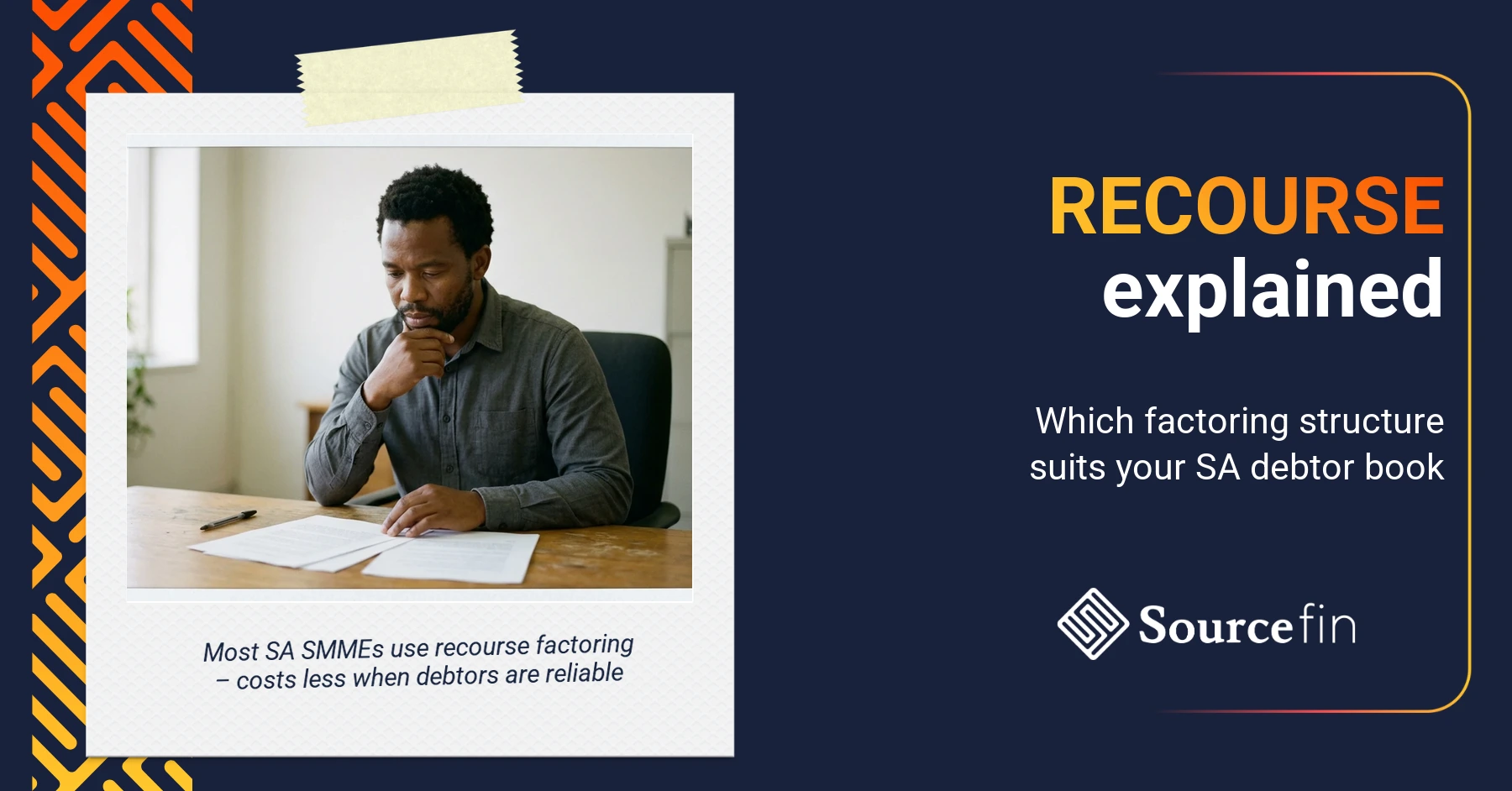
- Recourse factoring costs less because the factor carries less risk. Most South African invoice factoring agreements are structured on a recourse basis.
- Non-recourse factoring provides bad debt protection, but at a higher cost. The premium is only justified when your debtor book carries meaningful default risk.
- For SMMEs invoicing government entities or listed companies, recourse factoring is typically sufficient – these debtors rarely default.
- Invoice discounting keeps debtor risk management with you and typically offers more favourable terms than either factoring structure for SMMEs with reliable clients.
What Recourse vs Non-Recourse Invoice Factoring Means
When you enter a factoring agreement, you are selling your invoice to a third party – the factor. The factor advances you the majority of the invoice value and takes on the task of collecting payment from your client. But there is a critical condition embedded in every factoring agreement: what happens if your client does not pay?
This is where the recourse vs non-recourse invoice factoring distinction becomes concrete. In a recourse arrangement, the risk of non-payment stays with you. In a non-recourse arrangement, the factoring company accepts that risk. Everything else – the advance rate, the collection process, the speed of funding – can be similar. But this single clause determines who carries the exposure if a debtor defaults, and it has direct implications for both what you pay and what protection you receive. For a broader overview of how invoice factoring works in South Africa, see our pillar guide: invoice factoring South Africa.
How the Risk Transfer Works in Practice
In a recourse factoring arrangement, if your client fails to pay within the agreed collection period, the factoring company will require you to repurchase the invoice. Essentially, you give back the advance and take back the unpaid invoice. The factor is protected. You then pursue your client for payment directly. If the client ultimately defaults, the bad debt falls on you.
In a non-recourse factoring arrangement, if your client fails to pay, the factoring company absorbs the loss. They write off the invoice. You are not required to repurchase it, and the bad debt does not return to your balance sheet. The factor has assumed the credit risk of your debtor as part of the facility.
It is worth noting that non-recourse protection typically applies to debtor insolvency or formal inability to pay – not to commercial disputes or invoice discrepancies. If your client refuses to pay because of a dispute over delivery, quality, or contract terms, that is usually not covered under a non-recourse arrangement. Factoring companies are not insurers of disputed invoices.
Recourse Factoring: When It Is the Right Structure
Recourse factoring is the standard structure for most South African invoice factoring arrangements, and for most SMMEs it is the right starting point. It costs less because the factor carries less risk, and that cost difference is meaningful when compounded across many invoice cycles.
Recourse factoring makes sense when:
- Your debtors are government entities, listed companies, SOEs, or municipalities with strong payment records
- Your debtor book has consistent payment history with low or no defaults
- You have confidence in your clients’ ability to pay, even if payment is sometimes slow
- You are willing to manage debtor risk internally and pursue non-payers directly if needed
For SMMEs whose clients are in the public sector, recourse factoring is almost always sufficient. The South African government and its entities rarely become formally insolvent. Payment may be delayed – sometimes frustratingly so – but the risk of an absolute write-off is low. Paying the premium for non-recourse cover on a government invoice is typically unnecessary. See our guide on using invoice factoring for government work: invoice factoring for government contracts South Africa.

Non-Recourse Factoring: When the Premium Is Worth Paying
Non-recourse factoring is a meaningful risk management tool when your debtor book includes clients whose ability to pay is genuinely uncertain. The premium you pay for the non-recourse structure buys you protection against a bad debt event that could materially damage your business.
Non-recourse factoring is worth considering when:
- Your clients include smaller private companies with less predictable financial positions
- You operate in a sector where client insolvency is more common – retail, hospitality, or industries exposed to economic cycles
- Your business cannot absorb the impact of a large bad debt write-off without significant disruption
- You want to transfer debtor credit risk off your balance sheet entirely for strategic or reporting reasons
Non-recourse factoring is less common in the South African market than recourse factoring, but it is available through some providers for debtors who can be insured. The factor typically carries credit insurance on the debtors they accept for non-recourse funding, and that cost is passed through to you in the form of higher fees.
How Your Debtor Profile Should Drive the Decision
The recourse vs non-recourse invoice factoring decision should be driven by an honest assessment of your debtor book, not by a general preference for protection. The question to ask is: how likely is it that any of my clients will actually fail to pay?
If your clients are government departments, listed JSE companies, or large SOEs like Eskom or Rand Water, your default risk is low. These entities have mechanisms, budgets, and legal obligations to pay for services rendered. Payment delays are common. Payment failure is rare. Recourse factoring is appropriate.
If your clients include smaller private businesses, companies in financial difficulty, or sectors experiencing cyclical stress, your default risk is higher. Non-recourse cover starts to make more sense. For a detailed breakdown of how different debtor types affect your factoring eligibility and terms, see: invoice factoring requirements South Africa.
Invoice Discounting: A Third Path Worth Considering
For many established South African SMMEs, the most relevant alternative to both recourse and non-recourse factoring is invoice discounting. This is a structurally different product that addresses the same cash flow problem – converting unpaid invoices into working capital – without the disclosed, third-party collection model that factoring involves.
With invoice discounting, you retain full control of your debtor relationships. You continue to collect payment from your clients under your own name. The discounting company advances you cash against the invoice and recovers the advance when your client pays you. The arrangement is confidential – your clients have no reason to know a funder is involved. And because the discounting company does not absorb the operational cost of debtor management, the structure is typically more cost-effective for SMMEs with reliable debtors. For SMMEs weighing up recourse vs non-recourse invoice factoring against discounting, this cost difference is often the deciding factor.
Invoice discounting does not offer non-recourse protection as a standard feature – debtor risk stays with you. But for SMMEs with strong institutional clients where non-recourse cover is not needed anyway, this is rarely a constraint. At Sourcefin, we offer invoice discounting as a confidential, asset-backed facility. For a direct comparison of both products: invoice factoring vs invoice discounting.
Questions to Ask About Risk Structure Before Signing
Before committing to any factoring facility, get clarity on the risk structure in writing. These are the questions that matter:
- Is this facility recourse or non-recourse? Get this confirmed explicitly – not buried in general terms.
- If non-recourse: what events trigger the protection? Understand whether debtor disputes, not just insolvency, are covered.
- What is the recourse period? In a recourse facility, how long does the factor wait before requiring you to repurchase the invoice?
- Which debtors are eligible for non-recourse cover? Factoring companies typically apply non-recourse cover selectively based on debtor creditworthiness.
- What does the repurchase process look like? In a recourse facility, understand the exact mechanics and timeline of invoice buyback.
If you have outstanding invoices from creditworthy government entities or listed companies and want to assess whether invoice discounting is a better fit than factoring, apply to Sourcefin and we will assess your invoices and structure a facility that suits your debtor book. For guidance on what invoice factoring actually costs: invoice factoring rates South Africa.
Sources & References
Trade Finance Global. “What Is the Difference Between Invoice Factoring and Invoice Discounting?” 2025. tradefinanceglobal.com
Finfind. “Understanding Invoice Discounting and Factoring.” 2025. finfind.co.za
Frequently Asked Questions
What is the difference between recourse and non-recourse invoice factoring?
In recourse factoring, you must buy back the invoice if your client does not pay – the default risk stays with you. In non-recourse factoring, the factoring company absorbs the loss if your client fails to pay. Recourse factoring costs less. Non-recourse factoring provides bad debt protection at a higher cost.
Which type of invoice factoring is more common in South Africa?
Recourse factoring is far more common in South Africa. Most South African factoring agreements are recourse-based, particularly for SMMEs invoicing government entities, listed companies, or SOEs where the risk of formal debtor default is low. Non-recourse arrangements are available but less standard in the local market.
When does non-recourse invoice factoring make sense?
Non-recourse factoring makes sense when your debtor book includes smaller private companies with less predictable payment histories, or when your business cannot absorb the impact of a bad debt write-off. If your clients are government departments or listed companies, the additional cost of non-recourse cover is rarely justified.
Does non-recourse factoring cover all types of non-payment?
No. Non-recourse protection typically applies to debtor insolvency – a formal inability to pay. It does not usually cover commercial disputes, invoice discrepancies, or clients who refuse to pay because of a service or delivery issue. Always check the specific trigger events in the non-recourse clause before signing.
Is invoice discounting recourse or non-recourse?
Invoice discounting is typically a recourse structure – debtor risk stays with you, as you retain control of collections. However, because you manage the debtor relationship directly and the arrangement is confidential, the dynamic is different to factoring. For SMMEs with reliable institutional clients, this is rarely a limitation.
How does my debtor’s creditworthiness affect the recourse decision?
Your debtor’s creditworthiness is the primary input. If your clients are government entities, listed JSE companies, or large SOEs, the risk of formal default is low – recourse factoring is almost always sufficient. If your clients are smaller private businesses exposed to economic cycles, non-recourse cover starts to add genuine value.