
Invoice factoring construction South Africa gives construction SMMEs a way to convert confirmed invoices into immediate working capital – without waiting for main contractors or municipalities to process payment. Construction businesses face a structural cash flow gap: materials and labour fall due immediately, while payment terms run long and retention clauses withhold a portion of contract value until well after completion. This guide covers how factoring and invoice discounting work for construction invoices, how to handle retention, and what to look for before applying.
Key Takeaways
- Invoice factoring construction South Africa is well-suited to SMMEs because the cash flow gap is structural – materials and labour costs fall due immediately, while main contractors and municipalities commonly pay on 60 to 90-day terms.
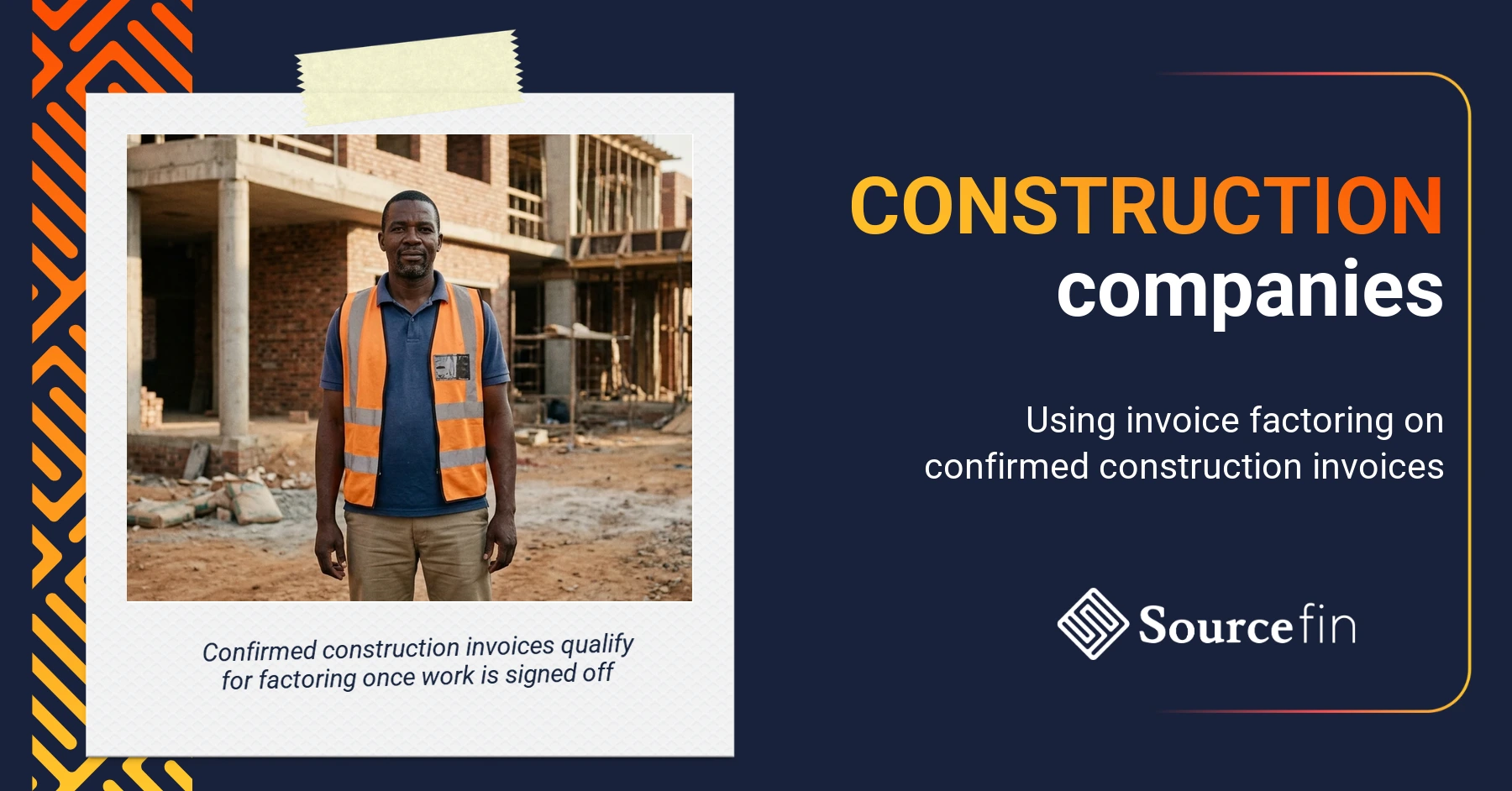
- Confirmed, signed-off construction invoices are strong factoring candidates. Once delivery is accepted and the invoice is undisputed, the debtor obligation is clear and the invoice is assessable.
- Retention clauses withhold a portion of contract value as performance security. This retention amount typically cannot be factored until it is formally released by the client – the billable portion of the invoice is what the funder advances against.
- Invoice discounting is often a better fit for construction SMMEs managing ongoing tender relationships – the funding arrangement remains confidential, and the main contractor or municipality is never aware.
- PO funding and invoice discounting can be combined across the same construction contract – PO funding covers materials and labour before delivery, while invoice discounting converts the confirmed invoice into immediate cash after.
The Structural Cash Flow Gap in South African Construction
Construction is one of the most cash-intensive sectors in the South African economy. Before an invoice is even raised, a contractor has already committed significant capital: materials purchased, labour deployed, plant and equipment hired or leased. These costs are immediate. The invoice comes later – once work is delivered and formally accepted by the client. And payment from that client, whether a main contractor on a larger infrastructure programme or a municipality contracting directly, typically follows on 60 to 90-day payment terms.
For a construction SMME managing multiple contracts at once, this timing mismatch creates genuine operational strain. Suppliers expect to be paid. Workers expect salaries. Plant hire charges continue regardless of payment cycles. The business cannot pause its cost base while waiting for a client’s finance department to process a claim. Invoice factoring construction South Africa is designed to close this gap – converting the confirmed invoice into immediate capital at the point of delivery, not at the point of client payment. For a full overview of how invoice factoring works: invoice factoring South Africa for construction businesses.
Why Construction Invoices Are Strong Factoring Candidates
The core of any factoring assessment is the creditworthiness of the debtor and the quality of the invoice. In construction, both can be strong.
South Africa’s construction sector is largely driven by government clients – municipalities, national departments, and SOEs delivering public infrastructure – and large main contractors with established balance sheets. These debtors have defined legal obligations to pay for services rendered. They are generally creditworthy, even when payment is slow. An invoice representing completed and confirmed work against a registered municipality or a substantial main contractor carries a clear, assessable obligation. The question for a funder is typically about when payment will arrive – not whether. That profile makes construction invoices viable assets to advance against, which is why invoice factoring construction South Africa is an established funding option in this sector.
Invoice Factoring Construction South Africa: How the Process Works
The factoring process on a construction contract follows the same structure as standard invoice factoring:
- You complete the work and obtain formal sign-off or acceptance of delivery from the client – main contractor, municipality, or SOE.
- You issue a valid, undisputed invoice to the client with the agreed payment terms, covering the billable amount for completed and accepted work.
- You submit the invoice to the factoring company, along with delivery confirmation and any supporting documentation the client requires.
- The factor advances you the majority of the invoice value – typically within 24 to 48 hours of approval.
- The factor notifies the client that the invoice has been assigned and that payment should be directed to the factor. This is the disclosed step in standard factoring.
- The client pays the factor according to its standard payment cycle.
- The factor releases the balance to you, minus the factoring fee.

The most important step is obtaining formal sign-off. A construction invoice that has been accepted and is not subject to any variation order dispute or pending inspection is a strong candidate. An invoice where work is awaiting final sign-off or where a section is under query is more complex to factor and will be assessed on a case-by-case basis.
Retention Clauses: A Construction-Specific Challenge
Retention is a feature of most formal South African construction contracts. A defined portion of the contract value is withheld by the client as performance security – released only after a maintenance period, defects inspection, or a set time following practical completion. Retention appears in contracts administered under standard forms including NEC and JBCC, and in most CIDB-compliant public sector procurement contracts.
The retention portion of a construction invoice typically cannot be factored until it is formally released. When you submit an invoice for factoring, the funder assesses the billable amount – the gross invoice value excluding the retention amount – as the fundable portion. Construction SMMEs should clarify with any prospective funder how they handle retention, what documentation is required to confirm the retention terms, and whether the funder offers any facility for retention release at a later stage.
Retention is not a barrier to using invoice factoring construction South Africa. It means understanding which portion of the invoice is available to advance against now, and planning separately for when the retained balance will be released.
Invoice Discounting vs Invoice Factoring for Construction Businesses
When choosing between the two structures, many established construction SMMEs distinguish between invoice discounting and invoice factoring construction South Africa on one key point: confidentiality. In standard factoring, the main contractor or municipality is formally notified that the invoice has been assigned to a third party. For construction businesses managing ongoing tender relationships – particularly with main contractors on multi-year programmes – this disclosure is not always comfortable.
With invoice discounting, the funding arrangement is not disclosed. You continue to manage the relationship with the client directly. You issue the invoice, follow up on payment, and collect in your own name. The discounting company advances cash against the invoice and recovers that advance when the client pays you. The client has no reason to know a funder is involved.
For construction SMMEs with established pipelines and multiple ongoing client relationships, invoice discounting is often the stronger fit. At Sourcefin, we offer invoice discounting for construction SMMEs as a confidential, asset-backed facility suited to businesses delivering work to government and corporate clients. For a direct comparison of both products: invoice factoring vs invoice discounting.
Combining PO Funding with Invoice Discounting in Construction
The cash flow gap in construction has two distinct phases. First, the pre-delivery phase: materials need to be purchased, labour deployed, and plant hired before the work is done and an invoice can be raised. Second, the post-delivery phase: the work is done, the invoice is issued, and the waiting begins.
Purchase order funding addresses the pre-delivery phase. It provides capital to fund delivery of a confirmed purchase order or contract scope. Once delivery is confirmed and the invoice is issued, invoice discounting takes over – converting the confirmed invoice into immediate cash. The two products work at different points in the same construction contract cycle and can be used in sequence, covering the full period from contract award through to collection.
For more on how these two products work together: PO funding vs invoice discounting guide for SMMEs. For construction SMMEs looking to fund delivery from award to collection: purchase order funding.
What Makes a Construction Invoice Eligible for Factoring or Discounting
Not every construction invoice is automatically eligible for invoice factoring construction South Africa or for invoice discounting. Key requirements are:
- Work must be complete and formally accepted. An invoice for work in progress, or where sign-off is pending, cannot be factored until delivery is confirmed and accepted by the client.
- The invoice must be undisputed. Any invoice subject to a variation order query, a defects dispute, or a pending inspection cannot typically be factored until the matter is resolved.
- The debtor must be verifiable. Registered main contractors, municipalities, and listed SOEs are assessable. Very small or newly established entities may require additional due diligence.
- The retention amount must be understood. The billable portion of the invoice – gross value less any withheld retention – is the assessable and fundable amount.
- Payment terms must be within range. Most factoring and discounting providers work with payment terms of 30 to 120 days. Longer or indefinite cycles require case-by-case assessment.
For a full breakdown of what factoring companies assess when reviewing an application: invoice factoring requirements South Africa.
If you have a confirmed construction invoice and want to assess whether it qualifies for invoice discounting with Sourcefin, apply here and we will review your invoice and debtor within 24 to 48 hours. For a broader look at how Sourcefin supports construction businesses: construction case study. For invoice discounting details or to explore government construction opportunities: government infrastructure tenders South Africa 2026.
Sources & References
Construction Industry Development Board (CIDB). “Standard for Uniformity in Construction Procurement.” cidb.org.za
Trade Finance Global. “Invoice Factoring: How It Works, Rates and Types.” 2025. tradefinanceglobal.com
Frequently Asked Questions
Can construction companies use invoice factoring in South Africa?
Yes. Construction companies are strong candidates for invoice factoring in South Africa because their invoices represent completed, confirmed work against generally creditworthy debtors – municipalities, main contractors, and SOEs. The key requirement is that the work is formally signed off and the invoice is undisputed. Retention amounts are typically assessed separately.
What is a retention clause and how does it affect invoice factoring for construction SMMEs?
A retention clause withholds a defined portion of contract value as performance security, released after a maintenance period or defects inspection. The retained amount typically cannot be factored until formally released. Factoring companies assess the billable portion of the invoice – gross value less retention – as the fundable amount. Construction SMMEs should confirm retention terms with their funder upfront.
Does my main contractor know I am using invoice factoring?
In standard invoice factoring, yes – the main contractor or municipality is notified that the invoice has been assigned to a third party. In invoice discounting, no – the arrangement is confidential and the client continues to deal with you directly. Many construction SMMEs managing ongoing tender relationships prefer invoice discounting for this reason.
What construction invoices qualify for factoring or discounting?
Invoices for completed and formally accepted work against registered main contractors, municipalities, SOEs, and verifiable government entities with payment terms of 30 to 120 days are typically eligible. The invoice must be undisputed and free of pending variation order queries or defects disputes. The billable portion – excluding retention – is the assessable amount.
How soon can a construction SMME access cash against a confirmed invoice?
At Sourcefin, approved invoices against verifiable debtors are typically advanced within 24 to 48 hours of approval. The assessment focuses on the quality of the invoice, the debtor’s payment profile, and confirmation of delivery. Speed depends on how quickly you can provide proof of delivery and any supporting documentation.
Can I use PO funding and invoice discounting on the same construction contract?
Yes. PO funding and invoice discounting address different phases of the same construction contract. PO funding covers the pre-delivery phase – providing capital to purchase materials and deploy labour before the invoice is raised. Invoice discounting covers the post-delivery phase – converting the confirmed invoice into immediate cash. The two products can be used in sequence across the same contract.