
Late Payments South Africa: Practical SMME Survival Guide
Late payments are strangling South African SMMEs. Learn practical steps to protect your cash flow, chase invoices faster, and keep your business growing.
On this page
- Key Takeaways
- Why Late Payments Are Getting Worse in South Africa
- How Late Payments Damage Your Business
- Your Legal Rights Under the 30-Day Payment Rule
- Practical Steps to Reduce Your Late Payment Risk
- Chasing Late Payments: What You Can Do When a Client Won't Pay
- How Invoice Discounting Bridges the Late Payment Gap
- Frequently asked questions
Late payments are one of the most persistent threats to small business survival in South Africa. National Treasury data shows R12.4 billion in overdue government invoices as at Q2 2025. This guide covers your legal rights, practical steps to protect your cash flow, and the funding options available when clients take too long to pay.
Key Takeaways
- At Q2 2025, 95,399 government invoices older than 30 days were unpaid – a combined R12.4 billion owed to suppliers, most of them small businesses (Source: National Treasury, 2025)
- About 91% of South African small businesses have experienced late payments, with many invoices running 30 or more days overdue
- The Public Finance Management Act legally requires government departments to pay within 30 days of receiving a valid invoice
- Many small businesses report being unable to pay their own staff on time as a direct result of late client payments – a problem that cascades through the entire business
- Invoice discounting lets you convert unpaid invoices into working capital once the invoice is verified and your debtor approved – without waiting for clients to pay
Why Late Payments Are Getting Worse in South Africa
South Africa's late payment problem has been worsening steadily, and the numbers confirm it. According to National Treasury data, 95,399 invoices older than 30 days remained unpaid at the end of Q2 2025 – representing R12.4 billion owed to suppliers across national and provincial government departments. That figure was already troubling at the start of the year, when R11.7 billion in overdue invoices sat on government books. By Q2, it had climbed by another R663 million – a 6% deterioration in a single quarter.
The Q2 figure also represented 13,663 more outstanding invoices than at Q1 – a 17% regression in three months. These aren't accounting abstractions. Behind each invoice is a business owner who delivered goods or completed a project on time, invoiced correctly, and is still waiting for payment that the law says should have arrived weeks ago.
Government departments are the most consistent offenders. The Public Finance Management Act (PFMA) explicitly requires departments to settle valid invoices within 30 days. Section 38(1)(f) is clear: accounting officers are legally obliged to pay all money owing within the prescribed period. Despite this, many departments – at national, provincial, and municipal level – routinely run at 60, 90, or even 120 days.
Private sector clients aren't blameless either. Corporate payment terms often stretch to 60–90 days, and some buyers push those terms further still. When delayed payments become the norm rather than the exception, even well-run businesses are pushed into survival mode.
The result is a cascading effect across the economy. When your client doesn't pay you, you delay paying your own suppliers. They delay paying theirs. The late payment culture spreads through entire value chains, weakening businesses that are otherwise well-run and financially sound.
How Late Payments Damage Your Business
The most obvious damage is the cash flow gap – but late payments hit far harder than most business owners realise until they're already in the thick of it.
Many South African small businesses report being unable to pay salaries on time because clients delayed payment. That's not just an operational inconvenience. It damages employee trust, drives staff turnover, and creates a reputational risk that's hard to recover from. Many more report that their business reputation was directly harmed by the downstream effects of late payment.
Beyond payroll, late payments affect your business across multiple fronts:
- Stock and materials. You can't replenish inventory or order materials for the next job if the cash from the last one hasn't arrived.
- Growth plans. Equipment purchases, new hires, and expansion all require predictable income. When cash flow is erratic, growth stalls.
- Supplier relationships. If you can't pay your own suppliers on time, you lose preferential terms, early-payment discounts, and the goodwill that keeps your cost base competitive.
- Your time. Chasing payments is exhausting and time-consuming. Every hour spent following up on outstanding invoices is an hour not spent winning new business or delivering for current clients.
- Borrowing costs. Many business owners resort to overdrafts, personal loans, or high-interest credit to bridge the gap – adding cost to a problem that was never their fault.

The good news is that late payments are manageable. Not painless – but manageable. The rest of this guide walks through your legal rights, practical prevention steps, and your options when things go wrong.
Your Legal Rights Under the 30-Day Payment Rule
South Africa has a clear legal framework governing payment terms, and most business owners don't use it nearly enough.
Treasury Regulation 8.2.3, issued under the Public Finance Management Act, requires national and provincial government departments to pay valid invoices within 30 days of receipt. This is a legal obligation, not a guideline. If a department fails to pay within that window, you are entitled to claim interest on the outstanding amount under the Prescribed Rate of Interest Act. The rate is calculated at the current repo rate plus 3.5%.
Before you can claim that interest, your invoice needs to be correct. Common reasons government departments delay payment – and use as justification – include:
- Missing or incorrect banking details on the invoice
- No valid purchase order number referenced
- Invoice submitted to the wrong contact or cost centre
- Goods or services not formally signed off as received
- The supplier is not registered or not up to date on the Central Supplier Database (CSD)
Getting these details right upfront isn't just good admin – it's the difference between being paid on day 30 and being paid on day 90. For a detailed breakdown of how government payment terms work in practice, including what to expect at each stage of the process, see our Government Tender Payment Terms guide.
For private sector clients, the 30-day rule doesn't apply automatically unless you've agreed to it in writing. This makes your contract or written payment agreement essential. If your terms specify 30 days and your client pays on day 60, you have grounds to claim interest – and to escalate if they don't respond.
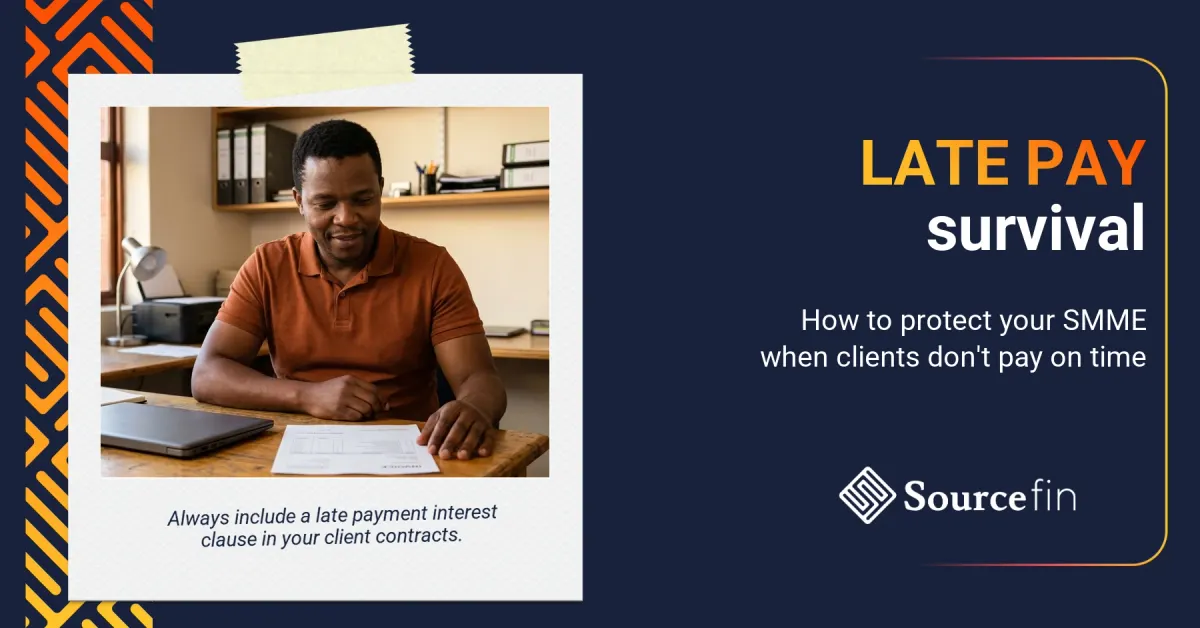
One practical step many business owners overlook: include a late payment interest clause in every client contract and every invoice. State clearly that amounts unpaid after 30 days will attract interest at the prescribed statutory rate. It's not aggressive – it's standard commercial practice, and it sends a clear signal that you take your payment terms seriously.
Practical Steps to Reduce Your Late Payment Risk
Prevention is far less painful than recovery. Most late payment problems can be meaningfully reduced with consistent practices applied from the start of every client relationship.
Set payment terms in writing before you start. Verbal agreements about when you'll be paid are rarely enforced. A written quote, proposal, or service agreement that specifies your payment terms – including a late payment interest clause – gives you a legal foundation to stand on. Get the client to sign it or confirm it in writing before work begins.
Invoice immediately and correctly. The 30-day clock starts when a valid invoice is received. Send your invoice on the day you complete the work or deliver the goods. Double-check every detail: your banking information, the client's purchase order number, your CSD registration status if the client is a government entity, and your VAT number if applicable.
Follow up early, not late. Most business owners chase invoices only once they're already overdue. A better approach: follow up on day 25 with a polite, professional reminder confirming the invoice has been received and is being processed. This gives you time to resolve any administrative issues before the due date passes – and signals that you're paying attention.
Diversify your client base. If one client represents more than 40% of your revenue, their payment behaviour can make or break your month. Spreading your client base reduces your exposure to any single late payer. This is easier said than done for newer businesses, but it's a goal worth working towards.
Know your client before you start. For new clients – especially large ones – it's reasonable to ask about their typical payment timelines or to request a deposit upfront. A client with a good payment track record usually won't object. One who pushes back hard on deposit requests or payment terms is worth paying attention to before you're owed a large sum.
Build a cash buffer where possible. Even a modest reserve – enough to cover one month of fixed costs – reduces the pressure when a payment arrives late. Many SMMEs find this difficult to maintain when margins are tight, which is exactly why having a funding option in place before you need it is worth considering.
Chasing Late Payments: What You Can Do When a Client Won't Pay
When prevention hasn't worked and an invoice is past due, you have more options than most business owners realise.
Start with a formal written demand. A formal demand – sent by email and, ideally, registered post – changes the tone of the conversation. State the invoice number, amount, original due date, the interest you're now entitled to claim, and a short but reasonable payment deadline (typically 7–14 days). Keep your tone professional throughout. The goal is payment, not a dispute.
Claim your interest. Under the Prescribed Rate of Interest Act, you can add statutory interest to the outstanding amount from the day it became overdue. This requires no court order. Include the interest calculation clearly in your demand letter. Some clients will settle promptly once they realise you know your rights.
Escalate within the organisation. If the person you've been dealing with isn't resolving the issue, go higher. A direct, professionally worded email to a financial director or senior manager – with all the facts set out clearly – often moves things faster than repeated follow-ups with a junior contact.
For government clients: escalate to National or Provincial Treasury. If a national or provincial department is in breach of the 30-day PFMA requirement, you can escalate to the relevant Treasury. Document your submission dates, delivery confirmation, and all follow-up correspondence carefully before you do.
Small Claims Court and attorneys. For amounts up to R20,000, Small Claims Court is accessible, relatively fast, and doesn't require legal representation. For larger amounts, a letter from an attorney – or the credible threat of one – is often enough to prompt payment. Actual litigation is slow and costly, so treat it as a last resort rather than a first response.
For a detailed breakdown of how to recover money from clients who have gone silent or are disputing payment, see our article on dealing with unpaid invoices from big clients.

How Invoice Discounting Bridges the Late Payment Gap
Sometimes, even when you've done everything right – clear contracts, correct invoicing, early follow-ups – a client still pays late. You can't always control when money arrives. What you can control is how you respond to the gap it creates in your cash flow.
This is where invoice discounting offers a practical solution. Instead of waiting 30, 60, or 90 days for your client to pay, you use the outstanding invoice itself as the basis for immediate funding. A funder advances up to 75% of the invoice value upfront – typically within 5 to 10 business days on a first deal – and pays you the remainder once your client settles the invoice, less a fee for the service.
You've already done the work and earned the money. Invoice discounting simply moves the payment forward to when your business actually needs it.
This approach is particularly useful for businesses that:
- Have large invoices with government departments or major corporates who pay reliably – but slowly
- Need to fund the next job before the current one's invoice has been settled
- Are growing quickly and can't afford to let cash flow gaps limit that growth
- Have experienced a one-off late payment that has created a short-term pressure in an otherwise healthy business
Unlike a traditional loan, invoice discounting is tied to a specific invoice or set of invoices. It's an advance on money you're already owed. Because the risk assessment focuses on your client's ability to pay – not just your own credit history – it's often accessible to SMMEs that wouldn't qualify for conventional bank finance. For a wider walk-through of the model, see the South African invoice discounting pillar.
Sourcefin issues term sheets in as little as 48 hours of receiving a complete application, and repeat clients can access funding in as little as two days once a facility is in place. The process is designed for business owners who don't have time to wait.
For a broader look at the tools and strategies available to South African SMMEs dealing with cash flow challenges, the Cash Flow Solutions South Africa guide covers the full picture.
If late payments are already affecting your business – or you want to make sure they never do – apply for funding and a Sourcefin team member will walk you through the options that fit your situation.
Sources & References
Business Report. "Urgent action needed: Late payments threaten South African small businesses." March 2026. businessreport.co.za
National Treasury South Africa. Supplier payment data – invoices outstanding beyond 30 days, Q1–Q2 2025. treasury.gov.za
Frequently asked questions
What is the 30-day payment rule in South Africa?
Treasury Regulation 8.2.3 under the Public Finance Management Act requires national and provincial government departments to pay valid invoices within 30 days of receipt. This is a legal obligation, not a guideline. If a department fails to pay within that window, the supplier is entitled to claim interest on the outstanding amount under the Prescribed Rate of Interest Act, at the current repo rate plus 3.5%.
Can I charge interest on a late invoice in South Africa?
Yes. Under the Prescribed Rate of Interest Act, you can claim statutory interest on overdue amounts from the date payment was due. The rate is calculated at the current repo rate plus 3.5%. You don't need a court order to add this interest to your demand. It's best practice to include a late payment interest clause in your contracts and invoices upfront so there's no dispute about the terms.
What should I do if a government department won't pay my invoice?
First, confirm your invoice is correct and that all supporting documents have been submitted. Then send a formal written demand citing the PFMA 30-day requirement and the interest you're entitled to claim. If the department doesn't respond, escalate to the relevant National or Provincial Treasury. Keep records of all submission dates and correspondence throughout the process, as these will be essential if you need to escalate further.
How does invoice discounting help with late payment problems?
Invoice discounting lets you convert an outstanding invoice into immediate cash without waiting for your client to pay. A funder advances up to 75% of the invoice value upfront within 5 to 10 business days on a first deal. You receive the remainder, less a fee, once your client settles the invoice. It's based on your client's ability to pay rather than your own credit history, making it accessible to many SMMEs who may not qualify for traditional bank finance.
Why are late payments getting worse in South Africa?
National Treasury data shows 95,399 government invoices older than 30 days remained unpaid at Q2 2025, representing R12.4 billion owed to suppliers. That figure had worsened by 17% in a single quarter. Government departments are the biggest offenders, routinely paying well beyond the legally required 30 days. Private sector clients also stretch payment terms, often to 60 or 90 days, which creates significant cash flow pressure for small businesses throughout the supply chain.
What are the most common reasons invoices are paid late?
The most common causes are administrative errors on the invoice itself (missing PO numbers, incorrect banking details, wrong contact details), clients using disputed items as a reason to delay the whole invoice, government departments with internal approval bottlenecks, and suppliers not being registered or up to date on the Central Supplier Database. Many delays can be prevented by invoicing correctly and immediately upon completion of work.

Sourcefin is a South African alternative finance provider that offers purchase order funding and invoice discounting to SMMEs, enabling businesses to fulfil confirmed purchase orders or tenders and unlock cash flow without collateral. Unlike traditional lenders or banks, Sourcefin also provides end-to-end support including supplier sourcing, logistics, project management, and risk oversight.