
Government Tender Payment Terms: When You Actually Get Paid
Government tender payment terms require 30-day payment by law, but reality differs. Learn about actual payment timelines and cash flow strategies
On this page
- The Legal Requirement: 30 Days
- The Payment Reality: What Actually Happens
- Impact on Small Business Cash Flow
- When Payment Takes Even Longer
- Planning Cash Flow Around Payment Terms
- Invoice Discounting: Bridging the Payment Gap
- Retention Amounts and Milestone Payments
- Late Payment Interest and Penalties
- Department-Specific Payment Patterns
- What to Do When Payment Doesn't Arrive
- Sources & References
- Frequently asked questions
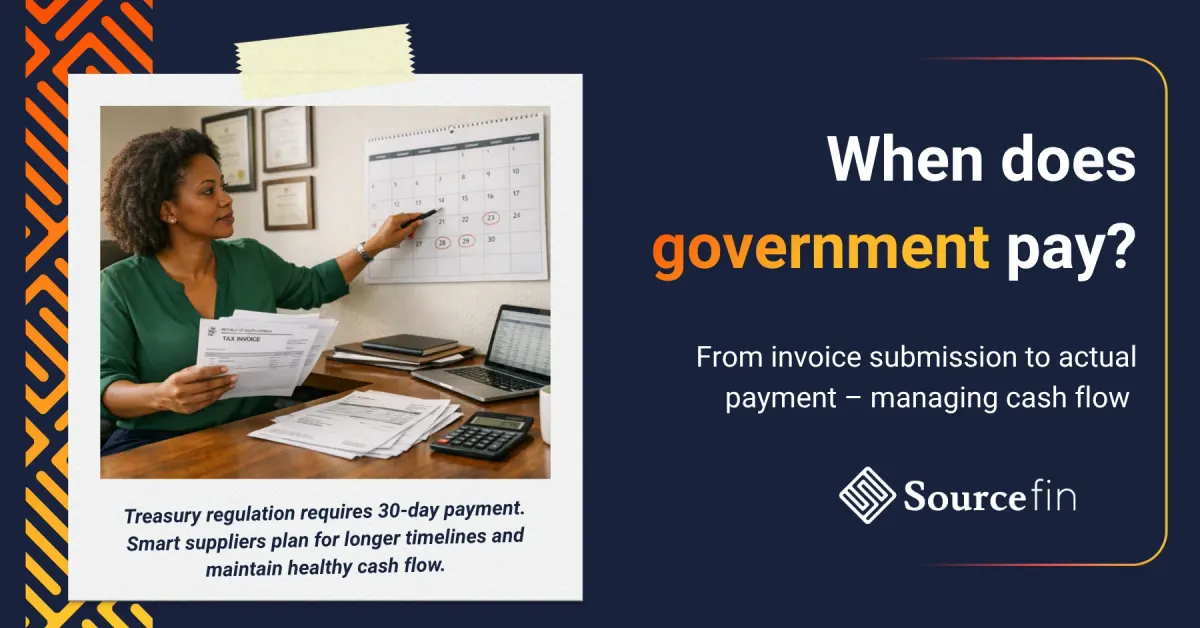
Government tender payment terms South Africa are governed by Treasury Regulation 8.2.3, which requires that payments to suppliers must be settled within 30 days from receipt of an invoice. However, National Treasury's own compliance reports show thousands of invoices paid after this deadline monthly, with factors including departmental approval hierarchies, invoice processing backlogs, and month-end payment cycles contributing to extended timelines that often stretch payment periods to 60-90 days in practice.
You've delivered the tender successfully. Goods arrived on time, quality met specifications, client accepted delivery without issues. Now you wait for payment. The contract states 30 days. Treasury regulations mandate 30 days. Yet your invoice sits unpaid at day 45, then day 60, then longer. Your suppliers need payment. Employees need salaries. Other opportunities require capital you don't have because government hasn't paid yet.
Understanding government payment terms isn't just about knowing the rules – it's about understanding the reality gap between policy and practice, and planning your cash flow accordingly. This guide explains what the law requires, what actually happens, and how successful suppliers manage the waiting period without jeopardising their business operations. For complete context on the tender process, see our guide to tendering in South Africa.
The Legal Requirement: 30 Days
Treasury Regulation 8.2.3 under the Public Finance Management Act is unambiguous: "Unless determined otherwise in a contract or other agreement, all payments due to creditors must be settled within 30 days from receipt of an invoice or, in the case of civil claims, the date of settlement or court judgement."
This isn't a guideline or performance target – it's a legal requirement. Section 38(1)(f) of the PFMA explicitly states that accounting officers must settle all contractual obligations and pay all money owing within the prescribed period. Non-compliance constitutes a breach of financial management legislation, not merely poor service delivery.
The 30-day period starts when the department receives a valid, complete invoice. If your invoice lacks required documentation, has incorrect details, or doesn't match the purchase order exactly, the clock doesn't start until you submit a compliant invoice. This means your actual payment timeline depends partly on invoice quality at submission.
Understanding these regulations helps you know what you're legally entitled to, but legal entitlement and practical reality don't always align. The question isn't what should happen – it's what does happen, and how you plan for that gap.
The Payment Reality: What Actually Happens
National Treasury publishes quarterly compliance reports tracking departmental payment performance against the 30-day requirement. These reports consistently show significant non-compliance across national and provincial departments. The data reveals patterns that tender suppliers need to understand when planning cash flow.
Common payment timeline realities include invoices paid between 30-60 days after receipt, invoices exceeding 60 days before payment, and month-end payment batching where invoices received mid-month wait until the next payment cycle. Some departments perform better than others – national departments generally pay faster than some provincial departments, and certain sectors (particularly health and public works) show higher rates of delayed payments.
Why do delays happen despite clear regulations? Government payment processing involves multiple approval stages. Your invoice moves from the receiving department to finance officials, through authorisation hierarchies, into payment processing queues, and finally to treasury for actual disbursement. Each stage takes time, and bottlenecks at any point extend your waiting period.
Invoice volume also impacts timing. Month-end periods see concentrated payment processing as departments finalise monthly accounts. Submitting invoices early in a month sometimes results in faster payment than submissions approaching month-end, though this varies by department. Budget cycles matter too – departments with budget pressures or year-end constraints may delay non-urgent payments, even when invoices qualify for immediate processing.
Impact on Small Business Cash Flow
The gap between 30-day policy and 60-90 day reality creates severe cash flow pressure for SMMEs. You've spent money executing the contract – paying suppliers, covering transport, managing labour costs. That capital is now tied up in an unpaid invoice while your business still has ongoing operational expenses.
First-time tender winners feel this pressure most acutely. Without established cash reserves or multiple revenue streams, a single delayed government payment can threaten business viability. You can't take new opportunities because your capital is locked. You can't pay suppliers on time, damaging those relationships. You might delay employee salaries, creating internal problems. Some businesses resort to expensive short-term borrowing just to survive the waiting period.
This reality is why understanding tender funding options before you win tenders is critical. Funding shouldn't be an emergency response when payment delays threaten your business. It should be part of your execution plan from the start, built into your pricing and cash flow projections.
The impact extends beyond individual businesses. National Treasury reports acknowledge that delayed payments particularly harm the SMME sector, contributing to business failures, employee retrenchments, and reduced capacity to take on additional work. This creates a cycle where capable suppliers become reluctant to tender because they can't afford the payment risk, reducing competition and limiting government's supplier pool.
When Payment Takes Even Longer
Some circumstances extend payment timelines beyond typical delays. Invoice disputes or queries about delivery quality, quantity discrepancies, or specification compliance require resolution before payment processes. Department budget constraints sometimes delay payments when allocated funds are depleted before year-end. Changes in procurement officials or departmental restructuring can disrupt payment processing as new personnel familiarise themselves with existing contracts.
If your payment significantly exceeds 30 days, you have escalation options. National Treasury established a centralised queries email ([email protected]) where suppliers can log non-payment concerns. Treasury follows up with transgressing departments and reports back on delay reasons and expected payment dates. This escalation mechanism provides recourse beyond simply waiting and hoping.
Document everything related to your invoice submission and delivery. Keep proof of delivery signed by department officials, original invoice submission with date stamps, all correspondence about the contract, and records of any queries or additional documentation requests. This paper trail becomes essential if you need to escalate payment issues or understand why delays occurred.
Planning Cash Flow Around Payment Terms
Successful government suppliers don't hope for 30-day payment – they plan for 60-90 days and treat faster payment as a bonus. This conservative approach prevents cash flow crises when inevitable delays occur. Before bidding on tenders, calculate whether you can afford to operate for 90 days with that capital tied up in unpaid invoices.
Factor funding costs into your tender pricing from the beginning. Whether you use invoice discounting, working capital facilities, or other cash flow solutions, those costs should be built into your pricing schedule as legitimate business expenses. Government isn't subsidising your financing needs, but tender pricing should reflect the full cost of delivering under government payment terms, including the cost of capital during waiting periods.
Diversify your revenue sources if possible. Businesses relying entirely on government contracts face concentrated cash flow risk. Mixing government and private sector work, or maintaining multiple government contracts with staggered payment cycles, helps smooth cash flow volatility. Building cash reserves during profitable periods provides buffer capacity for lean periods when payment delays extend longer than usual.
Understanding how to build your tender track record includes learning to manage payment timing strategically. Your first few tenders teach you how specific departments pay, which submission timing works best, and how to price appropriately for payment delays. Each delivered contract strengthens both your reputation and your understanding of practical cash flow management.
Invoice Discounting: Bridging the Payment Gap
Invoice discounting for SA SMMEs provides immediate cash flow against unpaid government invoices rather than waiting 30-90 days for department payment. After you complete delivery and submit your invoice, invoice discounting advances a substantial portion of the invoice value immediately. When government eventually pays, the advance and fees are recovered, and you receive the remaining balance. Where the pressure falls before delivery rather than after it, tender funding covers the mobilisation cost instead.
This solution specifically addresses government payment delays. You don't need perfect credit or extensive track record – the government department's creditworthiness matters more than yours. The invoice itself becomes the asset securing the advance. For first-time tender winners or businesses without traditional banking relationships, invoice discounting provides access to working capital that conventional lenders won't offer.
The Sourcefin approach to invoice discounting includes verification services confirming invoice legitimacy and delivery completion before advancing funds. This protects both parties and sometimes helps accelerate government payment processing through funder relationships with procurement officials. While government payment timing remains outside your control, managing your cash flow during the waiting period absolutely is within your control.
Invoice discounting costs vary based on several factors including the time period invoices remain outstanding, the advanced amount, client payment history, and complexity of verification. These costs are legitimate business expenses that should be factored into tender pricing, just like transport, insurance, or any other operational cost. Profitability depends on planning for all execution costs upfront, not discovering them after winning.
Retention Amounts and Milestone Payments
Some government contracts include retention clauses where a percentage of contract value (typically 5-10%) is held back until final project completion, defect liability period expiry, or other specified conditions. Retention extends your payment timeline beyond normal invoice periods because that final portion might not be released for months after main delivery.
Construction and infrastructure projects commonly include milestone-based payments rather than single lump sums. You receive payment as you complete defined project stages – initial mobilisation, foundation work, superstructure completion, finishing, handover. Each milestone requires inspection and approval before payment processing begins, meaning your overall contract payment stretches across the entire project timeline.
Understanding these payment structures before bidding helps you plan cash flow more accurately. A R1 million contract sounds substantial until you realise it pays in five R200,000 instalments over six months, with each payment subject to 30-90 day processing delays after milestone completion. Your working capital requirements look very different when structured this way.
Factor retention and milestone structures into your funding plans. Purchase order funding at contract start might cover initial execution costs, while invoice discounting handles milestone payment delays. The combination of funding solutions depends on your specific contract payment structure and working capital position.
Late Payment Interest and Penalties
Suppliers are legally entitled to claim interest on late government payments. After 30 days from invoice receipt, interest begins accumulating on the outstanding amount. The Prescribed Rate of Interest Act sets statutory interest rates (currently the repo rate plus 3.5%), which suppliers can claim for delayed payments.
Practically, claiming interest involves administrative effort and potential relationship strain with the paying department. Some suppliers choose not to pursue interest claims on payments that are merely weeks late, particularly if they maintain ongoing relationships with that department and don't want to create friction. Others include interest calculations in payment reminder correspondence as leverage for faster processing.
The existence of late payment interest provisions reveals government's acknowledgment that 30-day payment often doesn't happen. If compliance were universal, interest provisions would be unnecessary. The mechanism exists because delays are common enough to require legal recourse, even if that recourse is underutilised by suppliers concerned about future contract opportunities.
Department-Specific Payment Patterns
Payment timelines vary significantly between departments and spheres of government. National departments generally show better compliance with 30-day requirements than some provincial departments. Within provinces, performance differs dramatically – some achieve high payment compliance while others consistently show extensive delays.
Building knowledge of specific department payment behaviour helps you make informed bidding decisions. If you've delivered to Department A and experienced 45-day average payment, you know to plan accordingly for future work with them. If Department B consistently pays within 35 days, that predictability allows tighter cash flow planning. This institutional knowledge accumulates as you deliver more contracts.
Consider department payment history when evaluating tender opportunities. A slightly lower-value contract with a fast-paying department might be more valuable to your cash flow than a higher-value contract with a department known for 90-day delays. The total revenue matters less than the working capital implications and your ability to afford the waiting period.
When exploring where to find government tenders, factor payment reliability into opportunity assessment. Not all tenders are created equal from a cash flow perspective, even when contract values appear similar. Smart suppliers balance revenue opportunity against payment timing risk.
What to Do When Payment Doesn't Arrive
If your payment significantly exceeds reasonable timelines, don't just wait passively. Contact the department's accounts payable office for payment status updates. Request specific information about where your invoice sits in the approval process, whether any documentation issues need resolution, and when payment can realistically be expected. Document these interactions and keep records of responses received.
If departmental queries don't resolve delays, escalate to National Treasury's 30-day payment queries email. Treasury actively monitors payment compliance and follows up with departments showing poor performance. Your escalation adds to the compliance pressure departments face and often accelerates payment processing, particularly when delays are due to administrative inefficiency rather than legitimate payment disputes.
Maintain professional relationships even when frustrated by delays. The procurement officials you're dealing with may not control payment timelines but will remember suppliers who communicate professionally versus those who become aggressive or difficult. You want future contract opportunities, and relationship management matters in government procurement environments where repeat business is common.
Prevention works better than resolution. Submit perfect invoices that match purchase orders exactly, with all required supporting documentation attached. Follow up within a week to confirm invoice receipt and ensure it's entered into the payment system. This proactive approach catches issues early when they're easier to resolve rather than discovering problems weeks later when you're already experiencing cash flow pressure.
Sources & References
National Treasury PFMA Circulars: https://www.treasury.gov.za/legislation/pfma/circulars/
Treasury Regulation 8.2.3 – Payment of Suppliers: https://www.treasury.gov.za
National Treasury 30-Day Payment Compliance Reports: https://www.treasury.gov.za
Public Finance Management Act (PFMA): https://www.treasury.gov.za/legislation/pfma/
Prescribed Rate of Interest Act: https://www.gov.za
Treasury Regulation 8.2.3 legally requires payment within 30 days from invoice receipt. However, National Treasury's own compliance reports show thousands of invoices paid after this deadline monthly. In practice, payment timelines often extend to 60-90 days due to departmental approval hierarchies, invoice processing backlogs, budget constraints, and month-end payment cycles. Payment speed varies significantly between departments – national departments generally pay faster than some provincial departments, and sectors like health and public works show higher rates of delays.
Payment delays occur due to multiple approval stages that invoices must pass through from receiving department to finance officials, through authorisation hierarchies, into payment processing queues, and finally to treasury for disbursement. Additional factors include high invoice volumes at month-end creating processing backlogs, budget pressures or year-end constraints delaying non-urgent payments, invoice disputes requiring resolution before processing, departmental restructuring disrupting normal payment flows, and incomplete or incorrect invoices requiring resubmission before the 30-day clock starts.
Yes. After 30 days from invoice receipt, suppliers are legally entitled to claim interest on outstanding amounts. The Prescribed Rate of Interest Act sets statutory interest rates (currently the repo rate plus 3.5%) that suppliers can claim for delayed payments. However, claiming interest involves administrative effort and potential relationship strain with the paying department. Some suppliers choose not to pursue interest claims on payments that are merely weeks late, particularly if they maintain ongoing relationships with that department and want to avoid creating friction.
First, contact the department's accounts payable office for payment status updates and specific information about where your invoice sits in the approval process. Document all interactions. If departmental queries don't resolve delays, escalate to National Treasury's 30-day payment queries email ([email protected]) where Treasury actively monitors compliance and follows up with departments. Maintain professional communication throughout – the officials you're dealing with may not control payment timelines but will remember suppliers who communicate professionally for future contract opportunities.
Successful suppliers plan for 60-90 day payment timelines rather than hoping for 30 days. Strategies include factoring funding costs into tender pricing as legitimate business expenses, using invoice discounting to access immediate cash flow against unpaid government invoices rather than waiting months for payment, diversifying revenue sources to mix government and private sector work with staggered payment cycles, building cash reserves during profitable periods to provide buffer capacity, and calculating whether you can afford 90 days with capital tied up before bidding on tenders.
No, payment timelines vary significantly between departments and spheres of government. National departments generally show better compliance with 30-day requirements than some provincial departments. Within provinces, performance differs dramatically with some achieving high payment compliance while others consistently show extensive delays. Building knowledge of specific department payment behaviour helps make informed bidding decisions – a lower-value contract with a fast-paying department might be more valuable to your cash flow than a higher-value contract with a department known for 90-day delays.
Invoice discounting provides immediate cash flow against unpaid government invoices rather than waiting 30-90 days for department payment. After you complete delivery and submit your invoice, invoice discounting advances a substantial portion of the invoice value immediately. When government eventually pays, the advance and agreed fees are recovered, and you receive the remaining balance. This solution specifically addresses government payment delays and doesn't require perfect credit or extensive track record – the government department's creditworthiness matters more than yours, making it accessible for first-time tender winners.
Frequently asked questions
How long does government actually take to pay tender invoices in South Africa?
Treasury Regulation 8.2.3 legally requires payment within 30 days from invoice receipt. However, National Treasury’s own compliance reports show thousands of invoices paid after this deadline monthly. In practice, payment timelines often extend to 60-90 days due to departmental approval hierarchies, invoice processing backlogs, budget constraints, and month-end payment cycles. Payment speed varies significantly between departments – national departments generally pay faster than some provincial departments, and sectors like health and public works show higher rates of delays.
Why do government payment delays happen despite the 30-day legal requirement?
Payment delays occur due to multiple approval stages that invoices must pass through from receiving department to finance officials, through authorisation hierarchies, into payment processing queues, and finally to treasury for disbursement. Additional factors include high invoice volumes at month-end creating processing backlogs, budget pressures or year-end constraints delaying non-urgent payments, invoice disputes requiring resolution before processing, departmental restructuring disrupting normal payment flows, and incomplete or incorrect invoices requiring resubmission before the 30-day clock starts.
Can I claim interest on late government payments in South Africa?
Yes. After 30 days from invoice receipt, suppliers are legally entitled to claim interest on outstanding amounts. The Prescribed Rate of Interest Act sets statutory interest rates (currently the repo rate plus 3.5%) that suppliers can claim for delayed payments. However, claiming interest involves administrative effort and potential relationship strain with the paying department. Some suppliers choose not to pursue interest claims on payments that are merely weeks late, particularly if they maintain ongoing relationships with that department and want to avoid creating friction.
What should I do if my government tender invoice isn't paid after 30 days?
First, contact the department’s accounts payable office for payment status updates and specific information about where your invoice sits in the approval process. Document all interactions. If departmental queries don’t resolve delays, escalate to National Treasury’s 30-day payment queries email ([email protected]) where Treasury actively monitors compliance and follows up with departments. Maintain professional communication throughout – the officials you’re dealing with may not control payment timelines but will remember suppliers who communicate professionally for future contract opportunities.
How can small businesses survive 60-90 day government payment delays?
Successful suppliers plan for 60-90 day payment timelines rather than hoping for 30 days. Strategies include factoring funding costs into tender pricing as legitimate business expenses, using invoice discounting to access immediate cash flow against unpaid government invoices rather than waiting months for payment, diversifying revenue sources to mix government and private sector work with staggered payment cycles, building cash reserves during profitable periods to provide buffer capacity, and calculating whether you can afford 90 days with capital tied up before bidding on tenders.
Do all government departments pay at the same speed?
No, payment timelines vary significantly between departments and spheres of government. National departments generally show better compliance with 30-day requirements than some provincial departments. Within provinces, performance differs dramatically with some achieving high payment compliance while others consistently show extensive delays. Building knowledge of specific department payment behaviour helps make informed bidding decisions – a lower-value contract with a fast-paying department might be more valuable to your cash flow than a higher-value contract with a department known for 90-day delays.
What is invoice discounting and how does it help with government payment delays?
Invoice discounting provides immediate cash flow against unpaid government invoices rather than waiting 30-90 days for department payment. After you complete delivery and submit your invoice, invoice discounting advances a substantial portion of the invoice value immediately. When government eventually pays, the advance and agreed fees are recovered, and you receive the remaining balance. This solution specifically addresses government payment delays and doesn’t require perfect credit or extensive track record – the government department’s creditworthiness matters more than yours, making it accessible for first-time tender winners.

Sourcefin is a South African alternative finance provider that offers purchase order funding and invoice discounting to SMMEs, enabling businesses to fulfil confirmed purchase orders or tenders and unlock cash flow without collateral. Unlike traditional lenders or banks, Sourcefin also provides end-to-end support including supplier sourcing, logistics, project management, and risk oversight.