
Purchase Order Funding First Time Tender: Smart SA Guide
Purchase order funding first time tender: the first 7 days, supplier path, and how SA SMMEs deliver a maiden tender win without burning working capital.
On this page
- Key Takeaways
- What to do in the first 7 days after a first-time tender win
- How purchase order funding first time tender deals are structured
- Why first-time tender winners often qualify
- Common first-tender funding mistakes to avoid
- How a first-time tender win sets up the next one
- The bottom line on purchase order funding first time tender wins
- Frequently asked questions
Purchase order funding first time tender wins is a common reality check for South African SMMEs who have just opened the award letter and realised they need to pay suppliers long before the customer pays them. The honest answer: a first tender win is fundable, and Sourcefin does not require a prior track record. Sourcefin assesses the deal in front of the SMME – the confirmed PO, the customer's credibility, the supplier path, and the SMME's capacity to deliver – rather than years of historical contract history.
Key Takeaways
- Purchase order funding first time tender wins is one of the most fundable categories at Sourcefin – no prior contract history required.
- The first 7 days after a tender award shape the delivery: read the award conditions, confirm the PO, line up suppliers, and start the funding application.
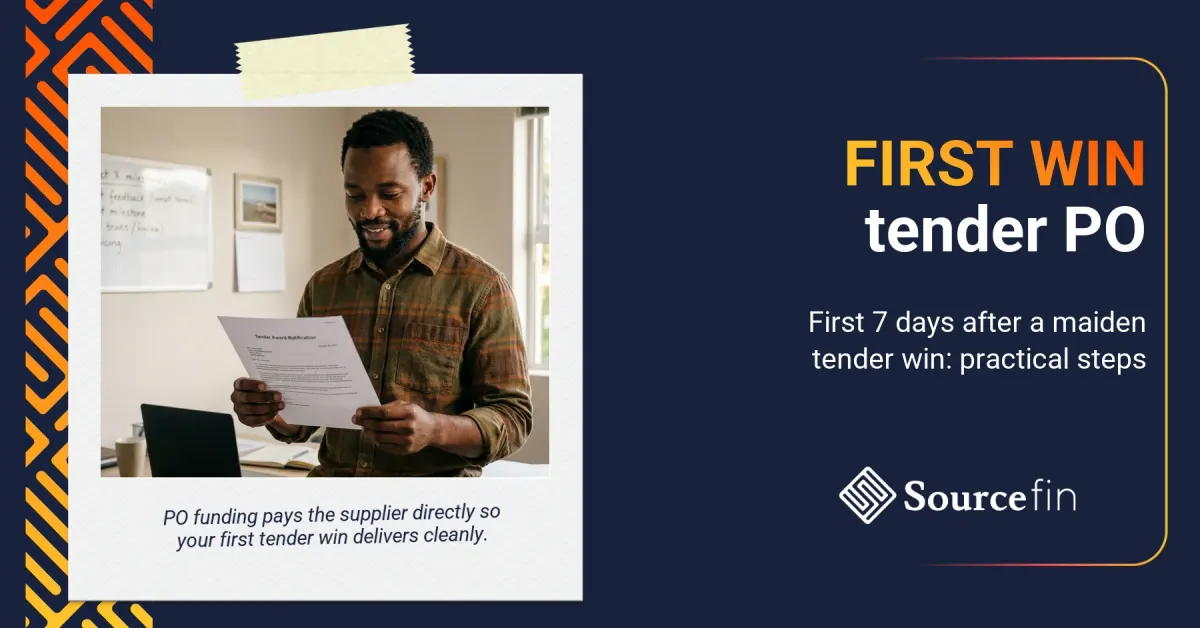
- Sourcefin pays the supplier directly – the SMME does not need to find cash before suppliers will produce or ship.
- Tender payment terms (often 30 days from invoice) match well with the deal-by-deal PO funding model.
- Apply at the funding application page as soon as the award letter is in hand.
What to do in the first 7 days after a first-time tender win
The seven days after a tender award are the most important for any first-time winner. The award letter is a moment of celebration, but the clock has already started. Here is the practical sequence:
- Day 1 – Read the award conditions carefully. Pay attention to delivery timelines, performance security requirements, special conditions, and the contract effective date. Highlight anything that requires action before delivery starts.
- Day 1–2 – Confirm and obtain the official purchase order. The award letter is not always the PO itself. Many organs of state issue a separate PO once contract conditions are accepted. Sourcefin's deal team works from the confirmed PO.
- Day 2–3 – Lock in supplier quotations. Get firm quotations from your chosen suppliers, including price, lead time, and payment terms. Where the SMME does not yet have a supplier relationship, Sourcefin's 2,000+ pre-vetted suppliers worldwide can be drawn on.
- Day 3–5 – Start the funding application. Begin at the funding application page. Upload the award letter, the PO, supplier quotes, CIPC documents, and director ID.
- Day 5–7 – Engage with the deal team. Sourcefin's deal team will verify the order, customer credibility, and supplier path, and walk through what the structured deal looks like.
Acting in this order in the first week protects the delivery window and the SMME's working capital.
How purchase order funding first time tender deals are structured
The structure is straightforward and deal-based:
- The SMME wins the tender and receives an official purchase order from the organ of state or corporate customer.
- Sourcefin verifies the PO with the issuing customer, checks customer credibility, and assesses the supplier path.
- Sourcefin pays the supplier directly for the goods or services needed to fulfil the order.
- The SMME delivers the order to the customer per the tender terms.
- The customer pays the SMME on the agreed payment terms (typically 30 days under PFMA prescripts).
- Sourcefin is repaid from that customer payment.
This is not a loan against the SMME's balance sheet. It is a deal-based transaction repaid from the customer's payment for that specific deal. For SMMEs new to the product, You've received a purchase order – now what? walks through the immediate post-PO actions in more detail.

Why first-time tender winners often qualify
Many SMMEs assume that lack of track record will block their first tender from being funded. That assumption comes from traditional lending logic – the idea that the lender funds the business based on past performance. Sourcefin's deal-based model is different:
- The deal is the assessment. Sourcefin's open-minded funding model assesses four practical questions about the specific deal: is the PO confirmed, is the customer credible, is the supplier path fundable, and does the SMME have capacity to deliver. None of those four questions require prior tender history.
- Tender customers tend to score well on credibility. Organs of state and large corporates issuing tenders typically present a clear, documented credibility picture for the customer-side question.
- Tender payment terms are well-understood. The 30-day PFMA prescript for organs of state gives Sourcefin a clear payment-timing framework.
- Supplier paths can be supported. Where the SMME's chosen supplier needs vetting, Sourcefin's pre-vetted supplier network may provide an alternative path.
The result: first-time tender winners are a category Sourcefin actively funds. A maiden tender is not a disadvantage in the Sourcefin assessment.
Common first-tender funding mistakes to avoid
- Waiting too long to start the funding conversation. Starting the application after suppliers are already pushing for payment is harder than starting in week one.
- Accepting unclear supplier terms. A supplier who will not commit to a fixed lead time or price introduces avoidable risk on the deal.
- Underestimating compliance prep. Some tenders require performance guarantees, B-BBEE certificates, or tax clearance certificates on the customer-side process. These are tender compliance items, not Sourcefin funding requirements, but they need attention separately.
- Trying to fund the deal with personal capital. Burning personal cash to bridge a 60-day customer payment timeline is the fastest way to put a first tender win at risk if anything else in the business needs working capital.
For broader tender-readiness guidance, see Tender Success: A Guide for South African SMMEs.
How a first-time tender win sets up the next one
The first tender is rarely the last. Delivering a first contract on time and to spec builds the practical track record that supports stronger future bids. Sourcefin's 100% delivery rate on funded deals reflects a disciplined assessment process – every deal that is funded is structured to deliver. For SMMEs, that record matters. Once the first tender is delivered cleanly, Sourcefin is well-positioned to support follow-on tenders as the SMME grows.
Many of the SMMEs Sourcefin has supported across more than R3 billion in PO funding since 2020 started with a single first tender. The NSBC named Sourcefin Funder of the Year 2026 in part because of how that journey is structured.
The bottom line on purchase order funding first time tender wins
A first tender win is fundable, and the most efficient way to deliver it is to start the funding application early. Sourcefin's deal-based model handles the supplier-side cash flow so the SMME can focus on delivery. For broader tender funding context, see PO Funding for Government Tenders. For the full product view, see the Purchase Order Funding service page.
For broader context, the National Treasury publishes PFMA prescripts governing organs of state procurement and payment terms, the Department of Small Business Development publishes SA small-business policy, and the Central Supplier Database is the SA government single supplier registration point.
Sources & References
- National Treasury – PFMA prescripts and organs of state procurement.
- Department of Small Business Development – SA small-business policy and reporting.
- Central Supplier Database – SA government single supplier registration point.
Frequently asked questions
Can I get purchase order funding for my first tender win in South Africa?
Yes. Sourcefin's deal-based model assesses the specific deal – the confirmed PO, the customer's credibility, the supplier path, and the SMME's capacity to deliver – rather than requiring prior tender history. First-time tender winners are a category Sourcefin actively funds, and a maiden tender is not a disadvantage in the assessment.
What should I do in the first 7 days after winning a tender?
Read the award conditions carefully, confirm and obtain the official purchase order, lock in supplier quotations with fixed prices and lead times, start the Sourcefin funding application, and engage with the deal team. Acting in this order in week one protects both the delivery window and your working capital before suppliers start asking for payment.
Do I need a track record of past contracts to get PO funding for a first tender?
No. Sourcefin does not require prior contract history. The four-question deal assessment – PO confirmed, customer credible, supplier path fundable, capacity to deliver – is based on the deal in front of the SMME, not the SMME's contract history. This is one of the structural differences between Sourcefin's purchase order funding and traditional business lending.
How does Sourcefin handle the supplier payment for a first-time tender?
Sourcefin pays the supplier directly for the goods or services needed to fulfil the tender. The SMME does not have to find cash to pay the supplier upfront. Where the SMME does not have an established supplier relationship, Sourcefin's 2,000+ pre-vetted suppliers worldwide can support the supply path. The customer pays the SMME on agreed terms after delivery, and Sourcefin is repaid from that payment.
What documents do I need for the first PO funding application?
The core set is the tender award letter, the confirmed purchase order, supplier quotation(s), CIPC business registration documents, proof of business address and bank account, and ID for company directors. Tender-specific items like B-BBEE certificates and tax clearance are typically customer-side procurement requirements rather than Sourcefin funding requirements.
Will winning and delivering a first tender help my next funding application?
Yes. A clean first delivery builds practical track record that supports stronger future bids and follow-on funding conversations. Sourcefin's 100% delivery rate on funded deals reflects a disciplined assessment process, so once an SMME has delivered one tender cleanly with Sourcefin, the next deal conversation typically moves faster.

Sourcefin is a South African alternative finance provider that offers purchase order funding and invoice discounting to SMMEs, enabling businesses to fulfil confirmed purchase orders or tenders and unlock cash flow without collateral. Unlike traditional lenders or banks, Sourcefin also provides end-to-end support including supplier sourcing, logistics, project management, and risk oversight.