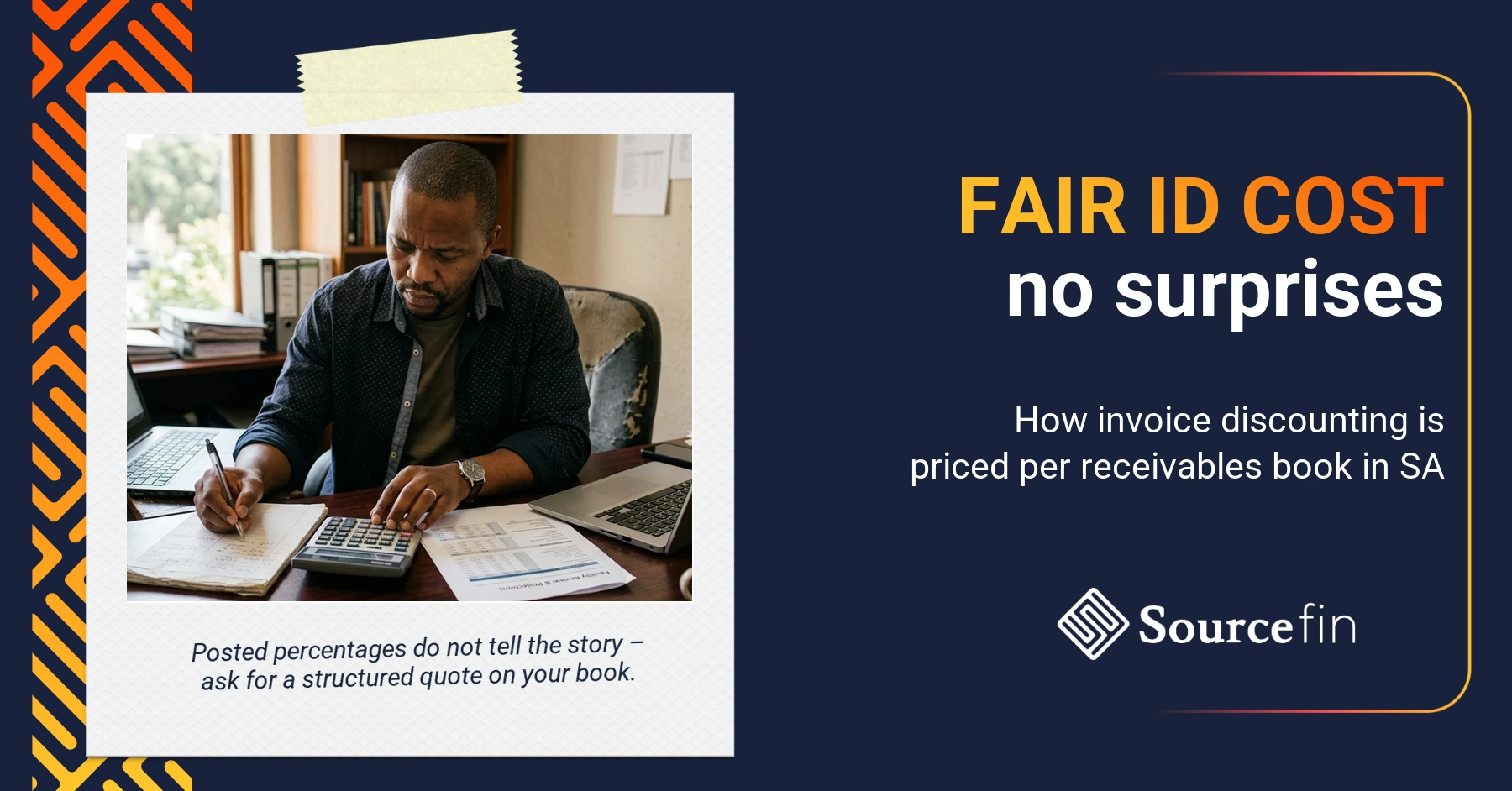

Invoice discounting costs South Africa are priced per facility, not against a single posted rate. The actual cost depends on the receivables book size, customer concentration, payment-cycle length, and operational complexity. There is no fixed percentage that applies across the board. The right way to assess cost is to put your actual receivables book in front of the funder and request a structured quote.
Key Takeaways
- Invoice discounting pricing is per-facility – the same SMME can receive different pricing on two different receivables books.
- Five factors drive cost: book size, customer concentration, payment-cycle length, operational complexity, and customer credit profile.
- Posted rates from any funder are starting points only – the structured quote on your specific book is what matters.
- The cost is built into the deal economics rather than charged as a separate fee schedule.
- Comparing invoice discounting cost to a bank overdraft rate is misleading – the products price differently for different reasons.
- For meaningful comparison, request structured quotes from multiple funders against the same actual receivables book.
Invoice Discounting Costs South Africa: Why There Is No Sticker Price
Most credit products in South Africa post a headline rate. A bank overdraft is “prime plus 3%”. A vehicle loan is “10.5% over 60 months”. The headline simplifies comparison, even if the actual rate you receive depends on your credit profile.
Invoice discounting costs South Africa work differently. There is no posted percentage that applies to every facility. The structure is per-book: the funder reviews the specific receivables, assesses the customer mix and payment patterns, considers the operational complexity, and prices the facility accordingly. The same SMME with the same business profile can receive meaningfully different pricing on two different receivables books in the same month.
This is not opacity for its own sake. It reflects the structural reality that invoice discounting is receivables-specific. Each book carries its own risk profile, and the pricing follows. For broader context on how invoice discounting works, the wider invoice discounting South Africa pillar guide explains the approach end to end.
The Factors That Drive Cost
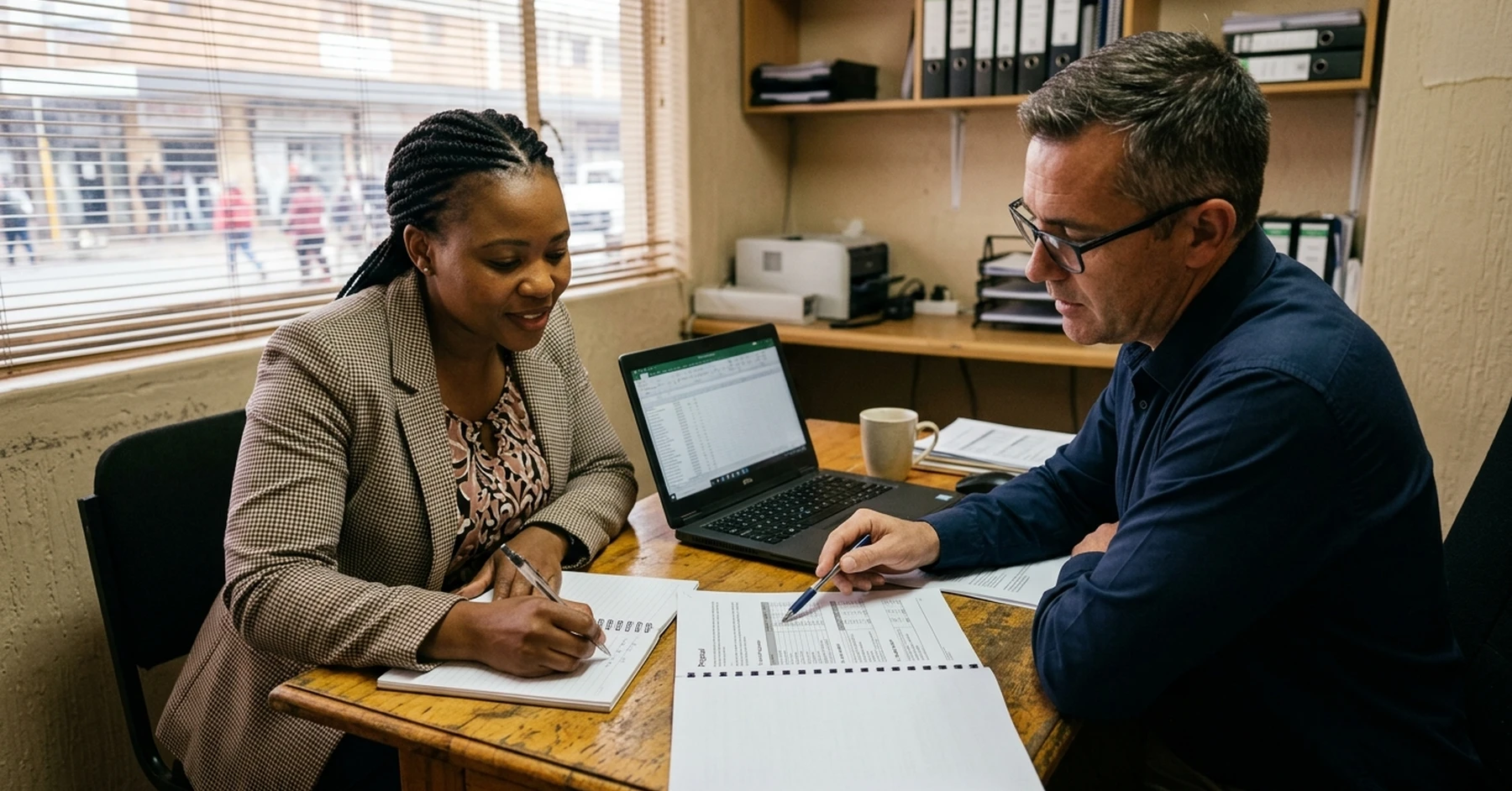
Five factors do most of the work in setting the price on an invoice discounting facility.
Book size. Larger receivables books spread fixed facility costs across a bigger base, which usually translates to relatively lower per-rand pricing. Smaller books carry the same operational overhead (setup, customer verification, reconciliation) over a smaller advance.
Customer concentration. A book diversified across many creditworthy customers prices differently from one with 80% sitting with a single customer. High concentration is funded but typically with more conservative pricing to absorb the concentration risk.
Payment-cycle length. Invoices that pay in 30 days price differently from those that take 90 days or longer. The longer the funder’s capital is out, the more that affects pricing.
Operational complexity. A simple monthly invoicing pattern with consistent customer terms is operationally clean. A complex book with multi-currency invoicing, retention provisions, or unusual payment terms requires more setup and ongoing management, which feeds into pricing.
Customer credit profile. Government, SOE, and major corporate receivables are easier to fund than receivables from small private customers with no payment history. The customer mix shapes both the advance percentage and the pricing.
These five factors are not exhaustive – complex or unusual facilities may have their own additional considerations – but they cover most of the variation between facilities.
How the Cost Is Structured Into the Facility
Invoice discounting cost is typically built into the facility economics rather than charged as a separate fee schedule. Each invoice that flows through the facility carries the funding cost. The cost is paid from the invoice settlement, not from your other cash flow.
That structure matters for SMMEs whose other working capital is already stretched. A traditional loan creates a new monthly obligation independent of the invoices that funded it. Invoice discounting sits inside the receivables economics. As invoices flow and pay, the facility runs on its own cycle without creating a separate monthly debt obligation against the SMME’s broader balance sheet.
Why Comparing Cost to a Bank Overdraft Rate Is Misleading
SMMEs often try to compare invoice discounting cost to a bank overdraft rate. The comparison rarely works cleanly because the products price for different things.
A bank overdraft is general-purpose, sized to your overall financial profile, capped at a fixed limit. The rate compensates the bank for credit risk against the borrower over time. Invoice discounting is receivables-specific, sized to your invoice book, and recovers from customer payment. The pricing compensates the funder for the risk of the specific receivables.
The invoice discounting vs bank overdraft South Africa guide walks through the difference in detail. The short version: a bank overdraft rate and an invoice discounting price are answering different risk questions. Comparing them as headline numbers obscures more than it reveals.
The right comparison is between two invoice discounting funders pricing the same actual book, or between invoice discounting and an alternative funding route applied to the same receivables. The invoice discounting company South Africa guide covers what to look for when comparing funders.
How to Request a Structured Quote
Getting a meaningful cost picture means putting your specific receivables book in front of the funder and asking for a structured quote. The conversation usually goes something like this:
You submit the application form. A Sourcefin representative follows up to walk through your business and customer base. Once your customer list, recent invoices, and CIPC certificate are shared, the facility review begins. Within a few business days for a clean book, a structured proposal is built – setting out the advance percentage on each invoice, the fee structure, the timing, and the operational mechanics, with the cost embedded in that structure.
That proposal is the meaningful number to compare. Posted percentages and rate cards from any provider are starting points, not commitments. The proposal on your specific book is what you can actually evaluate.
The full document picture sits in the invoice discounting requirements South Africa guide. The application walkthrough is in the how to apply for invoice discounting guide.
Common Cost Misconceptions
A few patterns come up regularly in conversations about invoice discounting cost.
“Invoice discounting is more expensive than a bank overdraft.” Sometimes yes, sometimes no, depending on the facility. For an SMME without the security or trading history a bank requires for a meaningful overdraft limit, the comparison is moot – the overdraft is not actually available at the size needed. For an SMME that qualifies for both, the cost picture depends on the specific book.
“There must be a typical percentage.” There is not. The variation between facilities is wide enough that a single average obscures more than it reveals. A clean book of government invoices on 30-day terms prices very differently from a concentrated book of small private customers on 90-day terms.
“I should negotiate the rate down.” Negotiation does happen, but mostly on facility structure rather than on a single percentage. Funders adjust the advance percentage, the customer-payment process, the timing, and the contingencies based on what fits the book. The conversation is richer than a back-and-forth on one number.
The Bigger Picture for SA SMMEs
South Africa’s SMME funding gap is documented widely. The IFC’s recent SA SMME finance partnership work shows that traditional credit access remains constrained for many SMMEs. Alternative funders – including invoice discounting providers – fill the gap by pricing per-book rather than per-borrower-profile, which often makes facilities viable that would not work through traditional credit at any cost.
The practical takeaway: do not pick a funder on a posted rate alone. Get the structured quote on your actual receivables book and evaluate that. To start a quote on a specific facility, the Sourcefin funding application form takes a couple of minutes and a representative will follow up to walk through the deal economics. The Sourcefin invoice discounting service page sets out the full process.
Sources & References
- South African Reserve Bank – Current Market Rates
- SME Finance Forum – IFC Financing to MSME Data
- IFC and FirstRand Bank Partner to Widen Access to Finance for Small Businesses in South Africa
Frequently Asked Questions
How is invoice discounting priced in South Africa?
Invoice discounting is priced per facility, not against a single posted rate. The funder reviews the specific receivables book, assesses the customer mix and payment patterns, and structures the cost into the facility economics. Five factors usually drive the price: book size, customer concentration, payment-cycle length, operational complexity, and customer credit profile.
Why is there no fixed percentage for invoice discounting cost?
Because invoice discounting is receivables-specific rather than borrower-specific. Each book carries its own risk profile, and the pricing follows. A clean book of government invoices on 30-day terms prices very differently from a concentrated book of small private customers on 90-day terms. A single posted rate would either overcharge clean books or undercharge complex ones.
Is invoice discounting more expensive than a bank overdraft in South Africa?
The comparison rarely works cleanly because the products price for different things. A bank overdraft rate compensates for borrower credit risk over a fixed limit. Invoice discounting pricing compensates for receivables-specific risk on a defined book. For SMMEs that qualify for both, the cost picture depends on the book. For those without the security a bank requires, the comparison is moot.
How do I get a meaningful quote on invoice discounting cost?
Submit the application form with your business details and a Sourcefin representative will follow up to walk through your customer base. Once your customer list, recent invoices, and CIPC certificate are shared, the facility review begins. Within a few business days for a clean book, a structured proposal sets out the advance percentage, fee structure, timing, and the cost embedded in that structure.
Can I negotiate the cost of invoice discounting?
Negotiation does happen, but mostly on facility structure rather than a single percentage. Funders adjust the advance percentage, the customer-payment process, the timing, and the contingencies based on what fits the book. Bringing a clean customer list, complete documentation, and a clear understanding of your invoicing patterns strengthens your position in the conversation.
Does invoice discounting charge separate setup or admin fees?
The cost is typically built into the facility economics rather than charged as a separate fee schedule. Each invoice that flows through the facility carries the funding cost, paid from invoice settlement. Some funders charge separate setup or facility management fees – these should be disclosed transparently in the structured proposal upfront. Reluctance to itemise fees is a warning sign.
What happens to the cost if customers pay late?
Invoice discounting cost typically scales with how long the funder’s capital is out. If a customer pays late, the cost of that specific invoice may increase, since the funder is exposed for longer. The structure should be clear in the proposal upfront. The risk of late payment is shared between the funder and the deal economics rather than placed entirely on the SMME.