
Invoice Discounting Limits South Africa: Real Guide
Wondering how much you can actually get from invoice discounting in SA? Here's how facility limits are set, what scales them, and how to grow yours.
On this page
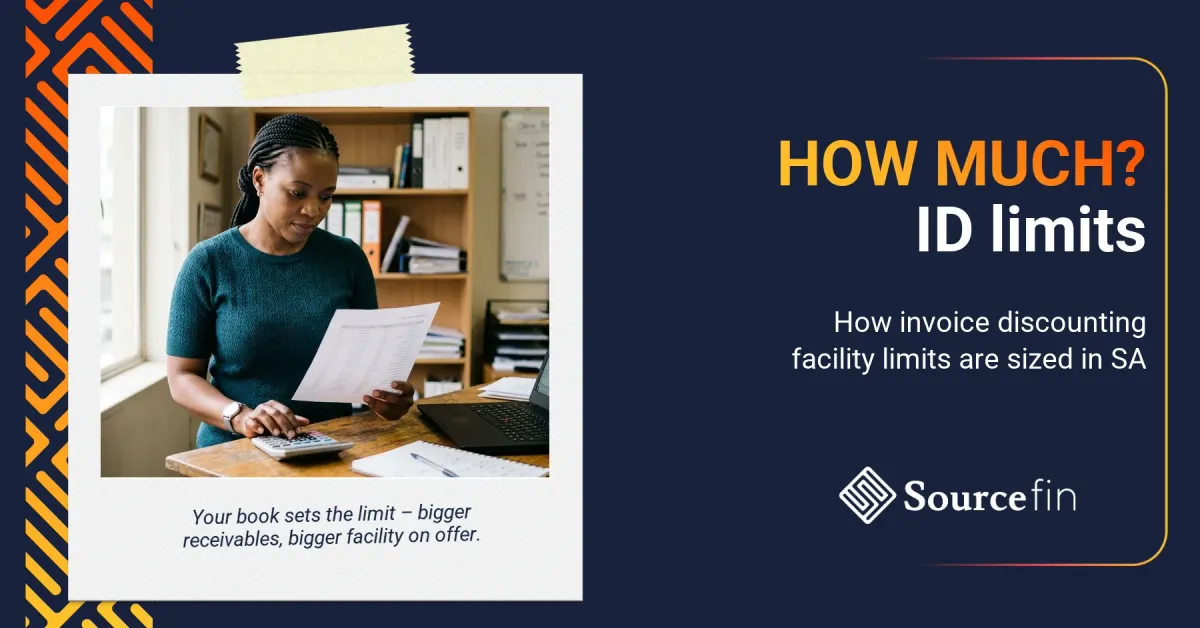
Invoice discounting limits South Africa are sized to your receivables book, not against a posted credit limit. The facility scales with the value of outstanding customer invoices, the customer concentration, and the typical payment cycle. As your invoice book grows, the available limit grows alongside. There is no fixed maximum that applies across the board – the book determines the size.
Key Takeaways
- Invoice discounting limits are receivables-driven, not credit-limit-driven – the book sizes the facility.
- Five factors size the limit: book value, advance percentage, customer concentration, payment cycle, and customer credit profile.
- Sourcefin's typical advance percentage is meaningful but not 100% of invoice value – a percentage is held back until customer payment.
- The limit grows naturally as your invoice book grows – the facility is dynamic, not static.
- For SMMEs whose receivables book is concentrated, limits are sized more conservatively to absorb concentration risk.
- Sourcefin funds invoice discounting facilities from R250,000 upwards through to multi-million-rand books.
Invoice Discounting Limits South Africa: How Sizing Actually Works
SMMEs comparing invoice discounting to a bank overdraft sometimes assume both work the same way: a fixed credit limit, drawable up to that limit. The reality is structurally different. A bank overdraft is sized once, against the borrower's overall financial profile, and stays at that limit until renegotiated. Invoice discounting is sized continuously, against the receivables book at any point in time.
This means invoice discounting limits South Africa are inherently dynamic. As you issue new invoices, the facility's available capacity grows. As customer payments come in and reduce the outstanding receivables, the available capacity adjusts. The funder is always working against the actual book, not a static number.
For broader context on how invoice discounting works, the wider invoice discounting South Africa pillar guide explains the model end to end. The invoice discounting vs bank overdraft guide covers the structural difference in detail.
The Five Sizing Factors

Five factors do most of the work in determining how much you can actually access through an invoice discounting facility.
Book value. The total value of outstanding invoices in scope for the facility. A R10 million book supports a much bigger facility than a R1 million book, all else equal. The book value is the foundation.
Advance percentage. The funder advances a percentage of each invoice's face value, not the full 100%. The remaining portion is held back until the customer pays. The advance percentage varies based on the customer mix, payment cycle, and book quality. For a clean book of strong customers, the percentage is high. For a more complex book, it may be more conservative.
Customer concentration. A book diversified across many customers supports a higher overall facility than a similarly-sized book where 80% sits with one customer. Concentration is funded but typically with more conservative sizing.
Payment cycle. Invoices that pay quickly free up capacity faster than slower-paying invoices. A book with 30-day cycles supports more dynamic limit growth than one with 90-day cycles.
Customer credit profile. Invoices from high-quality customers (government, SOE, listed corporates) support higher advance percentages than invoices from smaller private customers with patchy payment history.
How Limits Grow as Your Business Grows
One of the structural advantages of invoice discounting is the dynamic limit. As your business grows and your invoice book gets bigger, the available facility grows alongside without requiring formal renegotiation. New invoices flow into the facility, lift the available capacity, and fund more of the next month's operating cycle.
This contrasts with a bank overdraft, where growth in the business does not automatically grow the limit. You have to apply for a higher limit, wait for credit committee approval, and renegotiate the facility terms. Invoice discounting scales naturally.
For fast-growing SMMEs, this dynamic-limit feature is one of the main attractions. The funding tracks the business rather than constraining it.
What Limits Actually Look Like in Practice
For a typical SA SMME starting an invoice discounting facility, the initial limit is sized against the current receivables book. As the funder builds confidence in the SMME's invoicing patterns, customer payment behaviour, and operational reliability, the structure can evolve.
Sourcefin funds invoice discounting facilities from R250,000 upwards. Below that threshold, an overdraft facility is usually a better fit. Above that, the facility scales with the book through to multi-million-rand levels for established SMMEs with substantial receivables.
The advance percentage on individual invoices typically sits in a meaningful but not full range – a percentage is always held back until the customer payment lands, both as a fee mechanism and as a buffer against late payment or dispute. The exact percentage depends on the deal-specific factors above. The invoice discounting costs South Africa guide covers how pricing and advance percentages relate.
What Constrains the Limit
Several patterns commonly cap how much an invoice discounting facility can advance.
Customer concentration. If most of your invoice value sits with one or two customers, the funder cannot prudently advance against the full book. The facility is sized to absorb the risk that one of those customers might delay or default. Diversifying the book over time naturally lifts the cap.
Customer credit weakness. Invoices to customers with poor or undocumented payment history are typically excluded from the facility or funded at lower advance percentages. The "fundable book" can be smaller than the total receivables book if some customers do not qualify.
Long payment cycles or retention. Invoices with very long payment terms or significant retention provisions are funded more conservatively. The longer the funder's capital is out, the more the facility structure adjusts.
The what invoices qualify guide covers how individual invoices are assessed. The invoice discounting requirements South Africa guide covers how the broader book is evaluated.
How to Grow Your Limit Over Time
Three things lift facility limits naturally over time.
Book growth. As your business issues more invoices to creditworthy customers, the facility scales with the book. This is the simplest growth path.
Customer mix improvement. Replacing weaker customers with stronger ones (more government, SOE, or major corporate work) lifts the advance percentage on the book and grows the available facility.
Operational track record. As the funder sees the SMME run the facility cleanly over months and years, advance percentages can be reviewed upward, structures can be loosened, and concentrations can be tolerated more.
The Bigger Picture for SA SMMEs
South Africa's SMME funding gap remains documented in multiple reports. The IFC's recent SA SMME finance partnership work highlights that scaling working-capital access is one of the central challenges. Invoice discounting limits South Africa scale with the receivables book in a way that traditional credit limits do not, which is one reason the model fits growing SMMEs particularly well.
The practical takeaway: do not assume your facility limit is fixed. Discuss limit-growth pathways openly with each prospective funder upfront. To explore an invoice discounting facility against your specific book, the Sourcefin funding application form takes a couple of minutes. The Sourcefin invoice discounting service page sets out the full process.
Sources & References
Frequently asked questions
How are invoice discounting limits sized in South Africa?
Invoice discounting limits are sized to your receivables book at any point in time, not against a fixed credit limit. Five factors determine the limit: book value, advance percentage on each invoice, customer concentration, payment-cycle length, and customer credit profile. As the book grows, the available facility grows alongside without formal renegotiation.
Is there a maximum invoice discounting limit in SA?
There is no fixed maximum across the board. Sourcefin funds invoice discounting facilities from R250,000 upwards through to multi-million-rand books. The actual ceiling for any specific SMME is set by the receivables book size, customer mix, and payment patterns. Larger, more diverse, higher-quality books support larger facilities.
What advance percentage will I receive on each invoice?
Sourcefin's typical advance percentage is meaningful but not 100% of invoice value – a portion is always held back until the customer payment lands, both as a fee mechanism and as a buffer against late payment or dispute. The exact percentage depends on customer mix, payment cycle, and book quality. A clean book of strong customers attracts a higher percentage than a more complex book.
How does customer concentration affect my facility limit?
If most of your invoice value sits with one or two customers, the facility is sized more conservatively to absorb the concentration risk. The limit may be lower than the raw book value would suggest. Diversifying the book over time naturally lifts the cap. Concentration does not disqualify – it shapes the structure.
Can my invoice discounting limit grow as my business grows?
Yes, automatically. As you issue more invoices, the available facility grows alongside without requiring formal renegotiation. This contrasts with a bank overdraft, which stays at its limit until you apply for an increase. Invoice discounting scales naturally with the business, which is one of the structural advantages for fast-growing SMMEs.
What constrains how much I can actually access?
Three things commonly cap the facility: customer concentration that requires conservative sizing, customer credit weakness that excludes some invoices from the fundable book, and long payment cycles or heavy retention that reduce advance percentages. Improving the customer mix, shortening payment terms, and building track record all lift the cap over time.
How long does it take to grow a facility limit?
Book growth lifts the limit immediately – new invoices flow in and increase available capacity. Improvements to the customer mix or operational track record are reviewed at facility renewal points, typically annually, with structural adjustments at that stage. Discuss the limit-growth pathway with the funder upfront so you know what milestones unlock larger facilities.

Sourcefin is a South African alternative finance provider that offers purchase order funding and invoice discounting to SMMEs, enabling businesses to fulfil confirmed purchase orders or tenders and unlock cash flow without collateral. Unlike traditional lenders or banks, Sourcefin also provides end-to-end support including supplier sourcing, logistics, project management, and risk oversight.