
Skills Development Levy Reform 2026: Essential Guide
South Africa's 2026 SDL reform doubles the employer grant from 20% to 40% for SETA-compliant businesses. Here's what changed, who is affected, and what to do.
On this page
The skills development levy reform 2026 South Africa confirmed in the February budget delivers the most significant change to employer training obligations in over a decade. The mandatory employer grant doubles from 20% to 40% for employers who submit their Workplace Skills Plans and Annual Training Reports to the relevant SETA – meaning businesses that engage with the system can now recover twice as much of what they pay. The SDL rate itself remains unchanged at 1% of payroll. What changes is how much you can get back, and how the system is expected to operate going forward.
Key Takeaways
- The skills development levy reform 2026 doubles the mandatory employer grant from 20% to 40% of SDL paid – for employers who submit a Workplace Skills Plan and Annual Training Report to their SETA
- The SDL rate stays at 1% of payroll – unchanged since 2001. No new cost, but a significantly higher return for compliant businesses
- The SETA landscape will be consolidated – 21 SETAs are being reviewed and restructured for better governance and industry alignment
- A dual-training model combining classroom learning with practical workplace experience is being introduced, linked to real employment and infrastructure project outcomes
- Employers with an annual payroll below R500,000 do not pay SDL and are not directly affected – but may benefit indirectly from improved training pipelines
- The key action for SDL-liable SMMEs: confirm your SETA registration, submit your WSP by the June deadline, and budget for training investment that earns the 40% return
South Africa's skills development system has been a source of frustration for many SMME employers – paying 1% of payroll into a system that returned minimal value, with complex SETA processes and questionable training outcomes. The skills development levy reform 2026 announced by Finance Minister Godongwana addresses this directly. For the full budget context beyond skills, read our Budget 2026 South Africa SMME guide.
What the Skills Development Levy Reform 2026 Actually Changes
The core change is the mandatory grant percentage. Currently, employers who comply with SETA reporting requirements can claim back 20% of the SDL they pay as a mandatory grant. From the 2026/27 financial year, this rises to 40%. The remaining proportion flows to discretionary grants (awarded for specific training projects) and the National Skills Fund.
To be clear about what doesn't change: the SDL rate of 1% of payroll remains in place. The reform does not add a new cost. It restructures the return you can claim back, making the system more rewarding for employers who actively engage with it and more costly – in opportunity terms – for those who don't.
The SETA landscape is being consolidated. South Africa currently has 21 sector education and training authorities, a number widely criticised as too fragmented for effective governance. The 2026 reform begins a review and restructuring process – though exact consolidation timelines and the final number of SETAs were not specified in the budget announcement.
A dual-training model is also being introduced. This moves away from purely classroom-based qualification programmes toward work-integrated learning that combines formal training with structured workplace experience. The intention is to link training outcomes to actual employment and, specifically, to the infrastructure projects confirmed in the broader 2026 budget.
Who Is Affected by the SDL Reform
SDL liability applies to employers with an annual payroll above R500,000. If your total remuneration bill is below this threshold, you do not pay SDL and the grant changes do not apply to you directly. Employers at or above R500,000 pay 1% of their total payroll monthly – collected by SARS as part of the EMP201 submission.
For SDL-liable SMMEs, the 40% mandatory grant is only accessible if you submit two documents to your relevant SETA: a Workplace Skills Plan (WSP) at the start of the financial year, and an Annual Training Report (ATR) at the end. Employers who do not submit these documents receive no mandatory grant – the SDL payment becomes a pure tax with no return. This has always been the case, but the higher grant value makes non-compliance considerably more costly in opportunity terms.
Different sectors fall under different SETAs – manufacturing businesses register with MERSETA, services businesses with Services SETA, construction with CETA, and so on. Knowing which SETA covers your primary sector, and being registered with them, is a prerequisite for claiming any grant.
The Dual-Training Model – What It Means in Practice
The dual-training model is the structural reform beneath the grant percentage change. The current system has been criticised for funding qualifications that don't match labour market needs – classroom certificates with little connection to the skills employers actually require. The dual-training model responds to this by requiring training programmes to combine formal learning with structured workplace experience.
In practical terms, this looks like apprenticeship-style training in trades and technical disciplines: a learner splits time between a training provider and a workplace, building theoretical knowledge alongside real-world application. The employer hosts the practical component, contributes to the learner's development, and in turn builds capacity within their own business.
For SMME employers in construction, manufacturing, engineering, and technical services, this creates a genuine opportunity. Hosting a learner through a SETA-registered workplace learning programme qualifies as eligible training spend – recoverable through the grant system – while simultaneously building the skills pipeline your business needs. Infrastructure SMMEs, in particular, are well-positioned to benefit given the government's stated intention to link the dual-training model to the R1.07 trillion infrastructure build programme.

What SMME Employers Should Do Now
The practical response to the skills development levy reform 2026 follows a clear sequence. First, confirm whether you are SDL-liable. If your annual payroll exceeds R500,000, you are paying 1% monthly through your PAYE/EMP201 submission. If you are unsure, check your EMP201 returns – SDL appears as a separate line item.
Second, confirm your SETA registration. SDL-liable employers should already be registered with the SETA covering their primary sector. If you are not registered, or if your sector registration is outdated, contact the relevant SETA directly. Registration is a prerequisite for submitting WSP/ATR documents and claiming the mandatory grant.
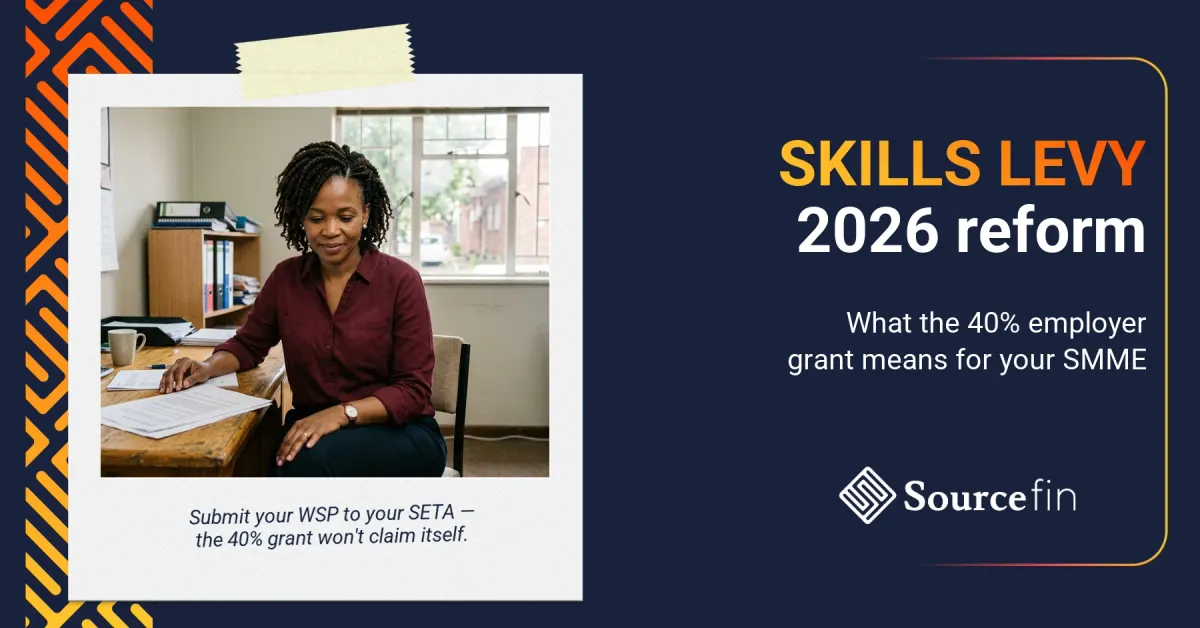
Third, submit your Workplace Skills Plan by the annual deadline – typically 30 June for most SETAs. The WSP outlines your planned training for the year. The ATR, submitted at year-end, reports on what training was actually completed. Both are required to access the 40% grant. Missing either submission means forfeiting the grant for that year.
Fourth, review your actual training budget. At a 40% return on SDL paid, the economics of structured training investment improve materially. A business paying R50,000 in SDL annually can recover R20,000 in mandatory grants if compliant – up from R10,000 under the previous 20% rate. If your training spend has been informal or unstructured, formalising it through SETA-registered programmes converts it into a recoverable cost.
Building a skilled, scalable team is one of the core levers for SMME growth – and that requires capital. Read our guide on scaling your South African SMME for a broader view of how people investment fits into a growth strategy, and our piece on financial confidence for SMMEs for how to structure your finances to support it. If training investment or working capital is the constraint, apply for funding to explore what's available for your business.
Sources & References
Frequently asked questions
What is the skills development levy reform in South Africa's 2026 budget?
The 2026 budget reform doubles the mandatory employer grant from 20% to 40% for employers who submit a Workplace Skills Plan and Annual Training Report to their SETA. The SDL rate itself remains at 1% of payroll – unchanged since 2001. The reform also introduces a dual-training model combining classroom learning with workplace experience, and begins consolidating the 21 SETAs into a more effective structure.
Do I have to pay the skills development levy as an SMME?
SDL applies to employers with an annual payroll (total remuneration bill) above R500,000. If your payroll is below this threshold, you are exempt from SDL and the reform does not directly affect you. If you are above the threshold, you pay 1% of your total payroll monthly through your EMP201 submission to SARS – the same rate as before the reform.
How do I claim the 40% mandatory employer grant from my SETA?
Submit a Workplace Skills Plan (WSP) to your relevant SETA by the annual deadline – typically 30 June – and an Annual Training Report (ATR) at year-end confirming what training was completed. Both submissions are required. If either is missing, you forfeit the mandatory grant for that year. Contact your sector's SETA directly to confirm registration, submission deadlines, and the correct documentation format.
Which SETA covers my business sector?
South Africa currently has 21 SETAs covering different industry sectors. Construction businesses register with CETA, manufacturing with MERSETA, services businesses with Services SETA, transport with TETA, and financial services with FASSET. If your business spans multiple sectors, your primary activity determines which SETA you register with. The DHET website lists all SETAs and their sector coverage.
What is the dual-training model introduced in the 2026 skills reform?
The dual-training model combines formal classroom-based training with structured workplace experience – similar to an apprenticeship structure. Learners split time between a training provider and an employer host, building theoretical knowledge alongside practical application. For employers, hosting a SETA-registered learner qualifies as eligible training spend, recoverable through the grant system, while building internal skills capacity.
How much can an SMME recover from SDL payments under the new 40% grant?
A business paying R50,000 in SDL annually can recover R20,000 in mandatory grants under the 40% rate – up from R10,000 under the previous 20% rate. At R100,000 in SDL paid, the recovery is R40,000. The mandatory grant covers training costs incurred on SETA-approved training programmes. Additional discretionary grants are available separately for specific qualifying projects.

Sourcefin is a South African alternative finance provider that offers purchase order funding and invoice discounting to SMMEs, enabling businesses to fulfil confirmed purchase orders or tenders and unlock cash flow without collateral. Unlike traditional lenders or banks, Sourcefin also provides end-to-end support including supplier sourcing, logistics, project management, and risk oversight.