
Invoice Discounting Government Contracts South Africa: Real
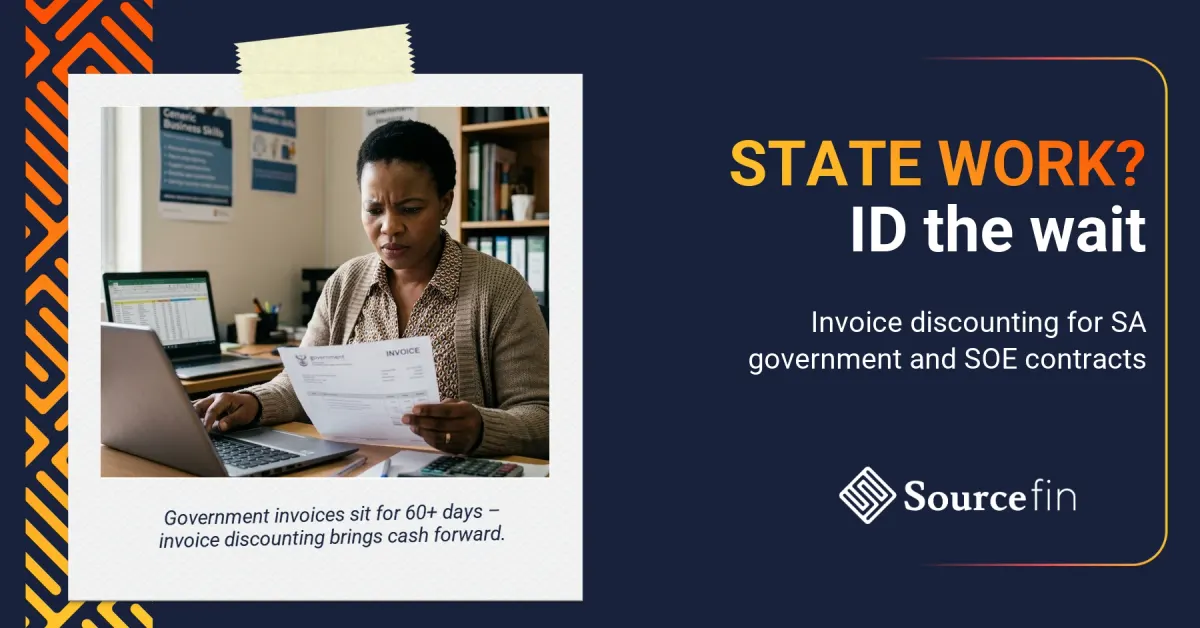
Supplying government and waiting 60+ days for payment? Here's how invoice discounting works for SA state and SOE contracts – cash now, not when they pay.
On this page
- Key Takeaways
- Invoice Discounting Government Contracts South Africa: Why the Model Fits
- The Government Payment Reality
- Common Government and SOE Scenarios
- What the Funder Looks At for Government Receivables
- What to Bring to the Application
- Comparing Invoice Discounting to Other Government-Supplier Funding
- The Bigger Picture for SA Government Suppliers
- Frequently asked questions
Invoice discounting government contracts South Africa is the working capital model that lets SMMEs supplying state and SOE contracts access cash from outstanding invoices without waiting on the slow public-sector payment cycle. The funder advances against invoices already issued for delivered work. The department or SOE pays in due course, the funder is repaid from that payment, and the SMME keeps the contract margin without absorbing the wait.
Key Takeaways
- Government and SOE invoices are typically high-quality receivables – the buyers are creditworthy, even if their payment cycles run long.
- The PFMA standard is 30 days from invoice. Practical reality often runs 60, 90, or longer depending on department and council.
- Invoice discounting compresses the wait, advancing cash within days of invoicing rather than after the eventual payment.
- Sourcefin's portfolio is roughly 80% public sector, with deep familiarity across departments, SOEs, and municipalities.
- Facility setup focuses on the customer profile and payment patterns more than your historical financials.
- Sourcefin funds invoice discounting facilities for government suppliers from R250,000 upwards.
Invoice Discounting Government Contracts South Africa: Why the Model Fits
Government and SOE procurement runs on long payment cycles. Departments, SOEs, and municipalities are typically reliable payers eventually, but eventually can mean 60, 90, or longer. For SMME suppliers who have already delivered the work, the gap between invoice and payment is the cash flow gap that defines the entire business.
Invoice discounting government contracts South Africa exists for this exact gap. The funder advances cash against the outstanding government invoice. The state or SOE pays per its own timeline. The advance is recovered from that payment, and the SMME has been able to operate, pay suppliers, and run the next month's work without absorbing the wait out of cash flow that did not exist.
For broader context on how invoice discounting works, the wider invoice discounting South Africa pillar guide explains the model end to end. The PO funding vs invoice discounting guide covers the choice between funding before or after delivery. For the mobilisation side, before delivery rather than after it, see tender funding.
The Government Payment Reality
South Africa's public-sector payment cycles vary widely. The PFMA-aligned standard is 30 days from invoice. Some departments run efficient procurement and pay close to that benchmark. Others, particularly some smaller municipalities and pressured SOEs, regularly stretch payment to 60, 90 days, or longer.
National Treasury monitors government payment compliance and publishes data, but the lived experience for SMME suppliers is that you cannot plan working capital around the 30-day promise. The reasons are structural – budget cycles, internal verification, supply chain compliance reviews, and political timing all add delay. None of this reflects badly on the contractor or the work delivered. It is simply how public-sector procurement operates.
Invoice discounting is built around this reality, not against it. The facility assumes the wait and structures the advance accordingly.
Common Government and SOE Scenarios

Sourcefin sees recurring patterns in government invoice discounting. Common scenarios include:
- National department supplies. Office equipment, IT, vehicles, consumables, and professional services delivered to departments under standard procurement frameworks. Invoices are typically issued monthly against deliveries.
- SOE contract execution. Suppliers to Eskom, Transnet, Rand Water, and similar entities delivering goods or services on awarded contracts. Payment cycles are usually contractually defined.
- Municipal invoice books. Suppliers to metros, district councils, and local councils across multiple categories – cleaning, security, IT, professional services, building maintenance. The tender funding for municipal contracts guide covers the funding alternatives.
- Public agency contracts. SETAs, regulatory bodies, and other state-aligned institutions awarding service or supply contracts.
- Specialist sub-contracts on government tender work. Where the SMME is a sub-contractor delivering a specialist trade on a larger awarded tender, invoicing the principal contractor whose payments come from the procuring entity.
Each scenario carries its own payment-cycle pattern, and the invoice discounting structure is adjusted to fit.
What the Funder Looks At for Government Receivables
The receivables-book assessment for government contracts focuses on three things.
The procuring entity. Different departments, SOEs, and councils have different reputations for payment performance. National Treasury's monitoring data, plus the funder's own experience across deals, informs how the facility is structured. Stronger payers attract simpler structures. Weaker payers may need more conservative advance percentages or longer recovery assumptions.
The contract and invoice quality. The funder reviews the underlying contract, the invoicing structure, and any contractual provisions that affect payment (retention, performance bonds, dispute clauses). Clean invoicing against clear contracts is fundable. Disputed or partially complete invoicing is harder.
The SMME's operational track record with the buyer. A supplier with a year of delivered invoices and a steady payment record from the same department is a different proposition from a first-time supplier. Both can be funded, but the assessment scales accordingly. The invoice discounting for tender winners guide covers first-time scenarios specifically.
What to Bring to the Application
The standard invoice discounting requirements apply to government receivables. The invoice discounting requirements South Africa guide covers the full document picture. For government contracts specifically, the funder will want to see:
- The signed contract or tender award letter from the procuring entity.
- Sample recent invoices showing the typical structure, value, and payment terms.
- An aged debtors report showing where each invoice sits in its payment cycle.
- Your CIPC company registration certificate and current SARS tax compliance status.
- CSD registration confirmation if you are an active government supplier.
- Recent business bank statements showing the historical payment patterns from this customer.
For a fuller view of the application process, the how to apply for invoice discounting walkthrough explains the steps from form submission through to facility setup.
Comparing Invoice Discounting to Other Government-Supplier Funding
SMMEs supplying government can fund the cash flow gap several ways. Invoice discounting funds against delivered work via outstanding invoices. PO funding (a different model entirely) funds against awarded contracts before delivery. A bank overdraft funds general working capital. Each has its place.
For SMMEs with a steady stream of monthly invoicing to a known government department, invoice discounting is usually the cleanest fit. The facility scales with the receivables book, the structure matches the payment cycle, and the cost is built into the invoice economics. The invoice discounting vs bank overdraft guide walks through the alternative.
For SMMEs at the contract-award stage who need capital before delivery to mobilise, PO funding is the more practical tool. The PO funding for government tenders guide covers that specifically. Many SMMEs use both – PO funding for execution and invoice discounting once invoices are issued.
The Bigger Picture for SA Government Suppliers
South Africa's government procurement system supports a meaningful share of SMME revenue across the country. Operation Vulindlela, ongoing infrastructure programmes, and the broader Treasury push for procurement transformation all point to sustained opportunity for SMMEs supplying state and SOE contracts.
The constraint, for many of these suppliers, is not winning the contract – it is managing cash flow while waiting on the procurement payment cycle. The IFC's recent SA SMME finance partnership work shows that traditional credit access remains constrained even for SMMEs holding strong contracts. Invoice discounting government contracts South Africa is one of the practical routes that lets the procurement opportunity translate to delivered, cash-flow-funded work on the ground.
To structure invoice discounting against a specific government receivables book, the Sourcefin funding application form takes a couple of minutes, and a Sourcefin representative will follow up to walk through the deal. The Sourcefin invoice discounting service page sets out the full process.
Sources & References
Frequently asked questions
Can I get invoice discounting for outstanding government contract invoices?
Yes, this is one of the most common use cases. Whether the invoices are from a national department, an SOE, or a municipality, invoice discounting advances cash against the outstanding receivables. The procuring entity pays per its own timeline, the funder is repaid from that payment, and the SMME has cash flowing without absorbing the wait.
How long do government departments and SOEs typically take to pay invoices?
The PFMA standard is 30 days from invoice. In practice, many SMMEs experience cycles of 60, 90 days, or longer depending on the entity, the budget cycle, and internal verification processes. National Treasury monitors compliance, but variance is wide. Invoice discounting is built around the realistic payment timeline rather than the optimistic 30-day promise.
Does the choice of department or SOE affect the facility setup?
Yes, the procuring entity's payment record is part of the facility assessment. National departments and major SOEs with documented payment patterns are typically funded with simpler structures. Smaller municipalities or pressured entities may need more conservative advance percentages or longer recovery assumptions. The facility is structured around the actual payment behaviour of your specific buyer.
What invoices qualify for discounting against government contracts?
Invoices issued for completed work or delivered goods, with clear payment terms, against a confirmed contract. Disputed invoices, partially complete work, or invoices for which retention applies in full are harder to fund. The cleaner the invoice and the underlying contract, the easier the funding. Sample your invoice book honestly with the funder upfront.
What documents do I need to apply for invoice discounting on government contracts?
The signed contract or tender award letter, sample recent invoices, an aged debtors report, your CIPC and SARS compliance, CSD registration confirmation if applicable, and recent business bank statements showing the payment patterns from this customer. The standard invoice discounting requirements apply – government contracts add no extra layer beyond what the procurement compliance already required.
Can I use invoice discounting alongside PO funding for the same government contract?
Yes, and many SMMEs do. PO funding handles the working capital before delivery (mobilisation, supplier payments, materials). Invoice discounting takes over once invoices are issued, advancing cash on the receivables before the procuring entity actually pays. The two tools cover different parts of the contract cycle and complement each other.
What is the minimum receivables book size to qualify?
Sourcefin funds invoice discounting facilities from R250,000 upwards. Smaller books are usually a poor fit because the operational work involved in setting up and managing the facility makes them unworkable for both sides. For sub-R250,000 government supplier needs, an overdraft facility or short-term working capital from a commercial bank is usually a better tool.

Sourcefin is a South African alternative finance provider that offers purchase order funding and invoice discounting to SMMEs, enabling businesses to fulfil confirmed purchase orders or tenders and unlock cash flow without collateral. Unlike traditional lenders or banks, Sourcefin also provides end-to-end support including supplier sourcing, logistics, project management, and risk oversight.