
Budget Facility for Infrastructure South Africa: Smart Guide
The Budget Facility for Infrastructure funds large public projects. Here's how the 2026/27 call works and how SMMEs access contracts from approved projects.
On this page
- Key Takeaways
- What the Budget Facility for Infrastructure South Africa Does
- How the 2026/27 BFI Call for Infrastructure South Africa Works
- The BFI and Ifisa – How They Work Together
- How SMMEs Access Contracts from Budget Facility for Infrastructure South Africa Projects
- Positioning Your SMME for BFI-Derived Contracts
- Frequently asked questions
The Budget Facility for Infrastructure South Africa is the financing mechanism behind the R1.07 trillion infrastructure pipeline confirmed in the 2026 budget – it funds large public projects that generate the subcontracting, materials, and facilities contracts SMMEs ultimately compete for. Understanding how the BFI works, who submits proposals, and how procurement flows from approved projects is the starting point for any SMME positioning itself in the infrastructure space.
Key Takeaways
- The Budget Facility for Infrastructure South Africa is a National Treasury mechanism that provides fiscal support for large public infrastructure projects requiring R1 billion or more
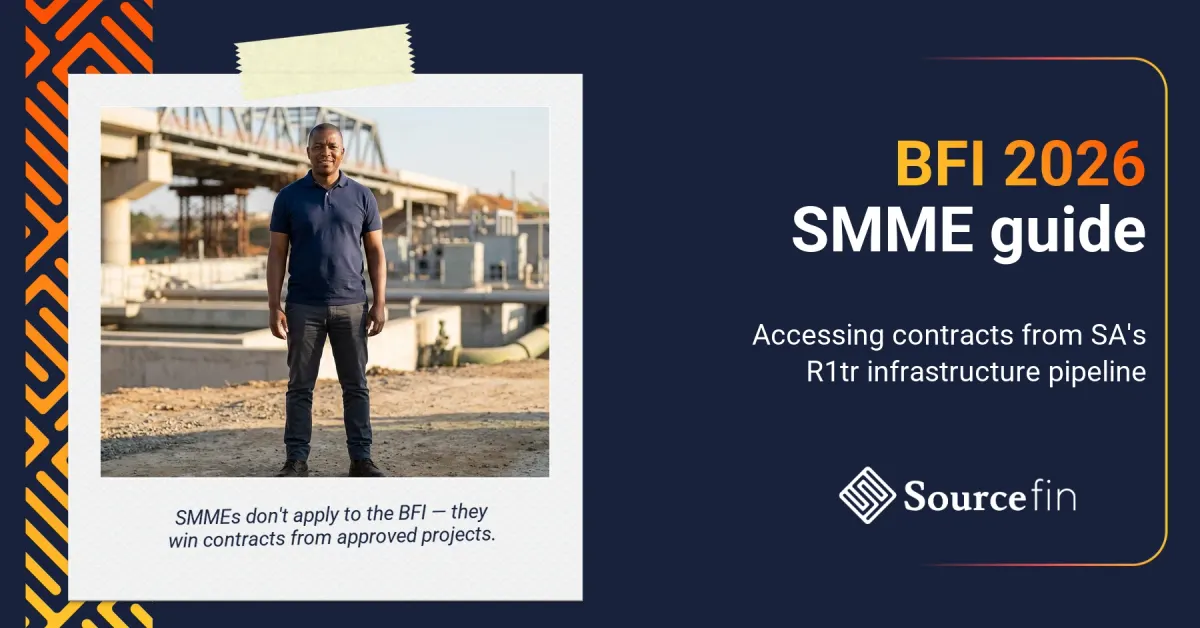
- Only government entities – national departments, provinces, municipalities – and public-private partnerships can submit proposals. SMMEs do not apply to the BFI directly
- Five major projects worth R21.9 billion have been approved through prior BFI cycles, including Transnet freight corridors and the Polokwane wastewater programme
- The 2026/27 call for proposals opened 26 February 2026 – with quarterly submission windows. Projects must qualify in priority sectors: transport, energy, water, health, and digital infrastructure
- The Infrastructure Finance Agency (Ifisa), launched at DBSA on 1 April 2026, now leads project preparation to feed future BFI pipelines
- SMME opportunity sits in the procurement that flows from approved projects – subcontracting, materials supply, and facilities management on funded builds
Most SMMEs tracking South Africa's infrastructure spend focus on tenders – the visible end of the procurement pipeline. The Budget Facility for Infrastructure South Africa operates one level upstream, approving the projects that generate those tenders. Knowing how it works clarifies where the money originates, which projects are likely to proceed, and where procurement opportunities will appear. For the full breakdown of the R1.07 trillion pipeline by sector, read our companion guide on infrastructure tenders South Africa 2026. For broader budget context, see our Budget 2026 South Africa SMME guide.
What the Budget Facility for Infrastructure South Africa Does
Large public infrastructure projects – a new water treatment facility, a freight rail corridor, a hospital campus – require financing that sits outside normal annual departmental budgets. National departments and municipalities often lack the balance sheet or fiscal headroom to absorb billion-rand projects within a single financial year. The BFI was created to solve this: it provides off-budget fiscal support, allowing qualifying projects to proceed through a separate approval and financing structure managed by National Treasury.
Projects approved through the BFI receive fiscal backing that makes them bankable – they can attract co-financing from development finance institutions, private capital through PPP structures, and infrastructure bonds. The R11.8 billion infrastructure bond issued in 2025 was directly linked to BFI-approved projects.
To date, five major projects with a combined value of R21.9 billion have been approved through prior BFI cycles. These include Transnet's coal and iron ore freight corridors and the Polokwane integrated wastewater management programme. Each approved project generates a procurement pipeline – construction contracts, subcontracting packages, equipment supply, and ongoing facilities management – that flows into the government tender system.
How the 2026/27 BFI Call for Infrastructure South Africa Works
The 2026/27 call for proposals opened on 26 February 2026, the day of Finance Minister Godongwana's budget speech. National Treasury operates the BFI through quarterly appraisal windows – proposals received before each quarterly deadline are assessed in that cycle. Projects that miss a window are held for the next quarter.
Qualifying projects must require a minimum of R1 billion in fiscal support, must fall within the priority sectors – transport, energy, water, digital infrastructure, health facilities, justice infrastructure, and tertiary education – and must be submitted by an eligible institution. Only national departments, provincial governments, municipalities, and entities structured as public-private partnerships can submit proposals. Private companies and SMMEs cannot apply to the BFI directly.
The assessment process considers the project's strategic alignment, technical feasibility, financial structuring, and implementation readiness. Projects that pass appraisal receive approval in principle, triggering the procurement preparation phase – which is where the SMME pipeline begins.
The BFI and Ifisa – How They Work Together
Infrastructure South Africa (ISA) has historically been responsible for developing bankable infrastructure projects – the preparation work that makes a project ready for BFI submission. From 1 April 2026, this function moves to the Infrastructure Finance and Implementation Support Agency (Ifisa), launched within the DBSA.
Ifisa consolidates infrastructure finance functions that were previously dispersed across the DBSA, ISA, and other entities. Its mandate is to accelerate project preparation – the technical, financial, and legal work required to move a project from concept to BFI-ready status – and to provide implementation support once projects are approved.
For the budget facility for infrastructure South Africa pipeline, the practical effect is a more integrated flow: Ifisa prepares projects, National Treasury approves fiscal support through the BFI, DBSA provides co-financing or infrastructure bonds, and procurement is issued. The 2026/27 cycle is the first to operate under this new institutional structure.
How SMMEs Access Contracts from Budget Facility for Infrastructure South Africa Projects
SMMEs do not submit to the BFI – but they win work from every project it approves. The path runs through the procurement system that activates once a BFI-approved project moves into implementation.
The main contractor on a large infrastructure project is typically a major civil engineering firm or joint venture. Government procurement policy under the Preferential Procurement framework requires these contractors to subcontract a portion of work to local SMMEs. On a R2 billion project, even a modest subcontracting allocation can mean hundreds of millions flowing to smaller contractors – and the main contractor actively seeks B-BBEE-compliant SMMEs to fill those packages.
Beyond subcontracting, BFI-approved projects generate direct procurement opportunities in facilities management (cleaning, security, catering on active sites), materials supply (aggregates, steel, concrete, PPE), and specialist trades (electrical, plumbing, signage, monitoring). These often appear as separate tenders from the procuring entity – municipality, department, or state entity – and are listed on TenderCentral alongside other government tenders.
Our full guide on tendering in South Africa covers what a winning submission looks like, and our guide on CSD registration covers the compliance baseline you need in place before any bid.

Positioning Your SMME for BFI-Derived Contracts
Winning contracts from budget facility for infrastructure South Africa projects requires the same compliance and capability that all government procurement demands – but with sector-specific preparation that sets you apart from generic bidders.
Sector alignment matters. BFI-approved projects fall in specific sectors – if your business supplies electrical materials, provides specialist civil services, or delivers facilities management, you need to be tracking procurement from entities in those sectors. Understand which municipalities and departments have active BFI-approved projects and follow their tender publications directly.
Compliance must be current before you need it. CSD registration, a valid SARS tax compliance pin, and a current B-BBEE certificate are all checked in real time during bid evaluation. An expired compliance document disqualifies your submission regardless of your pricing or capability. Sort these well before a tender deadline, not the week before.
Execution capital is the final constraint. Winning a subcontract or supply tender from a large BFI-funded project typically means materials to purchase and labour to pay before the first progress payment arrives. Purchase order funding advances working capital against your confirmed purchase order so you can begin delivery without waiting for payment. For SMMEs stepping into larger infrastructure contracts for the first time, this is often what makes the difference between delivery and default. Explore the full range of tender funding options available, or apply for funding before your next award comes through.
Sources & References
- Circular for the Consideration of Proposals by the Budget Facility for Infrastructure | National Treasury
- National Treasury Opens Budget Facility for Infrastructure Applications | Infrastructure South Africa
- Key Infrastructure Takeaways from the 2026 Budget Speech | Infrastructure News
- Budget 2026 South Africa: Practical Guide for SMMEs | Sourcefin
Frequently asked questions
What is the Budget Facility for Infrastructure in South Africa?
The Budget Facility for Infrastructure (BFI) is a National Treasury mechanism that provides off-budget fiscal support for large strategic public infrastructure projects requiring a minimum of R1 billion in fiscal backing. It allows projects that exceed normal departmental budget capacity to proceed through a separate approval and financing structure, making them bankable for co-financing from development finance institutions and private capital.
Can SMMEs apply to the Budget Facility for Infrastructure directly?
No. Only government entities – national departments, provinces, municipalities – and public-private partnerships can submit proposals to the BFI. SMMEs access the opportunity indirectly: once a project is approved and moves into implementation, procurement flows through the government tender system. SMMEs compete for subcontracts, materials supply, and facilities management contracts on BFI-funded projects.
How does the 2026/27 BFI call for proposals work?
The 2026/27 call opened on 26 February 2026. National Treasury operates quarterly appraisal windows – eligible institutions submit proposals before each quarterly deadline for assessment in that cycle. Qualifying projects must require at least R1 billion in fiscal support and must fall within priority sectors: transport, energy, water, digital infrastructure, health, justice, and tertiary education.
What is Ifisa and how does it relate to the BFI?
The Infrastructure Finance and Implementation Support Agency (Ifisa) was launched within the DBSA on 1 April 2026. It assumes the project preparation role previously held by Infrastructure South Africa (ISA) – conducting the technical, financial, and legal preparation work that makes a project ready for BFI submission. Ifisa also provides implementation support after BFI approval. It is designed to accelerate the flow of projects into the BFI pipeline.
How many projects has the BFI approved and what are they?
Five major projects with a combined value of R21.9 billion have been approved through prior BFI cycles. These include Transnet's coal and iron ore freight corridor upgrades and the Polokwane integrated wastewater management programme. An R11.8 billion infrastructure bond was issued in 2025 to co-fund these approved projects alongside fiscal support.
How do I win contracts from BFI-funded infrastructure projects?
Track tender publications from entities with active BFI-approved projects – municipalities, national departments, and state entities publish procurement opportunities on TenderCentral and the eTenders portal. Ensure your CSD registration, SARS tax compliance pin, and B-BBEE certificate are current before any deadline. For large subcontracts requiring upfront materials or labour costs, purchase order funding advances working capital against your confirmed purchase order so you can deliver before payment arrives.

Sourcefin is a South African alternative finance provider that offers purchase order funding and invoice discounting to SMMEs, enabling businesses to fulfil confirmed purchase orders or tenders and unlock cash flow without collateral. Unlike traditional lenders or banks, Sourcefin also provides end-to-end support including supplier sourcing, logistics, project management, and risk oversight.