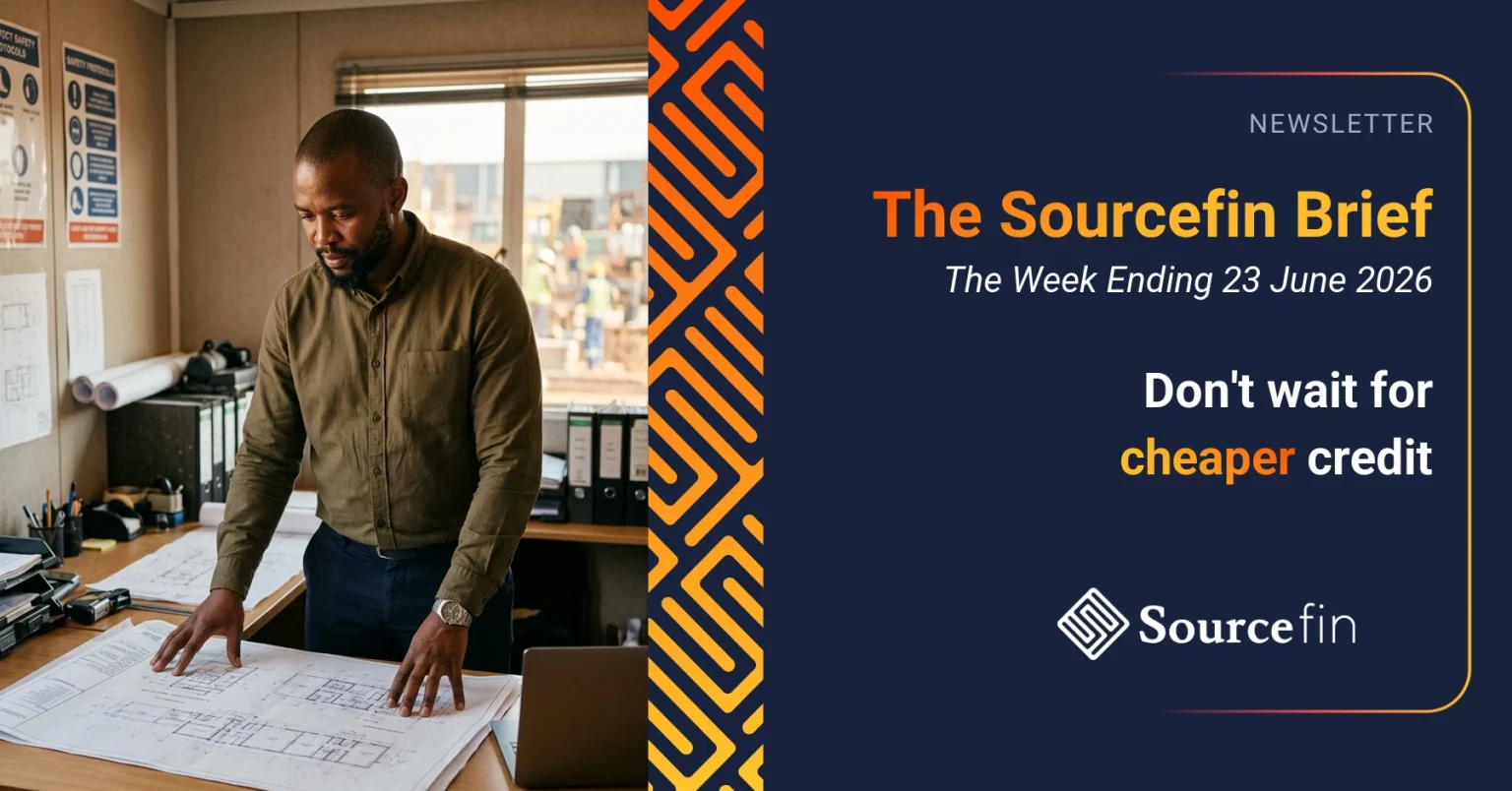

Invoice discounting for construction businesses works by advancing 75–85% of the value of a completed project invoice, putting cash in your account within 48 hours instead of waiting 60 to 90 days for a municipality or government department to pay. For construction SMMEs managing multiple contracts simultaneously, this is the difference between keeping the business moving and watching opportunities disappear while you wait.
Key Takeaways
- Invoice discounting for construction businesses advances 75–85% of invoice value within 24–48 hours of submission.
- Construction SMMEs routinely wait 60–90 days for municipal and government payment – invoice discounting closes this gap immediately.
- Approval is based on the end buyer’s creditworthiness, not your construction company’s balance sheet or credit history.
- SONA 2026 committed R156 billion to water and infrastructure – qualifying SMMEs need working capital to deliver on these contracts.
- Invoice discounting scales with your business – the more you invoice, the more working capital you can access.
Why Construction SMMEs Can’t Wait 90 Days for Payment
Construction is a cash-intensive business. Before you can invoice, you have already paid your subcontractors, bought materials, hired equipment, and kept site operations running for weeks or months. By the time you submit your invoice to a municipality or government department, the money has already left your account – and now you wait.
Treasury Regulation 8.2.3 requires government departments to pay suppliers within 30 days of receiving a valid invoice. In practice, most construction SMMEs report payment cycles of 45 to 90 days on government contracts, with some extending beyond 120 days where administrative delays compound. Each week of delay is a direct cash flow cost.
According to Business Partners Limited, at the end of Q2 2025 there were over 95,000 unpaid invoices older than 30 days across the South African SMME sector, with a combined value of R12.4 billion. Construction accounts for a significant portion of that – not because the work wasn’t done, but because the systems between doing the work and receiving payment create delays that can destabilise otherwise healthy businesses.
Invoice discounting for construction companies is designed specifically to solve this problem. You have done the work. You hold a valid invoice. Invoice discounting turns that invoice into working capital now – not in 90 days.
How Invoice Discounting for Construction Companies Works
The mechanics of invoice discounting for construction businesses are straightforward. Once you have completed a stage of work and issued an invoice – to a municipality, government department, SOE, or large private client – you submit that invoice to a funder.
The funder advances between 75% and 85% of the invoice value, typically within 24 to 48 hours. You receive that cash immediately and can use it to fund the next site operation, pay subcontractors, purchase materials for the next phase, or cover any other business cost.
When your client pays the invoice – on day 60 or day 90 – the funder receives their portion. You receive the remaining balance minus a funding fee. The funding fee varies based on deal size, the end buyer’s payment history, and the overall structure of the deal.
A practical example: a construction subcontractor completes R800,000 worth of concrete work on a municipal housing project. They invoice the municipality. Instead of waiting 60 days for payment, they submit the invoice for discounting and receive R640,000 within 48 hours. The municipality pays the full R800,000 sixty days later, and the subcontractor receives the remaining R160,000 minus the funding fee. The net result: continuous cash flow to fund operations, with no waiting.
The key approval driver is not your construction company’s age or credit history – it is the credibility of the end buyer. A South African municipality or government department is considered a strong debtor, which makes invoices issued against those buyers highly eligible for discounting. This makes invoice discounting particularly accessible for construction SMMEs doing government work, even if the business is relatively young.
Which Construction Projects Qualify?
Invoice discounting for construction businesses works across a broad range of project types, provided a valid invoice exists against a credible buyer. The most common qualifying scenarios include:
- Municipal and government housing projects – NHBRC-registered construction SMMEs building units under government housing programmes.
- Infrastructure contracts – Roads, water reticulation, stormwater drainage, electrical reticulation, and civil works for municipalities or state-owned entities.
- SOE contracts – Maintenance and construction work for Rand Water, Eskom, Transnet, and similar entities with predictable payment cycles.
- Large private-sector projects – Commercial property developers with established payment track records and clear contract documentation.
- Subcontractor invoices – If you are a subcontractor invoicing the main contractor directly, and the main contractor is a credible buyer, your invoices can qualify.
The minimum deal size for most invoice discounting facilities in South Africa starts at R250,000 per invoice or per facility. For smaller amounts, some funders offer selective invoice discounting – where individual invoices can be submitted as needed, without committing to a full facility.
The SONA 2026 Water Infrastructure Opportunity
SONA 2026 committed R156 billion to South Africa’s water and sanitation infrastructure – one of the single largest allocations to a sector that relies heavily on SMME construction contractors for delivery. This is not a theoretical opportunity. Municipalities and water boards are actively awarding contracts to qualifying SMMEs, many of them first-time winners who have never managed a project of this scale before.
The cash flow challenge is acute. Contracts worth R50 million require R15 to R30 million in working capital before a single invoice can be submitted. For SMMEs without established reserves, that gap is unbridgeable through conventional bank finance – but manageable through a combination of purchase order funding to start delivery and invoice discounting to sustain cash flow as stages are completed.
Construction SMMEs positioned to take on SONA 2026 infrastructure work need funding infrastructure to match. Invoice discounting is a key component of that infrastructure – particularly for contractors billing municipalities on 45-day cycles across multi-phase projects.
Invoice Discounting vs Bank Finance for Construction Businesses
Many construction SMMEs have experienced the friction of applying for a bank overdraft or business loan. Banks assess construction businesses against criteria that often work against them: limited operating history, irregular revenue patterns, project-based income, and balance sheets dominated by equipment and receivables rather than liquid assets.
Invoice discounting operates on a completely different logic. The funder is not lending against your balance sheet – they are advancing against a specific invoice, and their primary risk is whether the buyer will pay. If your end buyer is a government department or a credible private client, the risk profile is strong regardless of how long your business has been operating.
This is why invoice discounting for construction companies is often the most accessible working capital tool for SMMEs that banks have turned down. The construction business that cannot get a bank overdraft can still qualify for invoice discounting against a R2 million municipal housing invoice – because the municipality’s creditworthiness matters more than the SMME’s credit score.
The broader picture of cash flow solutions for South African SMMEs includes purchase order funding, working capital facilities, and invoice discounting – each serving a different stage of the project lifecycle.
How to Get Started with Invoice Discounting for Your Construction Business
The application process for invoice discounting is more direct than most construction SMMEs expect. You will typically need to provide:
- A copy of the invoice you want to discount
- The underlying contract or purchase order confirming the work was commissioned
- Proof of delivery or project completion documentation (site minutes, practical completion certificates, or equivalent)
- Basic company registration documents
Funders that specialise in SMME invoice discounting – including those working in the construction sector – review applications quickly. Term sheets for qualified invoices are often issued within 24 hours, with funding within two to five working days for a first transaction.
For repeat clients with an established facility, drawdowns happen faster – sometimes the same day the invoice is issued, with no new approval needed.
To explore invoice discounting for your construction business, apply directly with your next qualifying invoice. The conversation starts with your deal, not your credit score.
Sources & References
Business Partners Limited. Unpaid Invoice Data: Q2 2025 Report. 2025. businessreport.co.za
State of the Nation Address 2026. Water and Infrastructure Commitment: R156 Billion. February 2026. stateofthenation.gov.za
National Treasury. Treasury Regulation 8.2.3 – Payment of Suppliers within 30 Days. treasury.gov.za
Frequently Asked Questions
Can a construction company use invoice discounting on government contracts?
Yes. Government contracts are among the most eligible for invoice discounting in South Africa because municipalities and departments are considered strong, credible debtors. Funders assess the buyer’s ability to pay, so a valid invoice against a government department or SOE often qualifies even if the construction business is relatively new or has a limited credit history.
How much can a construction SMME borrow through invoice discounting?
Most invoice discounting facilities advance 75–85% of the invoice value. Minimum deal sizes typically start at R250,000 per invoice. There is no fixed maximum — the facility grows with your invoicing volume. A construction company invoicing R2 million per month could access R1.5 to R1.7 million in working capital through an invoice discounting facility.
How long does it take to get invoice discounting approved for a construction business?
For a first application, approval and initial funding typically takes two to five working days. Funders usually issue a term sheet within 24 hours of receiving a complete application with the invoice, contract documentation, and proof of delivery. For businesses with an existing facility, subsequent drawdowns can happen within 24 to 48 hours.
Does my construction company need a long trading history to qualify?
Not necessarily. Invoice discounting approval focuses primarily on the creditworthiness of the end buyer rather than the construction company’s own history. A business that has won its first government housing or infrastructure contract can qualify if the invoice is valid, the buyer is credible, and the work has been completed or is at a qualifying stage of completion.
What is the difference between invoice discounting and purchase order funding for construction businesses?
Invoice discounting is used after work has been completed and an invoice has been issued. Purchase order funding is used before delivery — when you have won a contract but need capital to buy materials and start work. Many construction SMMEs use both: purchase order funding to start and deliver the project, and invoice discounting to manage cash flow between billing milestones.
Can subcontractors use invoice discounting?
Yes. Subcontractors can use invoice discounting when they invoice the main contractor directly, provided the main contractor is a credible buyer with a clear payment obligation. The key requirement is a valid invoice against a buyer who is likely to pay. Subcontractors working under established main contractors on government projects are generally eligible.