
CSD Registration South Africa: Complete Supplier Guide
Without an active CSD registration, South African businesses cannot bid on government tenders or access public sector funding. Here's what to do.
On this page
- Key Takeaways
- What the Central Supplier Database Is and Who Manages It
- Why CSD Registration Became Mandatory in April 2016
- What You Need Before You Can Register
- How to Register on the CSD
- Keeping Your CSD Profile Current – Where Most Suppliers Fall Short
- CSD Registration South Africa and Your Access to Government Funding
- Frequently asked questions
CSD registration South Africa has been mandatory for all suppliers to government entities since April 2016. Without an active, verified profile on the Central Supplier Database, procurement officers cannot legally open your bid – not won't, but cannot. Your CSD profile is cross-checked against your CIPC registration and SARS tax compliance status in real time, which means all three must be current before any government opportunity can proceed.
Key Takeaways
- CSD registration South Africa has been mandatory since April 2016 – it is a legal prerequisite for all suppliers to government departments, municipalities, and state-owned entities.
- Procurement officers cannot legally process a bid from a supplier without an active, verified CSD profile – there is no workaround.
- Your CSD profile cross-checks your CIPC registration and SARS tax compliance in real time – all three must be current for the verification to pass.
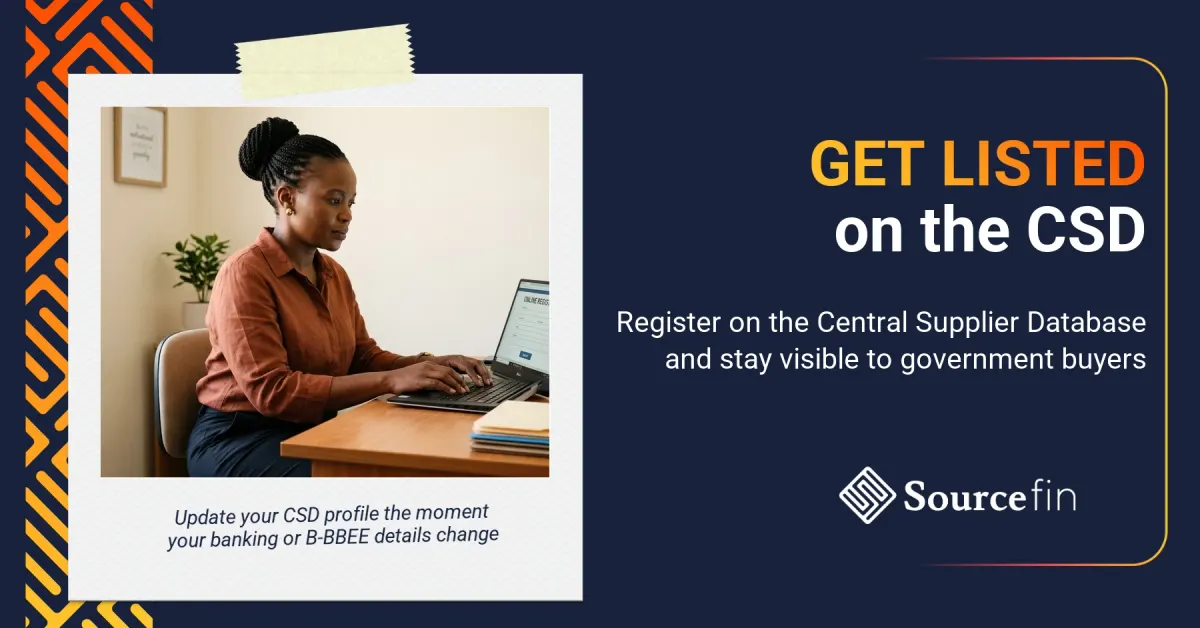
- Banking details, B-BBEE certificates, and director information must be updated on your CSD profile whenever they change, not only at annual review.
- Some alternative funders also verify CSD registration as part of their deal assessment for government-linked transactions.
What the Central Supplier Database Is and Who Manages It
CSD registration South Africa is administered by the Office of the Chief Procurement Officer (OCPO) at National Treasury. The Central Supplier Database was introduced to create a single, verified register of all suppliers doing business with the South African government – replacing a fragmented system where every department, municipality, and SOE maintained its own supplier lists.
When you register on the CSD, you receive a unique supplier number that is used across all government procurement transactions. Every procurement officer at every organ of state in South Africa uses the same database when verifying supplier compliance. That means one registration covers you for tenders with national departments, provincial government, municipalities, and state-owned entities – provided your profile is active and current.
The CSD sits at the heart of the compliance framework described in our pillar guide to SMME compliance and funding access. It is the verification layer that connects your CIPC registration and your SARS tax compliance into a single, real-time check that procurement officers run before opening any bid.
Why CSD Registration Became Mandatory in April 2016
Before the CSD existed, government procurement was vulnerable to fraud, duplicate payments, and irregular expenditure – in part because no single authority could verify supplier information across all state institutions simultaneously. Suppliers could appear compliant with one department while owing tax to SARS, being deregistered at CIPC, or holding fraudulent banking details in another department's records.
The CSD resolved this by centralising supplier verification. When a procurement officer runs a compliance check on your CSD profile today, the system pulls live data from CIPC and SARS in that moment. If either of those registrations has lapsed or become non-compliant, the CSD flags your profile immediately – regardless of what your profile showed the last time someone checked it.
This real-time verification is both the strength and the challenge of the CSD system. It creates accountability across the system, but it also means that a compliance failure that happens on a Wednesday afternoon can disqualify you from a tender bid submitted on Thursday morning.
What You Need Before You Can Register
CSD registration requires that you have several pieces of information and documentation ready before you start. The core requirements for a company registration are:
- Your company registration number from CIPC – your company must have Active status
- Your SARS income tax reference number and a valid TCS Pin showing Compliant status
- Your business bank account details – the bank account must be in the name of the registered company
- A valid B-BBEE certificate or sworn affidavit (for companies with annual turnover below the relevant threshold)
- Identification documents for all directors
- Proof of business address
All of this information is cross-checked against the CIPC and SARS systems during registration. If your CIPC status is not Active, or your SARS TCS shows Non-Compliant, your CSD registration will not be completed. Sort your CIPC registration and SARS tax compliance first.

How to Register on the CSD
CSD registration is done online at csd.gov.za, managed by National Treasury's OCPO. The process involves creating a user account, selecting your supplier type (company, individual, foreign supplier, or non-profit), and completing the supplier profile with your company information, banking details, and compliance documents.
Once your profile is submitted, the CSD system verifies your information against CIPC and SARS. If all verifications pass, you receive a CSD supplier number. This number is what you provide on tender documentation and what procurement officers use to verify your status at bid evaluation.
The registration process itself is straightforward when your underlying compliance is in order. Most delays happen because CIPC information does not match what is on the CSD form, or because the SARS TCS verification fails. Prepare your documents, confirm your CIPC and SARS status are both current, and the CSD registration typically completes without complication.
Keeping Your CSD Profile Current – Where Most Suppliers Fall Short
CSD registration is not a once-off exercise. Your profile must reflect your current company information at all times. The most common reasons a previously compliant CSD profile fails a verification are: an expired B-BBEE certificate, a change in banking details that hasn't been updated on the CSD, a director who has left the company but remains on the CSD record, and an underlying CIPC or SARS compliance failure that propagates automatically.
B-BBEE certificates have expiry dates. When yours expires, your CSD profile moves to a status that procurement officers will flag as incomplete – even if everything else is in order. Renew your certificate before it lapses and update your CSD profile on the same day the new certificate arrives.
Banking detail changes are particularly important. If your business changes banks or opens a new account, update the CSD immediately. A mismatch between your CSD banking details and the account you use for government payments is flagged as a fraud risk and triggers a manual verification process that can delay payment significantly.
At minimum, review your CSD profile annually. In practice, review it any time your CIPC record, SARS status, banking details, B-BBEE certificate, or director information changes – which in a growing SMME may be several times a year.
CSD Registration South Africa and Your Access to Government Funding
For SMMEs pursuing government tender and procurement opportunities, CSD registration South Africa is the gateway that determines whether you can participate at all. Without an active CSD profile, the process ends before it begins – not at evaluation, not at pricing, but at the first compliance check.
The connection to funding is equally direct. Purchase order funding and invoice discounting used to fund government contracts both require that the underlying contract is legitimate and that the supplier is recognised by the relevant government entity. For Sourcefin, CSD registration confirms that the supplier exists in the government system and that the procurement process followed the correct channels. For a wider walk-through of how the model works, see the SA invoice discounting pillar.
Some funders also verify CSD status independently as part of deal risk assessment for government-linked transactions. A missing or inactive CSD profile raises questions about the legitimacy of the contract that take time and effort to resolve.
If you are preparing to bid on your first government tender, or if you've had compliance issues that have kept you out of the market, the right sequence is: fix CIPC first, then SARS, then register on or update the CSD. By the time you're on the CSD with a clean profile, you're in a position to compete – and to access the funding that makes large contracts executable. Start your Sourcefin application when you're ready to take the next step.
Sources & References
National Treasury – Office of the Chief Procurement Officer (OCPO). Central Supplier Database: Supplier Registration and Compliance Guide. 2026. Retrieved from treasury.gov.za
South African Government. Central Supplier Database Registration Portal. 2026. Retrieved from csd.gov.za
Frequently asked questions
What is the Central Supplier Database (CSD) in South Africa?
The Central Supplier Database is a national register of all approved suppliers to South African government entities, managed by National Treasury's Office of the Chief Procurement Officer. It was introduced to centralise supplier verification across all organs of state – government departments, municipalities, and SOEs – replacing fragmented departmental supplier lists. Registration has been mandatory since April 2016.
How do I register on the CSD in South Africa?
Register at csd.gov.za. Create a user account, select your supplier type (company, individual, or non-profit), and complete your supplier profile with your company registration number, SARS tax reference number and TCS Pin, business banking details, B-BBEE certificate, director IDs, and proof of address. The system verifies your CIPC and SARS status in real time during registration – both must be current and compliant before your registration completes.
What documents do I need for CSD registration?
You need your CIPC company registration number (Active status), your SARS income tax reference number and a valid TCS Pin showing Compliant, a business bank account in your company's name with banking confirmation, a valid B-BBEE certificate or sworn affidavit, identification documents for all directors, and proof of business address. All information is verified against CIPC and SARS in real time, so both registrations must be in order before you start.
How often must I update my CSD profile?
Review your CSD profile at minimum once a year. Update it immediately whenever your banking details change, a director joins or leaves, your B-BBEE certificate is renewed, your company address changes, or your CIPC or SARS information is updated. The CSD cross-checks CIPC and SARS in real time, so any underlying compliance change – a lapsed CIPC annual return or non-compliant SARS status – flows through to your CSD profile automatically.
What happens if my CSD profile is not active when I bid for a tender?
Procurement officers cannot legally open or evaluate your bid if your CSD profile is inactive, incomplete, or flagged as non-compliant. There is no manual override. Your bid is disqualified at the compliance check stage – before pricing, experience, or any other criteria are considered. This is why maintaining an active, current CSD profile is a prerequisite, not an afterthought.
Does my B-BBEE certificate affect my CSD registration?
Yes. Your B-BBEE certificate or sworn affidavit is a required document on your CSD profile. When your certificate expires, your profile shows an incomplete or outdated status that procurement officers will flag. Renew your B-BBEE certificate before its expiry date and update your CSD profile on the day the new certificate is issued. For companies with qualifying small enterprise or exempted micro-enterprise status, a sworn affidavit may substitute for a formal certificate.
Do alternative funders check my CSD registration?
For government-linked transactions – contracts funded against a purchase order or invoice from a government department, municipality, or SOE – some alternative funders including Sourcefin verify CSD registration as part of deal due diligence. An active CSD profile confirms the supplier is recognised in the government procurement system and that the contract followed the correct channels, which reduces deal risk and speeds up the funding assessment.

Sourcefin is a South African alternative finance provider that offers purchase order funding and invoice discounting to SMMEs, enabling businesses to fulfil confirmed purchase orders or tenders and unlock cash flow without collateral. Unlike traditional lenders or banks, Sourcefin also provides end-to-end support including supplier sourcing, logistics, project management, and risk oversight.