
Invoice Discounting Staffing South Africa: Practical Guide
South African staffing agencies placing workers with government clients face 60–90 day payment delays. Invoice discounting converts those invoices within days.
On this page
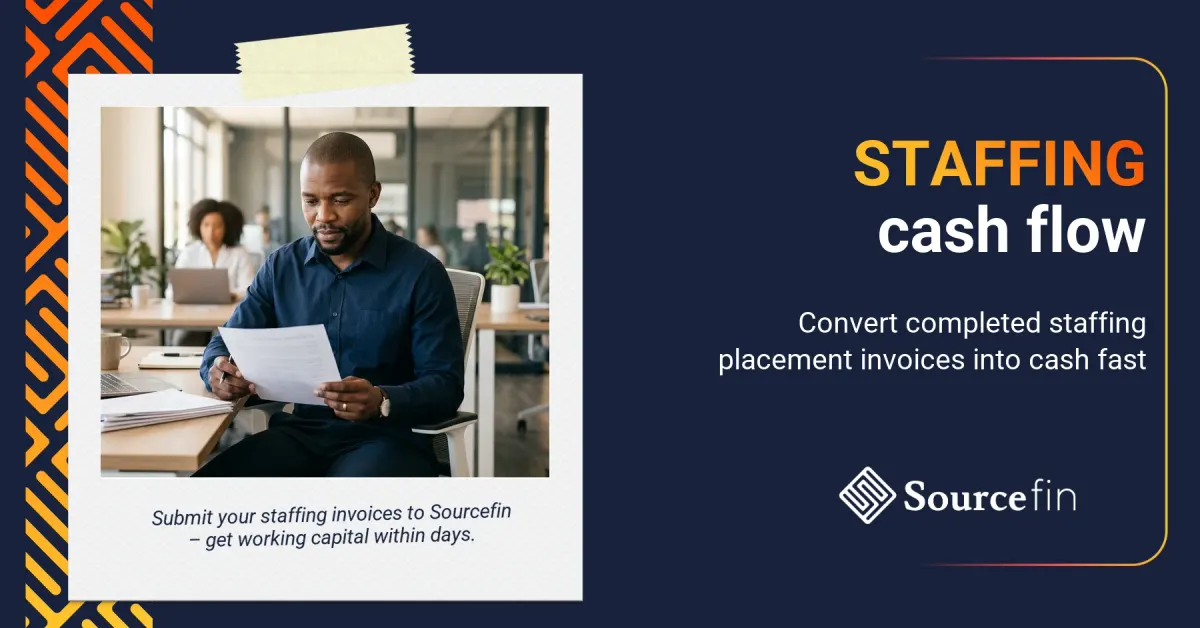
Invoice discounting staffing agencies use in South Africa converts completed placement invoices into working capital within days, not the 60 to 90 days government departments and municipalities take to settle. For labour brokers and staffing SMMEs placing workers with public sector clients, that payment gap is not an accounting delay – it is the central challenge of running the business, because worker wages go out every week regardless of when the invoice is paid.
Key Takeaways
- Invoice discounting staffing agencies use advances cash against completed placement invoices – no waiting 60 to 90 days for government departments to clear accounts.
- Staffing and labour broker businesses have a structural cash flow problem: workers must be paid weekly or fortnightly while government clients settle monthly invoices 90 days later.
- South Africa’s Basic Conditions of Employment Act sets strict wage payment obligations – delayed client payment is not a legal defence for late worker wages.
- The funding decision is based on your government or corporate client’s creditworthiness, not your business credit history or trading age.
- Consistent placement invoicing against government clients can qualify a staffing agency for a pre-approved working capital facility over time.
South Africa’s staffing and labour brokering sector places hundreds of thousands of workers across government departments, municipalities, state-owned enterprises, and large corporate employers. For the SMMEs that operate these agencies – many of them placing general workers, administrative staff, or skilled tradespeople with public sector clients – the business model is straightforward on paper: place the workers, invoice the client, get paid. In practice, the gap between invoicing and getting paid is where most staffing SMMEs face their greatest operational pressure. The invoice discounting staffing agencies use addresses that gap directly, and forms part of a broader set of cash flow solutions for South African SMMEs.
Why Government Staffing Contracts Create a Payroll Funding Gap
A staffing agency placing 50 workers with a government department invoices monthly for the total hours worked. The government department pays 60 to 90 days later – sometimes longer during budget freezes or procurement reviews. In that same period, the agency has paid those 50 workers their weekly or fortnightly wages, processed PAYE, contributed to UIF and the Skills Development Levy, and covered its own administrative overhead.
The mismatch is fundamental. Workers are paid on a weekly or fortnightly cycle. Clients pay on a monthly or longer cycle. The cash to bridge that gap has to come from somewhere – and for a small agency without significant reserves or a bank overdraft, that somewhere is often personal funds, expensive short-term credit, or deferred operational costs.
This is structurally identical to the problem faced by private security companies, which operate on the same continuous service, weekly wage model. The article on invoice discounting for security businesses covers the parallels in detail. For the underlying causes of government payment delays across sectors, see our overview of government payment delays in South Africa.
The Fixed Costs of a Staffing Agency
Running a staffing agency in South Africa involves a combination of statutory obligations and operational costs that cannot be deferred. Under the Basic Conditions of Employment Act, workers must be paid on the agreed cycle – late client payment does not constitute a lawful reason to delay wages. The core ongoing costs include:
- Worker wages for all placed staff, paid weekly or fortnightly
- PAYE, UIF contributions, and Skills Development Levy – remitted monthly to SARS
- Employer contributions to pension or provident funds where applicable
- Agency administration staff and recruiter salaries
- Compliance costs: CIPC annual returns, labour inspections, sector certifications
For an agency placing 80 workers across two government departments at average wages of R6,000 per month, the monthly payroll obligation is approximately R480,000 – before statutory contributions. If both clients are 90 days behind on payment, the agency is carrying nearly R1.5 million in outstanding invoices while needing to fund the next payroll cycle with no incoming cash.

How Invoice Discounting Staffing Agencies Use Works in Practice
The invoice discounting staffing agencies use follows the same structure as other service sector applications. Your placed workers complete a month’s work at a government department or municipality. You issue your invoice for the total placement fees or hours for that period. You submit the invoice to Sourcefin along with a service confirmation – typically a signed timesheet summary or client acknowledgement of hours worked. Sourcefin advances up to 75% of the invoice value, deployed within 5 to 10 business days on a first deal.
That advance covers the next payroll cycle: worker wages, statutory contributions, and agency operating costs. When the government client eventually settles the invoice, the advance and applicable fees are recovered, and you receive the remaining balance. The cycle repeats each month.
For agencies holding multiple concurrent government placements, this can evolve into a pre-approved working capital facility – where each new monthly invoice drawdown is handled automatically. The regularity of monthly placement invoicing against stable government clients makes staffing agencies particularly well-suited for facility structures over time.
What Staffing Businesses Need to Qualify
The qualifying requirements for invoice discounting staffing agencies need to meet are accessible for most established operations. The core criteria are:
- Your business must be CIPC registered and SARS tax compliant – including current PAYE and UIF registration
- The placements described in the invoice must have been worked for the billing period – confirmed by signed timesheets or a client acknowledgement
- Your client must be a qualifying debtor: a government department, municipality, SOE, or established corporate employer
You do not need to offer assets as security. You do not need years of audited financials. The strength of your debtor profile is the primary variable – and government departments are among the strongest qualifying debtors available.
Building Invoice Discounting Into Your Staffing Operations
The staffing agencies that manage cash flow most effectively are those that treat invoice discounting as a planned payroll tool rather than a crisis response. When you know that a government department will invoice monthly and pay 90 days later, the funding cost can be factored into your placement rate. The advance is deployed within 5 to 10 business days on a first deal, once invoice submission is complete. Payroll runs on time. Statutory contributions are met. You tender for additional placements from a position of financial stability rather than strain.
Apply through Sourcefin’s invoice discounting process to find out what your placement invoices are worth, or submit a funding application to explore all available options for your staffing business.
Sources & References
DPME. Research on the Delays and Non-payment by Government on SMME Invoices. 2020. dpme.gov.za
IT-Online. SMEs bear the brunt of SA’s late payment negligence. March 2026. it-online.co.za
Frequently asked questions
Can a staffing agency or labour broker use invoice discounting in South Africa?
Yes. Staffing agencies and labour brokers that invoice government departments, municipalities, SOEs, or large corporate employers are well-suited for invoice discounting. Funding is secured against your outstanding placement invoices, with approval based on the creditworthiness of your client rather than your agency's credit history. Businesses with consistent monthly placements against government clients are strong candidates.
How does invoice discounting help a staffing agency cover worker wages?
Once a completed placement invoice is submitted with signed timesheets or a client acknowledgement, Sourcefin advances up to 75% of the invoice value, deployed within 5 to 10 business days on a first deal. That cash is available before the next weekly or fortnightly payroll cycle. You no longer need to use reserves or short-term credit to pay workers while waiting 60 to 90 days for a government department to settle.
What documentation does a staffing agency need to discount a placement invoice?
You typically need the invoice itself, a service confirmation for the billing period – such as signed timesheets or a client-acknowledged summary of hours worked – and confirmation the invoice has been submitted to the client. Agencies with documented time-and-attendance records for placed workers are well-positioned for a straightforward approval process.
Does my staffing agency need to be PAYE registered to qualify for invoice discounting?
Yes. Current PAYE and UIF registration with SARS, combined with CIPC registration, forms the core compliance profile reviewed during the funding application. A staffing agency that is not PAYE registered would need to resolve that before funding could be approved – both as a legal requirement and as a qualifying criterion for the funder.
Can I use invoice discounting for placements with private corporate clients as well as government?
Yes, provided the corporate client meets the funder's debtor approval criteria. The approval process assesses the client's creditworthiness and payment history. Large corporates with strong balance sheets can qualify as approved debtors alongside government departments. A diverse debtor base increases the portion of your invoice book eligible for discounting.
How is invoice discounting different from a payroll finance product for a staffing company?
A traditional payroll finance product or overdraft adds debt to your balance sheet with interest charges and repayment schedules. Invoice discounting advances cash specifically against invoices already raised for work already completed – it is not debt but an advance on money owed to you. When your client pays, the advance and fees are recovered automatically. There are no monthly repayments and no collateral requirements.

Sourcefin is a South African alternative finance provider that offers purchase order funding and invoice discounting to SMMEs, enabling businesses to fulfil confirmed purchase orders or tenders and unlock cash flow without collateral. Unlike traditional lenders or banks, Sourcefin also provides end-to-end support including supplier sourcing, logistics, project management, and risk oversight.