
Invoice Discounting Catering South Africa: Practical Guide
South African catering SMMEs serving government schools face 60–90 day payment cycles. Invoice discounting converts invoices to cash within days.
On this page
Invoice discounting catering businesses use in South Africa converts completed service invoices into working capital within days, not the 60 to 90 days government schools, hospitals, and departments take to settle. For caterers holding school feeding scheme contracts, hospital canteen agreements, or government event catering accounts, that payment gap is the central cash flow challenge – not an administrative inconvenience.
Key Takeaways
- Invoice discounting catering businesses use advances cash against completed service invoices – no waiting 60 to 90 days for government schools and departments to pay.
- Catering is one of the most cost-intensive service sectors: ingredients, kitchen labour, fuel, and packaging run week by week regardless of when clients settle invoices.
- Government school feeding scheme and hospital canteen contracts offer steady, recurring revenue – but payment cycles rarely match weekly operating costs.
- The funding decision is based on your government client’s creditworthiness, not your business credit history or trading age.
- Consistent monthly invoicing against government contracts can qualify a catering business for a pre-approved working capital facility over time.
South Africa’s government spends billions each year on outsourced catering services – school feeding schemes, hospital canteens, correctional services catering, municipal staff canteens, and departmental event catering. Many of the businesses supplying these services are SMMEs. Most of them invoice monthly and wait. The invoice discounting catering businesses in this sector rely on sits within a broader set of cash flow solutions for South African SMMEs – this article focuses specifically on why catering contracts create a particular cash flow challenge, and how invoice discounting addresses it in practice.
Why Government Catering Contracts Create a Cash Flow Gap
Government catering contracts are attractive because they are predictable: fixed meal volumes, known client locations, regular monthly invoicing. The problem is not the contract itself – it is what happens after the invoice is submitted. Departments of Education, Health, and Correctional Services routinely take 60 to 90 days to process supplier payments, and this timeline stretches further during budget pressure periods or when invoices are queried on a technicality.
For a caterer, that delay is unworkable. A school feeding scheme serving 500 learners per day cannot pause food purchases while the provincial Department of Education processes the previous month’s invoice. Ingredients are purchased weekly – sometimes more often for fresh produce. Kitchen staff are paid on a regular cycle. The business runs whether or not the government has settled its account. For the structural reasons behind these delays, the article on government payment delays in South Africa explains the causes in detail.
The Operating Costs That Don’t Wait for Payment
Catering is a cost-intensive, margin-sensitive business. Unlike services where the main input is labour hours, catering combines labour with physical goods – food, packaging, fuel, and equipment – that must be purchased before the service is delivered. The core running costs include:
- Fresh produce, proteins, and staples – replenished weekly or more often
- Kitchen labour: cooks, prep staff, servers, and dishwashers on regular wage cycles
- Delivery vehicles, fuel, and driver wages for off-site contracts
- Packaging, disposables, and cleaning supplies
- Kitchen rental or equipment lease costs
A caterer holding three active government school contracts, each invoiced monthly at R150,000, may be carrying R450,000 in outstanding invoices while spending R120,000 to R150,000 per month to keep those contracts running. If all three clients are 90 days behind on payment, the business is effectively financing three months of operations with no incoming cash.
How Invoice Discounting Catering Businesses Use Works in Practice
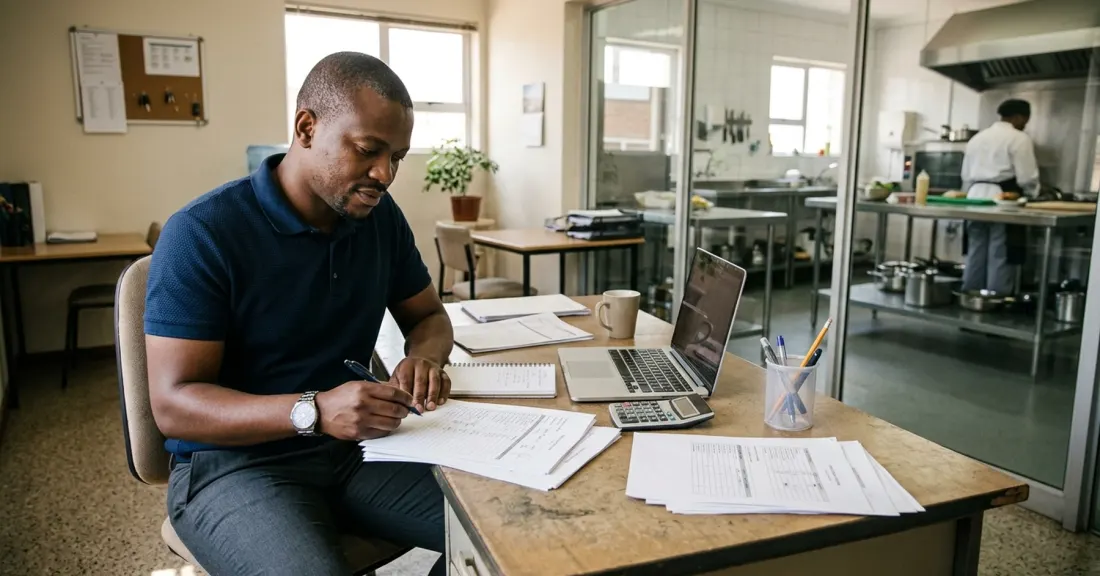
The invoice discounting catering businesses use follows the same structure as other service sector applications. You complete a month of meals at a government school or canteen. You issue your invoice to the relevant department or institution. You submit that invoice to Sourcefin along with service confirmation – typically a signed delivery or meal count record for the billing period. Sourcefin advances a substantial portion of the invoice value, usually within 24 to 48 hours.
That advance covers your next week’s ingredient purchases, wage payments, fuel costs, and packaging. When the government department eventually settles the invoice, the advance and applicable fees are recovered, and you receive the remaining balance. The cycle repeats with the following month’s invoice.
For caterers holding multiple concurrent contracts across different schools or sites, this process can evolve into a pre-approved working capital facility – where each new monthly invoice drawdown is processed automatically. The regularity of monthly catering invoices against government clients makes the sector well-suited for facility structures. Other labour-intensive service businesses face the same challenge – see how cleaning companies use invoice discounting to manage a similar cost structure.
What Catering Businesses Need to Qualify
The qualifying requirements for invoice discounting catering businesses need to meet are accessible for most established operations. The core criteria are:
- Your business must be CIPC registered and SARS tax compliant
- The meals or catering services described in the invoice must have been fully delivered for the billing period – confirmed by a signed meal count sheet, delivery record, or client acknowledgement
- Your client must be a qualifying debtor: a government school, provincial department, municipality, SOE, state hospital, or established corporate
- Any applicable food handling or sector compliance registrations should be current
You do not need assets as security. You do not need years of audited financials. The strength of your debtor profile is the primary variable – and provincial departments of education and health are considered low credit-risk debtors. A caterer with consistent monthly invoicing against a school feeding scheme contract is in a strong position to qualify, even if the business is relatively young.
Planning With Invoice Discounting Built In
The catering businesses that manage cash flow most effectively are those that plan invoice discounting into their cost model from the start. When you know that a government school will invoice monthly and pay 90 days later, the funding cost can be factored into your pricing. The advance is in your account within 48 hours of submitting your signed delivery records. Ingredients are purchased on schedule. Staff are paid. You bid on the next contract from a stable position.
If you hold multiple contracts and want to remove the per-invoice application process, a pre-approved facility is the natural next step. Apply through Sourcefin’s invoice discounting process to find out what your catering invoices are worth, or submit a funding application to explore all available options for your business.
Sources & References
DPME. Research on the Delays and Non-payment by Government on SMME Invoices. 2020. dpme.gov.za
IT-Online. SMEs bear the brunt of SA’s late payment negligence. March 2026. it-online.co.za
Frequently asked questions
Can a catering business use invoice discounting in South Africa?
Yes. Catering businesses that invoice government schools, provincial departments, state hospitals, municipalities, or large corporate clients are well-suited for invoice discounting. Funding is secured against your outstanding invoices, with approval based on the creditworthiness of your client rather than your company's credit history. Caterers with school feeding scheme or hospital canteen contracts are strong candidates.
How does invoice discounting help a catering company cover ingredient and wage costs?
Once a completed catering service invoice is submitted with a signed delivery or meal count record, Sourcefin advances a substantial portion of the invoice value within 24 to 48 hours. That cash is available before the next weekly ingredient purchase or wage cycle. You no longer need to use personal funds or high-cost credit to keep the kitchen running while waiting for government to process payment.
What proof does a caterer need to discount a school feeding scheme invoice?
You typically need the invoice itself, a service record for the billing period – such as a signed daily meal count sheet or acknowledgement from the school principal or site manager – and confirmation the invoice has been submitted to the relevant department. Caterers with documented daily registers are well-positioned for a straightforward application process.
Does my catering business need to be large to qualify for invoice discounting?
No. Invoice discounting is accessible to SMMEs of all sizes. The approval is primarily based on the creditworthiness of your client – the government school, department, or institution you are invoicing. A small catering business holding one or two consistent government contracts can qualify even without significant assets, a long credit history, or years of audited financials.
Can I use invoice discounting for both school feeding and hospital catering contracts?
Yes. Both government schools and state hospitals are qualifying debtors for invoice discounting, provided the service has been delivered and documented. You can discount invoices from multiple qualifying clients simultaneously, which means your full eligible invoice book – across schools, hospitals, or other government accounts – can be included in a funding facility over time.
How is invoice discounting different from a business loan for a catering company?
A business loan adds fixed debt to your balance sheet with scheduled repayments and typically requires collateral or a strong credit history. Invoice discounting is not debt – it advances cash against money already owed to you for meals already delivered. When your client settles the invoice, the advance and fees are recovered automatically. There are no monthly repayments and no collateral requirements.

Sourcefin is a South African alternative finance provider that offers purchase order funding and invoice discounting to SMMEs, enabling businesses to fulfil confirmed purchase orders or tenders and unlock cash flow without collateral. Unlike traditional lenders or banks, Sourcefin also provides end-to-end support including supplier sourcing, logistics, project management, and risk oversight.