
Fuel Levy Rebate South Africa Businesses: Practical Guide
Fuel levy rebate South Africa businesses guide: SARS diesel refund eligibility, the 2026 geotagging upgrade, documentation rules and timing-gap funding.
On this page
- Key Takeaways
- Two Mechanisms, One Conversation: Why Definitions Matter
- Who Qualifies for the Fuel Levy Rebate South Africa Businesses Use
- What the SARS Diesel Refund Is Worth
- The 2026 SARS Upgrade: Geotagging and the Side-Chain Ledger
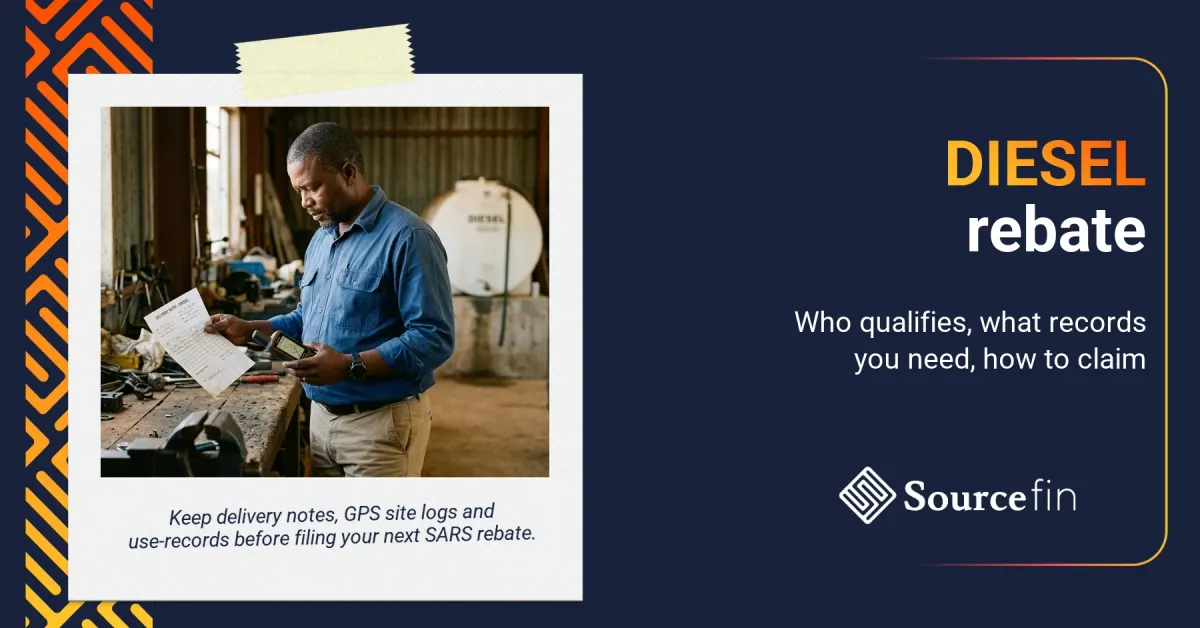
- Records to Keep for a Clean Claim
- The Timing Gap: Why the Rebate Does Not Solve Working Capital on Its Own
- Common Reasons Diesel Refund Claims Stall
- The Fuel Funding Hub: Read More
- Frequently asked questions
Fuel levy rebate South Africa businesses can claim is the SARS diesel refund, a long-standing programme that allows qualifying primary-production businesses in agriculture, mining, forestry, fishing and certain offshore operations to claim back a portion of the general fuel levy and the Road Accident Fund levy on diesel used for eligible activities. The refund is paid in arrears once SARS processes the claim, which means the cash benefit only arrives after the diesel has been bought, used and properly documented. The 2026 system upgrade introduced geotagging on diesel deliveries and a side-chain ledger to authenticate claims, tightening the documentation requirements for genuine claimants and reducing space for fraudulent submissions.
Key Takeaways
- The SARS diesel refund is the formal mechanism behind most fuel levy rebate South Africa businesses queries. It is separate from the temporary R3 per litre fuel levy reduction announced in April 2026.
- Eligibility is largely confined to agriculture, mining, forestry, fishing and certain offshore operations. General logistics, civils, catering, security and ICT do not qualify.
- The 2026 SARS upgrade introduced geotagging on diesel deliveries and a side-chain ledger to authenticate claims, with the aim of reducing fraudulent rebate claims that industry bodies have estimated in the multi-billion-rand range each year.
- Genuine claimants now face more documentation per claim, longer audit trails and tighter scrutiny of how the diesel was actually used on site.
- The refund is paid in arrears, which creates a timing gap between the moment diesel is bought and the moment the cash flows back. Working-capital products are designed for exactly this gap.
- A clean records system that ties every diesel litre to a verified site and an eligible activity is the difference between a smooth claim and a stalled one.
Two Mechanisms, One Conversation: Why Definitions Matter
Search traffic around fuel rebates and refunds in South Africa tends to mix two mechanisms that are different in scope, purpose and audience. Getting the definitions clear is the first step.
The first mechanism is the temporary R3 per litre general fuel levy reduction announced by Finance Minister Enoch Godongwana and Minister of Mineral Resources and Energy Gwede Mantashe on 31 March 2026. That reduction applied at the pump from 1 April 2026 to 5 May 2026, was available to all consumers and businesses, and was scheduled for re-evaluation on 6 May 2026. Moneyweb covered the announcement in detail. The wider mechanics of that relief, and what changes when it expires, are covered in the sibling cluster article on fuel levy repayment 2026 South Africa.
The second mechanism, and the one this article focuses on, is the SARS diesel refund. This is the long-standing programme that allows qualifying primary-production businesses to claim back a portion of the general fuel levy and the Road Accident Fund levy on diesel used for eligible activities. The eligibility rules and current refund values are published on the SARS diesel refunds portal. The refund is sometimes referred to as the diesel rebate, and that is the term most operators use in practice.
The two mechanisms are not interchangeable. The R3 reduction was a broad consumer relief measure with a fixed end date. The diesel refund is a sector-specific programme that has been in place for decades and continues operating regardless of whether short-term levy relief is in place. Both reduce the effective cost of fuel for the right party, but they do so through different routes and on different timelines.
Who Qualifies for the Fuel Levy Rebate South Africa Businesses Use
The diesel refund eligibility list is narrower than many SMME owners assume. SARS limits qualifying activities to specific primary-production sectors where the diesel is consumed away from public roads or in a defined operational context. The qualifying sectors and indicative use cases are:
- Agriculture – diesel used for tractors, harvesters, irrigation pumps, crop-spraying equipment, packhouse generators and on-farm transport that does not enter public roads.
- Mining – diesel used in haul trucks, drills, generators and earthmoving equipment operating within the mine perimeter or on private mine roads.
- Forestry – diesel used in chainsaws, skidders, log-loading equipment and forest road maintenance plant.
- Fishing – diesel used in commercial fishing vessels operating from South African ports.
- Certain offshore operations – diesel used in defined offshore activities such as bunkering vessels, drilling rigs and supply boats, where the operation falls within SARS's listed eligible categories.
Activities that do not qualify, regardless of how diesel-heavy they are, include general road transport, civils and construction, catering, security patrols, courier and last-mile logistics, and ICT field services. The reasoning is consistent across the list: diesel consumed in vehicles operating on public roads is treated as already paying for road infrastructure through the general fuel levy and the Road Accident Fund levy, and the refund is reserved for production activities that do not draw on that infrastructure in the same way.
SMMEs in qualifying sectors that operate a mixed fleet need to keep clean separation between diesel used in eligible activities and diesel used in road transport. A typical example is a farm that uses one diesel bowser to refuel tractors and irrigation pumps and a separate fuel card for the bakkie that runs to town. Only the bowser-fuelled diesel is claimable. Mixing the two is one of the most common reasons claims are queried or rejected.
What the SARS Diesel Refund Is Worth
The diesel refund value changes when the underlying fuel levy and Road Accident Fund levy values change. The refund is calculated as a defined cents-per-litre figure set by SARS, applied to the volume of eligible diesel actually consumed in qualifying activities during the claim period. SARS publishes the current rates on the diesel refunds portal and updates them in line with annual Budget changes.
For a working farm running a meaningful diesel volume across the season, the cumulative annual refund can be a material line on the income statement. For a small mine running multiple haul trucks and generators on a 24-hour cycle, it can be larger again. The point is not the absolute number, which varies operation to operation, but the structure: every litre of eligible diesel is claimable, and the records that support the claim need to reconcile to the cent.
The 2026 Budget kept the diesel refund mechanism in place with no headline change to eligibility. What it changed was the way claims are authenticated and reviewed. That change is administrative rather than rate-driven, and it is where most genuine claimants need to focus attention this year.
The 2026 SARS Upgrade: Geotagging and the Side-Chain Ledger
SARS announced two specific upgrades to the diesel refund system in 2026. The first is geotagging applied to diesel deliveries. When a fuel supplier drops diesel at a claimant's site, the delivery is now recorded against a verified geographic location rather than only an account reference. The geotag becomes part of the audit trail that supports the eventual refund claim.
The second is the introduction of a side-chain ledger to authenticate claims. The side-chain ledger holds an immutable record of each delivery and links it to subsequent claim submissions, making duplicate or fabricated claims significantly harder to file. Industry bodies have estimated pre-upgrade fraudulent claims in the multi-billion-rand range each year. The two upgrades are the formal response.

For an SMME that has been claiming the rebate for years, the practical change is more documentation per claim and a longer audit trail. Three areas tend to need attention before the next claim is filed:
- Delivery records. Each diesel delivery to a claimant site needs to be recorded with a geotag that matches the registered eligible-use site. Discrepancies between delivery location and registered use site will be flagged.
- Use logs. Records that tie diesel volumes to specific eligible activities, equipment hours and operator entries are now central to the audit trail. Tractor hour meters, haul truck telemetry, generator run-time logs and packhouse production records all play a role.
- Reconciliation. The volume claimed needs to reconcile to the volume delivered, less any non-eligible use, with a clean paper trail. Estimated splits and round-number assumptions are exactly the kind of entries that draw audit queries under the new system.
For sectors that have historically run lighter administration, the upgrade is a workload increase. For sectors that already operate with strong site logs, the change is mostly a question of formatting and consistency rather than fundamental new effort.
Records to Keep for a Clean Claim
The records list below is a practical working set for a typical mid-sized agricultural, mining or forestry operation. The exact requirements are set by SARS and operators should always cross-check against the current SARS diesel refunds portal. As a working baseline, a clean claim file usually contains:
- Diesel supplier delivery notes for every drop, with date, volume, supplier reference and verified site location.
- Bowser or storage tank dip readings before and after each delivery, with dated entries and an operator signature.
- Equipment use logs tying diesel draw to specific eligible activities, with hour meter readings, operator name and date.
- Vehicle and plant register listing each piece of equipment and its eligibility status under the diesel refund rules.
- Separation records where the operation runs both eligible and non-eligible activities, showing how diesel is allocated across the two categories.
- SARS account standing, current tax clearance and CIPC standing, all of which are pre-conditions for receiving any refund payment.
The most effective way to stress-test a claim file is to walk it backwards. Start with the litres being claimed, trace them through the use logs to the underlying activity, then back to the delivery records and the supplier invoices. Any break in that chain is where SARS is most likely to query the claim under the new system. The wider SARS tax compliance guide covers the broader compliance posture that supports any rebate claim.
The Timing Gap: Why the Rebate Does Not Solve Working Capital on Its Own
The SARS diesel refund reduces the effective cost of diesel for qualifying operations, but it is paid in arrears. The cash benefit only arrives once SARS has processed the claim, which can take weeks or months from the date the claim is filed. The diesel itself was bought, paid for and consumed weeks or months before that.
For an SMME running a peak production cycle, that timing gap is real. A farm filling tanks for harvest needs the diesel today and the cash for the diesel today. The rebate, when it arrives, helps the next cycle rather than the one currently running. A mining contractor on a multi-month earthworks contract carries the same pattern at higher absolute volumes. The cash flow shape is straightforward: outflow now, partial inflow later.
This is exactly the situation that working-capital products are designed for. Two products fit the pattern most cleanly. The first is invoice discounting, where an SMME with approved invoices to creditworthy buyers can advance most of the invoice value within days of the invoice being issued and use the advance to fund the next round of diesel. The mechanics are covered in the invoice discounting service guide and in the cluster article on invoice discounting for fuel price hedging.
The second is purchase order funding, which fits operators that have won a contract or order and need to mobilise diesel, materials, sub-contractors and labour before delivery starts. The funder pays the suppliers directly, the operator delivers the contract, and repayment is taken from the customer's payment when it lands. The product page on purchase order funding sets out the structure. For agricultural operations specifically, both products can be used in sequence across a season: purchase order funding to mobilise inputs, then invoice discounting against the eventual invoices once produce has been delivered.
The diesel refund continues to flow back into the operation through SARS in arrears, reducing the effective cost of the diesel already consumed. The working-capital facilities cover the gap in real time. The two are complementary rather than alternatives.
Common Reasons Diesel Refund Claims Stall
Beyond the new geotagging and side-chain ledger requirements, the recurring reasons claims stall are well known to anyone who has filed multiple cycles. The five most common are:
- Eligibility drift. An operation that originally qualified under a clear primary-production activity later picks up secondary work that uses diesel in a non-eligible way, without separating the records. Claims that mix eligible and non-eligible litres are queried.
- Site mismatch. Diesel delivered to one location but recorded as used at another. Under the new geotagging system this is now a hard data point rather than a paper-only entry.
- Volume gaps. Bowser or tank dip readings that do not reconcile to delivery volumes plus consumption logs. Small gaps accumulate and become a question on audit.
- Compliance lapses. Tax clearance expired, CIPC filing late, VAT vendor status under review. Any one of these stalls the refund payment regardless of the underlying claim merit.
- Estimated entries. Use logs filled in retrospectively with round-number estimates rather than recorded at the time. The new audit trail is built around contemporaneous records, not after-the-fact reconstructions.
The fix in each case is administrative rather than financial. A weekly recordkeeping discipline, a simple eligibility review every quarter and a compliance check before each claim cycle removes most of the friction.
The Fuel Funding Hub: Read More
This article sits inside the wider Sourcefin fuel funding cluster. For the broader picture of how working-capital products fit around fuel cost moves and SARS refunds, the pillar guide on business fuel loans South Africa is the place to start. For the specific April-to-May 2026 levy story and what changes when the R3 reduction is re-evaluated, the cluster article on fuel levy repayment 2026 South Africa covers the timing and the Treasury mechanics in detail.
For SMMEs ready to discuss how the rebate timing gap fits with a working-capital facility, the funding application form is the right starting point. A team member follows up to walk through the situation, the contracts or invoices that would underpin a facility, and the practical mechanics of drawing and repayment.
Sources & References
- Diesel refunds – South African Revenue Service.
- Ministers Godongwana and Mantashe: short-term relief measures on fuel price increases – South African Government, March 2026.
- Government cuts fuel levy by R3 to curb price shock – Moneyweb.
- Fuel Price Media Statement – Department of Mineral Resources and Energy.
- Diesel rebate changes: what farmers need to know – Farmer's Weekly.
- SARS diesel refund system overhaul – Engineering News.
Frequently asked questions
What is the fuel levy rebate South Africa businesses can claim?
It is the SARS diesel refund, a long-standing programme that allows qualifying primary-production businesses to claim back a portion of the general fuel levy and Road Accident Fund levy on diesel used for eligible activities. Qualifying sectors are agriculture, mining, forestry, fishing and certain offshore operations. The refund is paid in arrears once SARS processes the claim and is separate from the temporary R3 per litre fuel levy reduction announced in April 2026.
Is the diesel rebate the same as the R3 fuel levy reduction announced in April 2026?
No. The R3 per litre fuel levy reduction is a temporary, broad relief measure that applied at the pump from 1 April 2026 to 5 May 2026 and was available to all consumers and businesses. The SARS diesel refund is a separate, long-standing programme limited to qualifying primary-production sectors. The two operate independently and on different timelines.
Who qualifies for the SARS diesel refund?
Eligibility is largely confined to agriculture, mining, forestry, fishing and certain offshore operations, where diesel is used for activities away from public roads or in defined operational contexts. General road transport, civils, catering, security and last-mile logistics do not qualify. SARS publishes the current eligibility rules and refund values on its diesel refunds portal.
What changed in 2026 with the SARS diesel refund system?
SARS introduced geotagging on diesel deliveries, recording the location of each drop against the claimant's stated use site, and added a side-chain ledger to authenticate claims and reduce duplicate or fraudulent submissions. Genuine claimants now face more documentation per claim and longer audit trails, with tighter scrutiny of how diesel was used on site.
What records do I need to support a diesel rebate claim?
A clean claim file typically includes diesel supplier delivery notes with verified site locations, bowser or storage tank dip readings, equipment use logs tied to eligible activities with hour meter entries, a vehicle and plant register, separation records for any non-eligible use and current SARS, CIPC and tax clearance standing. The records need to reconcile from claimed litres back to delivery and supplier invoices.
How can SMMEs bridge the timing gap while waiting for the diesel rebate?
The SARS refund is paid in arrears, so the diesel is bought and used before the cash benefit arrives. Working-capital products are designed for that gap. Invoice discounting advances most of an approved invoice's value within days, which can fund the next round of diesel. Purchase order funding pays suppliers directly so an SMME can mobilise a contract without depleting cash reserves. Both products can run alongside the rebate process.

Sourcefin is a South African alternative finance provider that offers purchase order funding and invoice discounting to SMMEs, enabling businesses to fulfil confirmed purchase orders or tenders and unlock cash flow without collateral. Unlike traditional lenders or banks, Sourcefin also provides end-to-end support including supplier sourcing, logistics, project management, and risk oversight.