
SMME Funding Partner South Africa: Honest Track Record
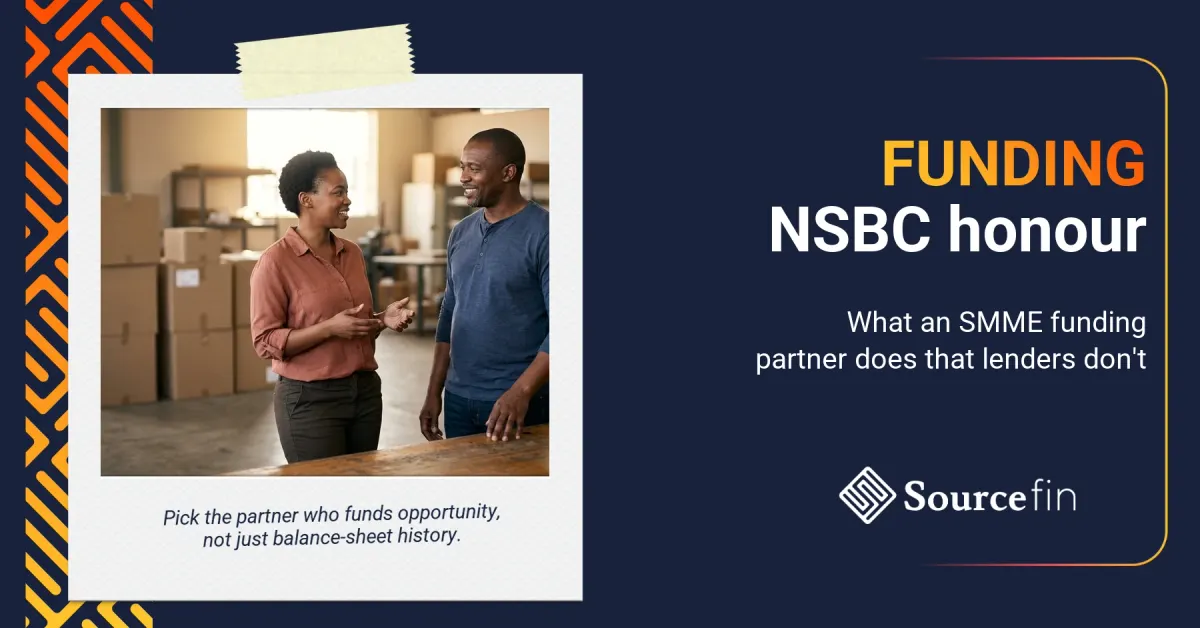
What an SMME funding partner actually does, behind the headlines. R3bn deployed, more than 2,000 SMMEs enabled, and an NSBC feature that explains why.
On this page
- Key Takeaways
- Why a real SMME funding partner matters more than a lender
- The Covid origin story behind Sourcefin
- What 2,000+ SMME funding partner relationships have taught us
- How TenderCentral closed the visibility gap
- How partners and advisors make Sourcefin's reach wider
- What an open-minded SMME funding partner actually evaluates
- About the source – NSBC Small Biz Friday feature
- Frequently asked questions
An SMME funding partner backs the opportunity in front of you, not just the history behind you. Sourcefin – featured this week as the National Small Business Chamber's Small Biz Friday business on thesmallbusinesssite.co.za – has deployed more than R3 billion and enabled more than 2,000 South African SMMEs, holds an all-time bad debt ratio under two percent, and has delivered on 100 percent of funded deals.
Key Takeaways
- Sourcefin is the NSBC Small Biz Friday Featured Business this week on thesmallbusinesssite.co.za, a recognition that hands the spotlight to the SMMEs we back.
- An SMME funding partner judges the opportunity in front of a business, not the gaps behind it.
- More than R3 billion has been deployed, enabling more than 2,000 South African SMMEs, with many B-BBEE Level 1 enterprises among them.
- An all-time bad debt ratio under two percent and a 100 percent delivery rate on funded deals shows the model works at scale.
- TenderCentral closes the visibility gap by aggregating verified tenders from national, provincial and municipal entities for free.
- Sourcefin won the National Funder Award at the South African Small Business Awards in 2025 and is a proud NSBC Partner.
- The honest test of a funding partner is the track record, not the marketing.
Why a real SMME funding partner matters more than a lender
The NSBC feature on thesmallbusinesssite.co.za put it plainly. Entrepreneurs didn't just need stock during the early Covid years, they needed trust, support and a financial partner who would invest in their potential. That sentence carries the weight of the whole article. A lender writes a cheque. A partner picks up the phone when something goes sideways at a delivery, walks the supplier conversation with you, and sticks around to see the deal through.
SMMEs across South Africa carry a quiet weight. They keep payroll running, they hire from their own communities, and they show up for tenders where the margin for error is thin. When a young business wins a purchase order from a hospital, a municipality or a private buyer, the moment of celebration is short. The next thought is always the same. How do we pay for the stock, the labour and the logistics before the buyer pays us?
That is the gap an SMME funding partner exists to close. Not with a tick-box checklist, but with a real assessment of what you have won and how it gets delivered. Banks are built for stability. Sourcefin is built for speed. The two roles sit alongside each other in the South African economy, each serving a different mandate. The point of a partner is to look at the opportunity on the table and ask one honest question. If this delivery succeeds, can the business pay us back?
That question opens up funding for businesses that a one-size-fits-all assessment would never reach.

The Covid origin story behind Sourcefin
The story behind Sourcefin starts in 2020, in a warehouse, with a chartered plane. Avi Mishan brought a planeload of urgently needed medical supplies into South Africa from China. Hospitals needed stock fast. Frontline staff needed protection fast. And word travelled fast.
Within hours, that warehouse was full of SMME owners holding government purchase orders. They had won the work. They had the orders in hand. What they did not have was the cash to pay suppliers, ship the stock and deliver before payment terms ran their course. Traditional finance was slow to respond at that moment, and bureaucracy was heavy by design. The SMMEs in that warehouse were not failing. They were simply outside the lanes that formal finance had been built to serve.
What emerged was a deeper truth. Entrepreneurs didn't just need stock. They needed a financial partner who would back their potential.
Sourcefin was co-founded in May 2021 by Avi Mishan, Joshua Kadish and Marom Mishan. The goal was specific. Build the partner the warehouse moment had revealed. Rather than applying a one-size-fits-all assessment, the company would look at three honest questions. Can we trust the client. Can the goods or services be delivered. Will the end buyer pay. If the answers stack up, the deal goes through. That framework has not changed since.
The reason it has held up is that it was never an idea on a slide. It was a response to real SMMEs holding real orders, in a real moment of national pressure.
What 2,000+ SMME funding partner relationships have taught us
The receipts matter when you talk about partnership, because anyone can say the word. More than R3 billion has been deployed in alternative funding since 2021. More than 2,000 South African SMMEs have been enabled. Many of those businesses are B-BBEE Level 1 enterprises that historically struggled to access financing through formal pathways. The team that does this work has grown to more than 50 young South Africans, most of them under 35, all of them invested in changing how SMME funding feels from the client's side of the table.
Behind every one of those numbers is a different story. A wastewater contractor delivering reservoirs. A telecoms operator scaling from a handful of staff to dozens. An engineering business managing pressure systems for state-owned enterprises. A women-owned branding agency taking on bigger corporate accounts. The industries are different. The shape of the partnership is the same. Listen first. Understand the deal. Get the funding into the hands of the operator quickly so the work can begin.
What we've learned, across more than 2,000 partnerships, is that the standard funding pipeline misses real businesses for reasons that have nothing to do with capability. Some are too new. Some have a recent judgement that does not reflect who they are now. Some are operating in industries that automated credit models do not score well. None of those facts mean the business cannot deliver. We see this every day on our clients page, where the people doing the work tell their own stories.
If a partner is doing its job, it learns something from every deal and brings that knowledge into the next conversation.
Why the numbers behind a funding partner matter
The proof of an opportunity-based model is in the durability of the book. Sourcefin has held an all-time bad debt ratio below two percent since launch. The delivery rate on funded deals is 100 percent. Those two numbers, sitting alongside each other, are the honest test of the model.
The first number says the business is selecting the right deals and managing the right risks. The second says that when a deal is funded, the goods or services actually reach the end buyer. Funding without delivery is not funding. It is a problem deferred. Holding a 100 percent delivery rate across more than a thousand deals is the kind of receipt that explains why the recognition keeps coming. Sourcefin is also the recipient of the Eric Ellerine Entrepreneur of the Year for the open-minded funding model that produces these outcomes.

How TenderCentral closed the visibility gap
Funding solves only one half of the problem an SMME faces. The other half is finding the work in the first place. That is where the South African tender environment has been quietly failing the businesses it most needs to lift. Tender notices are scattered across many portals. Information is often outdated. A meaningful slice of the data sits behind subscription paywalls that smaller players cannot afford. The result is that the businesses with the most to gain from a public procurement contract are often the last to know it exists.
TenderCentral was launched to close that gap. It aggregates verified tenders from national, provincial and municipal entities into one searchable interface. There are no paywalls for SMMEs. The platform is free to use. A construction operator in the Northern Cape can find a tender in Limpopo. A cleaning business in Cape Town can see a Gauteng municipal opportunity the same morning it is advertised. That is what visibility looks like when you build the platform with the SMME, rather than the gatekeeper, in mind.
Visibility on its own does not pay for delivery. That is why TenderCentral sits next to the funding side of the business. An SMME can see the tender, win it, and pick up the phone for the working capital that turns the win into delivered work. The combination is the point. For practical guidance on the bidding side, the longer-form piece on finding government tenders in South Africa walks through the steps in plain language.
This is also why Sourcefin invested in scaling the platform with Futuregrowth. More liquidity behind more visibility means more SMMEs find work and finish work.
How partners and advisors make Sourcefin's reach wider
Reach is the practical measure of a funding partner. It does not matter how good the model is if the SMMEs who need it never hear about it. That is why AffiliateHub exists. It is the formal partner channel for accountants, brokers, business advisors and industry connectors who already sit close to South African SMMEs.
An accountant doing the books for ten or fifteen owner-managed businesses sees the cash flow gaps before anyone else. A broker placing tender bonds knows which clients are taking on contracts they cannot self-fund. A business advisor walking a client through a procurement opportunity often becomes the first person they ask about working capital. AffiliateHub gives those advisors a direct line into Sourcefin, a transparent commission structure, and a way to follow the deal through to funded.
The wider the network, the more SMMEs find a foot in the door. It takes a network to find the businesses that traditional pipelines miss. That is the honest design of the channel.
What an open-minded SMME funding partner actually evaluates
The open-minded part of the assessment is often misunderstood. It does not mean Sourcefin funds anything. It means the questions asked are different from the questions a one-size-fits-all assessment would ask. The starting point is the deal. Has the work been won. Is the buyer real. Is the supply chain in place. Can the SMME deliver in the time available.
If the deal stacks up, the next question is the operator. Bank statements get a careful read. Credit reports are read for context, not as a binary pass-or-fail. A judgement from three years ago does not carry the same weight as a pattern of behaviour today. The conversation matters. A founder who is straight about a tough year is a different proposition from one trying to hide it. Trust is built in the exchange.
The third question is delivery. Purchase order funding is the right tool when the work has been won and the operator needs working capital to fulfil. Invoice discounting is the right tool when the work has been done and the operator is waiting on a 30, 60 or 90 day payment term. Both tools are practical, and both are designed around the cash flow shape of South African public and private contracts. Where the contract is a public sector award, tender funding is the same model applied on tender terms.
The first conversation is the funding application. There is no penalty for asking. The fastest way to start is to apply here and let the team walk through the deal in front of you. If the fit is right, a term sheet usually follows within 5 to 10 business days on a first deal. If the fit is wrong, you'll know that quickly too, and the team will tell you why.
About the source – NSBC Small Biz Friday feature
The National Small Business Chamber runs Small Business Friday as a national campaign that asks South Africans to put their money where their backbone is. Each Friday the campaign features a small or medium business that exemplifies the spirit of the programme. This week's Featured Business is Sourcefin, on the NSBC's editorial home at thesmallbusinesssite.co.za.
The feature is grounded in the Covid origin story, the partnership model and the receipts of the last few years. It also references Sourcefin's National Funder Award win at the South African Small Business Awards in 2025, an award that recognises funders who go beyond providing capital and actively support the sustainability and growth of SMMEs. Sourcefin is a proud NSBC Partner, and the recognition is a credit to every SMME on the forgotten side of the funding map who took the meeting, did the work and finished the deal. The full feature is available at Sourcefin: Enablers of South African SMMEs.
Sources & References
- The Small Business Site – Sourcefin: Enablers of South African SMMEs – original NSBC Small Biz Friday feature
- National Small Business Chamber (NSBC)
- Small Business Friday South Africa
- Statistics South Africa – SMME contribution data
Frequently asked questions
What does an SMME funding partner do that a traditional lender doesn't?
An SMME funding partner backs the opportunity in front of a business, not only the history behind it. Banks are built for stability and serve a different mandate by design. Sourcefin sits alongside that mandate, looking at the deal you have won, the supplier who will deliver, and the buyer who will pay. The partnership extends beyond the transfer of funds into supply chain support and follow-through to delivery.
What is NSBC Small Biz Friday?
Small Business Friday is a national campaign run by the National Small Business Chamber that asks South Africans to support small and medium businesses on Fridays. The NSBC features a Small Biz Friday business each week on its editorial home at thesmallbusinesssite.co.za. The campaign is designed to drive awareness, foot traffic and purchasing toward SMMEs across the country, and to highlight the real businesses behind the headline numbers.
What does Sourcefin's National Funder Award mean for SMMEs?
The National Funder Award at the South African Small Business Awards in 2025 recognises funders who go beyond providing capital and actively support the sustainability and growth of SMMEs. For an SMME, the award is a useful third-party signal that the model has been independently assessed against peers. It does not replace your own diligence on a partner, but it gives a clearer baseline of credibility before the first conversation.
How does Sourcefin assess opportunity over balance sheet?
The assessment runs across three honest questions. Can the client be trusted, based on transparent conversation and a careful read of bank statements and credit context. Can the goods or services be delivered, with a vetted supplier and a workable supply chain. Will the end buyer pay, on a timeline that the deal can carry. If the answers stack up, the deal is fundable, even where conventional pipelines would say no.
How does TenderCentral help SMMEs find work?
TenderCentral aggregates verified tenders from national, provincial and municipal entities into one searchable interface. The platform is free for SMMEs, with no paywalls. An SMME owner can filter by sector, region and value, and act on a tender the same morning it goes live. The result is a real reduction in the visibility gap that has historically kept smaller players out of public procurement opportunities.
How can advisors and accountants partner with Sourcefin via AffiliateHub?
AffiliateHub is the formal channel for accountants, brokers and business advisors who already work with South African SMMEs. Sign-up is straightforward, the commission structure is transparent, and referrals can be tracked from first introduction through to funded deal. The advisor remains the trusted relationship for the SMME, while Sourcefin handles the funding side of the conversation. The wider the network, the more SMMEs find a route in.

Sourcefin is a South African alternative finance provider that offers purchase order funding and invoice discounting to SMMEs, enabling businesses to fulfil confirmed purchase orders or tenders and unlock cash flow without collateral. Unlike traditional lenders or banks, Sourcefin also provides end-to-end support including supplier sourcing, logistics, project management, and risk oversight.