
Invoice Discounting Startups South Africa: Smart Guide
New SMME with first customer invoices but no overdraft? Here's how invoice discounting works for SA startups – customer creditworthiness opens the door.
On this page
- Key Takeaways
- Invoice Discounting Startups South Africa: Why It Works for New SMMEs
- The Startup Funding Catch-22 in South Africa
- How Invoice Discounting Assesses a Startup
- What Funders Look at for Startup Applications
- Common Startup Scenarios That Get Funded
- When Invoice Discounting May Not Yet Fit a Startup
- How Invoice Discounting Compares to Other Startup Funding Options
- The Bigger Picture for SA Startups
- Frequently asked questions
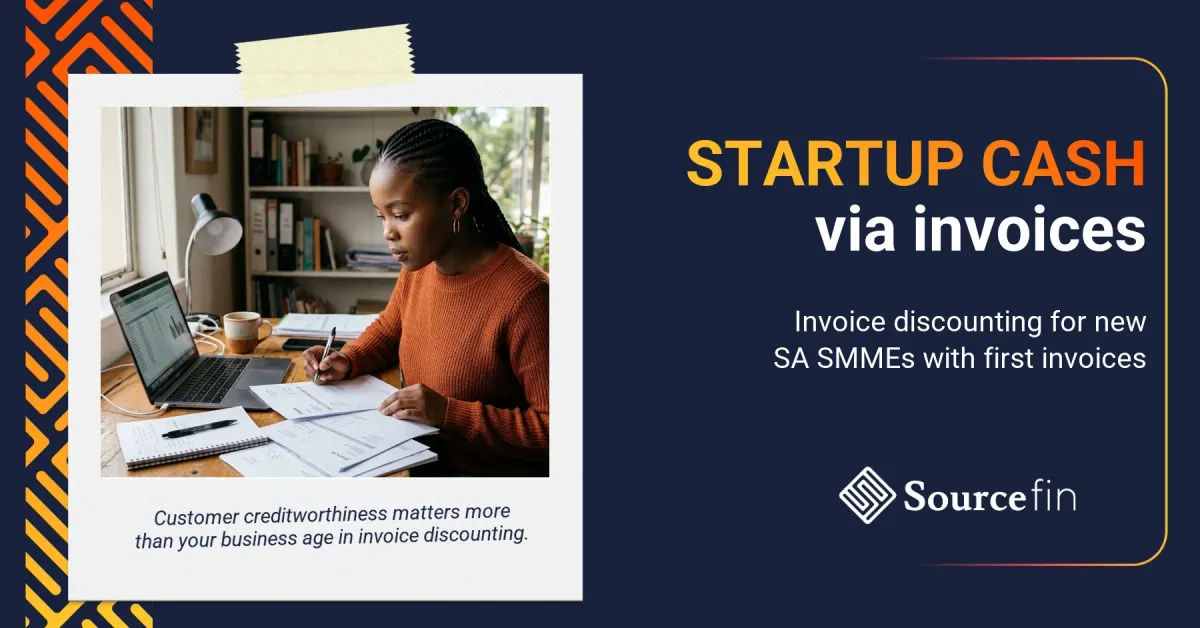
Invoice discounting startups South Africa is real for new SMMEs that have started invoicing creditworthy customers. The model assesses the customers, not the business's age – a startup with one strong customer relationship and a steady stream of invoices can be funded as confidently as an established business. The receivables book opens the door, even without years of trading history.
Key Takeaways
- Invoice discounting does not require years of trading history – it assesses the receivables book and the customer mix.
- Startups with creditworthy customers can secure facilities even without an established overdraft track record.
- The customer profile (government, SOE, major corporate) carries significant weight for first-time applicants.
- Sourcefin funds startup invoice discounting facilities from R250,000 upwards – the receivables book needs to be of meaningful size.
- Honest framing of being new to the market is a positive signal when paired with real customer relationships.
- Invoice discounting often unlocks faster than a bank facility for startups because it focuses on the customer rather than the SMME's history.
Invoice Discounting Startups South Africa: Why It Works for New SMMEs
The traditional credit world is hard on startups. Banks lean on track record, audited financials, and security – none of which a new SMME has by definition. The result is a chicken-and-egg problem: you need trading history to access funding, but you need funding to build trading history.
Invoice discounting startups South Africa solves the problem differently. Because the model assesses the customer base rather than the historical financial profile, a brand-new SMME with steady invoicing to creditworthy customers can be funded. The customer is doing most of the credit work for the funder by paying reliably. The startup only needs to show it can deliver and invoice cleanly.
For broader context on how invoice discounting works, the wider invoice discounting South Africa pillar guide explains the model end to end. The invoice discounting vs bank overdraft guide covers why a bank overdraft typically requires more historical track record than invoice discounting does.
The Startup Funding Catch-22 in South Africa
South Africa's SMME funding gap is documented in multiple reports. The IFC's recent SMME finance partnership work shows that even with traditional lenders moving to widen access, formal credit reaches a small minority of registered MSMEs. Startups sit at the worst end of that gap because they have no past data for a bank's scoring model to assess.
The conventional advice – build three years of trading history, then apply for credit – assumes the startup can fund itself through that period. For most SMME founders winning their first meaningful customer contracts, that is not realistic. Without working capital, payments to suppliers and staff slip behind customer payment cycles. The cycle traps capable businesses indefinitely.
Invoice discounting breaks the cycle by focusing on the customer in front of the startup rather than the years that came before.
How Invoice Discounting Assesses a Startup
For an established SMME, the funder reviews the receivables book alongside the financial track record. For a startup, the receivables book carries more of the weight, with three areas examined closely.
The customers. Are they creditworthy? Do they pay reliably? Are they large enough that the funder can verify their payment history? Government departments, SOEs, and major corporates are easiest. Smaller private customers with no payment record are harder.
The invoicing pattern. Is there steady, predictable invoicing emerging? A startup invoicing R200,000 monthly to two reliable customers presents a much stronger book than a startup with a single one-off invoice and uncertain follow-through.
The owner. Even without business history, the owner's background matters. Prior sector experience, employment history, or specialist knowledge can substitute for trading track record. The conversation with the funder is part of the assessment.
What Funders Look at for Startup Applications

The standard invoice discounting requirements apply. The invoice discounting requirements South Africa guide covers the full document picture. For startups, certain elements take on extra weight:
- The customer list. Detailed, current, with payment terms specified for each customer relationship. The strength of the list does most of the work in startup invoice discounting.
- Sample customer invoices. A handful of recent invoices showing the typical structure, value, and payment terms. The funder needs to see real receivables, not projected ones.
- Recent business bank statements. Even if only a few months long, statements show actual trading activity and customer payment behaviour.
- The owner's background. Sector experience, prior roles, professional credentials. This is the substitute for trading history.
- Honest framing of being new to the market. Disclosure is a positive signal. Trying to oversell experience is the fastest way to lose credibility.
Once the documents are clear, the how to apply for invoice discounting walkthrough explains the application process. The form itself is short – the conversation that follows does most of the work.
Common Startup Scenarios That Get Funded
Sourcefin sees recurring patterns in startup invoice discounting applications.
Sector spin-offs. An employee leaves an established business to start their own with first customer relationships drawn from former employers or industry contacts. The startup has no trading history but the owner brings deep sector competence and credible customer relationships.
Government supplier startups. A new SMME wins their first government tender or supply contract through proper procurement. The procuring entity is creditworthy, payment cycles are documented, and the receivables become fundable as soon as invoices are issued.
Service-business launches. A new cleaning, security, or professional services business that has signed contracts with established corporate clients. Monthly invoicing creates a steady receivables book even from month one.
Sub-contracts on bigger work. A startup wins sub-contracts from established principal contractors. The principal is the customer, and their standing reinforces the receivables book.
When Invoice Discounting May Not Yet Fit a Startup
Three situations make invoice discounting harder for a startup.
If the customer base is entirely small private businesses with no payment history, the receivables book is difficult to fund regardless of the startup's qualities. Without verifiable customers, the funder has no basis for advancing.
If the receivables book is below R250,000, invoice discounting is usually the wrong tool. The operational work involved in setting up a facility does not work at smaller scales. The wider SMME funding alternatives overview covers other routes for sub-R250,000 needs.
If the owner has active legal issues related to fraud or asset stripping, the startup application is unlikely to proceed regardless of how strong the receivables look. Trust is a non-negotiable layer in the assessment.
How Invoice Discounting Compares to Other Startup Funding Options
Startup funding in South Africa is a crowded landscape. Government grants (SEDA, NEF, IDC), incubator equity, friends-and-family rounds, and bank credit all have a place. Each works for a different stage and need.
For a startup with creditworthy customers issuing real invoices that need bridging until customer payment, invoice discounting is usually the most practical match. There is no equity given up. There is no long credit application process. The funder is matching the advance to a specific receivables book that has documented payment cycles. The invoice discounting vs bank overdraft comparison goes deeper on the credit side. The invoice discounting company South Africa guide covers what to look for when evaluating funders.
The Bigger Picture for SA Startups
South Africa's SMME ecosystem produces capable founders every month. The constraint is rarely talent, ambition, or even market opportunity – it is access to working capital at the moment customer relationships start producing real invoices. Invoice discounting startups South Africa exists specifically to close that gap.
For a startup with first invoices on the books and a real customer relationship, the practical next step is short. To structure invoice discounting against the receivables book, the Sourcefin funding application form takes a couple of minutes, and a Sourcefin representative will follow up to walk through the deal. The Sourcefin invoice discounting service page sets out the full process.
Sources & References
Frequently asked questions
Can a brand-new SMME with no trading history get invoice discounting in South Africa?
Yes. Invoice discounting assesses the customer base and the receivables book first, not your trading history. A startup with creditworthy customers issuing real invoices can be funded as confidently as an established business. The customer's payment ability, the invoicing pattern, and the SMME owner's sector experience do most of the talking.
What does Sourcefin look at when assessing a startup invoice discounting application?
Three things matter most: the customers (creditworthy, verifiable, paying reliably), the invoicing pattern (steady, predictable, of meaningful value), and the owner's background (sector experience, prior roles, personal credibility). Trading history is helpful but not essential. The receivables book itself does the heavy lifting in a startup assessment.
What kind of customers make a startup's first invoice book easier to fund?
Government departments, SOEs, and major corporates are the easiest customers because their payment ability is well established. A first customer relationship with a national department, a Rand Water-style entity, or a major retail chain is much easier to fund than the same-sized invoice book from small private customers with no payment history. Customer profile matters significantly for first-time applicants.
Do I need audited financials to apply as a startup?
No. Invoice discounting does not require audited annual financial statements for most facilities, and a brand-new business will not have them anyway. For facilities over R1 million, additional financials may be needed, but for typical startup first facilities, recent business bank statements alongside the customer list and sample invoices are enough.
What if my receivables book is too small to qualify?
Sourcefin funds invoice discounting facilities from R250,000 upwards. For sub-R250,000 receivables, an overdraft facility, short-term working capital from a commercial bank, or a SEDA grant may be a better fit. The wider SMME funding alternatives landscape covers these other routes. Once your receivables book grows above the threshold, invoice discounting becomes the more practical option.
Will Sourcefin take equity in my startup in return for invoice discounting?
No. Invoice discounting is a receivables-financing arrangement, not an equity investment. You retain full ownership of the business. The funder advances cash against your customer invoices and is repaid from those payments. This is one reason invoice discounting suits founders who want to grow without diluting ownership in early stages.
How quickly can a startup get an invoice discounting facility set up?
Speed depends on document readiness and book complexity. Once the customer list, sample invoices, and supporting documents are submitted, the facility review moves quickly. Straightforward startup facilities with strong customers can move from application to setup in days rather than weeks. Complex facilities or those requiring detailed customer verification take longer.

Sourcefin is a South African alternative finance provider that offers purchase order funding and invoice discounting to SMMEs, enabling businesses to fulfil confirmed purchase orders or tenders and unlock cash flow without collateral. Unlike traditional lenders or banks, Sourcefin also provides end-to-end support including supplier sourcing, logistics, project management, and risk oversight.