
Invoice Discounting Requirements South Africa: Real Guide
Wondering what you need to qualify for invoice discounting in SA? Here's the document checklist, the customer criteria, and the profile funders actually assess.
On this page
- Key Takeaways
- Invoice Discounting Requirements South Africa: The Full Picture
- The Receivables Book Requirements
- The Compliance Pack
- The Financial and Customer Pack
- The Customer Profile Funders Look At
- The Three-Pillar Assessment
- SMME Profile: What Funders Look For
- What Disqualifies a Facility
- How Invoice Discounting Requirements Compare to a Bank Loan
- The Bottom Line on Invoice Discounting Requirements
- Frequently asked questions
Invoice discounting requirements South Africa centre on three things: a meaningful receivables book with creditworthy customers, a clean compliance pack, and a clear operational fit. You need a current customer list with payment terms, recent invoices, CIPC and SARS compliance, and bank statements showing trading activity. The funder assesses your customers as much as your business.
Key Takeaways
- The non-negotiable starting point is a meaningful receivables book with reasonable payment terms (30, 60, or 90 days).
- Compliance pack: CIPC company registration in good standing, valid SARS tax compliance status, ID copies for directors.
- Financial pack: recent business bank statements (3 months minimum), sample customer invoices, customer list with payment terms.
- Sourcefin's deal-size sweet spot for invoice discounting facilities is R250,000 upwards.
- Customer creditworthiness drives the facility – your customers' payment ability matters as much as yours.
- For facilities over R1 million, additional financials are required.
Invoice Discounting Requirements South Africa: The Full Picture
Invoice discounting requirements South Africa funders look at fall into three buckets: the receivables book, the compliance pack, and the SMME profile. All three need to check out for a facility to be structured. The absence of any one of them stalls the application.
The receivables book sits at the centre. Without a meaningful, fundable customer book, there is nothing to advance against. The compliance pack is the operational hygiene that lets the funder transact with you. The SMME profile is the trust layer – who you are, how you have operated, and whether you are someone the funder can work with through the facility cycle.
For broader context on how the model works, the wider invoice discounting South Africa pillar guide explains the approach end to end. This article focuses specifically on what you need to bring to the table.
The Receivables Book Requirements
Three book characteristics determine whether a facility qualifies.
First, the book needs to be of meaningful size. Sourcefin's typical invoice discounting facilities start at R250,000 and run through to multi-million-rand books. Below that threshold, an overdraft facility from a commercial bank is usually a better fit. The invoice discounting vs bank overdraft guide covers when each tool fits.
Second, the book needs creditworthy customers. Government departments, SOEs, major corporates, and well-established mid-market businesses all qualify naturally. A book made up entirely of small private customers with patchy payment history is much harder to fund. The what invoices qualify guide covers this in detail.
Third, the payment cycles need to fit the model. Invoice discounting works best when invoices have agreed payment terms (30, 60, or 90 days) rather than indefinite or unpredictable cycles. Predictable timing lets the funder structure the facility cleanly.
The Compliance Pack
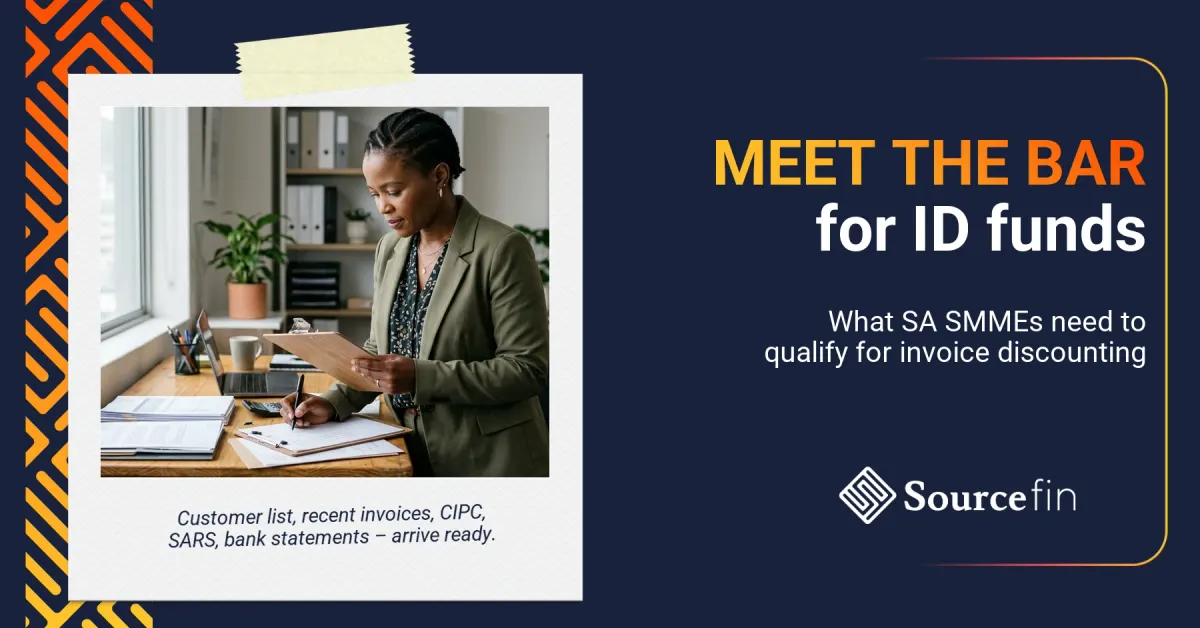
The compliance pack is the standard set of documents every invoice discounting funder will request. Pull these together early.
- CIPC company registration certificate. Confirms your legal entity exists and is in good standing. Annual returns must be up to date.
- SARS tax compliance status (Tax PIN). A current PIN. The SARS tax compliance status guide explains how to retrieve or refresh it.
- South African ID for directors and reps. Standard FICA requirement.
- VAT registration certificate if your business is VAT-registered.
The Financial and Customer Pack
The financial and customer pack shows the funder what your receivables book actually looks like.
- Customer list with payment terms. Who your customers are, what they typically owe, and the agreed payment terms. The foundation of the facility review.
- Recent customer invoices. A sample of invoices from your most active customers. Shows invoice format, value, and terms.
- Business bank statements (3 months minimum). Shows trading activity, customer-payment patterns, and how funds move through the business.
- Aged debtors report if you have one. Helps the funder see the current collection profile across the book.
- For facilities over R1 million, additional financials are usually requested: management accounts for the past 3 months, AFS no older than 18 months, and tax return summaries for the past 2 financial years.
The Customer Profile Funders Look At
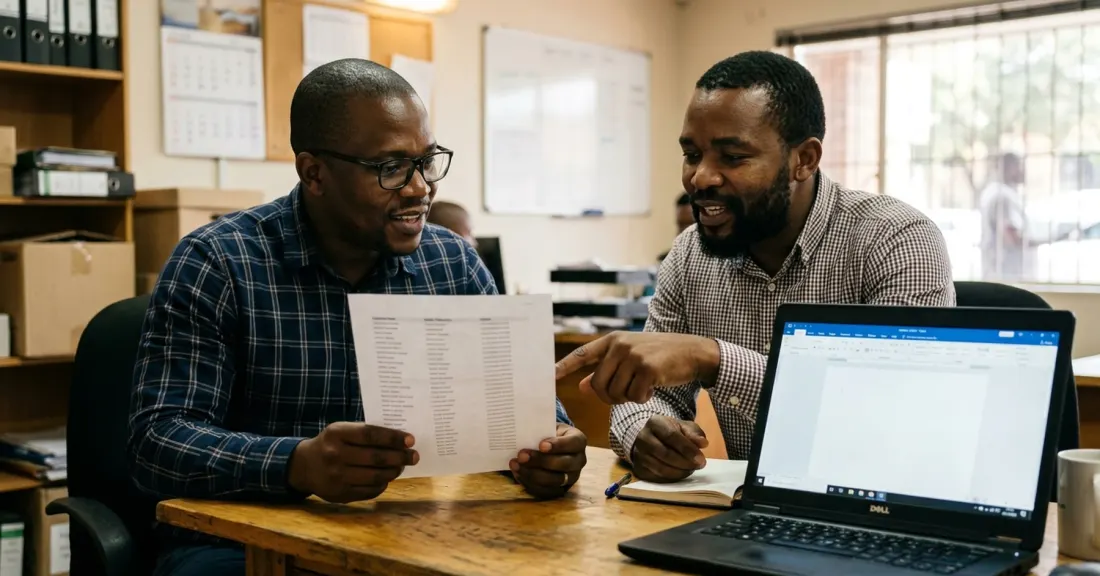
Customer creditworthiness sits at the heart of invoice discounting. The funder is, in effect, lending against the future payment from your customer rather than against your own balance sheet. That makes the customer profile critically important.
Strong customers are characterised by predictable payment behaviour, reasonable payment terms, and financial standing the funder can verify. Government departments and SOEs are typically funded easily because their payment behaviour is documented and traceable. Major listed corporates are similarly straightforward. Mid-market private businesses with several years of trading history fall into a middle category. Small private businesses with no payment record are the hardest to fund against.
Customer concentration is a related concern. If 80% of your invoice value sits with one customer, the facility carries customer-concentration risk that needs separate structuring. The funder may agree to fund the book with adjusted terms or may want to see the concentration reduced over time. The invoice discounting limits guide covers how this plays into facility sizing.
The Three-Pillar Assessment
The documentation requirements exist because Sourcefin assesses every facility against three pillars: trust, the receivables book, and the operational fit.
The trust pillar covers the SMME owner. Bank statement patterns, credit bureau history, prior business activity, and the conversation with the assessor all contribute. A credit issue does not auto-disqualify you – but how you talk about it matters. Disclosure with context outperforms silence followed by discovery.
The receivables book pillar is the heart of the assessment. Customer creditworthiness, concentration, payment-cycle predictability, and the volume of monthly invoicing all feed in. The funder looks at the actual customer list and recent invoices to build the facility around what is genuinely there.
The operational fit pillar covers how the facility will run alongside your existing banking. Will the facility be confidential or disclosed to your customers? How will reconciliation work? Will the funder handle credit control, or will you? The confidential vs disclosed invoice discounting guide covers a key part of this.
SMME Profile: What Funders Look For
The SMME profile is the human layer of invoice discounting requirements South Africa. Funders look for owners who understand their own receivables book. If you can explain who your top customers are, why they pay when they do, where the concentration risk sits, and how invoicing flows month to month, that signals operational competence.
They also look for owners who have done the upstream work. Lined up the customer list. Pulled the aged debtors report. Cleaned up the SARS compliance. Read the bank statements. The applicants who arrive prepared move much faster through the process than those who arrive expecting the funder to fill in the gaps.
What Disqualifies a Facility
Some patterns reliably stop facilities.
A receivables book made up entirely of small private customers with no payment history is difficult to fund. So is a book where the SMME effectively does business with three or four entities and a sudden loss of one of them would collapse the cash flow. Those are concentration risks the facility cannot offset alone.
On the SMME side, active legal proceedings related to fraud, asset stripping, or director misconduct are the strongest disqualifiers. So is dishonesty during the application – a credit issue or customer dispute you tried to hide is a much bigger problem than the issue itself.
How Invoice Discounting Requirements Compare to a Bank Loan
Bank loans and invoice discounting ask for overlapping but different document sets. Bank loans typically require audited or reviewed annual financial statements, comprehensive director balance sheets, and security registrations on top of the standard compliance pack. Invoice discounting leans heavier on the receivables-book documents – the customer list, recent invoices, and aged debtors report – and lighter on long-term financial reporting.
For a fuller comparison of the two, the invoice discounting vs bank overdraft South Africa guide walks through the difference. Once the requirements are clear, the how to apply for invoice discounting walkthrough explains the application process. And if you are still comparing providers, the invoice discounting company South Africa guide covers what to look for in a funder.
The Bottom Line on Invoice Discounting Requirements
Invoice discounting requirements South Africa are practical, not bureaucratic. Bring a meaningful receivables book in the right size range. Bring a clean compliance pack with current SARS, CIPC, and ID. Bring recent business bank statements and a customer list with payment terms. Be honest about anything unusual in your customer concentration. Do that, and the assessment moves quickly.
South Africa's SMME funding gap is well documented. The IFC's recent SA SMME finance partnership work shows that even traditional lenders are moving to widen access. Knowing the requirements – and arriving prepared – is how SMMEs convert opportunity into funded receivables.
To start an application, the Sourcefin funding application form takes a couple of minutes. The Sourcefin invoice discounting service page sets out the full process from there.
Sources & References
Frequently asked questions
What is the minimum requirement to qualify for invoice discounting in South Africa?
The starting point is a meaningful receivables book of at least R250,000 with creditworthy customers and reasonable payment terms (30 to 90 days). Beyond the book, you need CIPC company registration, valid SARS tax compliance, ID for directors, and recent business bank statements. Customer creditworthiness drives much of the assessment – your customers' payment ability matters as much as your own.
Do I need audited annual financial statements for invoice discounting?
It depends on facility size. For facilities below R1 million, AFS are not required – recent business bank statements give the funder enough picture of trading activity. For facilities over R1 million, you do need Annual Financial Statements no older than 18 months, plus management accounts for the past 3 months and tax return summaries for the past 2 financial years.
What kind of customers do I need for invoice discounting to qualify?
Government departments, SOEs, major listed corporates, and well-established mid-market private businesses all qualify naturally because their payment ability is well documented. A receivables book made up entirely of small private customers with no payment record is much harder to fund. The funder is, in effect, advancing against your customers' future payment, which makes the customer profile critical.
Can I apply if my SARS tax compliance status has lapsed?
You can still apply with the essentials – CIPC certificate and customer list. The SARS Tax PIN sits in the bonus document group: it speeds the facility review when current, but is not a hard blocker. Refresh it via SARS eFiling in parallel with the application. If your PIN is current when you apply, send it with the initial submission.
Does customer concentration affect whether I qualify?
Yes. If most of your invoice value sits with one or two customers, the facility carries customer-concentration risk that needs separate structuring. The funder may agree to fund the book with adjusted terms, or may want to see the concentration reduced over time as the business grows. High concentration does not automatically disqualify, but it shapes the facility structure significantly.
What is the minimum facility size for invoice discounting in SA?
Sourcefin funds invoice discounting facilities from R250,000 upwards through to multi-million-rand books. Smaller facilities are usually a poor fit because the operational work involved in setting up and running the facility makes them unworkable for both sides. For sub-R250,000 needs, an overdraft facility or short-term working capital from a commercial bank is usually a better tool.
What stops an invoice discounting application from proceeding?
Three things. The receivables book is too small or made up of customers the funder cannot verify. The customer concentration is so high that loss of one customer would collapse the cash flow. The SMME owner has serious unresolved issues – active fraud proceedings, recent business failures with unpaid creditors, or substantial deception during the application. Documentary gaps are usually solvable. Book-fundamental gaps are not.

Sourcefin is a South African alternative finance provider that offers purchase order funding and invoice discounting to SMMEs, enabling businesses to fulfil confirmed purchase orders or tenders and unlock cash flow without collateral. Unlike traditional lenders or banks, Sourcefin also provides end-to-end support including supplier sourcing, logistics, project management, and risk oversight.