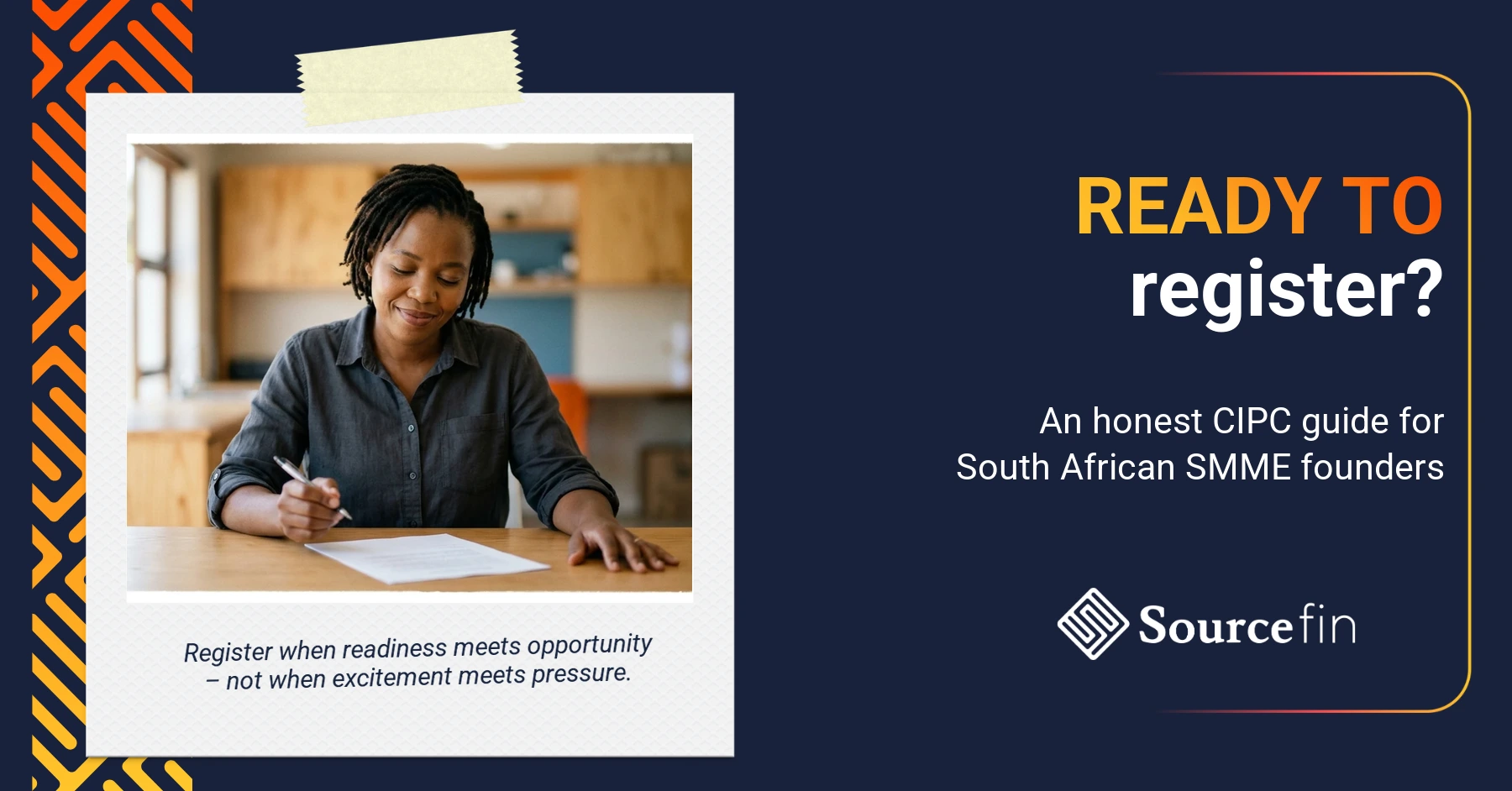

Register a business in South Africa when you have a real client, a confirmed contract, or a clear opportunity that needs a formal entity – not because someone told you to. Registration opens up funding, tenders, and limited liability, but it also brings compliance obligations that punish founders who formalise before they are ready.
Key Takeaways
- Registering a business in South Africa opens up most formal funding routes, government and corporate tenders, and limited liability – but each comes with ongoing CIPC and SARS obligations.
- The CIPC registration process is genuinely affordable (about R175 in fees) and fast (two to three business days). The real cost sits in annual returns, beneficial ownership filings, provisional tax, and bookkeeping.
- Sole proprietors are simplest to start with but usually too thin a structure for serious funding. Pty Ltd companies are preferred by funders. New close corporations have not been registrable in South Africa since 1 May 2011.
- You are automatically registered for income tax with SARS the moment your Pty Ltd is registered with CIPC. VAT registration is only compulsory once turnover passes R2.3 million per twelve months, up from R1 million on 1 April 2026.
- Beneficial ownership filing has been mandatory in South Africa since 24 May 2023 and is now enforced alongside annual returns. Missing it can carry fines of up to R1 million or 10% of turnover.
- If you do not have a customer, a contract, or steady income yet, it is usually smarter to validate the market first and register only when there is something real to formalise.
The cost of being told to “just register” before you are ready
You meet a founder who has been told the answer is to “just register”. They go to CIPC, they get a Pty Ltd, they get an automatic SARS tax number – and three months later they are buried in beneficial ownership reminders, provisional tax forms, and an accountant’s invoice they did not budget for. There is no contract on the table. There is no client. There is just a formal company that costs money to keep alive and quietly erodes the founder’s savings while they work out what the business actually is.
That is the exact tension Sourcefin sat down to unpack with Lerato Mathodlana on The Great Enabler podcast. Watch the full conversation below.
Lerato runs a business compliance practice in South Africa and has walked hundreds of founders through CIPC for the first time. Her opening line was a warning: “Most entrepreneurs believe the first step to starting a business is registering a company with CIPC. But that is often the biggest mistake people make.” Her point is not that registration is wrong. It is that registration without readiness creates exposure – CIPC obligations and SARS deadlines accumulate from day one whether or not the business has revenue.
This guide is the honest version of that conversation. It covers when registration is the right call, when waiting is smarter, what registration actually gives you access to, and what it quietly costs on the other side. Use it as the decision framework before you register a business in South Africa.
When you should register a business in South Africa
Lerato’s threshold for formalising is practical: register when you can fulfil a contract or service a customer. In her words, “as soon as you have done that research in the back end, that speaks to the idea being concrete enough for it to have repeat clients, contracts, and a decent turnover where you can see that this is not going to be wasting my time or frustrating me.” Translation: register when there is something real to register for.
The founders who register a business in South Africa at the right moment tend to share a handful of clear readiness signals before they touch the CIPC portal:
- You have a confirmed customer, contract, or purchase order that needs a registered entity to invoice from.
- You are pursuing tenders – the Central Supplier Database (CSD) only accepts registered Pty Ltd companies or sole proprietors with a tax reference number, and government buyers verify both.
- You need limited liability to separate your personal assets (your house, your car, your savings) from business risk.
- You are pursuing funding from a formal lender or alternative funder, both of which almost always require a Pty Ltd.
- You can absorb the time and rand cost of compliance – annual returns, provisional tax twice a year, beneficial ownership filings, and bookkeeping support.
- You have steady or repeat-revenue potential, not a one-off opportunity that may not return.
If you tick five or six of those boxes, the decision to register a business in South Africa is largely made for you – it is the doorway to the next stage. If you tick two, slow down.
When to wait – and why that is the smarter call
Waiting is not a failure of ambition. It is a refusal to take on obligations the business cannot yet carry. The most common scenarios where waiting wins:
- No revenue yet, still validating the idea. Test the market first. Make calls. Quote three potential clients. Run a trial offer. If nobody pays, the business has no economic foundation – a CIPC certificate will not change that.
- Survivalist or informal trade with no formal buyers. If you are selling to consumers in cash with no need for VAT invoices, a tax reference number, or a tender process, formal registration may add cost without adding revenue.
- You cannot yet cover annual returns, accountant fees, and the time cost of compliance. Year-one running costs of a registered Pty Ltd can comfortably reach a few thousand rand once you include bookkeeping. Without revenue, those become losses.
If this is you, that is fine. Sourcefin has a separate guide on how to start a business with no money in South Africa that covers the validation and first-customer steps. Get the order first. Then come back to this guide and register a business in South Africa when the foundations are in place.
What registering actually opens up
When you register a business in South Africa, you are not buying a status symbol – you are opening a doorway to specific commercial advantages that an unregistered trader cannot access. The honest list:
- Formal funding access. Almost every alternative funder and every bank in South Africa lends to registered companies, not sole traders. Without a registered Pty Ltd, your funding options shrink to friends, family, and personal credit.
- Government and corporate tenders. CSD registration, B-BBEE affidavits, tax clearance, and the SBD bid documents all require a registered entity. So do most corporate procurement panels.
- Limited liability. A Pty Ltd is a separate legal person. If the business is sued or fails, your personal estate – house, car, savings – is generally protected, provided you have not signed personal sureties or acted recklessly.
- A business bank account. Banks require company registration documents to open a business account. Keeping business and personal money separate is the single biggest discipline gain of formalising.
- Buyer credibility. Large buyers prefer registered suppliers. A CIPC registration number on your quote signals that you exist in the system and can be vetted.
- A track record that compounds. Each year of trading as a registered company builds tax history, financial statements, and a business credit profile – all of which lower the cost of future funding.
If you are weighing which funding routes those doors lead to, the complete guide to SMME funding options in South Africa covers every product from bank facilities to alternative funding and asset finance side by side.

The commitment side – what you take on
This is the section most “just register” advice quietly skips. Once you are registered, you owe both CIPC and SARS specific deliverables – on time, every year, regardless of revenue. Treat this section as the year-one running cost you must price into the decision.
CIPC annual returns
Every registered company in South Africa must file an annual return with CIPC within 30 business days of its registration anniversary. Fees start at R100 for companies with turnover up to R1 million and scale with turnover. The annual return is essentially a declaration to CIPC that the business still intends to trade. Miss it for two consecutive years and CIPC starts the deregistration process – your company name, your tender prospects, your tax registration, and your bank account all evaporate at the same time. Sourcefin has a dedicated walkthrough of CIPC registration and annual returns in South Africa if you want the operational detail.
Beneficial ownership filing
Beneficial ownership filings became mandatory in South Africa on 24 May 2023, introduced by the General Laws (Anti-Money Laundering and Combating Terrorism Financing) Amendment Act 22 of 2022, which amended the Companies Act 71 of 2008. A beneficial owner is any natural person who ultimately owns or controls 5% or more of the company. From 1 July 2024, CIPC has enforced these filings alongside annual returns. Companies incorporated after the amendment must file beneficial ownership within 10 business days of incorporation. Penalties for non-compliance can reach R1 million or 10% of turnover, whichever is greater – and CIPC publishes non-compliant companies on its enforcement register.
SARS obligations
When you register a Pty Ltd at CIPC, SARS knows. The two systems are integrated, so you receive an income tax reference number automatically – no separate registration required. From there:
- Income tax. Companies pay corporate income tax on profits (or the lower small business corporation rates if you qualify).
- Provisional tax. Companies must file an IRP6 provisional return twice a year – six months into the tax year and at year-end – even in their first trading year.
- VAT. Compulsory only once turnover passes R2.3 million per twelve months, raised from R1 million on 1 April 2026. Voluntary registration is available once turnover passes R120,000 per twelve months. Sourcefin has a focused breakdown of the VAT registration threshold for 2026 and what it means for SMMEs.
- PAYE, UIF, and SDL. Triggered the moment you put your first employee on payroll.
The wider SARS tax compliance guide for South African businesses covers each of these in operational detail.
Record-keeping discipline
Registration without records is a setup for SARS penalties. You need to keep invoices, expense receipts, bank statements, and supplier records for at least five years. Most SMMEs either learn bookkeeping software early or pay a bookkeeper a monthly retainer. Either way, the discipline cost is real – and it is the single biggest source of late-night anxiety for founders who registered too soon.
Tender prep – CSD and CIDB
If your reason for registering is tenders, CIPC is only step one. The Central Supplier Database (CSD) is the gateway to all government procurement – free to register on, but it pulls your CIPC data and SARS tax compliance status in real time. The CSD registration guide for South African suppliers covers the full process. Construction businesses bidding on public works may also need a Construction Industry Development Board (CIDB) grading.
Sole proprietor vs Pty Ltd vs CC – what to pick
This is the question most first-time founders get stuck on. The honest answer is short.
Sole proprietor. You are the business. No separate legal entity, no CIPC registration, no annual returns. Easiest to start, cheapest to run. The catches: no limited liability (your personal estate is on the line for business debt), no Pty Ltd-only funding products, harder to win formal tenders, and harder to bring in shareholders or sell the business later.
Pty Ltd (private company). A separate legal person. Limited liability, preferred by funders, eligible for every formal procurement process, builds an independent credit and tax history. The trade-off is the ongoing CIPC and SARS obligations covered above. Lerato’s own framing is direct: “PTYs are preferred when it comes to funding partnerships… sole proprietors are too small, too limited to fund.”
Close corporation (CC). Worth knowing the rule because the question still comes up: new CCs cannot be registered in South Africa. From 1 May 2011, when the Companies Act 71 of 2008 took effect, no new close corporations could be incorporated and no conversions from a company to a CC are allowed. Existing CCs (registered before that date) continue to operate under the Close Corporations Act, 1984 unless they voluntarily convert or deregister. If anyone tells a first-time founder to “go register a CC”, that advice is fifteen years out of date.
Partnership. Possible, but treat it carefully. Most SMME partnerships in South Africa do not survive the first three years because the work, talent, and contribution levels of the partners drift over time. The exceptions – medical practices, law firms, some accounting firms – tend to have formal partnership agreements drafted by lawyers from day one. If you are considering a partnership, write the agreement before you register.
How to register a company with CIPC – the plain-English version
The mechanical process to register a business in South Africa is genuinely straightforward. Lerato’s walkthrough on the podcast is correct: you can have a registered Pty Ltd, a tax reference number, and a business bank account in under a week, for less than R200 in CIPC fees.
- Reserve a company name (optional). R50 per application, up to three names submitted in order of preference. The reservation is valid for six months. Pick a name that does not box you into a single industry – “Cleaning Solutions” closes doors, a non-descriptive brand name keeps them open.
- Submit the registration. R125 for a private company (Pty Ltd). Total of about R175 with a reserved name. Done online at the CIPC portal. You add directors, the registered address, and submit identity documents.
- Wait two to three business days. CIPC processes the registration and issues a certificate of incorporation and a registration number.
- Receive automatic SARS registration. Because CIPC and SARS are integrated, an income tax reference number is generated automatically and sent to you – usually within days of CIPC approval.
- File beneficial ownership within 10 business days. This is a hard deadline for newly incorporated companies. Skip it and CIPC enforcement applies from day one.
- Open a business bank account. Take the CIPC certificate and the director’s ID to your preferred bank. Pick a low-fee, pay-as-you-use account – not a fully managed business banker package, unless your turnover already justifies it.
- Register on the CSD if you plan to tender. Free, online, and takes under an hour if your CIPC and SARS records are clean.
If cost is the friction point, the Small Enterprise Development and Finance Agency (SEDFA) – the 2024 merger of SEDA and SEFA – offers free non-financial support to South African SMME founders, including help navigating CIPC and SARS registration.

Questions to ask yourself before you register a business in South Africa
Run through this list before you register a business in South Africa. If you answer “no” or “not sure” to four or more, the smarter move is to wait, validate, and revisit in three to six months.
- Do I have a customer, contract, or real near-term opportunity that needs a registered entity?
- Is my income or pipeline steady enough to cover annual returns, tax filings, and bookkeeping?
- Do I understand my likely tax obligations – income tax, provisional tax twice a year, the VAT threshold (R2.3 million from 1 April 2026), and PAYE if I hire?
- Can I keep proper financial records and meet filing deadlines – or pay someone to?
- Do I need limited liability to separate my personal and business assets?
- Am I pursuing funding or tenders that genuinely require a registered company?
- Which structure fits where I am right now – sole proprietor for low-friction testing, or Pty Ltd for serious trading and funding?
If you want to take that decision out of your own head and into a structured tool, Sourcefin’s Funding Fit Diagnostic asks the same questions in a different format and points to the next sensible step for your specific stage.
After you register – the next moves
Once you register a business in South Africa, the day your CIPC certificate lands is not the finish line. The first 30 days are when the foundation either holds or starts to drift. The non-negotiable next steps:
- File beneficial ownership. Within 10 business days of incorporation. Treat this as part of registration, not as an optional add-on.
- Open a business bank account. Move personal and business money into separate flows on day one. Most regret stories start with “I kept it all in one account”.
- Register on the CSD if you are tendering. Free and fast – do it the same week.
- Decide on bookkeeping. Either pick an accounting tool or appoint a bookkeeper. Do not hand over your CIPC login to anyone except a trusted, named professional – company hijacking is a real and rising risk.
- Get clarity on your tax obligations. Note the dates for your first provisional tax return and the VAT registration trigger. Calendar them.
- Win the first order. The whole point of formalising was to access a level of business that needed it. Now go win the deal you registered for.
When you are ready, Sourcefin is in your corner
Sourcefin’s core position is simple: we can’t always lend, but we always enable. Whether you are about to register a business in South Africa for the first time or already trading, if you are not yet ready for funding, the best thing we can do is help you avoid registering too early, validate the opportunity properly, and come back to us when there is a real order to fund.
When you are registered and the first contract lands – whether a purchase order from a corporate buyer, a tender award from a municipality, or an invoice you need to wait 60 days to be paid on – that is the moment Sourcefin steps in. Banks are built for stability. Sourcefin is built for speed. We have deployed over R3 billion to South African SMMEs, funded more than 1,000 businesses, and maintained a 100% delivery rate doing it.
The two products that fit most SMME cash-flow gaps:
- Purchase order funding – we pay your supplier on your behalf when you have a confirmed order and you do not have the capital to fulfil it.
- Invoice discounting – we advance cash against invoices you have already delivered on, so you do not have to wait 30, 60, or 90 days for the buyer to pay.
When you are ready, the next step is the Sourcefin funding application. For ongoing tender opportunities to fund, TenderCentral publishes verified public and private sector tenders across South Africa.
The decision to register a business in South Africa is not the test of whether you are serious about business. Readiness is. Get the order or the validated client first, register when the obligations match what your business can carry, and treat formalisation as a doorway rather than a hurdle. The Sourcefin orbit is here for you on both sides of that doorway.
In this series: deeper dives on registering a business in South Africa
This pillar is the decision framework. Each of the deep-dive guides below picks up one specific question or decision in detail – read them once you have decided to register a business in South Africa and want the operational answer for your situation:
- Sole proprietor vs Pty Ltd in South Africa: which to pick – the binary structural decision, by readiness and funding intent.
- Beneficial ownership filing CIPC: complete SMME guide – the R1 million risk every newly registered Pty Ltd must avoid in its first 10 business days.
- Year-one compliance costs for a South African Pty Ltd: the honest number – three scenario budgets (bootstrap, mid-tier, scaling).
- Choosing a company name in South Africa that doesn’t box you in – the CIPC name decision that survives growth into new industries.
- Directors and shareholders in a South African Pty Ltd: who to bring on and when – the partnership-risk filter and the case for staying solo.
- CIDB grading South Africa: what construction SMMEs need after registering – the next compliance step for builders aiming at public works.
- Holding company structure for South African SMMEs explained – when a single Pty Ltd outgrows itself.
Related reads from Sourcefin
Companion guides on adjacent topics – tendering, funding, financial discipline – that pair with this decision:
- SMME compliance: the CIPC, SARS and CSD guide – the operational companion pillar to this decision-framework piece.
- Starting your own business: the start-up costs to consider – the cash plan that should precede CIPC.
- Tendering in South Africa: the complete guide – the follow-on path if you are registering to bid.
- How to get business funding in South Africa – funding routes that open once you have a registered Pty Ltd.
- The importance of financial planning for SMEs – record-keeping and budgeting habits that protect a newly registered business.
Sources & References
CIPC. Company Forms and Fees. 2026. cipc.co.za
CIPC. Enforcement of beneficial ownership filings and securities registers. 2024. cipc.co.za
SARS. Corporate Income Tax. 2026. sars.gov.za
Cliffe Dekker Hofmeyr. VAT threshold increased: Should SMEs remain registered? March 2026. cliffedekkerhofmeyr.com
The Great Enabler Podcast. Lerato Mathodlana on starting and registering a business in South Africa. 2026. youtube.com
SEDFA. Small Enterprise Development and Finance Agency. sedfa.org.za
Frequently Asked Questions
How much does it cost to register a business in South Africa?
CIPC charges R125 to register a private company (Pty Ltd), plus R50 per name reservation – about R175 in total with a reserved name. From there, the real recurring costs are CIPC annual returns (starting at R100), beneficial ownership filings, provisional tax preparation, and bookkeeping. Budget a few thousand rand per year for compliance once you are trading.
How long does CIPC company registration take in South Africa?
Most private company registrations complete in two to three business days once you submit the application online through the CIPC portal. Name reservation, if you choose to reserve one, adds another day or two. SARS automatically registers the company for income tax within days of CIPC approval and sends a tax reference number by SMS or email.
Do I need to register for VAT when I register a Pty Ltd in South Africa?
No. VAT registration is separate from CIPC registration and becomes compulsory only once your turnover passes R2.3 million per twelve months (raised from R1 million on 1 April 2026). You can register voluntarily once turnover passes R120,000 per twelve months if VAT-registered status helps your client base. Below R120,000, registration is not allowed.
Can I register a business in South Africa without reserving a name first?
Yes. You can skip name reservation and register a private company for R125 directly. CIPC will assign the registration number as the company name – something like 2026/123456/07. You can apply for a name change later if you want a branded name. Most founders reserve a name (R50 per application) for credibility on quotes and contracts.
What is the difference between a sole proprietor and a Pty Ltd in South Africa?
A sole proprietor and the business are the same legal person – simple to set up but no limited liability and harder to access formal funding or tenders. A Pty Ltd is a separate legal entity with limited liability, preferred by funders, and eligible for every formal procurement process. The trade-off is ongoing CIPC and SARS compliance obligations the sole proprietor does not face.
What happens if I miss a CIPC annual return?
CIPC charges a late filing penalty on top of the standard fee, and the penalty accumulates daily after the 30-business-day window closes. Miss two consecutive annual returns and CIPC begins the deregistration process. Once deregistered, the company name, its tax registration, and its tender eligibility are all lost. Reinstating a deregistered company is possible but expensive and slow.
Do I need an accountant when I register a business in South Africa?
Not on day one – CIPC registration itself does not require an accountant. From the first month of trading, a bookkeeper or accounting software becomes essential to track income and expenses for SARS provisional tax and annual returns. Many founders start with affordable accounting software and add a bookkeeper or accountant once turnover and complexity justify the cost.