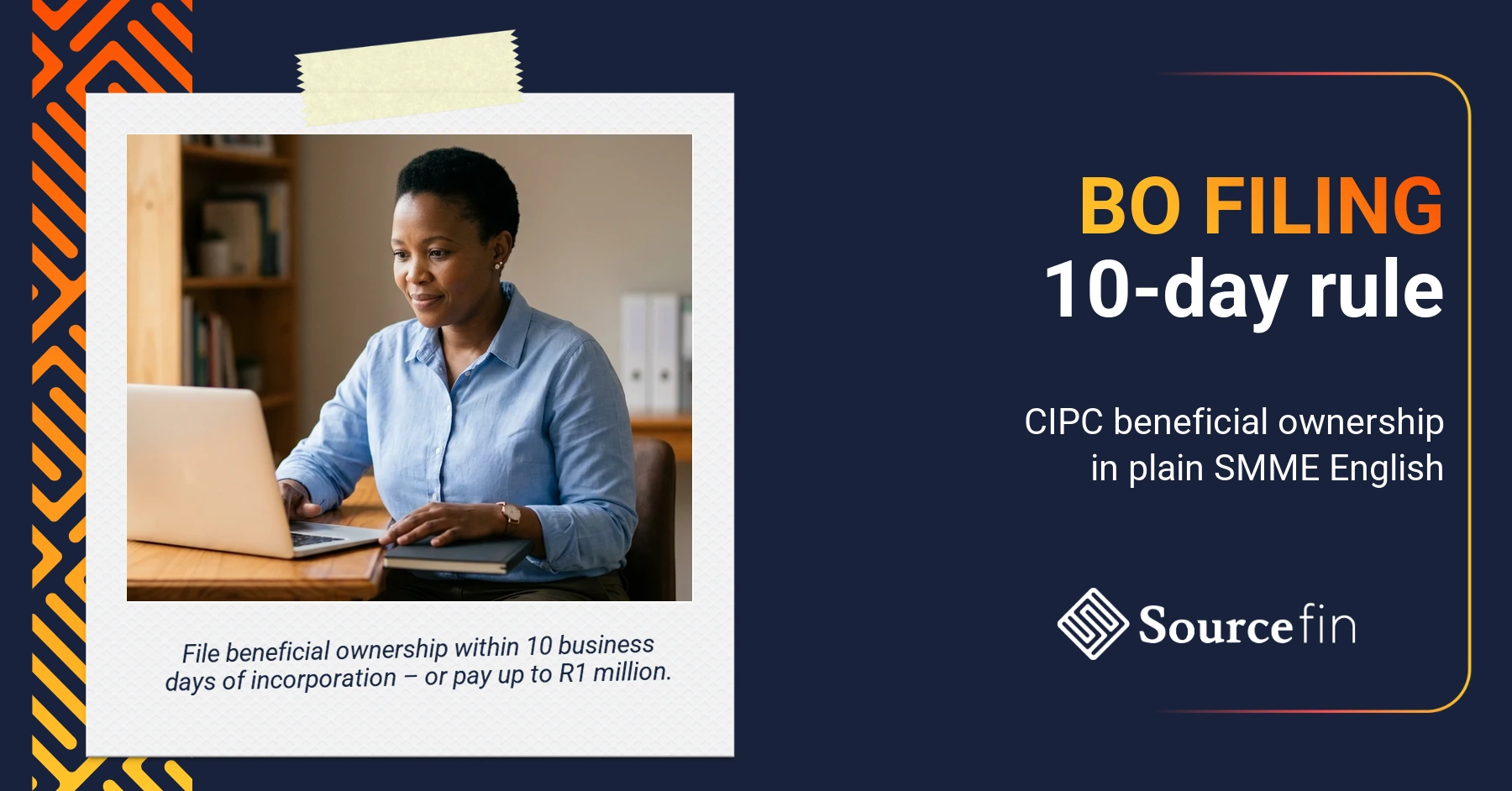

Beneficial ownership filing CIPC is the single highest-stakes compliance deadline a newly registered South African Pty Ltd will face in its first month. Filings became mandatory on 24 May 2023 and are now enforced alongside annual returns. Newly incorporated companies must file within 10 business days of incorporation. Penalties for missing the filing can reach R1 million or 10% of turnover.
Key Takeaways
- Beneficial ownership filing CIPC has been mandatory in South Africa since 24 May 2023, introduced by the General Laws (Anti-Money Laundering and Combating Terrorism Financing) Amendment Act 22 of 2022.
- A beneficial owner is any natural person who ultimately owns or controls 5% or more of the company – directly or through another entity.
- Newly incorporated companies must file beneficial ownership at CIPC within 10 business days of incorporation. There is no grace period.
- Since 1 July 2024, CIPC strictly enforces beneficial ownership declarations alongside annual returns. Missing it can prevent your annual return from being accepted.
- Penalties for non-compliance can reach R1 million or 10% of turnover, whichever is greater. Non-compliant companies are published on CIPC’s enforcement register.
- The filing is free and submitted through the CIPC e-Services portal – the only cost is the time to gather supporting documents and complete the disclosure.
What beneficial ownership filing CIPC actually means in South Africa
This article sits inside Sourcefin’s complete guide on how to register a business in South Africa. The pillar covers the decision to register. This cluster covers the single most-missed compliance step that follows registration: filing your beneficial ownership at CIPC.
A beneficial owner, in South African company law, is a natural person who ultimately owns or controls a company – directly or indirectly. The 5% threshold means that anyone holding at least 5% of the shares (or controlling at least 5% of voting rights, or exercising effective control via any other route) must be disclosed to CIPC by name, ID, address, and the percentage of ownership or control they hold.
The requirement was introduced by the General Laws (Anti-Money Laundering and Combating Terrorism Financing) Amendment Act 22 of 2022, which amended Section 56 of the Companies Act 71 of 2008. The driver was South Africa’s commitment to address Financial Action Task Force (FATF) grey-list findings on anti-money laundering and combating the financing of terrorism. The intent of the register is to make it impossible to hide ownership of a South African company behind nominee shareholders, trust structures, or layered subsidiaries.
Lerato Mathodlana addressed this directly on The Great Enabler podcast. Her framing was clear: “This is an international regulation that actually empowers South Africa to prevent money laundering and company-related crime.” Watch the full conversation – the beneficial ownership section is the most directly relevant to this cluster.
The 10-business-day rule for newly incorporated companies
The hardest part of beneficial ownership filing CIPC is the deadline for new companies. Any Pty Ltd incorporated after the amended regulations took effect must file its beneficial ownership information within 10 business days of incorporation. That is a hard deadline, not a target. CIPC enforcement applies from day one – the filing is part of the act of becoming a company, not a separate later step.
For founders new to the system, the practical sequence after CIPC issues the certificate of incorporation is:
- Receive the CIPC certificate of incorporation (usually within two to three business days of submitting the registration).
- Register on the CIPC e-Services portal if you have not already.
- Log a beneficial ownership filing for the newly incorporated company – name, ID number, residential address, and percentage of ownership or control for every natural person at 5% or above.
- Upload supporting documents – usually identity documents and a share register or securities register.
- Submit. CIPC acknowledges the filing electronically.
If the company has only a single director and shareholder – which is the most common structure for a newly registered SMME – the filing is straightforward. The complication arises when the company has corporate shareholders, trust shareholders, or multiple layers of ownership. In those cases the disclosure must trace through each layer until it identifies a natural person.

What information you need to file
Per CIPC’s e-Services beneficial ownership filing guide, the standard information required for each beneficial owner is:
- Full name and surname (as per ID).
- South African ID number or passport number for non-South African residents.
- Nationality.
- Residential address.
- Contact details – email and phone.
- Percentage of beneficial interest in the company (must be 5% or more to be disclosable).
- Type of beneficial interest – ownership, voting rights, control, or other.
- Date the beneficial interest was acquired.
You will also need to upload a copy of the company’s securities register (which CIPC will accept either as a standalone document or as part of the Memorandum of Incorporation) and a certified copy of each beneficial owner’s identity document.
Beneficial ownership filing CIPC alongside annual returns
From 1 July 2024, CIPC began strictly enforcing beneficial ownership declarations alongside annual return filings. Practically, this means the beneficial ownership filing must be up to date before the annual return can be processed. If your company is due for its annual return and the beneficial ownership filing is missing or out of date, the system will not allow you to file the annual return.
The cascade is real. Miss the beneficial ownership filing, and the annual return is blocked. Miss the annual return for two consecutive years, and CIPC begins the deregistration process – your company name, your tax registration, your tender prospects, and your bank account all evaporate at the same time. Sourcefin’s CIPC registration and annual returns guide covers the deregistration risk in operational detail.
The R1 million penalty (and the enforcement register)
CIPC has been explicit about the consequences of non-compliance. Administrative fines for failing to maintain a Beneficial Ownership Register can reach R1 million or 10% of annual turnover, whichever is greater. CIPC also publishes the names of non-compliant companies on its enforcement register, where they are visible to any potential buyer, supplier, lender, or government department running due diligence.
For an SMME with a turnover of R5 million, the 10% calculation reaches R500,000 – a potentially business-ending penalty for missing a free filing that takes well under an hour to complete. The asymmetry is the point. CIPC has set the penalty high precisely because the filing itself is cheap.
When ownership changes – the update rule
Beneficial ownership filings are not a one-and-done event. If the ownership of your company changes – a director takes a larger share, a new shareholder is added, a beneficial interest is sold – the filing must be updated. The Companies Act requires the update to be filed promptly. Best practice for newly registered Pty Ltds is to treat any change in directors or shareholders as a trigger event for re-filing beneficial ownership.
Common triggers that founders forget:
- Bringing on a co-director or co-shareholder.
- Issuing new shares for funding rounds.
- Buying out a departing partner.
- Transferring shares to a family trust or holding company.
- Removing a delinquent or deceased director.
Each of these requires a fresh beneficial ownership filing. The cost is the same – free – but the discipline of remembering to do it is what separates a clean compliance record from a flagged one.
In this series: more on registering a business in South Africa
This cluster is one of several deep-dives that pair with the main pillar:
- Should you register a business in South Africa? Honest SMME guide – the decision framework that precedes filing.
- Year-one compliance costs for a South African Pty Ltd – where this filing sits in the broader compliance budget.
- Directors and shareholders in a South African Pty Ltd – the structure choices that drive who counts as a beneficial owner.
- Holding company structure for South African SMMEs explained – how multi-entity structures complicate beneficial ownership disclosure.
When the compliance is clean, Sourcefin is next
Clean CIPC compliance – including a current beneficial ownership filing – is one of the first things a funder checks when reviewing a Pty Ltd for a working capital deal. Companies on CIPC’s enforcement register, or with overdue annual returns, struggle to access formal funding regardless of how good the underlying business is.
When your CIPC record is clean and a real order or invoice is in hand, the next step is the Sourcefin funding application. Our two flagship products – purchase order funding and invoice discounting – are designed for the moment between winning the contract and getting paid. Banks are built for stability. Sourcefin is built for speed. R3 billion deployed, 1,000+ SMMEs funded, 100% delivery rate.
Sources & References
CIPC. Enforcement of beneficial ownership filings and securities registers. 2024. cipc.co.za
CIPC. Beneficial Ownership Filing step-by-step guide (e-Services). 2024. cipc.co.za
EY. South Africa: New beneficial ownership reporting requirements for companies. 2023. ey.com
The Great Enabler Podcast. Lerato Mathodlana on registering a business in South Africa. 2026. youtube.com
Frequently Asked Questions
How long do I have to file beneficial ownership at CIPC after registering a company?
Newly incorporated companies in South Africa must file beneficial ownership at CIPC within 10 business days of incorporation. The deadline is a hard rule, not a target. CIPC enforcement applies from day one, and missing the filing can carry administrative penalties of up to R1 million or 10% of turnover, whichever is greater.
Who counts as a beneficial owner for CIPC filing purposes?
A beneficial owner is any natural person who ultimately owns or controls 5% or more of the company. This includes direct shareholders, indirect shareholders through other entities, and anyone exercising effective control over the company by any other route. Layered structures must be traced through until a natural person is identified.
Does beneficial ownership filing CIPC cost anything?
No. The filing itself is free, submitted through the CIPC e-Services portal. The only cost is the time to gather supporting documents – usually copies of identity documents and a share or securities register. Most single-director, single-shareholder Pty Ltds can complete the filing in under an hour once they have their certificate of incorporation.
What happens if I miss the beneficial ownership filing deadline?
Two consequences. First, your next CIPC annual return cannot be processed until beneficial ownership is up to date – the systems are linked. Second, CIPC can impose administrative penalties of up to R1 million or 10% of turnover, and your company name appears on the public enforcement register, which lenders, suppliers, and government departments can see.
Do I need to refile beneficial ownership when my company structure changes?
Yes. Any change in beneficial ownership – new shareholders, share transfers, director changes that affect control, transfers to family trusts or holding companies – triggers a fresh filing. Best practice is to update the beneficial ownership filing in the same week as any shareholder or director change is registered with CIPC.
Do existing companies registered before 24 May 2023 also have to file beneficial ownership?
Yes. All companies registered in South Africa, regardless of date of incorporation, must maintain a current beneficial ownership filing. CIPC enforces existing companies’ filings alongside annual returns from 1 July 2024. If your Pty Ltd was registered before May 2023 and you have not filed, do it before your next annual return is due.