
Purchase Order Funding vs Trade Finance: SA Smart Guide
Purchase order funding vs trade finance in South Africa. What each covers, who it suits, and how SA SMMEs choose between the two.
On this page
- Key Takeaways
- What trade finance covers
- What purchase order funding covers
- When PO funding fits vs when trade finance fits
- Documentary requirements – purchase order funding vs trade finance
- Time-to-fund – purchase order funding vs trade finance
- Cost approach – purchase order funding vs trade finance
- Where the two products complement each other
- The bottom line on purchase order funding vs trade finance
- Frequently asked questions
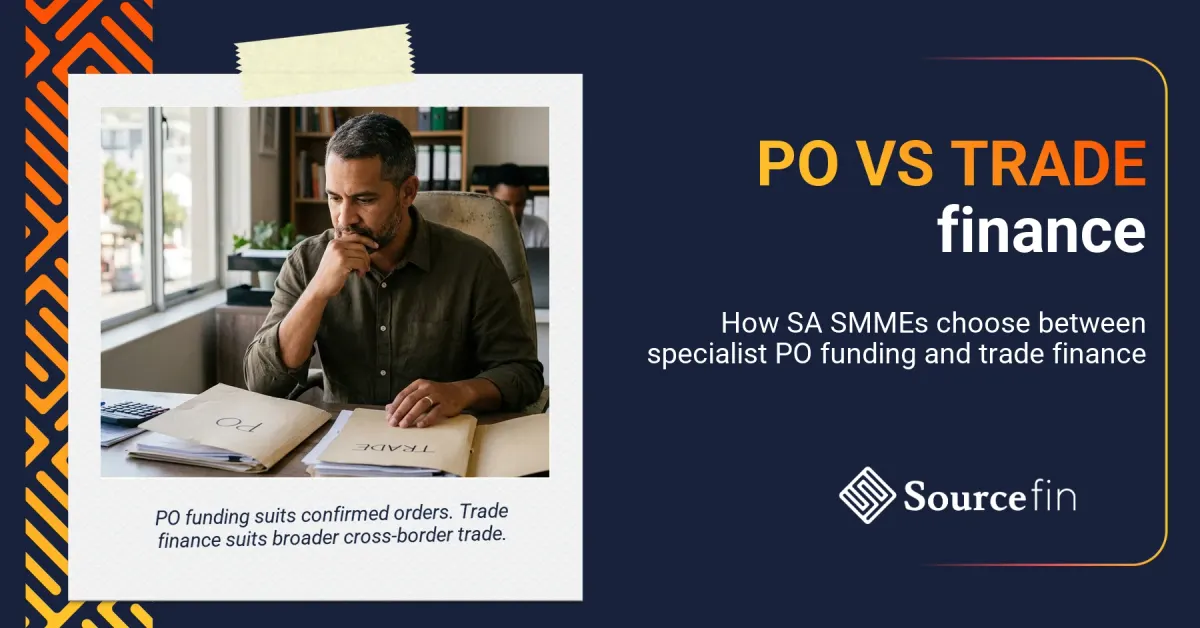
Purchase order funding vs trade finance is a comparison South African SMMEs face when sizing the right finance for a confirmed deal. The short version: trade finance is the broad umbrella covering letters of credit, bank guarantees, structured cross-border transactions and supplier credit; purchase order funding is the specialist niche that pays the supply side of a single confirmed order. SA SMMEs typically use PO funding when the deal is one confirmed order with a credible customer; trade finance when the deal involves complex cross-border structures, multiple banks, or instruments like LCs.
Key Takeaways
- Purchase order funding vs trade finance: trade finance is the broad product family; PO funding is one specialist niche within it.
- PO funding suits SMMEs with one confirmed order from a credible customer who needs the supply side paid before delivery.
- Trade finance suits more complex, often cross-border, structured transactions involving instruments like letters of credit, guarantees, or documentary collections.
- SA SMMEs choosing between purchase order funding vs trade finance should look at deal complexity, customer geography, instrument type, and time-to-fund.
- Apply at the funding application page for a personalised view on which tool fits your specific deal.
What trade finance covers
Trade finance is an umbrella term covering a range of financial instruments that support buying and selling, particularly cross-border. The most common trade finance products include:
- Letters of credit (LCs) – a bank guarantees payment to a seller subject to documentary conditions, governed by the International Chamber of Commerce's UCP 600 standard.
- Bank guarantees – performance, advance payment, or payment guarantees issued by a bank in favour of a buyer or seller.
- Documentary collections – banks act as agents to exchange shipping documents for payment.
- Structured trade finance – bespoke arrangements often involving multiple parties, commodities, or extended payment chains.
- Supplier credit and buyer credit – longer-dated finance to bridge international trade cycles.
Trade finance is typically the product suite that established corporates and larger SMMEs use for cross-border buying and selling. The products are well-established, internationally codified, and bank-issued. They are also often documentation-heavy and slower to arrange than specialist domestic alternatives.
What purchase order funding covers
Purchase order funding is a specialist niche within the broader trade finance landscape. It targets one specific problem: an SMME holds a confirmed purchase order, the supply side needs to be paid before delivery, and the customer pays on terms after delivery. Sourcefin pays the supplier directly, the SMME delivers, the customer pays, and Sourcefin is repaid from that payment.
The model is purpose-built for confirmed-order transactions. It does not require letters of credit, complex documentary structures, or multi-party arrangements. The assessment focuses on the deal itself: confirmed order, credible customer, fundable supplier path, capacity to deliver. Sourcefin's open-minded model assesses these four practical questions on every deal.
For a fuller introduction to the product, see A quick guide to purchase order funding.

When PO funding fits vs when trade finance fits
The choice is usually a function of deal shape, not preference. Practical guidance:
- Domestic SA confirmed order from a government or large corporate customer – purchase order funding typically fits. Speed, documentary simplicity, and the deal-by-deal model match the use case.
- Cross-border import where the supplier is overseas and requires an LC – trade finance fits. The transaction requires the documentary infrastructure banks provide.
- Export to an international customer requiring documentary collections – trade finance fits. Cross-border payment instruments are the standard tool.
- Complex structured deal across multiple parties, commodities, or stages – trade finance fits. Bespoke structures call for the bank arsenal.
- Specialist domestic SMME-scale transaction, including manufacturing inputs sourced internationally where the SMME holds the import relationship – purchase order funding may fit even where imports are involved, because Sourcefin can pay the supplier directly without needing the LC infrastructure.
Many SMMEs find that purchase order funding handles a wider range of confirmed-order scenarios than they initially assume. The deal-by-deal assessment lets Sourcefin evaluate whether the model fits without requiring the SMME to pre-classify the deal.
Documentary requirements – purchase order funding vs trade finance
Trade finance documentation is typically structured around instruments and shipping requirements: commercial invoice, bill of lading, certificate of origin, insurance certificates, inspection certificates, and the LC or guarantee document itself. International standards (UCP 600 for LCs) define the documentation precisely.
Purchase order funding documentation is lighter and SMME-focused:
- Business registration documents (CIPC)
- Proof of business address and bank account
- The confirmed purchase order or contract
- Supplier quotation(s)
- ID for the company directors
The asymmetry reflects the different products. Trade finance handles complex cross-border risk; PO funding handles single-deal supply-side cash flow.
Time-to-fund – purchase order funding vs trade finance
Trade finance turnaround depends on the instrument. LCs typically take days to weeks to issue, longer where the underlying transaction is complex or where multiple banks are involved. Structured trade finance can take weeks or months.
Purchase order funding is designed to move at the pace of the deal. The simplest deals can move in days. Time-to-fund depends on how quickly the application is complete and how clean the supplier and customer documentation is – not on the issuance of an underlying financial instrument.
Cost approach – purchase order funding vs trade finance
Both products price by deal. Trade finance pricing reflects bank issuance costs, instrument-specific charges (LC fees, guarantee fees, document-handling fees), and the underlying credit risk. Purchase order funding pricing reflects the deal-specific risk: customer credibility, supplier path complexity, expected payment terms, and deal size.
For an accurate quote on a Sourcefin purchase order funding deal, apply via the funding application page. The deal team prices each deal on its own merits rather than against a generic rate card.
Where the two products complement each other
Trade finance and purchase order funding are not mutually exclusive. Larger SMMEs and corporates often use both: trade finance for the cross-border import legs of complex deals, purchase order funding for the domestic SA delivery to the end customer. Each tool handles the part of the transaction it is built for.
For SMMEs comparing PO funding against another close cousin – invoice discounting – see PO funding vs invoice discounting. That comparison covers the pre-delivery vs post-delivery split that matters in many SMME deals.
The bottom line on purchase order funding vs trade finance
Choose by deal shape, not by name. For a confirmed SA purchase order from a credible customer where the constraint is paying the supply side before the customer pays, purchase order funding is purpose-built. For complex cross-border structured deals requiring documentary instruments, trade finance is the tool. Sourcefin's specialists assess each deal against the four practical questions and tell SMMEs honestly whether the deal fits.
For broader context, the International Chamber of Commerce publishes trade finance standards including UCP 600 for letters of credit, the Department of Small Business Development publishes SA small-business policy, and the IFC SME Finance Forum publishes the global MSME Finance Gap database covering emerging markets.
Sources & References
- International Chamber of Commerce – Trade finance standards including UCP 600.
- Department of Small Business Development – SA small-business policy and reporting.
- IFC SME Finance Forum – Global MSME Finance Gap database, World Bank Group.
Frequently asked questions
What is the difference between purchase order funding and trade finance?
Trade finance is the broad umbrella product family covering letters of credit, bank guarantees, documentary collections, and structured cross-border transactions. Purchase order funding is one specialist niche within that landscape – it pays the supplier of a confirmed purchase order so the SMME can deliver. Trade finance handles complex cross-border risk; PO funding handles single-deal supply-side cash flow.
When should an SA SMME use purchase order funding vs trade finance?
Use PO funding when you hold one confirmed order from a credible customer and need the supply side paid before delivery. Use trade finance when the deal involves complex cross-border structures, letters of credit, bank guarantees, or multi-party documentary instruments. Many transactions actually fit PO funding even where imports are involved, because Sourcefin can pay the supplier directly without LC infrastructure.
Is purchase order funding cheaper than trade finance?
Both products price by deal. Trade finance pricing reflects bank issuance costs and instrument-specific fees. Purchase order funding pricing reflects the deal-specific risk profile – customer credibility, supplier path complexity, deal size, and expected payment terms. Direct cost comparison only makes sense when looking at a specific deal against a specific quote on both products.
Can I use both purchase order funding and trade finance on the same deal?
Yes. Larger SMMEs and corporates often use both: trade finance for cross-border import legs of complex transactions, and purchase order funding for the SA delivery leg to the end customer. Each tool handles the part of the transaction it is built for.
How long does purchase order funding take compared to trade finance?
Purchase order funding is designed to move at the pace of the deal – the simplest deals can move in days. Trade finance instruments like letters of credit typically take days to weeks to issue, with structured trade finance arrangements often taking weeks or longer. PO funding is generally the faster tool for confirmed SA purchase orders.
Does Sourcefin offer trade finance products like letters of credit?
Sourcefin specialises in purchase order funding rather than the broader trade finance product suite. Where a deal requires letters of credit, bank guarantees, or other documentary instruments, those typically sit with banks that issue trade finance products. Sourcefin's role is the specialist supply-side funding for confirmed orders.

Sourcefin is a South African alternative finance provider that offers purchase order funding and invoice discounting to SMMEs, enabling businesses to fulfil confirmed purchase orders or tenders and unlock cash flow without collateral. Unlike traditional lenders or banks, Sourcefin also provides end-to-end support including supplier sourcing, logistics, project management, and risk oversight.