
Forgotten SMME Funding: Real Support for SA Builders
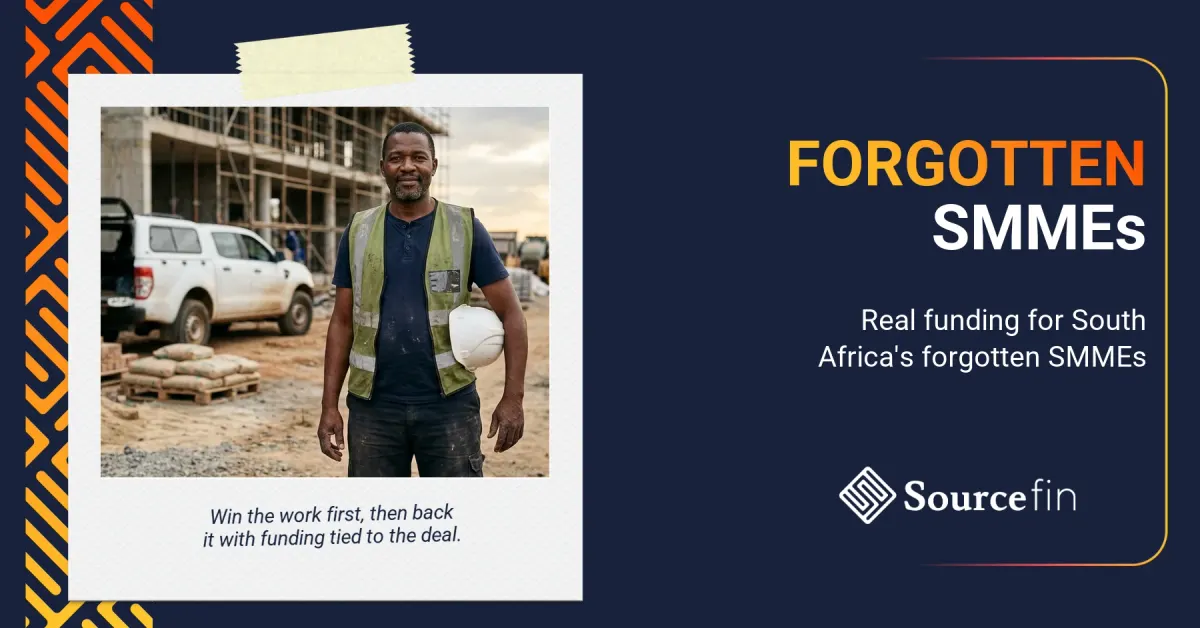
South Africa's forgotten SMME builders win the work but lose to cash flow gaps. Here's what real, open-minded Sourcefin funding looks like in practice.
On this page
- Key Takeaways
- The gap between winning the work and getting paid
- Why the forgotten SMME is forgotten – by the numbers
- What open-minded forgotten SMME funding actually looks like
- The tender truth: visibility and liquidity together
- Impact funding in real life
- How Sourcefin partners and advisors help more forgotten SMMEs find a foot in the door
- About the source
- Frequently asked questions
The forgotten SMME is the trading, delivering, job-creating business that South Africa runs on, but that traditional finance often cannot see. Sourcefin's open-minded funding model backs these owners by linking capital to confirmed work – purchase orders and invoices – instead of credit history alone. The result is real support for SA builders, with sourcing help, project oversight and recovery support alongside the cash. Featured by Sunday Times Ignite, April 2026.
Key Takeaways
- The forgotten SMME is not lacking grit, only the kind of support that matches South African reality.
- SMMEs are over 90% of South Africa's businesses and employ around 60% of the workforce, yet face an estimated R350 billion funding gap.
- Most of the country's SMME-created jobs come from businesses turning over under R1 million a year – exactly the segment most often left behind.
- Open-minded funding looks at confirmed work and real delivery, not only credit history and collateral.
- Sourcefin pairs purchase order funding and invoice discounting with sourcing, project management, legal oversight and recovery support.
- TenderCentral tackles the visibility problem by aggregating verified tenders into one free, searchable place.
- Featured in the Sunday Times Ignite April 2026 edition, the Sourcefin story is a portrait of partnership, not a sales pitch.
The gap between winning the work and getting paid
If you run an SMME in South Africa, you already know the rhythm. You win the work. You secure the purchase order. You get the contract. You quote, you find the supplier, you start planning the logistics. Then the real challenge arrives, and it is almost never the work itself. It is cash flow.
Between "you've got the job" and "you've been paid", there is a gap that can swallow a business whole. Payment terms stretch to 30, 60, even 90 days. Suppliers want deposits upfront. Staff still need salaries. Fuel needs to go into the bakkie. Diesel for the generator does not pay for itself.
And while all of that is happening, you are the one carrying the deal in your own two hands. Many SMMEs end up funding growth with personal risk, family loans, or sheer desperation. None of it is ideal. All of it is common. The pressure of holding a real opportunity together with no working capital is one of the most under-discussed challenges in South African business.
What makes it heavier is that this happens in an economy that depends on SMMEs more than we often admit. The gap is not a niche problem. It is a national one, and it falls hardest on the businesses creating the most jobs in the most overlooked corners of the country.

Why the forgotten SMME is forgotten – by the numbers
The scale of this is easy to miss until you stack the numbers up. More than 90% of businesses in South Africa are SMMEs. They contribute around 40% of GDP, and they employ about 60% of the workforce. When SMMEs move, the country moves. Yet the funding gap remains at an estimated R350 billion, according to research from FinFind.
Look closer and the picture sharpens. FinFind data shows that 80.5% of SMME-created full-time jobs come from businesses with under R1 million turnover per annum. And 65.6% of SMMEs applying for funding sit below that same R1 million turnover line. In other words, the businesses creating the most jobs are the same businesses most likely to be turned away when they ask for capital.
There is a structural reason for this. Around 60% of SMMEs lack collateral, and over 75% do not use accounting systems. The conventional "prove it on paper" model leaves many promising businesses behind, not because they are not real, but because the paper trail does not match the rules of the game.
This is the heart of what Sourcefin calls the forgotten SMME. Not lacking ambition. Not lacking grit. Just lacking the kind of support that matches South African reality. The bigger picture is captured in Statistics South Africa data and amplified by groups like the National Small Business Chamber – SMMEs are the engine, and the engine is running underfuelled.
What open-minded forgotten SMME funding actually looks like
Traditional assessments often miss the mark because they were never built for this segment. They were built for established balance sheets, multi-year audited financials and tangible collateral. Those are reasonable things to want. They are also things that early-stage SMMEs rarely have, even when their next contract is real and signed.
Sourcefin takes a different shape. The starting question is forward-looking: if this opportunity succeeds – the tender delivered, the invoice paid – can the business deliver and get paid? That is what open-minded funding means in practice. It is not about ignoring risk. It is about assessing real risk in context, and then structuring funding that helps the SMME actually deliver.
This is why Sourcefin specialises in purchase order funding and invoice discounting. Both products link funding directly to confirmed work. With purchase order funding, the funding is tied to a legally binding promise of work – the PO itself. With invoice discounting, the funding is tied to delivery already done and an invoice already issued.
This shape matters. It means the question is not "what does your last three years of audited turnover look like?" but "is this deal real, and can we partner with you to deliver it?" That is a fundamentally different conversation, and it is the conversation a working SMME owner needs.
For more on choosing between these two products, the PO funding vs invoice discounting guide walks through the practical differences. For the most common questions SMMEs raise before applying, the SMME funding questions South Africa piece covers them in plain language.
What support beyond capital looks like in practice
Capital alone rarely closes the loop. A well-funded SMME can still hit the wall on supplier costs, delivery timing, contract clauses or slow-paying buyers. So Sourcefin's model pairs funding with practical support across the deal.
That support includes access to over 2 000 pre-vetted suppliers through the in-house sourcing team, often opening up better quality goods at better prices. It includes project management to keep delivery on track, legal and finance oversight to strengthen contracts, and recovery support to help accelerate payments when invoices stretch.
Crucially, incentives stay aligned. Sourcefin only gets paid when the SMME gets paid. There is no scenario where the funder wins and the client loses. That single piece of design changes the whole tone of the relationship – sleeves rolled up, service-driven, transparent – and is a big part of why Sourcefin has been featured in the Sunday Times Ignite story as "a partner in your corner". For more on what that partnership actually looks like in day-to-day terms, see the SMME funding partner South Africa piece.
For real-world examples of this in action, the our clients page is worth reading.

The tender truth: visibility and liquidity together
In South Africa, tenders are sometimes treated like a dirty word. For many legitimate SMMEs, that framing does not match reality. Tenders are a critical route to market, to credibility, to skills development and to employment. The real problem is access. Access to opportunity is often as hard as access to finance.
Tender information is fragmented across multiple portals. It is often outdated. It is frequently locked behind subscription fees that exclude smaller players from the start. A small contractor in Mpumalanga should not have to pay a monthly subscription just to find out that a relevant municipal contract closed last week.
That is why Sourcefin launched TenderCentral in 2025. It is a free platform built to remove these barriers, aggregating verified tenders into one searchable place, with filters by sector and region, deadlines, and documentation accessible at no cost. No paywall. No fluff. Just opportunity, made visible.
This matters because Sourcefin sees the same pattern repeatedly. Entrepreneurs win tenders or secure purchase orders, then struggle to find the upfront capital to deliver. When traditional finance is not the right fit and payment terms stretch, promising opportunities can quietly become high-pressure obligations that push owners toward personal loans and family bailouts.
Sourcefin and TenderCentral address the two persistent barriers facing SMMEs together: visibility and liquidity. Not as a slogan, but as a practical system that helps entrepreneurs find work and fund delivery. For more context on how to actually win in this space, the tendering in South Africa complete guide and finding government tenders are good next reads.
Impact funding in real life
The Sunday Times Ignite feature highlighted three deals that capture what this kind of partnership actually delivers on the ground. None of them are abstract.
The first is innovation at scale. A specialist cool-coating technology supplier, backed through delivery, has been rolled out across national contracts. The work reduces electricity usage and improves working conditions inside heavy industrial spaces. Real climate impact, real working-condition impact, all delivered through a forgotten SMME.
The second is dignity. A school feeding supplier was funded across 25 consecutive deals to keep meals flowing into 13 schools, even when upstream payments were delayed. Children eat. Programmes do not collapse halfway through a term. That is what cash flow timing looks like when it goes right.
The third is community. A wastewater infrastructure project worth roughly R350 million stopped raw sewage flowing into people's homes in the Vaal. The contract was real, the SMME was capable, and the missing piece was upfront capital. Sourcefin filled that piece, and a community got its dignity back.
For a deeper look at how these deals get structured on the ground, the construction case study is the most detailed write-up.
How Sourcefin partners and advisors help more forgotten SMMEs find a foot in the door
One of the quieter truths in this space is that many forgotten SMMEs do not know that funding like this exists. They have an accountant, a broker, a mentor, an industry body – and that network is often where the first conversation about cash flow happens. The wider that network reaches, the more SMMEs get found.
That is the role of AffiliateHub. It is a formal channel for accountants, advisors, brokers, and industry connectors to refer SMMEs into Sourcefin's funding process and earn commission on successful deals. It is built to extend reach into corners of the economy where the forgotten SMME is hardest to find but most needs to be backed.
For the SMME owner reading this, the front door stays simple. The first step is the funding application. Tell us what you've won, what you need to deliver it, and the conversation starts there. For broader growth context, the strategies for scaling your South African SMME guide pairs well with funding decisions.
About the source
This article draws directly on the Sourcefin feature published in the Sunday Times Ignite April 2026 edition under the title "Access to Opportunity. Funding to Deliver. A Partner in Your Corner." The full digital edition is available at issuu.com. Statistics referenced come from FinFind's published SMME funding gap research and from broadly available South African SMME contribution data. Where the Sunday Times Ignite feature offered language that captured the lived reality of forgotten SMMEs, we have chosen to honour that language rather than rewrite it.
Sources & References
- Sunday Times Ignite, April 2026 edition – original Sourcefin feature
- FinFind – SMME funding gap research and SMME job creation data
- Statistics South Africa – SMME contribution data
- National Small Business Chamber – SMME advocacy
Frequently asked questions
What is a 'forgotten SMME' in the South African context?
A forgotten SMME is a real, trading South African business that traditional funders often cannot see, usually because it lacks long credit history, audited financials, or hard collateral. These are the businesses that win the work but struggle to fund delivery. They are not lacking ambition or grit, just the kind of support that matches South African business reality on the ground.
Why do banks turn down SMMEs that are trading and delivering?
Banks operate within deliberately conservative mandates designed to protect depositors and maintain financial stability. Their assessment models lean on long credit history, audited financials, and tangible collateral. Many smaller SMMEs simply do not match that profile yet, even when they have signed contracts and real opportunities. It is not a question of will, it is a question of design. Different lenders are built for different jobs.
How big is the SMME funding gap in South Africa?
Research published by FinFind estimates South Africa's SMME funding gap at around R350 billion. The same research shows that 80.5% of SMME-created full-time jobs come from businesses turning over under R1 million per annum, and that 65.6% of SMMEs applying for funding sit below that R1 million line. The job creators most often sit in the funding blind spot.
What is the difference between purchase order funding and invoice discounting?
Purchase order funding releases capital before delivery, against a confirmed PO, so the SMME can pay suppliers and execute the contract. Invoice discounting releases capital after delivery, against an issued invoice, so the SMME does not have to wait 30, 60, or 90 days to be paid. Both products link funding to confirmed work rather than backward-looking financials.
How does TenderCentral help forgotten SMMEs?
TenderCentral is a free Sourcefin platform launched in 2025 that aggregates verified South African tenders into one searchable place, with filters by sector, region, deadline, and documentation. It removes two of the biggest access barriers smaller SMMEs face: fragmented tender information across many portals, and subscription paywalls that lock out smaller players. The point is to make opportunity visible to everyone.
How does Sourcefin AffiliateHub work?
AffiliateHub is Sourcefin's formal referral channel for accountants, financial advisors, brokers, and industry connectors who already work with SMMEs. Partners refer SMMEs into Sourcefin's funding process, track referrals in real time, and earn commission on successful deals. The point is simple: the wider the trusted network reaches into the economy, the more forgotten SMMEs get found and funded.

Sourcefin is a South African alternative finance provider that offers purchase order funding and invoice discounting to SMMEs, enabling businesses to fulfil confirmed purchase orders or tenders and unlock cash flow without collateral. Unlike traditional lenders or banks, Sourcefin also provides end-to-end support including supplier sourcing, logistics, project management, and risk oversight.