
The delivery gap: what SMMEs need after winning the work
Winning the tender is the start, not the finish. Sourcefin's Ben Atie and Herman Lubega on the delivery gap and how to improve your chances of getting funded.
On this page
- Key takeaways
- Why small businesses need more than money
- What is the delivery gap?
- We back where you're going, not where you've been
- What partnership looks like in real life
- When a deal doesn't fit the usual mould
- Five ways to improve your chances of getting funded
- What if the answer is no?
- How to get started
- Frequently asked questions
The delivery gap is the space between winning a contract and actually delivering it: getting a team on site, finding the right suppliers, negotiating a fair price and delivering on time. A real funding partner closes it by backing the opportunity, helping structure the deal and staying close until the goods arrive and your client pays.
Key takeaways
- Winning the tender is the start, not the finish line. The delivery gap opens the day you win.
- Money alone doesn't close the delivery gap. Speed, supplier connections and help planning the deal do.
- Sourcefin asks three things: can we trust you, can the work be done, and will your client pay?
- Be open early, read before you sign and don't leave funding to the last minute.
Why small businesses need more than money
You've won the tender. You pop the champagne. Then it hits you: now you actually have to deliver.
South Africa's small businesses face a funding gap of more than R350 billion. As Business Report points out, the problem isn't a shortage of money. It's that many businesses aren't ready to qualify yet.
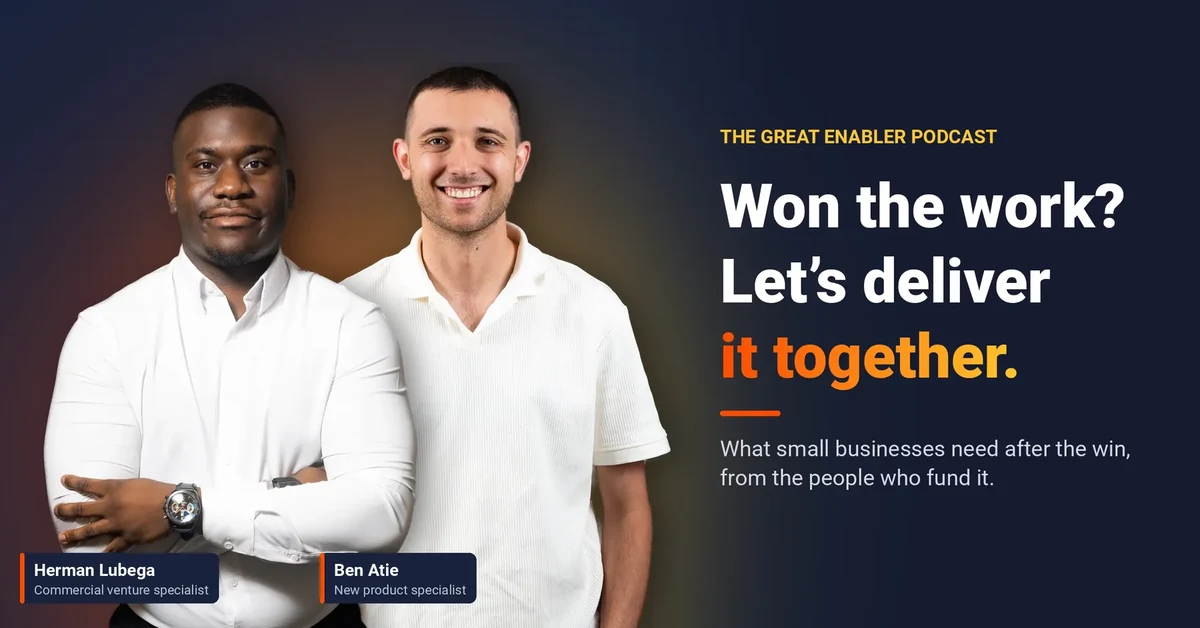
On a recent episode of The Great Enabler Podcast, Jedd Harris sat down with Ben Atie, new product specialist, and Herman Lubega, commercial venture specialist, from Sourcefin's innovation team. Their job is simple: find a way to say yes.
Banks look after other people's savings, so they need security, years of trading and strong financials. That's how they're built. Many good small businesses don't tick those boxes yet. They're too new, too small or too different. We call them the forgotten SMMEs. What they need isn't only money. It's speed, and someone to help them plan the deal properly.
What is the delivery gap?
There's the funding gap, and there's the delivery gap. The funding gap is about getting the money. The delivery gap is about what happens next: getting your team on site, finding the right suppliers, negotiating a fair price and delivering on time. That's where many businesses get stuck.
Herman Lubega explained how Sourcefin approaches it.
"We're not just going to advance you the money, say good luck and hope our money comes back in 30 or 60 days. We're going to partner with you to make sure the goods get delivered from point A to Z, at the right time and to the right spec."
– Herman Lubega, commercial venture specialist, Sourcefin
That's why we connect you with more than 2,000 suppliers we trust, and with other clients who can help you deliver. It's the difference between a lender and an SMME funding partner.
We back where you're going, not where you've been
Jedd puts it simply: we back the opportunity, not the history. Traditional lenders ask what you own. We ask what you can deliver. Character still matters, but your future matters more.
And here's the thing. If you deliver, your client pays, you make your profit and we get paid back. Closing the delivery gap is how your win becomes our win.

What partnership looks like in real life
Cash stuck in an insurance claim
A building supplier was opening a new office when one of its clients didn't pay. Insurance would cover it, but the payout would take months. Within two weeks, we advanced part of the claim, so the business could keep buying stock and paying staff.
A deal outside our comfort zone
When a mining deal came in, Ben and Herman were the first to admit they aren't miners. So they brought in industry experts to check the deal on the ground and help plan it from start to finish.
Chuck Chilli: when to take the money
Chuck Chilli's founder came to us expecting another no. Instead, the first meeting was all about his opportunity, not his debt. His deal manager even told him not to take all the money at once, because you pay for what you take. That advice saved the business a couple of salaries. Read the full Chuck Chilli Foods case study.
That's partnership: putting you first.
When a deal doesn't fit the usual mould
Most businesses we work with need purchase order funding to buy stock for an order, tender funding to deliver a government contract, or invoice discounting to get up to 75% of an unpaid invoice now.
But the innovation team also looks at deals that don't fit neatly. One recent example: a promoter couldn't sell tickets until he'd booked a big-name DJ, and couldn't book the DJ until he'd sold tickets. We paid for the booking and were paid back from ticket sales. Deals like this take longer, and we can't promise a yes. But we will look.

Five ways to improve your chances of getting funded
1. Tell us everything upfront
If there's a problem, tell us in the first meeting. We can plan around what we know. A surprise two months in can sink the deal.
2. Read before you sign
Ben saw a deal fall apart a week before delivery because the client only objected to a key term at the very end. Read everything. Ask questions early. It's fine to take a few hours to think.
3. Don't leave funding to the last minute
Start early, so a delay doesn't cost you the order. Make funding your plan A, not your plan B.
4. Stay in touch every day
Your deal manager is on your side. Herman calls them your biggest champion. Keep talking, and your deal keeps moving.
5. Be honest, even when it means "not yet"
One business owner turned down money days before payout because he didn't need it yet. That honesty earned our trust. Money you take before you're ready still costs you.
What if the answer is no?
Ben's rule: if it's a no, say so quickly. Nobody should be left waiting. Often, a first no just means we need more information, and the deal still goes ahead. And if we can't fund you yet, we'll point you to the next step, like finding your next opportunity on Tender Central.
At the end of the episode, Herman's advice was simple: don't lose hope. Ben's: choose your partners carefully. And Jedd's: funding isn't money sitting in a bank account. It's what that money does when it leaves.
How to get started
Not sure what kind of funding you need? Take the free Funding Fit diagnostic. Already won the work? Apply for funding early, so the delivery gap never becomes the reason you lose the order. When the funding fits, the growth follows.
Sources & references
- The Great Enabler Podcast – How to survive the tender using purchase order funding, with Ben Atie and Herman Lubega
- Sourcefin – Chuck Chilli Foods case study
- Business Report – South Africa's R350 billion SME funding gap: a call for business readiness (January 2026)
Full episode transcript
Edited for readability. Watch the full episode on YouTube.
Meet Sourcefin's innovation team
Jedd Harris: Ben, Herman, very nice to have you. This is a first for The Great Enabler podcast. I haven't interviewed two people in the same session before, so this is going to be interesting, and I don't think there are two nicer people to have done it with. I honestly have no idea where this conversation is going to go, so it's going to be something different for the viewers.
Jedd Harris: We're built to enable. As Sourcefin, as The Great Enabler. And what does enable mean? It means taking a business or a person from where they are to where they want to go, and making that process easier through shared wisdom and the life experiences we've had. So by the end of anything we do on The Great Enabler, an SMME should have watched the video and thought, I'm actually in a better position to access funding, grow my business or hire a team. I have no doubt that sitting with the two of you, there will be lessons for SMMEs to take their business to the next level. Because it's your first time on The Great Enabler, let's start where all good conversations start, with an introduction. Ben, do you want to start us off?
Ben Atie: Sure. Hi, YouTube. I'm Ben Atie. I'm a new product specialist at Sourcefin, an actuary by background, and very excited to be here.
Jedd Harris: And Herman.
Herman Lubega: I'm Herman Lubega, commercial venture specialist at Sourcefin. I'm a chartered accountant, I've been at Sourcefin for just over a year now, and it's been a good journey.
Jedd Harris: Very interesting titles, very snazzy ones. I don't know if they let you choose your own titles.
Ben Atie: A bit of corporate jargon.
Jedd Harris: Take us through what that means. Ben, starting with yours.
Ben Atie: Sure. New product specialist. Sourcefin has two core products that it's really an expert in: purchase order funding and invoice funding. But there are other very natural funding opportunities that come out of being a funder connected with SMMEs, opportunities that present themselves. So on paper, my job is to look at new product opportunities for Sourcefin. Be that asset finance, trade finance, or the more unusual financing of locked-away cash: receivables, insurance claims, court orders, things like that. I'll let Herman speak to the other side, which is ventures.
Herman Lubega: We sit within the innovation team at Sourcefin. Like Ben said, one side is new products, and the other side, where I sit, is new ventures. What opportunities are out there? Is it geographical expansion? How do we reach as many SMMEs as possible? Strategic collaborations or partnerships, and potentially strategic investments in companies that could add a lot to the Sourcefin ecosystem. It is quite funny, when we say our roles, people say, "That's amazing," but then, "What is that?"
Jedd Harris: Sometimes they don't even ask the follow-up. They just say, "That's amazing," and leave it there.
Herman Lubega: But ultimately, it's really about how we reach as many SMMEs as possible. The funding gap South Africa has is well documented, because a lot of SMMEs struggle to get funding from traditional lenders. So we come in to try to find solutions. We work with the client a lot, and a lot of what we see is a first for us. It's about how we mitigate the risk to a tolerable level for Sourcefin, and in the same way, how we help SMMEs with a contract they've won or a project they've been awarded. It's that problem-solving approach.
What a forgotten SMME is
Jedd Harris: We often say Sourcefin was born to enable the forgotten SMME. Ben, tell me what that means to you. What does a forgotten SMME mean, and how does Sourcefin help bridge the funding gap?
Ben Atie: A lot is said about SMMEs being the backbone of the economy. They contribute 35 to 40% of our GDP, yet less than 10% can qualify for bank funding. What is a forgotten SMME? I think it's that other 90%. It's very nice that banks say they care about SMMEs, and it's very nice that SMMEs are the backbone of the economy, at least in narrative. But practically, what SMMEs need is funding, obviously, but they also need the speed that comes with it. They often need guidance on how to actually structure something like this. They need advice: should I order this stock, should I import from overseas, should I expand locally or globally, which market should I attack, what product entry should I have? All of that is part of enabling the SMME economy in South Africa.
Ben Atie: What's really cool about the innovation team is that banks have a mandate they have to meet. Clients have to have a certain balance-sheet strength or sufficient trading history. Whereas for Herman and me, the goal and the role is to find a way to say yes. Funding requests come in, and it's our job to quickly come to an answer: is this something we can fund? If so, how are we going to structure it, and how quickly can we release the funds? Every day we walk in, it's a brand new challenge. We have no idea what's going to walk through the door. It could be international or local, agriculture or commodities. Every day is a new and exciting challenge, and Sourcefin has given us this platform to enable as many SMMEs as possible in South Africa.
Herman Lubega: And what's important is that banks are great. They are the custodians of the nation's wealth, so they have to act with a level of responsibility, which means there are a lot of deals they can't do because of certain risk factors. Do you have sufficient collateral to pose as security? A lot of the SMMEs we deal with are really good, strong businesses, but they haven't been trading for three years. They don't have the track record, or they don't meet certain financial thresholds banks apply. But they have very solid businesses that, with a funding partner who really walks the journey with them, could go five or ten steps ahead. That's what we try to do. And we don't only look at one-off transactions. We try to structure things so that next time they have something similar, they know where to go.
Jedd Harris: The money a bank uses is Herman, Ben and Jedd's money sitting in our accounts, and we probably wouldn't want them to take huge risks with it. Sourcefin is funded differently, so our shareholders are comfortable for us to take that type of risk. There are some deals a bank's mandate will just never allow it to do. It's not that the opportunity isn't there.
What the delivery gap is
Jedd Harris: Herman, you mentioned the funding gap. When I interviewed Josh a while back, he spoke a lot about the delivery gap. You win an opportunity, but you can't necessarily execute on it. A lot of SMMEs make the mistake of winning the tender, popping the champagne, and then realising, "Oh, I actually have to deliver this thing now." In your words, what is the delivery gap?
Herman Lubega: That does happen often.
Jedd Harris: To be honest, once you've been awarded the tender, that's when the hard work really starts.
Herman Lubega: Exactly. Now you have to rally the troops, buy your supplies and get people on site. Ben spoke to it in his answer. SMMEs need more than just funding. They need assistance. They need experts and partners who are going to help them deliver, because people get awarded tenders but don't actually know who the right suppliers are, whether they could get discounts, how to negotiate with suppliers and how to actually deliver, especially on projects with performance risk. That's the delivery gap: there isn't a lot of assistance to help the SMME once they've got the funding. And I think that's what Sourcefin does really well. We're not just going to advance you the money, say good luck and hope our money comes back in 30 or 60 days. We're going to partner with you to make sure the goods get delivered from point A to Z, at the right time and to the right spec. It's that partnership approach, as opposed to us just being a funder. Slowly, we're doing our part in narrowing that delivery gap.
Ben Atie: Just to add, one thing I'm always blown away by when we meet clients is how impressive a lot of them are: their business acumen, the way they think through problems. If you're a big corporate with a problem, you can always throw money at it. SMMEs definitely don't have that luxury, so they really are grinders and operators. That's why it's so important for Sourcefin to build longer-term relationships with these SMMEs. You need to supply and deliver laptops? We can put you in touch with one of our preferred suppliers, or with another client who delivers desks, so you can build something together. It's not just delivering on one tender or purchase order. It's longer-term relationships that help these SMMEs get from a smaller level to a much more established business, where they can procure bank funding, expand their reach or achieve far more of their goals.
What partnership looks like on real deals
Jedd Harris: I'm very involved in the marketing side at Sourcefin, and a lot of funders call themselves partners. Our first tagline ever was "Partners for growth". That was the tagline when I joined five years ago, and it's truly something real on the ground. I'd love to hear an example from both of you. What does partnership literally look like in the Sourcefin context?
Ben Atie: One of the deals we ran is a great example. The client is a supplier of building materials and ceramics, and they did quite a lot of business. They had given some of their debtors 30-day terms, and one of those debtors defaulted. It was a particularly bad time for them to lose that debtor from a cash-flow perspective, because they had just started looking to expand. They were opening a new office. They approached us and said, "No one else really knows what to do with this, but we've submitted a trade credit insurance claim." Trade credit insurance says that if one of your debtors defaults, the insurer will pay you out. The problem, as is inevitable, is that things are slow. The insurer has to check that everything is legitimate, that there's no fraud, that the default actually happened and the goods were delivered. It's a long, slow process, and it was burning a hole in the client's pocket at a time when they needed to buy more stock and pay wages. Within two weeks, from introduction to funds out, we were able to advance a percentage of that insurance claim, and they used the funds to turn their stock. At the end, once repayment happened, the client wrote to say they really enjoyed working with us and would definitely think of us again. For me, that's what partnering is about. It's not just that we advanced the funds. It's that they felt they had a real problem, Sourcefin came in with a real solution, and it plugged a really important gap. That's why Sourcefin should exist.
Herman Lubega: It speaks to what we were saying earlier: we really will try to find a solution for clients in any industry. We're currently in the middle of a commodity transaction, typically a high-risk industry that people don't really understand. It's very technical. So we reached out to partners of ours who are experts in the industry and told them about the deal. We said, "This is the offtake agreement, and we need to cover everything in between: from the raw material, through the beneficiation process, to the end product." I'm not a miner. Ben's not a miner. We don't have that sector expertise, so we brought in fellow partners to be our eyes and ears on the ground, help us perform our due diligence and ultimately structure a transaction where we're able to deliver. It speaks to out-of-the-box thinking and going beyond even our comfort zones to find a solution, because ultimately it was a great contract, and if the client could fulfil it, it would be incredible.
Jedd Harris: It's mutually beneficial as well. By being partners and investing more than just funding, we improve the likelihood of a successful delivery, and by doing so, we improve the chances of Sourcefin being repaid at the end of the deal. We enable them for success, which ultimately enables us to be repaid. It's a really nice circle.
Chuck Chilli and the drawdown advice
Jedd Harris: One of the examples I've had of partnership on the ground is Chuck Chilli. They're quite famous at Sourcefin and were one of the early guests on the podcast. The founder had been on a rejection road show. He'd been turned down by multiple entities, and his bank told him he'd exhausted his overdraft and some of his debit orders were bouncing.
Chuck Chilli founder (clip): We are using most of our current overdraft month to month. We clear it and then we max it, clear it and max it, continuously. So when they look at us, they say you don't really qualify for anything at the moment.
Jedd Harris: He was referred to Sourcefin, and our head of revenue, who was new and eager to prove himself, gave the client an amazing experience. What struck me in that interview was that the founder said he was deflated. He had given up hope. Everyone had rejected him, and he was ready for another rejection from Sourcefin.
Chuck Chilli founder (clip): What really brought us hope was the questions you were asking, because in the first meeting I was not very hopeful.
Jedd Harris: What changed his mind was the way we asked questions in the first meeting. It was all about the opportunity, not how much debt he had or what his balance sheet looked like. We wanted to understand the opportunity, the business and where he and his partner wanted to take it. It was a high-risk deal for Sourcefin, because it wasn't one we usually do, but our head of revenue guided him on exactly when to draw down. The founder said, where in your life have you found a funder who tells you when to draw down? Because the funder only earns when you draw down. So now he had a funder telling him not to draw down too soon, because we needed to prove the cash flow would stabilise. He said that guidance saved him a number of people's salaries on that deal.
Chuck Chilli founder (clip): The more you draw down up front, the more interest is accumulating, and that makes a difference. For a small business like us, that difference was a couple of people's salaries in the end.
Jedd Harris: For me, that's partnership in action. It's putting ourselves second and the SMME first to enable them.
Sourcefin underwrites the opportunity, not the history
Herman Lubega: I think that's the forward-looking approach. In that interview, it was all about the work, all about the contract, because if you're able to deliver on the contract, it increases our chance of being repaid. And the way we typically structure with a profit share, the SMME also walks out benefiting. So it's not about what's happened in the past, your defaults or your judgments. I think that's how we differ from traditional lenders. It's really: if we come and partner with you on this deal and make sure it goes well, will we get paid at the end?
Jedd Harris: Exactly. And the answer is yes. I usually sum it up as: Sourcefin underwrites the opportunity, not the history. Traditional lenders are very much underwriting the history. Your collateral, your property, do you own this, do you have judgments? At Sourcefin, it doesn't really matter where you came from. Obviously it's important from a character perspective, but what's more important is where you're going. That's where we place our emphasis.
Purchase order funding and invoice discounting in 30 seconds
Jedd Harris: Our core products are purchase order funding and invoice discounting, and I love asking each team member for their perspective. Ben, PO funding in 30 seconds or less. What is it?
Ben Atie: In its simplest form, a client receives a purchase order for the delivery of laptops, desks, chairs, cameras, anything. PO funding gives the client the money to purchase the stock, and we recover off the back of that. What makes Sourcefin's PO funding unique is what we've spoken about: yes, there's the funding component, but much more importantly, there's assistance with delivery. Making sure specs are right, delivery happens where it has to, timelines are met, and constantly communicating with the offtaker. All of that ensures success, not only on the deal but in the potential growth of our client, because it gives them the opportunity to get another PO and grow the business. But in its simplest form, it's paying for stock.
Jedd Harris: Very nice, Ben. No pressure, Herman. Invoice discounting. I'll admit, when we launched the product, it took me a while to understand what invoice discounting meant, so we now often call it invoice funding. In 30 seconds or less, Herman, what is it?
Herman Lubega: I must agree with you. At first I was like, guys, what is this? But really, you have an SMME who has already delivered on their work. They've already paid the costs to fulfil the contract, and now they invoice their end buyer. The end buyer says, "Amazing," but they probably have 30-day or 60-day payment terms. So you've earned that revenue, but you have to wait. What Sourcefin does is come in on day one and advance a percentage of that invoice, so you can pay your suppliers, your salaries and your rent today. We take on the timing risk until the end buyer pays, and in that time you've continued with your operations and taken on new work. You just don't have to wait for that time lag anymore.
Funding deals that don't fit a box
Jedd Harris: You both work slightly outside those two products. For the audience's sake, that doesn't mean far outside them. You're the team I send people to when an SMME at a conference gives me an example of a deal that I'm not sure fits invoice discounting or PO funding, but it feels like it has a forward-looking edge. What are some of those outliers, how do you think about structuring them, and what should an SMME bring to improve its chances?
Ben Atie: Over my time at Sourcefin, about a year as well, we've looked at some really wild, out-of-the-box things. They often get rejected, but it's always fun to read through the proposal first. The most important thing is that it applies Sourcefin's thesis on lending: we back the client, not the balance sheet, and we back the contract, not the history. Everything we look at tries to fit within that lens, and that can take you to some really interesting places. We actually just completed a deal for what we're calling, for now, pre-event funding. Say Jedd is really excited because he wants to bring DJ Herman into the country for an event. Jedd wants to sell tickets so he can pay for DJ Herman, but he needs to announce that DJ Herman is coming to do that. Of course, he can't announce DJ Herman until he pays for DJ Herman. So you've got a chicken-and-egg situation. But from a certain perspective, it's no different. We came in, provided the funds, paid to confirm the DJ, the event could be announced, and we recovered off the back of ticket sales. It's really purchase order funding done a little backwards. The goods are the DJ, and recovery happens after delivery of the announcement. An organisation like that, running an event, doesn't have the balance-sheet strength or trading history to prove it works. But if we believe DJ Herman is going to sell out the stadium, why shouldn't you be able to get funding on the back of that?
Herman Lubega: What's important on this deal, and all deals we work on, is that up front, in the first meeting, we'll say, "This isn't typically what we do, but we're always happy to have the meeting," because there's a lot we can learn as well. You asked what an SMME can do to help its application. In these sessions, give us as much information as possible and let's work together to find something that works for you and for us. Had we not been at Sourcefin, we probably wouldn't have come across a scenario like pre-event funding. It was about understanding how tickets are sold, when you announce the artist and how the money flows, and it took multiple sessions to understand how we could structure it. The SMME doesn't have to have all the answers up front. As long as they're transparent and share all the relevant information, it has a good likelihood of going through, or at least we can propose a solution. Ultimately it's up to them to accept or decline, but at least we've put our best foot forward.
Managing expectations on new deal types
Jedd Harris: What I also like is that you manage expectations up front, which is very important. I had a session with Josh earlier, and he's working on quite a sizable order. He said he's 49/51 on whether it goes ahead. I asked him, "You've worked on this for weeks. What happens if it gets rejected?" And he said, "Jedd, in meeting number one I said I'm happy to look at it, but I cannot guarantee we're going to get a yes."
Ben Atie: It's a completely novel concept, and we have to go to the investment committee. When we start, we tell clients exactly that: we're happy to look at this and apply our minds to it, but you have to exercise a bit of patience with us. It's not going to be your normal Sourcefin turnaround time. We'll keep you updated, but it will take multiple sessions to understand how to structure it. And because we're often the first through the door on these deals, it can throw off other stakeholders. You'll call someone and say, "We need you to do a slightly unusual session to give us comfort," and they'll say, "I can do it, it's just so unorthodox." And we say, "We know, but this is how we get it over the line." That's where clients cooperating with us makes a huge difference.
Your deal manager is your biggest champion
Herman Lubega: I think it was in one of your previous interviews with Cody where you said the deal manager is your best friend. The way I see it, the deal manager is the client's biggest supporter inside Sourcefin. They represent the client's best interests and really try to push the deal forward. When you propose something to the client, they can see you're doing your best to find a solution. And sometimes, after a couple of weeks or a month or even two of structuring, it does get to the rejection phase. But because they could see from the beginning how involved you were and how much effort you put in, that difficult conversation is easier. They're a lot more understanding. More often than not, we're probably not their first option. Some people haven't heard of Sourcefin and go to their banks first. So we come in closer to the end, but the fact that we worked with them to find a solution means they feel heard.
Ben Atie: Communication is so important. There shouldn't be a day that goes by while the deal is being structured that you aren't in constant communication. "What's the update? Have you sent this through?" Especially on the work we do, which is complicated and takes time to structure correctly. As a client, your expectation should be that you're constantly hearing from your relationship manager or deal manager. I once heard someone say that when a funder puts money into your business, yes, it's debt, but they've almost come in as an equity partner. And any partnership only works when there's open and clear communication on all sides.
The deals that got away
Jedd Harris: Great points. Let's turn to the deals that got away. A lot of the time, SMMEs feel rejections only hurt the business that was rejected. What I've come to learn is that there's a big bit of hurt on our side too, when the credit committee or investment committee says no. Take me to a time when a deal got away, and how it felt.
Herman Lubega: Those aren't easy. When a deal has been going on for about two months and you've really been trying to find a solution, you're so heavily invested that when you go to credit committee and they point something out, you're the one saying, "No, guys, this is what we need to do. I'll go back and get this." You just want to make it happen. You do take it personally. But often, after credit committee or investment committee, it's not an outright rejection. More comfort is needed, or specific answers. So we go back to the drawing board and back to the client with the feedback, and something that was originally a rejection ends up getting over the hurdle.
Ben Atie: Clients don't often see what happens on the back end: the late nights deal managers put in, the compliance team getting things in order. We've been in credit committees after putting hours into bigger deals. We had one with a quasi-equity type structure that fell at the last hurdle, and I remember I just had to get out of the building and clear my head. You become invested in the client's success, and nothing breaks a deal manager's heart more than seeing a deal fall through after all that work. That's why it's so important that potential pitfalls come up early, even the ones you're scared of. It's so much easier to get things over the line when we have all the information up front and know how to structure it and mitigate the risk, as opposed to a last-minute hitch after two months of work.
Jedd Harris: I couldn't reach Ben for a week after that one.
Avoidable rejections and what to learn from them
Jedd Harris: Think of a deal from your time here that was an avoidable rejection, where if the client had done one thing differently, it would have been approved. Let's use it to educate the SMMEs watching. I interviewed Dudu recently and he spoke about timing. The end buyer said that if the stock wasn't there two days before the deadline, they wouldn't accept it and would most likely cancel the PO. He was at credit committee, ready to sign, but the end buyer wouldn't extend. What had happened was the SMME had been promised funding by a family friend, who pulled out after a while, and they started the application with Sourcefin too late. You can't commit to funding when you're not guaranteed the extension. Imagine funding branded stock that arrives and gets rejected. You can't do anything with it. As hard as it was, Dudu said he didn't want to put the client in a position where stock was rejected and they still owed Sourcefin money. The learning there is to have funding as a plan A, and know the players in the funding space, whether it's Sourcefin or others, before you go ahead. Can you think of a deal like that?
Ben Atie: I had a deal where we'd gone through all the stages. We presented a term sheet, they accepted it, and we were in the middle of the legal agreements, which for us can be quite complicated because they're tailored to the specific deal. The client came back with some comments, and at the bottom was a note saying a specific term was unacceptable to them. The problem was that it was a key term for us, in the original term sheet and in all the conversations. I don't think the client did it maliciously. I think they were stressed, looked at the price, and didn't read the rest of the terms. The deal fell through because it was non-negotiable for us, and credit committee had approved the deal with that term in mind. It was really avoidable. The lesson for any SMME is: read the terms before you sign, but more than that, set your non-negotiables up front. Think about the impact of what you read. Guys often come in a rush and blindly accept anything, and that can put you in a dangerous position down the line. There's nothing wrong with saying, "Sounds good. Can I take a couple of hours to think about it?" It's better for us too. If we'd known it was an issue up front, we would have structured it differently. But three weeks later, with delivery the next week, there was nothing we could do.
Jedd Harris: To add to that, an SMME should realise the funder has to be comfortable with the risk, because it's the funder's money going out. It's not a tactic to delay until the end and assume that because so much effort has gone in, the funder will just accept the terms. A funder can pull out at the last minute. That's why it's such good advice to raise your non-negotiables up front.
Ben Atie: One of our rules is that if it's going to be a no, get to a no as quickly as possible. It's important for everyone. We aren't spending time on it, and the SMME knows what's going on. If you're dragging them along and they expect funding because they haven't heard a no, and then two months later they get an email saying "we regret to inform you", they're left wondering what they did wrong.
Honesty builds trust
Herman Lubega: I'll take a different angle. What's really good to see from an SMME, from a funder's perspective, is openness and truthfulness. Just today we got feedback on a deal we've been working on for a while. We'd gone through term sheets and legal agreements and were almost at the point of disbursing. The SMME came to us and said, "Guys, it would be great to get your money, but to be honest, your money is probably better spent elsewhere right now. I've found a solution for now. Let's revisit in a month. I don't feel I'd make the best use of the funds right now." You'd think that if someone can get money, they'll just take it. He could easily have signed and had money in his account tomorrow. On one side, there goes our work. But on the other side, that honesty is refreshing. It builds a level of trust, and when that client comes back in a month, it's left a sweeter taste and we're a lot more open to looking at something again.
Ben Atie: It's the easiest sell to credit committee in the world. We always ask who the client is and what their character is. Being able to tell that story, credit committee will practically say, "Don't even tell us about the deal. We trust you."
Jedd Harris: You're 100% right. A business coach I once interviewed said funding is a powerful tool, but it's powerful both ways. It can drive growth, but if you're not ready for it, it can expose weakness and frailty. If you accept money when you're not ready, that money comes with a cost. It's not that you just give the money back with no fee attached. If your business isn't generating the cash flow, it's probably better to have no funding than to accept whatever you can get. Our first question is, can we trust you? That client showed we can. With a client who hides something in the first interaction, we inevitably find it, because we have a very good process, and that trust is breached. You'll always be hesitant taking it to credit committee, because the question isn't only whether they can pay us back, but whether they will.
The calabash – wisdom worth sharing
Jedd Harris: Gentlemen, it's been unbelievable. I'm almost envisaging an "Ask the innovation team" segment, where we take questions from SMMEs and tackle them one by one with your actuarial and CA expertise. One final question. We've been sitting next to the calabash, the symbol of our podcast. When I look at a calabash, I think of people sitting in a circle, passing it around and sharing wisdom through their stories, which is exactly what we've been doing for the last hour. Think of one piece of advice you'd place in the calabash to share with the audience.
Herman Lubega: What's important, and it's easier said than done, is not to lose hope. It's very easy to become despondent after many rejections. But think of the Chuck Chilli story. Yes, a few rejections in the past, but if you believe in your product and your service and what you're able to do, you will come across the right partner for you if you keep trying. We've often been the last resort and funded the deal. So keep the energy to keep moving despite hardships and rejections, because once you find the right partner, they'll support you to the end.
Ben Atie: To add an actuarial twist: people talk about the 80/20 rule, which is based on the Pareto distribution. It says roughly 80% of what happens to you comes from 20% of the decisions or moments. The tails of the distribution, those small, random decisions, have such a meaningful impact on your life. So don't give up, and don't lose hope. I think South Africa is in quite an exciting place, and as Sourcefin grows and expands there's real excitement in the space. Choose the right partners. That's really important, because the wrong partner will take you down the wrong path. And keep going, because I know we said it's just a narrative in some ways, but it really is true. SMMEs are the backbone of this economy.
Jedd Harris: And where there's crisis, there's opportunity. That's what I find at Sourcefin. Outside these walls, it can feel like doom and gloom, and people ask when you're moving overseas. But we get to see that South Africa is on the up. We get to see concerts being hosted, commodities being delivered, and products on supermarket shelves that wouldn't be there if someone hadn't looked at a funding decision a little differently. We get to see communities being impacted. Funding isn't money in a bank account. It's what that money does when it leaves the bank account. Guys, it's been a privilege. You can see why Sourcefin is on the up: highly talented, highly intelligent, but most importantly, highly passionate about the sector we serve. Thank you so much.
Herman Lubega: Thanks for having me.
Ben Atie: I loved being here. Thank you.
Frequently asked questions
What is the delivery gap for SMMEs?
The delivery gap is the space between an SMME winning a contract and actually delivering it. It covers getting a team on site, finding reliable suppliers, negotiating a fair price and meeting the client's deadline and specification. Funding alone does not close the delivery gap. Supplier connections, deal structuring and close support through to payment do.
What does a funding partner for SMMEs do?
A real funding partner for SMMEs does more than advance cash. It backs the opportunity rather than the business's history, helps structure the deal, connects the business to the right suppliers and stays in close contact until the goods are delivered and the end buyer pays. Funding starts the deal. Partnership gets it delivered.
Can I get funding without a long trading history?
Some funders, including Sourcefin, assess the opportunity in front of you rather than how long you've traded. They look at whether you can be trusted, whether the work can be delivered and whether the end buyer can pay. A newer business with a confirmed order and a solid plan can still qualify.
Why can't banks fund some SMME deals?
Banks look after depositors' money, so their mandate requires collateral, balance-sheet strength and a trading history. Many SMME deals, such as a large tender won by a young business, fall outside that mandate by design. Specialist funders built for deal-specific risk can step in where bank criteria don't apply.
What happens if Sourcefin can't fund my deal?
Sourcefin aims to give a clear answer quickly, so you aren't left waiting. A first decline is often a request for more comfort rather than a final no, and the deal manager will explain what's needed. Where funding isn't possible yet, the team points you to the next step towards becoming funding-ready.

Sourcefin is a South African alternative finance provider that offers purchase order funding and invoice discounting to SMMEs, enabling businesses to fulfil confirmed purchase orders or tenders and unlock cash flow without collateral. Unlike traditional lenders or banks, Sourcefin also provides end-to-end support including supplier sourcing, logistics, project management, and risk oversight.