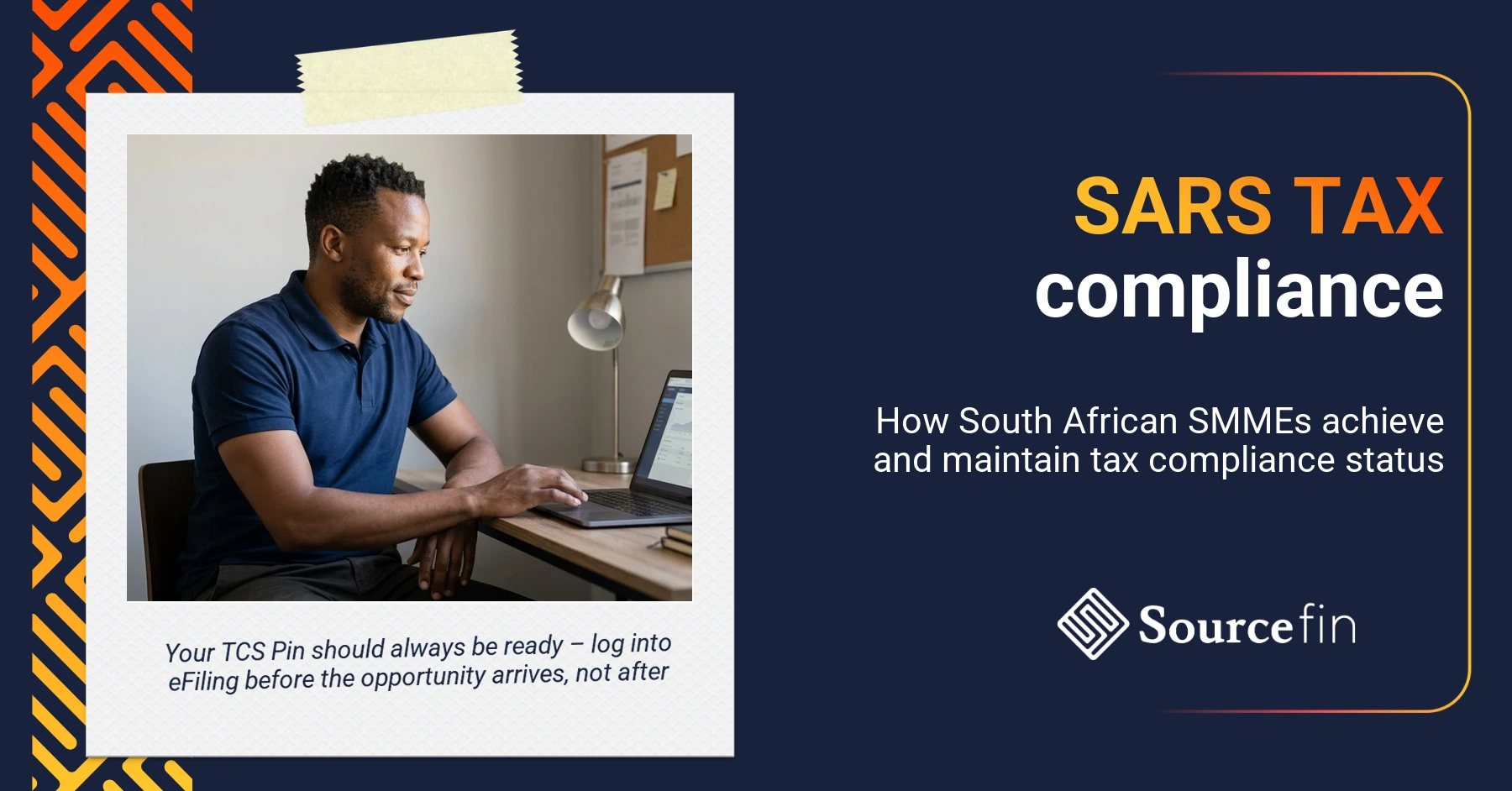

SARS tax compliance is verified before every government tender is processed, every CSD profile is activated, and every funding deal is assessed. Your Tax Compliance Status – accessible through SARS eFiling – tells funders and government buyers whether your business is safe to transact with. Understanding what it means, how to check it, and how to keep it green is one of the most practical things any South African SMME owner can do.
Key Takeaways
- SARS tax compliance status is verified in real time via your TCS Pin – funders and government buyers check it directly before any deal proceeds.
- Compliant means all returns filed, no outstanding assessments, and no undisputed tax debt across income tax, PAYE, VAT, and provisional tax.
- A single missed return or outstanding payment can switch your status from Compliant to Non-Compliant, sometimes within 24 hours.
- Your SARS status feeds directly into your CSD profile and is cross-checked against your CIPC registration whenever a compliance verification is run.
- Fixing a non-compliant SARS status takes time – getting compliant before you need the TCS Pin is always faster than trying to fix it under pressure.
What SARS Tax Compliance Means in Practice
SARS tax compliance is not a certificate you apply for and receive once. It’s a real-time status that reflects the current standing of all your tax obligations. When you share your TCS Pin with a government procurement officer or a funder, they don’t look at a document you printed last month – they pull your live compliance status directly from the SARS system at that moment.
A compliant status means four things: all your returns have been filed on time, there are no outstanding tax assessments, there is no undisputed tax debt, and your tax affairs are in order across every relevant tax type. In the context of our broader guide to SMME compliance and funding access, SARS tax compliance sits alongside CIPC registration and CSD status as one of the three pillars that determine whether your business can access funding and government opportunities.
The types of tax that affect most SMMEs are income tax (corporate tax on business profits), provisional tax (advance payments on expected income), PAYE (if you have employees on payroll), and VAT (if your taxable turnover exceeds the mandatory registration threshold). All of them feed into your overall compliance status.
Income Tax and Provisional Tax: What Every SMME Must File
Every registered company in South Africa must file an income tax return – an ITR14 – with SARS each year, regardless of whether the business made a profit. A zero-return is still a return. Failure to file means SARS may raise an estimated assessment, which creates a tax liability that sits against your compliance status until resolved.
Provisional tax applies to businesses and individuals whose income is not subject to full PAYE withholding. Most SMME owners who receive income through their companies rather than a salary will be provisional taxpayers. Provisional tax is paid in two instalments during the tax year – a first payment at the six-month mark and a second at year-end – based on an estimate of taxable income. Missing either payment or significantly underestimating your liability attracts penalties that affect your compliance standing.
The key discipline here is consistency. Keep your bookkeeping current throughout the year so your provisional tax estimates are accurate. Surprises at year-end – large unexpected liabilities – are harder to resolve quickly than a tax position managed month by month.
VAT Registration: When It Becomes Mandatory and What It Requires
VAT registration becomes mandatory once your business’s taxable supplies exceed R1 million over any consecutive 12-month period. If you are approaching that threshold or have crossed it, you must register with SARS as a VAT vendor – failure to do so creates backdated liability and compliance problems.
Once registered, you must submit VAT returns on a regular cycle – monthly or bi-monthly depending on your turnover – and remit the net VAT collected. Late submissions and late payments both affect your SARS tax compliance status. A missed VAT return is one of the fastest ways to become non-compliant, because the system flags it immediately at the next compliance verification.
Voluntary VAT registration is available from R50,000 in taxable supplies if it benefits your business – for example, if you supply primarily to VAT-registered entities and want to claim input tax credits. Speak to your accountant about whether voluntary registration makes commercial sense for your specific situation.
How to Check Your Tax Compliance Status
Your SARS tax compliance status is managed through eFiling at efiling.sars.gov.za. Log in to your eFiling profile, navigate to the Tax Compliance Status section under My Compliance Profile, and request your TCS Pin. The system will generate a unique PIN that a third party – a funder, a procurement officer, a buyer – can use to verify your current compliance status directly with SARS.
Your TCS Pin is valid for a limited period and reflects your status at the moment it is checked, not when it was generated. This means a pin you generate today may reflect a different status tomorrow if a return becomes overdue or an assessment is raised overnight.

For this reason, the best practice is to check your TCS status proactively – not just when a tender or funding application requires it. Log into eFiling at least monthly. Make it a habit the same way you review your bank balance. If you see a compliance flag, you want to discover it on a quiet Tuesday, not the day before bid closing.
Common Reasons Businesses Become Non-Compliant – and How to Fix It
The most frequent causes of non-compliant SARS tax compliance status among South African SMMEs are: outstanding income tax returns from previous years, missed provisional tax payments, overdue VAT submissions, PAYE payments not made on time, and disputes with SARS that have been left unresolved.
Outstanding returns are the most common and the most fixable. Log into eFiling and check your return history across all tax types. File every outstanding return – even if you cannot pay the liability immediately. Filing the return stops the non-submission penalty from accumulating and opens the door to entering a payment arrangement with SARS.
If you have a tax debt you cannot settle in full, SARS does allow taxpayers to arrange deferred payment plans. A formalised arrangement with SARS – where you are meeting the agreed payment schedule – can restore your compliance status. What keeps you non-compliant is ignoring the debt, not the debt itself.
Your CIPC registration and your CSD registration both depend on your SARS compliance status being active and current. A non-compliant SARS status creates a chain reaction across all three compliance pillars.
SARS Tax Compliance and Your Access to Funding
Every funding pathway – commercial banks, government-linked programmes, and alternative funders – requires some form of SARS tax compliance verification. Banks check it when you apply for a business loan or overdraft. Government tender processes require a valid TCS Pin at bid submission. The Central Supplier Database cross-checks your SARS status in real time and will flag a non-compliant profile immediately.
Alternative funders like Sourcefin look at SARS tax compliance as part of a broader deal assessment. Unlike traditional banks, we don’t base decisions solely on credit history – we assess whether the specific opportunity is viable and whether the end buyer will pay. But compliance is still required. A non-compliant SARS status signals financial disorganisation that introduces risk into every deal we’d structure.
If your SARS tax compliance is currently non-compliant, start with your eFiling profile today. File outstanding returns, arrange any outstanding payments with SARS, and work toward restoring your compliant status before you approach any funder. The sooner you fix it, the sooner the opportunities open back up. When you’re ready to explore purchase order funding or invoice discounting, start your Sourcefin application and we’ll work through the picture with you. For broader context on the receivables product, see the South African invoice discounting pillar.
Sources & References
South African Revenue Service (SARS). Tax Compliance Status and eFiling Guide. 2026. Retrieved from sars.gov.za
National Treasury, South Africa. Preferential Procurement Policy and Compliance Requirements for Government Suppliers. 2026. Retrieved from treasury.gov.za
Frequently Asked Questions
How do I check my SARS tax compliance status in South Africa?
Log in to SARS eFiling at efiling.sars.gov.za and navigate to My Compliance Profile, then Tax Compliance Status. Request your TCS Pin and check that your status reads Compliant. The pin can be shared with funders or procurement officers so they can verify your status directly. Your compliance status reflects the current state of all your tax obligations — not a historical snapshot.
What does a SARS Tax Compliance Status of Non-Compliant mean?
A Non-Compliant TCS status means one or more of your tax obligations are outstanding — this could be an unfiled return, an outstanding tax assessment, an unpaid debt, or a combination of these across income tax, VAT, PAYE, or provisional tax. Non-Compliant status prevents you from bidding on government tenders, completing CSD verifications, and being approved by most funders until resolved.
What is a TCS Pin and how do I use it?
A TCS Pin (Tax Compliance Status Pin) is a unique code generated through SARS eFiling that allows a third party — a funder, procurement officer, or buyer — to verify your current tax compliance status directly with SARS. It is valid for a limited period and reflects your status at the time it is checked, not when it was generated. You can generate a new TCS Pin at any time through eFiling.
When must a South African business register for VAT with SARS?
VAT registration becomes mandatory once your taxable supplies exceed R1 million over any consecutive 12-month period. Once registered, you must submit VAT returns on the cycle SARS assigns — monthly or bi-monthly — and remit the net VAT collected. Voluntary registration is available from R50,000 in taxable supplies if commercially beneficial. Failure to register when required creates backdated liability and compliance problems.
What is provisional tax and who must pay it?
Provisional tax is paid by businesses and individuals whose income is not fully subject to PAYE withholding — which includes most SMME owners receiving income through their companies. It is paid in two instalments during the tax year based on estimated taxable income. Missing either payment or significantly underestimating your liability attracts penalties that affect your SARS tax compliance status.
How do I fix a non-compliant SARS status?
Start by logging into eFiling and reviewing your compliance dashboard across all tax types. File every outstanding return, even if you cannot pay the liability immediately — filing stops the non-submission penalty from accumulating. If you have a tax debt you cannot settle in full, SARS allows formalised payment arrangements. Meeting an agreed payment schedule can restore your compliance status. Ignoring the debt is what keeps you non-compliant.
How does SARS tax compliance affect tender bids and government funding?
Government procurement regulations require a valid TCS Pin showing Compliant status for any bid submission. The Central Supplier Database also cross-checks your SARS compliance status in real time — a non-compliant status flags your CSD profile immediately and prevents procurement officers from processing your bid. Alternative funders like Sourcefin also verify SARS compliance as part of deal due diligence for government-linked transactions.