
Fuel Levy Repayment 2026 South Africa: Practical SMME Plan
Fuel levy repayment 2026 South Africa: how Treasury is funding the R6 billion gap, what changes after May 5, and a practical SMME planning checklist.
On this page
Fuel levy repayment 2026 South Africa is a question of timing and trade-offs, not a single bill arriving in the post. The R3 per litre reduction granted from 1 April 2026 cost the fiscus around R6 billion in foregone revenue. National Treasury closed that gap for the April-to-May window using a combination of unspent vaccine programme funds, higher than expected platinum group metal royalties and a draw from the Gold and Foreign Exchange Contingency Reserve Account. The relief is now scheduled for re-evaluation on 6 May 2026, when the Department of Mineral Resources and Energy publishes the next monthly fuel price adjustment. SMMEs that depend on diesel or petrol need a plan that does not assume the relief will continue.
Key Takeaways
- The R3 per litre fuel levy reduction granted on 1 April 2026 cost the fiscus approximately R6 billion in foregone revenue. That figure was covered through three Treasury sources, not a future levy clawback on consumers.
- Treasury has stated the relief will be re-evaluated monthly. The next data point is the Department of Mineral Resources and Energy fuel price adjustment on 6 May 2026.
- If the relief is not extended, industry projections point to a petrol price increase of roughly R1.82 to R2.14 per litre and a diesel jump of around R5.92 per litre.
- SARS upgraded the diesel refund system in 2026 with geotagging on diesel deliveries and a side-chain ledger to authenticate refund claims, tightening the documentation requirements for qualifying primary-production sectors.
- SMMEs should plan for two scenarios: relief continues for a further month, and relief expires. The right working-capital response covers both.
Where the R6 Billion Came From, and Where It Did Not
One of the more persistent misconceptions about the fuel levy reduction is that the R6 billion shortfall will be recovered from consumers through a future hike. The actual mechanism for the April-to-May window is different. National Treasury covered the R6 billion gap from three identifiable internal sources, treating the relief as fiscally neutral within the 2026 Budget framework rather than as a deferred consumer cost. The breakdown, as reported across the press conference and follow-up coverage, was:
- Approximately R2.7 billion redirected from unspent vaccine programme allocations.
- Approximately R1.4 billion drawn from higher than expected platinum group metal royalties.
- Approximately R1.9 billion drawn from the Gold and Foreign Exchange Contingency Reserve Account, supported by a stronger rand position.
That funding stack covers the announced window. It does not commit Treasury to repeating the same trick if the relief is extended into a third or fourth month. Moneyweb reported that the Treasury director-general was explicit about the limits, noting that further cushioning would cost millions the fiscus does not readily have. For an SMME owner, the practical reading is straightforward: do not plan around the relief continuing without an explicit Treasury announcement.

What Happens on 6 May 2026
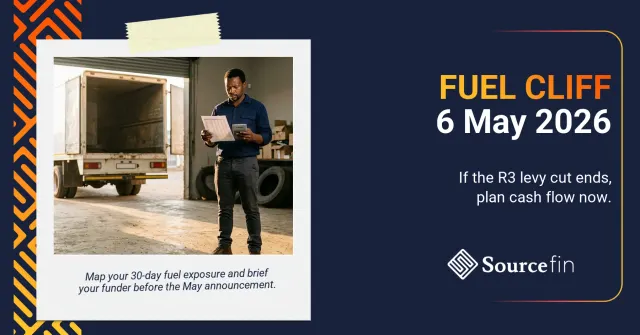
The Department of Mineral Resources and Energy publishes the May 2026 fuel price adjustment on Tuesday 6 May. That announcement carries two pieces of information. The first is the standard monthly adjustment based on international product prices, the rand-dollar exchange rate movement during the previous calendar month, and the slate levy. The second is whether the temporary R3 per litre levy reduction remains in place, is partially withdrawn or is allowed to expire.
Industry projections published in late April pointed to a petrol price increase of roughly R1.82 to R2.14 per litre and a diesel jump of around R5.92 per litre if the relief is not extended. EWN reported on 23 April that Finance Minister Enoch Godongwana hinted at a possible extension. At the time of writing the matter remains open.
For SMMEs, the question is not which forecast is right. The question is what an extra R5.92 per litre on the next refuel cycle would do to your operating margin and cash position. A diesel-heavy fleet running 6,000 km a month at 40 litres per 100 km would carry an additional R142,080 of monthly fuel cost across a 10-vehicle fleet at that price step. That cost is real, predictable and timed to the day the announcement lands. Working-capital products are designed to absorb exactly this kind of move.
The SARS Diesel Refund System, Tightened in 2026
Alongside the R3 reduction, SARS announced a meaningful upgrade to the diesel refund system. The diesel refund is the long-standing programme that allows qualifying primary-production businesses to claim back a portion of the general fuel levy and Road Accident Fund levy on diesel used for eligible activities. The qualifying activities are largely confined to agriculture, mining, forestry, fishing and certain offshore operations, with the eligibility rules and current refund values published on the SARS diesel refunds portal.
The 2026 system upgrade introduced two changes worth knowing. Geotagging is now applied to diesel deliveries, recording the location at which fuel is dropped against the claimant's stated use site. A side-chain ledger has been added to authenticate claims and reduce duplicate or fraudulent submissions. Industry estimates put pre-upgrade fraudulent claims in the multi-billion-rand range each year. For genuine claimants, the practical change is more documentation per claim, longer audit trails and tighter scrutiny of how the diesel was used.
For non-qualifying sectors, including general logistics, civils, catering, security and ICT, the diesel refund does not apply. Those businesses carry the full general fuel levy on their diesel purchases. The R3 reduction granted in April applies across the board, but the rebate-style refund only flows back to qualifying primary-production users.
What SMMEs Should Do in the Next Two Weeks
The practical planning window for the May fuel price adjustment is short. With the announcement on 6 May and the new prices effective from midnight on 5 May, the actions that matter need to happen now, not after the announcement. A practical checklist for SMME owners:
- Map your fuel exposure for the next 30 days. Average litres per week for petrol and diesel, multiplied by realistic price scenarios at current and post-relief levels. The number you are looking for is the additional rand impact on the next 30 days of operations.
- Check your customer payment cycle against that exposure. If your customer payments arrive 60 days after invoice and your fuel cost has just stepped up, the cash gap to bridge is roughly the additional cost multiplied by two months. Working-capital products are designed for exactly this shape.
- Review your contract pricing terms for fuel-adjustment clauses. Most multi-month government and corporate contracts allow for fuel-cost pass-through after a defined trigger. Check whether your contracts include such a clause and what the trigger is.
- If you qualify for the SARS diesel refund, refresh your documentation. Geotagging and the new side-chain ledger mean your supporting records need to be clean before the next claim is filed.
- Speak to your funder before 5 May, not after. A facility approved before the price step gives you optionality. A scramble for working capital after the price step costs more in time and certainty.
For SMMEs that want to discuss whether invoice discounting, purchase order funding or a blended facility fits their situation, the Sourcefin funding application form is the right starting point. A team member follows up directly to walk through the numbers.
Why Fuel Levy Repayment 2026 South Africa Sets the Pattern Beyond May
The April relief was framed as a temporary measure to cushion the impact of a sudden international oil price move. The wider pattern, though, is not new. Fuel costs in South Africa are exposed to two volatile inputs: the international product price, and the rand-dollar exchange rate. Either one can move sharply in a short window. The 2026 Budget framework includes the levy as a meaningful revenue line, which means short-term consumer relief always carries a fiscal trade-off and is therefore unlikely to become a permanent fixture.
For SMMEs, the planning posture that flows from this is to treat fuel as a volatile input rather than a stable cost. That means working-capital facilities ready to draw on, contract terms that allow for fuel-cost pass-through where realistic, and operational levers in place to absorb a step change without compromising delivery. The pillar guide on business fuel loans in South Africa walks through the funding side in detail. The cluster article on transport fleet fuel cost management covers the operational levers for fleet operators specifically.
Two further pieces of context worth keeping front of mind. The wider government fuel levy relief guide covers the policy backdrop in detail. For sector-specific applications, the invoice discounting for fuel price hedging piece walks through how an invoice-side facility absorbs price volatility week to week.
Sources & References
- Ministers Godongwana and Mantashe on short-term relief measures to address fuel price increases – South African Government.
- Government cuts fuel levy by R3 to curb price shock – Moneyweb.
- Fuel price set to rise in May: Will government extend R3 fuel levy cut? – Eyewitness News, 23 April 2026.
- Diesel refunds – South African Revenue Service.
- Fuel Price Media Statement – Department of Mineral Resources and Energy.
Frequently asked questions
Will South African consumers have to repay the R6 billion fuel levy relief?
No. National Treasury covered the R6 billion shortfall for the April-to-May relief window from three internal sources: unspent vaccine programme allocations, higher than expected platinum group metal royalties, and a draw from the Gold and Foreign Exchange Contingency Reserve Account. The mechanism for the announced window is fiscally neutral within the 2026 Budget framework, not a deferred consumer cost.
Will the R3 fuel levy reduction be extended past 5 May 2026?
At the time of writing the matter is open. Treasury has stated the relief will be re-evaluated monthly. EWN reported on 23 April that Finance Minister Enoch Godongwana hinted at a possible extension. The Department of Mineral Resources and Energy publishes the May fuel price adjustment on 6 May 2026, which will confirm the position.
How much could fuel prices rise on 6 May if the relief expires?
Industry projections in late April pointed to a petrol price increase of roughly R1.82 to R2.14 per litre and a diesel jump of around R5.92 per litre if the relief is not extended. The actual figure is set by the Department of Mineral Resources and Energy on 6 May 2026.
Did SARS change the diesel refund process in 2026?
Yes. SARS introduced geotagging on diesel deliveries and a side-chain ledger to authenticate refund claims. The aim is to reduce fraudulent or duplicate submissions, which had been estimated in the multi-billion-rand range each year. Genuine claimants now need cleaner documentation and longer audit trails for each claim.
Which sectors qualify for the SARS diesel refund in South Africa?
Qualifying activities are largely confined to agriculture, mining, forestry, fishing and certain offshore operations. The detailed eligibility rules and current refund values are published on the SARS diesel refunds portal. General logistics, civils, catering, security and ICT do not qualify and carry the full general fuel levy on their diesel purchases.
What should an SMME do in the next two weeks to prepare for the May fuel adjustment?
Map the fuel exposure for the next 30 days at both current and post-relief prices, check whether your customer payment cycle will leave a cash gap, review your contracts for fuel-cost pass-through clauses, refresh diesel refund documentation if you qualify, and speak to your funder before 5 May. A facility approved before the price step gives you optionality. A scramble after the step costs more in time and certainty.

Sourcefin is a South African alternative finance provider that offers purchase order funding and invoice discounting to SMMEs, enabling businesses to fulfil confirmed purchase orders or tenders and unlock cash flow without collateral. Unlike traditional lenders or banks, Sourcefin also provides end-to-end support including supplier sourcing, logistics, project management, and risk oversight.