
Business Fuel Loans South Africa: Practical 2026 Guide
Business fuel loans South Africa: how SMMEs fund through rising fuel costs and the May 2026 levy cliff with invoice discounting, PO funding and bridging.
On this page
- Key Takeaways
- The May 2026 Fuel Levy Cliff: Why This Matters Right Now
- What Are Business Fuel Loans, and How Do They Work in South Africa
- The Real Cost of Fuel Inflation for South African SMMEs
- Five Funding Options Behind Business Fuel Loans South Africa Searches
- How Fuel Levy Rebates Work for South African Businesses
- Sector-by-Sector: How Fuel Costs Hit Different SMMEs
- How to Apply for Business Fuel Loans South Africa
- The Fuel Funding Hub: Read More on Business Fuel Loans South Africa Options
- Frequently asked questions
Business fuel loans South Africa cover a small group of working-capital products that South African SMMEs use to keep operating when fuel costs rise faster than customer payments arrive. The most relevant options are invoice discounting against approved invoices, purchase order funding for fuel-heavy contracts, short-term bridging finance, and supplier-issued fuel card facilities. With the R3 per litre fuel levy reduction set to be re-evaluated on 6 May 2026, and projected May fuel price increases pointing to a petrol rise of around R1.82 to R2.14 per litre and a diesel jump of close to R5.92, fleet operators, contractors and tenderpreneurs need a plan that does not rely solely on a bank overdraft.
Key Takeaways
- Business fuel loans in South Africa are not a single product. They are a basket of working-capital options including invoice discounting, purchase order funding, bridging finance and fuel cards.
- The R3 per litre fuel levy reduction granted on 1 April 2026 is scheduled for re-evaluation on 6 May 2026. If it falls away, diesel could jump by close to R5.92 per litre and petrol by R1.82 to R2.14 per litre.
- Most SMME cash-flow gaps caused by fuel cost shifts are short and predictable. They sit between the moment fuel is purchased and the moment a customer settles an invoice. Working-capital products are designed for exactly this gap.
- The diesel rebate from SARS reduces the effective fuel cost for qualifying primary-production businesses such as agriculture, mining and forestry. The system was tightened in 2026 with geotagging and refund-system upgrades.
- Logistics, construction, catering, agriculture, security and e-hailing sectors carry the highest fuel exposure as a share of operating costs and are the most common applicants for fuel-related working capital.
- A blended approach often gives the best fit. Purchase order funding covers the upfront fuel and material spend on a contract, then invoice discounting takes over once delivery has happened.
The May 2026 Fuel Levy Cliff: Why This Matters Right Now
On 31 March 2026, Finance Minister Enoch Godongwana and Minister of Mineral Resources and Energy Gwede Mantashe announced a temporary reduction of the general fuel levy by R3 per litre, applied to both petrol and diesel from 1 April 2026 to 5 May 2026. The intervention was designed to cushion South African consumers and businesses from a sudden price shock driven by surging international oil prices.
The reduction comes at a cost of approximately R6 billion in foregone state revenue, funded through a combination of unspent vaccine programme allocations, higher than expected platinum group metal royalties, and a draw from the Gold and Foreign Exchange Contingency Reserve Account. National Treasury has stated the relief will be re-evaluated monthly for the next two months. As reported by Moneyweb, the measure is structured as fiscally neutral and the revenue gap will be closed within the existing 2026 Budget framework.
For SMMEs, the practical question is what happens on Wednesday 6 May 2026, when the Department of Mineral Resources and Energy publishes the May fuel price adjustment. Industry projections published in late April pointed to a petrol price increase of between R1.82 and R2.14 per litre if the relief is not extended, and a diesel jump of around R5.92 per litre. EWN reported on 23 April that Godongwana hinted at a possible extension, but at the time of writing the matter remains open.
The point for South African business owners is straightforward. A diesel-heavy operation with a 30-day customer payment cycle that suddenly has to absorb an additional R5.92 per litre on its next refuel does not have time to wait and see. The cash flow conversation needs to happen now, not on 7 May. This is the situation the working-capital products grouped under business fuel loans South Africa search results are designed to address: short, defined cash gaps caused by predictable cost moves and standard customer payment cycles.

What Are Business Fuel Loans, and How Do They Work in South Africa
The phrase "business fuel loans South Africa" is a search term, not a single product on offer. Search Google and you will find a mix of fuel cards, vehicle finance products, working-capital facilities and informal lending. None of them is a loan in the traditional sense of a fixed instalment over a fixed term. The market simply does not offer a clean "borrow R200,000 today, repay over 24 months, use it for fuel" product, because fuel is a recurring operating expense and lenders do not typically structure long-term debt against operating costs.
What exists in practice is a set of working-capital products that South African SMMEs can use to bridge the gap between buying fuel and being paid for the work that consumed it. The four most relevant categories are:
- Invoice discounting against an approved customer invoice, which advances most of the invoice value within days of the invoice being issued. The advance can be used for any operating expense, including the next round of fuel.
- Purchase order funding for businesses that have won a tender or order with verified fuel-heavy delivery requirements. The funder pays the supplier directly so the SMME can secure stock, fuel and labour without using its own cash.
- Bridging finance for short, defined cash gaps where a payment is expected but not yet received. Typically used to cover a period of weeks rather than months.
- Fuel card facilities issued by oil majors and specialist providers. These are line-of-credit products that the SMME settles monthly. They smooth fuel spend but do not solve a wider cash-flow problem.
Bank-issued working-capital products such as overdrafts, business credit cards and term loans also exist and serve their own purpose. South African banks are built for stability and apply the underwriting standards their depositor mandates require. That is by design, and it is what keeps the wider system safe. Alternative funding fills a gap banks are not structured to serve, particularly where the security a lender holds is the customer invoice or purchase order rather than the SMME owner's home or vehicle.
For a deeper look at how invoice-side funding works in practice, see the existing guide on invoice discounting for fuel price hedging. For the bidder's view of fuel tenders, see the practical walkthrough in purchase order funding for fuel tenders in South Africa.
The Real Cost of Fuel Inflation for South African SMMEs
Fuel sits inside the consumer price basket and feeds inflation directly. Statistics South Africa's March 2026 release showed headline CPI ticking up to 3.1 percent, with fuel as the single biggest contributor to the monthly change. That number has consequences beyond the cost of refuelling a vehicle, because every business that depends on transport, deliveries, plant operations or generator backup has fuel embedded somewhere in its cost base.
For a South African SMME, the practical impact varies sharply by sector. The data points worth keeping in mind:
- For a diesel-heavy fleet operator running 10 trucks averaging 40 litres per 100 km over 6,000 km a month, a R5.92 per litre diesel increase translates to roughly R142,080 of additional monthly fuel spend before any contract repricing.
- For a small civils contractor running plant on a 6 month construction contract, the equivalent diesel exposure can sit between 8 and 14 percent of the contract's operating budget.
- For a catering or events SMME running multiple bakkies between sites and a generator at a venue, the sensitivity is real but smaller in absolute terms, often R5,000 to R20,000 a month.
- For an e-hailing operator running 4 vehicles, a 2 rand per litre petrol move translates to roughly R3,000 to R5,000 a month per vehicle in additional fuel cost, depending on use.
The compounding factor is late payment. Most SMMEs that win government or large corporate work face customer payment terms of 30, 60 or 90 days. The fuel was purchased and consumed weeks before the invoice will be paid. A payment delay of one or two cycles transforms a manageable price rise into a working capital problem.
The combination of a fuel cost step-up and a customer who pays on day 60 is exactly the situation that working-capital products are designed for. The question is not whether to fund the gap, but which product fits the situation best.
Five Funding Options Behind Business Fuel Loans South Africa Searches
The five working-capital products covered below are the practical answers most SMMEs find when they search for business fuel loans South Africa providers. None of them is a traditional fuel loan, but each one is built to absorb a fuel-cost shift in a way a long-term loan cannot.
1. Invoice Discounting for Fuel-Heavy Businesses
Invoice discounting is the cleanest fit when the SMME has already done the work, issued an invoice to a creditworthy buyer, and is waiting for that invoice to be paid. The funder advances most of the invoice value within days of approval. Repayment is taken from the customer's payment when it lands on its normal terms, not before. Common use cases include logistics businesses delivering on a multi-month contract, security companies invoicing monthly for guarding services, cleaning and FM contractors invoicing on month-end, and ICT services firms billing in arrears.
For a fleet operator with R1.8 million of approved invoices sitting on a 60 day clock, invoice discounting can free up most of that working capital almost immediately, allowing the next round of fuel and salaries to happen without dipping into reserves. The Sourcefin product page on invoice discounting explains the process in detail.
2. Purchase Order Funding for Fuel Tenders and Contracts
Purchase order funding fits a different situation: the SMME has won a contract or order but has not yet started delivery. The contract is verified, the buyer is creditworthy, and the work requires significant upfront spend on stock, materials, sub-contractors and fuel. Sourcefin pays the supplier directly so the SMME can mobilise the contract without depleting its cash reserves. Repayment is taken from the customer's payment when delivery is complete and the invoice is settled.
For a fuel tender specifically, purchase order funding is often the only practical path. Fuel suppliers do not extend long credit terms on bulk orders, particularly to younger or smaller businesses. The full mechanics are covered in the purchase order funding service guide, and the cluster article on PO funding for fuel tenders walks through a worked tender scenario.
3. Bridging Finance for Short-Term Fuel Cost Increases
Bridging finance is the right choice when the cash gap is short, defined and certain. A confirmed payment is on the way, the SMME knows when it will land, and the cost increase that needs to be covered is for a known set of weeks rather than an open-ended period. Bridging is more expensive on a per-day basis than invoice discounting, because the funder does not have an invoice as security, but it is faster and lighter on documentation for the right scenario.
Bridging is also useful where an SMME wants to buy a larger fuel volume in a single bulk order to lock in a better unit price. The funder's view is straightforward: the savings from bulk purchase needs to comfortably cover the cost of the bridging facility, and the repayment source needs to be predictable.
4. Fuel Card Facilities and Their Tradeoffs
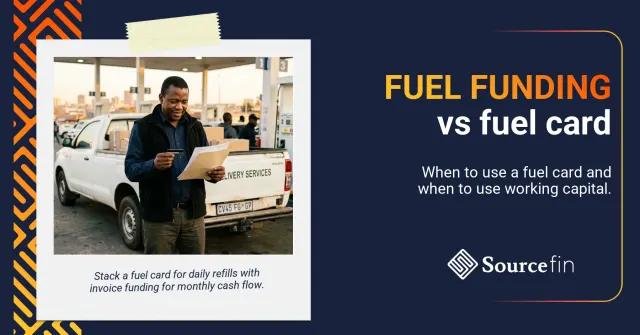
Fuel cards from oil majors and specialist providers operate as monthly credit lines secured against the SMME's account. They smooth weekly fuel spend into a single monthly settlement, simplify reporting, and often come with discounts at participating sites. They are not a working-capital product in the same sense as invoice discounting or PO funding. The SMME still settles the full balance every month from its own cash, and the credit line is usually small relative to a fleet operator's broader funding needs.
Fuel cards work well alongside other working-capital products, not as a substitute for them. A fleet running on a fuel card facility for daily refuelling, an invoice discounting facility for monthly cash flow, and an occasional PO funding line for bigger contracts is a common South African setup.
5. Blended Funding Approaches for Fleet Operators
For multi-stage projects, the cleanest answer is to combine purchase order funding for the upfront delivery phase with invoice discounting once the work has been completed and invoiced. The two products work in sequence. Purchase order funding pays for the fuel, materials and labour to deliver the contract. Once the customer has signed off and the invoice has been issued, invoice discounting takes over, advancing the bulk of that invoice's value while waiting for the buyer's payment to arrive. The SMME never carries more exposure than one stage of the contract at a time.
This blended approach is particularly relevant for civils contractors on long-duration government work, ICT integrators on multi-phase rollouts, and logistics businesses on annual transport contracts where individual job tickets are invoiced monthly. The Sourcefin funding application form is the right starting point for any SMME wanting to discuss a blended approach. A team member follows up to walk through the situation.

How Fuel Levy Rebates Work for South African Businesses
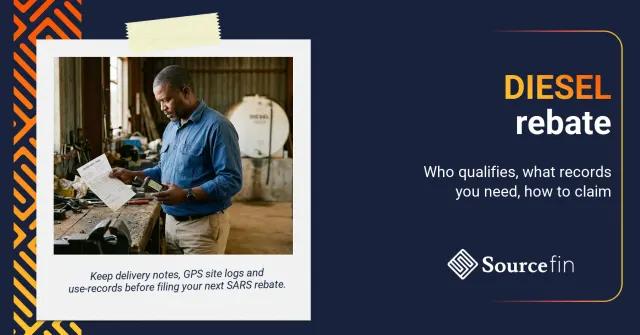
The diesel rebate is a separate matter to the temporary R3 per litre fuel levy reduction. The diesel rebate is a long-standing SARS programme that allows qualifying primary-production businesses to claim back a portion of the general fuel levy and the Road Accident Fund levy on diesel used for eligible activities. The qualifying activities are largely confined to agriculture, mining, forestry, fishing and certain offshore operations. SARS publishes the eligibility rules and current rebate values in its dedicated diesel refund portal.
The 2026 Budget brought meaningful changes to how the diesel rebate is administered. SARS announced an upgraded refund system that uses geotagging on diesel deliveries and a side-chain ledger to authenticate claims. The intent is to reduce fraudulent rebate claims that were estimated at over R3 billion a year by some industry bodies. For genuine claimants, the practical change is more documentation per claim, a longer audit trail, and tighter scrutiny of how the diesel was used.
For an agricultural or mining SMME, the diesel rebate can materially reduce the effective cost of fuel. The cash benefit is paid in arrears when the rebate claim is processed by SARS, which means the cash flow lift only arrives after the diesel has been bought, used and claimed. Working-capital products can bridge that timing gap when needed.
For non-qualifying sectors, including general logistics, civils, catering, security and ICT, the diesel rebate does not apply. Those businesses carry the full general fuel levy on their diesel purchases. The R3 reduction granted in April 2026 has applied across the board, but the rebate-style relief only flows back to qualifying primary-production users.
Sector-by-Sector: How Fuel Costs Hit Different SMMEs
Logistics, Transport and Fleet Operators
Logistics businesses are the most fuel-exposed SMME category in South Africa. Diesel typically sits between 25 and 40 percent of operating cost for a fleet operator, depending on route mix, vehicle age and fuel efficiency. A R5.92 per litre diesel move translates almost directly into a margin compression unless the contract carries a fuel surcharge clause. The right working-capital response is usually invoice discounting against the monthly billing cycle, sometimes paired with a fuel card facility for daily operations. The cluster article on transport fleet fuel cost management covers the operational levers in more detail.
Construction and Civils
Civils contractors carry diesel exposure through plant operations, site generators, water bowsers and material delivery. On a typical municipal civils contract, fuel sits between 8 and 14 percent of the operating budget. The cleanest funding path is purchase order funding at contract mobilisation, then invoice discounting against certified invoices once work has been completed. The construction sector is also a common applicant for blended funding because contracts run over multiple stages.
Catering, Events and Hospitality
Catering and event SMMEs run lower absolute fuel volumes but face acute timing pressure. Fuel for delivery vehicles, generator hire for venues, and refrigerated transport all need to be paid before the event. Invoice discounting against a confirmed corporate or government client invoice is the most common fit. The cluster guide on invoice discounting for catering SMMEs walks through a worked catering scenario.
Agriculture and Primary Production
Agricultural SMMEs benefit from the diesel rebate, but the rebate is paid in arrears and does not solve the immediate cash flow need at planting, harvest or peak processing time. Working-capital products are commonly used to bridge the period between buying diesel and receiving the rebate, particularly for crop spraying, mechanical harvesting and packhouse operations.
Security Services
Security businesses run multiple patrol vehicles on continuous duty cycles, with monthly fuel spend that scales with the number of contracts. The funding pattern is similar to logistics: invoice discounting against monthly customer billing is the dominant fit, with a portion of the fleet on fuel card facilities for daily refuelling.
E-Hailing, Taxi and Last-Mile
E-hailing operators running multiple vehicles face a direct, daily fuel cost exposure with no contract pricing buffer. Bridging finance and invoice-style facilities against platform settlement cycles are increasingly used, particularly by operators running 5 or more vehicles. The IOL story this week on small businesses and e-hailing drivers buckling under fuel cost pressure points to how acute the pressure has become for this segment.

How to Apply for Business Fuel Loans South Africa
The Sourcefin process for business fuel loans South Africa applicants is intentionally light at the application stage. The starting point is the short funding application form, which captures contact details, the funding amount being considered and the type of facility that fits. A team member then follows up directly to walk through the SMME's situation, the contracts or invoices that would underpin the facility, and the practical mechanics of how funding would be drawn and repaid.
Before that conversation, an applicant typically benefits from having a short summary of the following on hand:
- The contract, purchase order or invoice that the funding would be drawn against, with its expected payment date.
- A view of the buyer or buyers involved, particularly whether they are a government department, a state-owned entity, a listed corporate or a private company.
- The intended use of funds, whether that is fuel, materials, payroll, sub-contractors or a blend.
- Recent SARS, CIPC and CSD compliance status. Active compliance is non-negotiable for almost all working-capital and tender-related funding.
- A short business background covering how long the SMME has been trading, the sector it operates in and the typical contract size it works with.
Compliance is the most common point at which applications stall. CSD registration, current SARS standing, valid CIPC filing and where applicable a current B-BBEE certificate are the gate to most government work and to the funding facilities that sit behind it. The wider SARS tax compliance guide covers the practical steps for getting and keeping that standing.
The Fuel Funding Hub: Read More on Business Fuel Loans South Africa Options
This pillar sits at the centre of a wider set of articles covering the practical detail of business fuel loans South Africa options for different sectors and contract types. The cluster currently includes:
- Government fuel levy relief for businesses 2026 – what the R3 reduction means, who qualifies, and what changes when it expires.
- Fuel price increase impact on South African business – the operational and cash-flow consequences of the 2026 fuel price cycle.
- Fuel tender cash flow management – how SMMEs structure cash flow on government and large-corporate fuel tenders.
- Transport fleet fuel cost management – practical operational levers for keeping fleet fuel costs in check.
- Invoice discounting for fuel price hedging – using invoice-side working capital to absorb fuel price volatility.
- Purchase order funding for fuel tenders – the bidder's playbook for funding fuel-heavy tender awards.
- Invoice discounting for logistics SMMEs – the working-capital pattern for road freight, courier and transport businesses.
For SMMEs ready to start a funding conversation, the funding application form is the first step. A Sourcefin team member follows up to discuss which mix of products fits the situation.
Sources & References
- Ministers Godongwana and Mantashe: short-term relief measures on fuel price increases – South African Government, March 2026.
- Government cuts fuel levy by R3 to curb price shock – Moneyweb.
- Fuel price set to rise in May: Will government extend R3 fuel levy cut? – Eyewitness News, 23 April 2026.
- Diesel refunds – South African Revenue Service.
- Fuel Price Media Statement – Department of Mineral Resources and Energy.
- Consumer Price Index – Statistics South Africa monthly CPI release.
Frequently asked questions
What are business fuel loans in South Africa?
Business fuel loans South Africa is a search term that maps to a basket of working-capital products rather than a single product. The most relevant options are invoice discounting against approved customer invoices, purchase order funding for fuel-heavy contracts, short-term bridging finance and supplier-issued fuel card facilities. Each is designed to bridge the gap between buying fuel and being paid for the work that consumed it.
Will the R3 fuel levy reduction in South Africa be extended past 5 May 2026?
At the time of writing the matter is open. Finance Minister Enoch Godongwana announced that the R3 per litre reduction granted from 1 April 2026 would be re-evaluated monthly. EWN reported on 23 April that the minister hinted at a possible extension. The Department of Mineral Resources and Energy publishes the May fuel price adjustment on 6 May 2026.
How much could the May 2026 fuel price increase be if the levy relief expires?
Industry projections in late April pointed to a petrol price increase of between R1.82 and R2.14 per litre and a diesel jump of close to R5.92 per litre. The actual figure will be confirmed by the Department of Mineral Resources and Energy on 6 May 2026.
Can I claim a SARS diesel rebate as a South African business?
Only if your business operates in a qualifying primary-production sector such as agriculture, mining, forestry, fishing or certain offshore activities. SARS publishes the eligibility rules and current rebate values on its diesel refund page. The rebate is paid in arrears after the diesel has been bought, used and claimed, with tighter documentation since the 2026 system upgrade.
Which is better for fuel-heavy contracts: invoice discounting or purchase order funding?
It depends on where the contract sits. Use purchase order funding when you have a verified order or tender award but have not yet started delivery. Use invoice discounting once you have completed the work and issued an invoice to a creditworthy buyer. For multi-stage contracts, a blended approach uses purchase order funding for the upfront delivery phase and invoice discounting once invoices are issued.
How fast can a fleet operator get a Sourcefin invoice discounting facility approved?
The application form takes only a few minutes. After submission, a Sourcefin team member follows up directly to discuss the facility, the contracts or invoices that would underpin it and the practical mechanics. Active SARS, CIPC and CSD compliance is non-negotiable and is the most common point at which applications stall.

Sourcefin is a South African alternative finance provider that offers purchase order funding and invoice discounting to SMMEs, enabling businesses to fulfil confirmed purchase orders or tenders and unlock cash flow without collateral. Unlike traditional lenders or banks, Sourcefin also provides end-to-end support including supplier sourcing, logistics, project management, and risk oversight.