
Rebuild Business Credit Score South Africa: Proven Steps
A practical, step-by-step guide to repairing a damaged business credit profile while continuing to operate and access alternative funding.
On this page
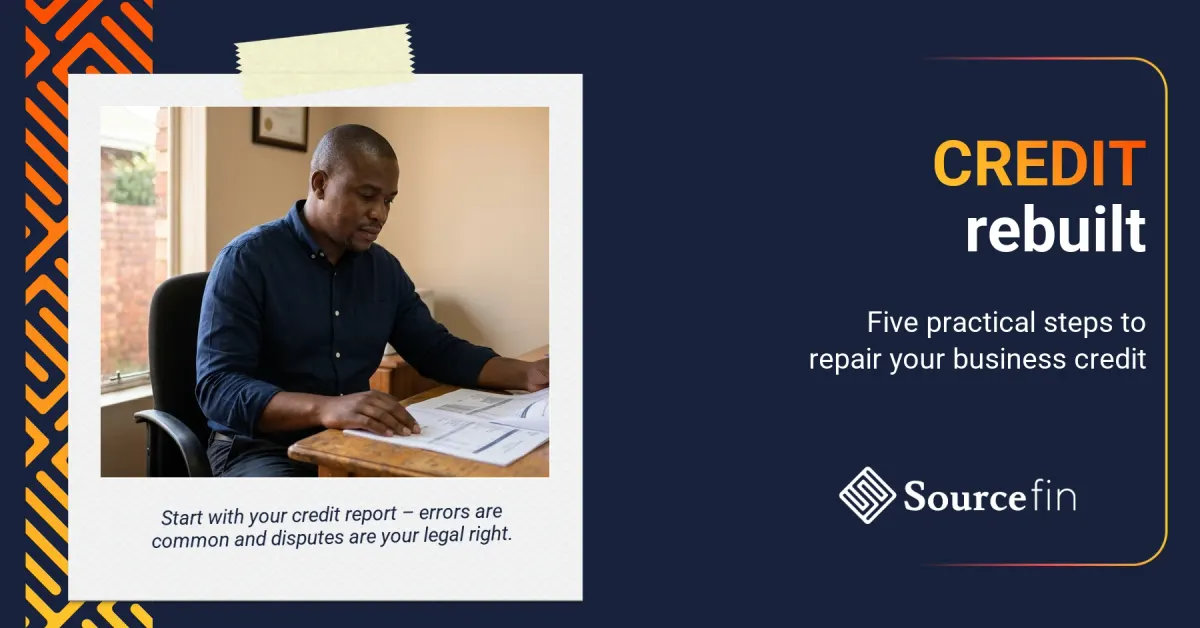
Rebuild business credit score South Africa in five practical steps: separate your business and personal finances, resolve outstanding SARS obligations, review and dispute your credit bureau profile, pay suppliers consistently, and build a verified track record through alternative funding. Significant damage takes 12 to 36 months to repair – but you can access funding throughout that process.
Key Takeaways
- Accessing funding and rebuilding your credit profile are not mutually exclusive – you can do both at once.
- Separating business and personal finances is the single most important structural step for any credit recovery plan.
- SARS compliance, even through a formal payment arrangement, restores your standing with most funders.
- You have a legal right to one free credit report per year from each registered credit bureau – and you can dispute errors.
- Every completed alternative funding deal builds a track record that supports a future bank application.
- Realistic recovery timelines range from 12 to 36 months for significant credit damage – patience and consistency are the plan.
Accessing Funding and Rebuilding Credit Are Not Mutually Exclusive
Many business owners assume that a damaged credit profile means they must choose: fix the credit or run the business. That is a false choice. South African SMMEs with impaired credit records can access funding today through alternative channels – and those same funding arrangements actively contribute to rebuilding the credit profile over time.
The National Credit Regulator's Q3 2024 Consumer Credit Market Report recorded over 10.19 million consumers with impaired credit records in South Africa. (Source: NCR Consumer Credit Market Report Q3 2024) That number reflects real financial pressure on real businesses. It does not reflect a permanent condition.
If you are currently working around a credit problem to keep trading, read our guide on loans for bad credit South Africa for the full picture on accessing funding now. This article focuses on what comes next: the practical work of repairing the damage.
Rebuild Business Credit Score South Africa: The Five Practical Steps
There is no shortcut here. Credit recovery is a process, not an event. What follows is the honest, practical sequence that works – not a promise of quick results, but a clear map of the road ahead.

Step 1: Separate Your Business and Personal Finances
If your business income flows through your personal account, stop. Open a dedicated business bank account immediately. This is the foundation of everything that follows.
Lenders assess your business health from its financial history. When business and personal transactions are mixed, it becomes impossible to tell what the business actually earns, spends, or owes. A dedicated business account creates a readable record and generates the commercial banking history that feeds into your credit profile over time. Our article on how to separate business and personal finances walks through the practical steps in detail.
Step 2: Resolve Outstanding SARS Obligations
Tax compliance is one of the first things any funder checks. An outstanding SARS liability – VAT, PAYE, income tax – will block most funding applications before they progress. It will also disqualify you from government tender work, which requires a valid SARS Good Standing certificate (Tax Compliance Pin).
The good news is that SARS does not require you to pay everything upfront. A formal payment arrangement, applied for through eFiling or a SARS branch, is enough to restore compliance status while you work through the balance. Many SMMEs do not know this. They carry unresolved SARS debt, assume they are stuck, and keep trading without engaging.
Engage. A payment arrangement is not a failure – it is a formal agreement with SARS that demonstrates you are dealing with the problem responsibly. Once in place, your compliance status is restored, your tender eligibility returns, and most funders will accept it. (Source: National Credit Act 34 of 2005, South African Government)
Step 3: Review and Dispute Your Credit Bureau Profile
South Africa's major credit bureaux – TransUnion, Experian, and Compuscan – are regulated under the National Credit Act. Under that Act, every individual has the right to one free credit report per year from each registered bureau.
Pull your report. Read it carefully. Errors appear more often than most people expect: accounts incorrectly listed as in default, debts that have been settled but not marked as such, and old judgements that should have been removed. Every one of these errors is dragging your score down unnecessarily.
If you find an error, you have the right to raise a dispute directly with the bureau. The bureau is required to investigate and, if the error is confirmed, correct it. This process takes time – typically 20 business days per dispute – but the improvement is real and permanent once resolved.
Also check for how your credit score affects business opportunities beyond just funding. A cleaner profile opens doors to supplier credit, longer payment terms, and better rates on the financing you do access.
Step 4: Build Consistent Payment Behaviour
Credit scores are built on payment history. Every supplier you pay on time and every financial obligation you meet consistently adds to the positive side of your ledger. This is slower than disputing errors, but it is the most durable part of recovery.
Prioritise accounts that report to credit bureaux – ask your existing suppliers whether they do. Consistently on-time payments will reflect positively in your bureau profile over the following months. Trade references also carry real weight when you approach a new funder or supplier and your formal score is still recovering.
Step 5: Build a Track Record with Alternative Funders
This is where accessing funding now and rebuilding credit converge. Every completed invoice discounting transaction or purchase order deal that you complete on time and in full becomes part of your funding history. It demonstrates to any future lender – including a traditional bank – that your business is reliable, that your clients pay, and that you manage financial obligations responsibly.
Alternative funding is not a dead end. It is a bridge. The 2025 MSME Access to Finance Report by Finfind found that 85.6% of all South African funding applications come from micro-enterprises – many using alternative funding as their primary route to capital while building the track record needed for traditional credit. (Source: SMEs South Africa – 2025 MSME Access to Finance Report)
Sourcefin assesses deals on the strength of your clients and your contracts – not your credit history alone. If you have confirmed purchase orders or outstanding invoices from creditworthy clients, you may qualify today. Start a funding application to find out where you stand.
What to Expect: A Realistic Timeline for Credit Recovery
Honesty matters here. Rebuilding a damaged credit profile is a process that typically takes 12 to 36 months, depending on the severity of the damage. Judgements, write-offs, and sequestrations take longer to fade than late payments or missed instalments.
Here is what a realistic recovery arc looks like:
- Months 1–3: Open a dedicated business account, contact SARS, pull your credit reports, identify and lodge disputes on any errors.
- Months 3–6: Disputes resolved, SARS arrangement in place, clean account history beginning to build. First alternative funding deals completed.
- Months 6–12: Positive payment behaviour visible in bureau profile. Trade references accumulating. Funding history with alternative providers growing.
- Year 1–3: Gradual score improvement as negative listings age and positive history accumulates. Options expand. Bank appetite for the business increases.
Not every business will qualify for a bank loan even after three years of rebuilding. That is a realistic outcome, not a failure. What does change is the range of options available. Alternative funders, government procurement programmes, and trade finance providers all become more accessible as your profile strengthens.
If you are currently dealing with a funding rejection, our article on why South African SMMEs get rejected for funding covers the most common reasons. And for the full picture of funding options available with impaired credit, read how to get business funding with bad credit in South Africa.
Banks are built for stability. Sourcefin is built for speed and asset-based decisions. These serve different moments in a business's journey. The goal of credit rebuilding is to expand what is possible over time – not to replace one model with the other. Start with the five steps, be consistent, and access the funding you need now while the work continues.
Sources & References
Frequently asked questions
How long does it take to rebuild a business credit score in South Africa?
Significant credit damage typically takes 12 to 36 months to repair. The timeline depends on the severity of the problem – late payments clear faster than judgements or write-offs. Consistent positive behaviour, settled accounts, and resolved credit bureau errors all accelerate recovery. You can access alternative funding throughout this period while the repair work progresses.
Can I get business funding while my credit score is still poor?
Yes. Alternative funders like Sourcefin assess deals based on the strength of your clients and contracts, not your credit history alone. Invoice discounting and purchase order funding are available to businesses with impaired credit records, provided the underlying client or purchase order is from a creditworthy buyer. Completing these deals on time also builds a positive track record for future applications. For a wider walk-through of the model, see the South African invoice discounting pillar.
How do I dispute an error on my credit bureau report in South Africa?
Pull your report from TransUnion, Experian, or Compuscan – you are entitled to one free report per year from each bureau under the National Credit Act. Identify the incorrect entry and lodge a formal dispute directly with the bureau. They are required to investigate within 20 business days and correct verified errors. Keeping a record of your dispute correspondence is strongly advised.
Does a SARS payment arrangement affect my credit score?
A formal SARS payment arrangement restores your tax compliance status, which most funders require. It does not automatically improve your credit bureau score, but it removes a key barrier to funding applications. Unresolved SARS debt is more damaging than a managed arrangement, so engaging with SARS early and formalising repayment terms is always the better course of action.
Why is separating business and personal finances important for credit rebuilding?
Mixing business and personal transactions makes it impossible for any funder to accurately assess your business's financial health. A dedicated business account creates a clean, readable record of what the business earns and spends. It also generates a commercial banking history over time, which feeds positively into your credit profile and makes future funding applications significantly easier to assess.
Does using invoice discounting or PO funding help rebuild my credit?
Yes, indirectly. Every completed invoice discounting or purchase order funding deal builds a verified track record with your funder. This history demonstrates to future lenders – including traditional banks – that your business operates reliably, that your clients pay, and that you manage financial obligations responsibly. Alternative funding is a bridge to broader credit options, not a permanent alternative.
Which credit bureaux operate in South Africa and how do I access my report?
The main credit bureaux regulated under the National Credit Act are TransUnion, Experian, and Compuscan. Each is required to provide one free credit report per year on request. Visit each bureau's website directly, verify your identity, and request your report. Review all three reports, as different creditors may report to different bureaux and errors may appear on one but not others.

Sourcefin is a South African alternative finance provider that offers purchase order funding and invoice discounting to SMMEs, enabling businesses to fulfil confirmed purchase orders or tenders and unlock cash flow without collateral. Unlike traditional lenders or banks, Sourcefin also provides end-to-end support including supplier sourcing, logistics, project management, and risk oversight.