
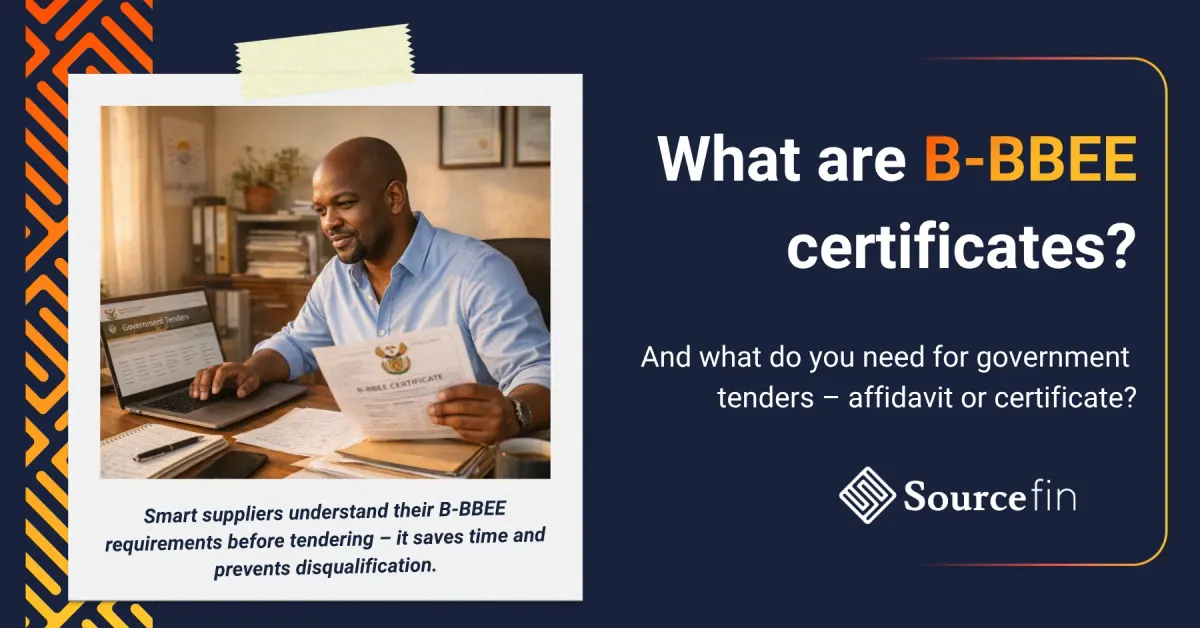
B-BBEE Certificates for Tenders: Affidavit vs Certificate
Understand B-BBEE certificate requirements for government tenders in South Africa. Learn when you need an affidavit vs certificate, validity periods, and more.
On this page
- What B-BBEE Certificates Actually Prove
- EME Affidavits: The Free Route for Businesses Under R10 Million
- QSE Requirements: When Affidavits Still Work
- SANAS Accreditation: Why It Matters
- The 12-Month Validity Period You Can't Ignore
- How B-BBEE Levels Translate to Tender Points
- Common Mistakes That Trigger Disqualification
- Managing Cash Flow During Contract Execution
- Building Tender Capability
- Sources & References
- Frequently asked questions
B-BBEE certificates prove your business's transformation status for government tenders. EMEs (under R10 million turnover) can use a free sworn affidavit or CIPC certificate. QSEs (R10-50 million turnover) with 51%+ black ownership also use affidavits, whilst those with less than 51% black ownership need a certificate from a SANAS-accredited verification agency. All B-BBEE documents are valid for 12 months only and must be current when you submit your tender bid.
If you're preparing to tender for government work, one document appears on every mandatory list: proof of your B-BBEE status. For many small business owners, the confusion starts immediately – do you need an affidavit or a certificate? Can you get it for free, or must you pay a verification agency? What happens if you submit the wrong document?
These aren't trivial questions. Submitting incorrect B-BBEE documentation leads to automatic disqualification, regardless of how competitive your pricing is or how well you meet the technical requirements. Your tender submission must include valid, current B-BBEE proof – the right type, properly completed, and still within its validity period.
The good news is that most South African small businesses qualify for the free route. The challenge is understanding which category you fall into and what documentation that requires.
What B-BBEE Certificates Actually Prove
Broad-Based Black Economic Empowerment isn't voluntary for businesses wanting government contracts. The Preferential Procurement Policy Framework Act requires organs of state to apply preference points based on your B-BBEE status when evaluating tenders.
Your B-BBEE documentation proves where you sit on the transformation scale – from Level 1 (best) to Level 8, or Non-Compliant. This directly affects your score under the 80/20 or 90/10 preference points system. A Level 1 contributor receives maximum B-BBEE points, whilst a non-compliant business scores zero on the transformation component, even if you submit the lowest price.
The certificate or affidavit shows your B-BBEE status level, your black ownership percentage, and confirms you've been properly assessed according to the Codes of Good Practice. Government procurement officials use this to calculate your preference points. Without it, you can't participate in the tender process at all.
EME Affidavits: The Free Route for Businesses Under R10 Million
Exempt Micro Enterprises (EMEs) have annual turnover below R10 million. If your business falls into this category, you don't need an expensive verification process. CIPC offers free B-BBEE certificates for EMEs, or you can complete a sworn affidavit.
EMEs automatically qualify for Level 4 B-BBEE status (100% recognition level). If your EME is 100% black-owned, you're elevated to Level 1. If it's 51% black-owned, you achieve Level 2. These automatic levels apply without needing to score points on the seven transformation elements that larger businesses must tackle.
A sworn affidavit is a legal document declaring your company's details, turnover, and black ownership percentage. You complete it yourself as a director or member of the business – third parties can't complete it on your behalf. The affidavit must be signed before a Commissioner of Oaths, which you can access for free at police stations or magistrate's courts. It's valid for 12 months from the date of signing.
CIPC's online B-BBEE certificate service provides an alternative to the affidavit. The electronic certificate serves the same purpose and costs nothing. Applications must come from directors or members directly, your contact details must be current for receiving the OTP, and the information you provide must be accurate – false shareholder details constitute a criminal offence. Entities with foreign directors can't use the CIPC service and must use the sworn affidavit route instead.
QSE Requirements: When Affidavits Still Work
Qualifying Small Enterprises sit between R10 million and R50 million turnover. Your B-BBEE documentation requirements depend entirely on your ownership structure.
QSEs with 51% or higher black ownership can still use the affidavit route. The process mirrors EME affidavits – you complete the sworn statement declaring your company details, turnover band, and black ownership percentage, then have it signed by a Commissioner of Oaths. The affidavit confirms your automatic B-BBEE level based on your black ownership percentage and remains valid for 12 months.
QSEs below 51% black ownership face different requirements. You must obtain a proper B-BBEE certificate from a SANAS-accredited verification agency. This involves a formal audit process where the agency examines your company against the B-BBEE scorecard elements, calculates your points, and issues a certificate showing your achieved level. The certificate costs money – verification fees vary by agency and company size – and takes several weeks to complete.
Some business owners mistakenly think they can avoid the verification route by using an affidavit even when they don't meet the 51% threshold. This doesn't work. Tender disqualification follows immediately when procurement officials discover your affidavit doesn't match your actual ownership structure. The rules exist for good reasons, and gaming them creates compliance risks you don't need.
SANAS Accreditation: Why It Matters
When you need a proper B-BBEE certificate rather than an affidavit, it must come from a SANAS-accredited verification agency. SANAS (South African National Accreditation System) is the official body appointed to accredit agencies that conduct B-BBEE verifications.
Certificates from unaccredited providers aren't recognised. Government entities and compliant private sector clients will reject them. This matters because the B-BBEE verification industry attracts dubious operators promising quick certificates at suspiciously low prices. These certificates look legitimate but hold no legal standing.
You can verify an agency's accreditation status on the SANAS website before engaging them. Legitimate agencies display their SANAS accreditation details openly and won't hesitate when you ask to see proof. The verification process takes time – typically 4-8 weeks depending on your documentation readiness – because it involves proper examination of your business operations, ownership structure, and scorecard compliance.
Agencies accredited by IRBA (Independent Regulatory Board for Auditors) were previously allowed to conduct verifications, but that arrangement ended in December 2016. Only SANAS-accredited agencies can now issue valid B-BBEE certificates. If you're working with an old certificate from an IRBA-accredited auditor, it won't be accepted for current tenders.
The 12-Month Validity Period You Can't Ignore
Every B-BBEE document – whether affidavit, CIPC certificate, or agency-issued certificate – expires 12 months after its issue date. There are no extensions, no grace periods, and no exceptions. When your tender submission reaches the procurement office, your B-BBEE documentation must still be within its validity period.
An expired certificate disqualifies your bid just as completely as not having one at all. Tender evaluation happens on specific dates, and if your certificate crossed its 12-month mark before that date, you're out. This catches many businesses who had valid documentation when they started preparing the bid but didn't notice the expiry date approaching.
Smart suppliers mark renewal dates well in advance. Start your renewal process at least four to six weeks before expiry, particularly if you're expecting to submit tenders around that time. For EMEs using affidavits, renewal means completing a fresh affidavit with current financial information and getting it signed again. For agencies issuing certificates, you'll need to provide updated financial statements and undergo a new verification process.
The 12-month rule applies universally. Even if your business operations haven't changed, even if your ownership structure stayed constant, even if your previous level was high – the documentation must be renewed annually. This creates an ongoing compliance requirement that you need to build into your business calendar alongside your tax clearance renewals and CSD registration updates.
How B-BBEE Levels Translate to Tender Points
Understanding your B-BBEE level matters because it directly affects your tender score. The 80/20 preference points system applies to tenders up to R50 million, allocating 20 points maximum for B-BBEE status. Tenders above R50 million use the 90/10 system, where 10 points maximum go to B-BBEE.
A Level 1 contributor receives full points – 20 under the 80/20 system or 10 under 90/10. Level 2 gets slightly fewer points, and the scale descends from there. By Level 8, you're receiving minimal B-BBEE points. Non-compliant businesses get zero, which often makes winning impossible even with the lowest price.
The preference points system means two things. First, your B-BBEE status can overcome a higher price. If your competitor quoted lower but has worse B-BBEE credentials, the points system might push your bid ahead. Second, neglecting B-BBEE creates a points deficit you can't recover through pricing alone. Dropping your price to compensate for zero B-BBEE points rarely works – the maths doesn't favour it, and you're undermining your own profitability.
This is why tender strategy considers B-BBEE early. Your level affects which opportunities you should pursue, how aggressively to price, and whether partnerships or subcontracting arrangements might strengthen your position.
Common Mistakes That Trigger Disqualification
B-BBEE documentation seems straightforward until you see how many businesses get it wrong. The most common error is submitting an affidavit when your turnover or ownership structure requires a certificate. Procurement officials check this – your financials on the CSD registration will show if you've exceeded the EME threshold, and ownership claims on affidavits can be verified against CIPC records.
Directors completing affidavits on behalf of companies sometimes make mistakes on the black ownership percentage. This isn't a number you estimate or round up optimistically. It must reflect actual shareholding according to your company's share register and CIPC documentation. Overstating ownership to claim a better B-BBEE level constitutes fraud and can trigger criminal charges beyond just losing the tender.
Expired certificates catch many suppliers. You might have been compliant when you started preparing the bid, but if the certificate expires before the tender closes or before evaluation completes, you're disqualified. Always check the exact expiry date and compare it against the tender timeline – closing date, evaluation period, potential delays, award date. If there's any risk of expiry, renew early.
Using certificates from unaccredited agencies creates problems you won't discover until tender evaluation. The certificate looks legitimate, you paid money for it, but it holds no legal standing. Government procurement offices maintain lists of SANAS-accredited agencies and will verify your certificate's source. When they find it came from an unaccredited provider, your entire bid fails compliance.
Some businesses try to skip B-BBEE documentation entirely, thinking they'll explain their situation or provide it later. There's no "later" in tender processes. Standard Bidding Documents list B-BBEE proof as mandatory. Missing mandatory documents means automatic disqualification, usually without any opportunity to rectify. The tender closes, evaluation proceeds, and your incomplete submission goes nowhere.
Managing Cash Flow During Contract Execution
Winning the tender is one milestone. Having the working capital to execute the contract is another. Many small businesses with strong B-BBEE credentials and competitive pricing struggle because they can't fund the upfront costs that government contracts require. You need to buy materials, pay suppliers, cover labour, and manage operations for 30 days or longer before receiving payment.
This is where purchase order funding changes the calculation. Instead of scrambling to find capital after winning, you arrange funding that releases when the purchase order is issued. The funding covers your supplier payments and operational costs, letting you execute the contract professionally whilst waiting for the government department to pay. For the wider view, see the South African PO funding playbook for the end-to-end approach. That arrangement is part of the standard tender funding route for SMMEs holding a compliant award.
Businesses with solid B-BBEE documentation but limited working capital often avoid tendering entirely, assuming they can't compete. That's leaving opportunity on the table. Proper funding structures let you leverage your B-BBEE status and technical capability without being constrained by your bank balance. The contract becomes executable regardless of your current cash position.
For contracts where you're delivering work progressively and invoicing in stages, invoice discounting provides another route. You submit your invoice to the government department as normal, then access funding against that invoice immediately rather than waiting 30 days for payment. This keeps your cash flow healthy throughout the contract duration and lets you take on larger opportunities.
Building Tender Capability
Getting your B-BBEE documentation right is one component of tender readiness. It sits alongside your tax clearance certificate, your CSD registration, your completed SBD forms, and your technical capability to deliver the work. Each element matters, and missing any one of them disqualifies your bid regardless of how strong the others are.
The businesses that win government contracts consistently treat tender compliance as an ongoing system rather than a last-minute scramble. They know their B-BBEE renewal dates, maintain current documentation, and understand exactly which category they fall into. They don't guess about affidavit eligibility or hope that an expired certificate won't be noticed. They handle the paperwork correctly because they've seen what happens when it goes wrong.
Your B-BBEE status represents both your transformation contribution and your competitive positioning. Getting the documentation right protects your ability to compete whilst demonstrating the professionalism that makes you a reliable supplier. It's not bureaucracy for its own sake – it's the entry requirement for accessing government procurement opportunities that can transform your business.
Sources & References
- Department of Trade, Industry and Competition – B-BBEE Procurement & Verification
- CIPC B-BBEE Certification Service
- B-BBEE Commission Practice Guide 01 of 2022
- B-BBEE for South African SMEs: EME, QSE, Affidavit or Certificate
- RSM South Africa – Determining Validity of B-BBEE Affidavits
Yes, if your business qualifies as an EME (under R10 million turnover) or a QSE (R10-50 million) with 51% or higher black ownership. The sworn affidavit must be signed by a Commissioner of Oaths and is valid for 12 months. Businesses outside these categories need a certificate from a SANAS-accredited verification agency. Using an affidavit when you don't qualify leads to disqualification.
All B-BBEE documents – affidavits, CIPC certificates, and agency-issued certificates – are valid for exactly 12 months from the date of issue. There are no extensions or grace periods. Your documentation must still be valid on the date tender evaluation occurs, not just when you submit the bid. Mark your renewal date and start the renewal process 4-6 weeks before expiry.
Commissioners of Oaths are available at South African Police Service stations (free), magistrate's courts, attorney offices, and some bank branches. You must be present with your completed affidavit and valid identity document. The Commissioner will verify your identity, witness your signature, and stamp the document. Only directors or members of your business can complete and sign the affidavit – third parties aren't permitted.
Both serve the same purpose for EMEs and are equally valid for tender submissions. CIPC certificates are issued electronically through CIPC's online portal at no cost. Sworn affidavits are physical documents you complete yourself and have signed by a Commissioner of Oaths. Choose whichever suits your needs – CIPC certificates are convenient for online submissions, affidavits work when you need a physical document. Both expire after 12 months.
Your bid will be disqualified during compliance evaluation. Tender processes don't allow you to submit updated certificates after the closing date. You must ensure your B-BBEE documentation remains valid throughout the entire tender timeline – from submission through evaluation to potential award. If your certificate will expire during this period, renew it before submitting your tender bid.
Only SANAS-accredited verification agencies can issue legally recognised B-BBEE certificates for businesses requiring formal verification (QSEs below 51% black ownership and larger enterprises). Certificates from unaccredited providers will be rejected by government procurement offices and compliant private sector clients. You can verify an agency's accreditation status on the SANAS website before engaging them. Don't risk paying for a certificate that holds no legal standing.
Yes, if your circumstances change. If your turnover exceeds R10 million and pushes you from EME to QSE status, or if your QSE black ownership drops below 51%, you must obtain a proper certificate from a SANAS-accredited agency rather than continuing to use affidavits. The change takes effect for new tender submissions from when the circumstance changed, not from when you get the new certificate. Keep your documentation aligned with your actual business status to avoid compliance issues.Frequently asked questions
Can I use a sworn affidavit instead of a B-BBEE certificate for government tenders?
Yes, if your business qualifies as an EME (under R10 million turnover) or a QSE (R10-50 million) with 51% or higher black ownership. The sworn affidavit must be signed by a Commissioner of Oaths and is valid for 12 months. Businesses outside these categories need a certificate from a SANAS-accredited verification agency. Using an affidavit when you don’t qualify leads to disqualification.
How long does a B-BBEE certificate or affidavit remain valid?
All B-BBEE documents – affidavits, CIPC certificates, and agency-issued certificates – are valid for exactly 12 months from the date of issue. There are no extensions or grace periods. Your documentation must still be valid on the date tender evaluation occurs, not just when you submit the bid. Mark your renewal date and start the renewal process 4-6 weeks before expiry.
Where can I get a sworn affidavit signed by a Commissioner of Oaths?
Commissioners of Oaths are available at South African Police Service stations (free), magistrate’s courts, attorney offices, and some bank branches. You must be present with your completed affidavit and valid identity document. The Commissioner will verify your identity, witness your signature, and stamp the document. Only directors or members of your business can complete and sign the affidavit – third parties aren’t permitted.
What's the difference between CIPC B-BBEE certificates and sworn affidavits?
Both serve the same purpose for EMEs and are equally valid for tender submissions. CIPC certificates are issued electronically through CIPC’s online portal at no cost. Sworn affidavits are physical documents you complete yourself and have signed by a Commissioner of Oaths. Choose whichever suits your needs – CIPC certificates are convenient for online submissions, affidavits work when you need a physical document. Both expire after 12 months.
What happens if my B-BBEE certificate expires before the tender closes?
Your bid will be disqualified during compliance evaluation. Tender processes don’t allow you to submit updated certificates after the closing date. You must ensure your B-BBEE documentation remains valid throughout the entire tender timeline – from submission through evaluation to potential award. If your certificate will expire during this period, renew it before submitting your tender bid.
Do I need a SANAS-accredited agency or can any verification company issue my certificate?
Only SANAS-accredited verification agencies can issue legally recognised B-BBEE certificates for businesses requiring formal verification (QSEs below 51% black ownership and larger enterprises). Certificates from unaccredited providers will be rejected by government procurement offices and compliant private sector clients. You can verify an agency’s accreditation status on the SANAS website before engaging them. Don’t risk paying for a certificate that holds no legal standing.
Can I change my B-BBEE status from an affidavit to a certificate mid-year?

Sourcefin is a South African alternative finance provider that offers purchase order funding and invoice discounting to SMMEs, enabling businesses to fulfil confirmed purchase orders or tenders and unlock cash flow without collateral. Unlike traditional lenders or banks, Sourcefin also provides end-to-end support including supplier sourcing, logistics, project management, and risk oversight.