
Invoice Discounting Healthcare South Africa: Practical Guide
Healthcare supply SMMEs in South Africa wait 60–90 days for government payment while costs run daily. Invoice discounting converts those invoices within days.
On this page
- Key Takeaways
- Why Government Hospital Non-Payment Creates a Supply Crisis
- The Cost Structure of a Healthcare Supply Business
- How Invoice Discounting Healthcare Businesses Use Works in Practice
- What Healthcare Supply Businesses Need to Qualify
- Making Invoice Discounting Part of Your Supply Model
- Frequently asked questions
Invoice discounting healthcare businesses use in South Africa converts completed supply invoices into working capital within days, not the 60 to 90 days – or longer – that government hospitals and departments take to settle. For medical consumable suppliers, pharmaceutical distributors, and clinical equipment providers serving public health facilities, that payment gap is not a financial inconvenience. It is a stock-level and operational crisis that builds month by month.
Key Takeaways
- Invoice discounting healthcare businesses use advances cash against completed supply invoices – no waiting for government hospitals to clear payment cycles.
- South Africa’s public health sector owes suppliers hundreds of millions in overdue payments, with the Eastern Cape and Gauteng DoH under particular scrutiny in recent reporting.
- Healthcare supply businesses carry costs continuously: stock replenishment, delivery logistics, cold chain compliance, and staff – regardless of when invoices are paid.
- The funding decision is based on your government hospital or DoH client’s creditworthiness, not your business credit history or trading age.
- Consistent invoicing against government health facilities can qualify a supplier for a pre-approved working capital facility over time.
South Africa’s public health system depends on a network of small and mid-sized suppliers to keep hospitals stocked – medical consumables, pharmaceuticals, surgical equipment, hygiene products, and clinical disposables that facilities cannot source themselves. Many of these suppliers are SMMEs. Most of them invoice government hospitals or provincial departments of health and then wait. The invoice discounting healthcare businesses in this sector use sits within a broader set of cash flow solutions for South African SMMEs – this article focuses specifically on how it applies to healthcare supply, why the payment problem in this sector has become structurally severe, and what qualifying looks like for a medical or clinical supplies business.
Why Government Hospital Non-Payment Creates a Supply Crisis
By February 2026, the Eastern Cape Department of Health had accumulated approximately R1 billion in unpaid pharmaceutical accounts, triggering medicine shortages at public hospitals across the province – including chemotherapy outages and needle shortages reported at multiple facilities. The Auditor-General’s office had flagged the department for high deficit spending and persistent cash shortfalls. The Gauteng Department of Health drew similar warnings in late 2025, with the South African Medical Technology Industry Association raising the alarm over unpaid supplier accounts threatening the stability of medical technology supply chains.
These are not isolated incidents. They are symptoms of a structural problem: provincial health departments regularly commit budget allocations to cover prior-year accruals, leaving insufficient cash flow to settle current-year invoices on time. For the SMME supplying those facilities, the result is a 60 to 90 day payment cycle that can extend to 120 days or longer during budget pressures. The article on government payment delays in South Africa covers the structural causes in detail.
The Cost Structure of a Healthcare Supply Business
Healthcare supply businesses carry costs that do not pause while invoices wait for departmental processing. Stock must be replenished before the next delivery cycle – a hospital that orders monthly consumables cannot accept a partial delivery because the previous invoice has not yet been paid. Cold chain requirements for pharmaceutical and biological products add logistics costs that are fixed per delivery regardless of payment status. Staff and drivers are salaried. Fuel and transport run on schedule.
The compounding effect is significant. A supplier holding three outstanding invoices from the same provincial hospital – each at 90 days – is effectively financing three months of stock, delivery, and overhead without receiving any return. Without a working capital solution, the only options are to draw on personal funds, take on high-cost short-term debt, or reduce supply volumes. The last of these carries its own risk: a supplier that cannot fulfil contract volumes may lose the contract entirely.

How Invoice Discounting Healthcare Businesses Use Works in Practice
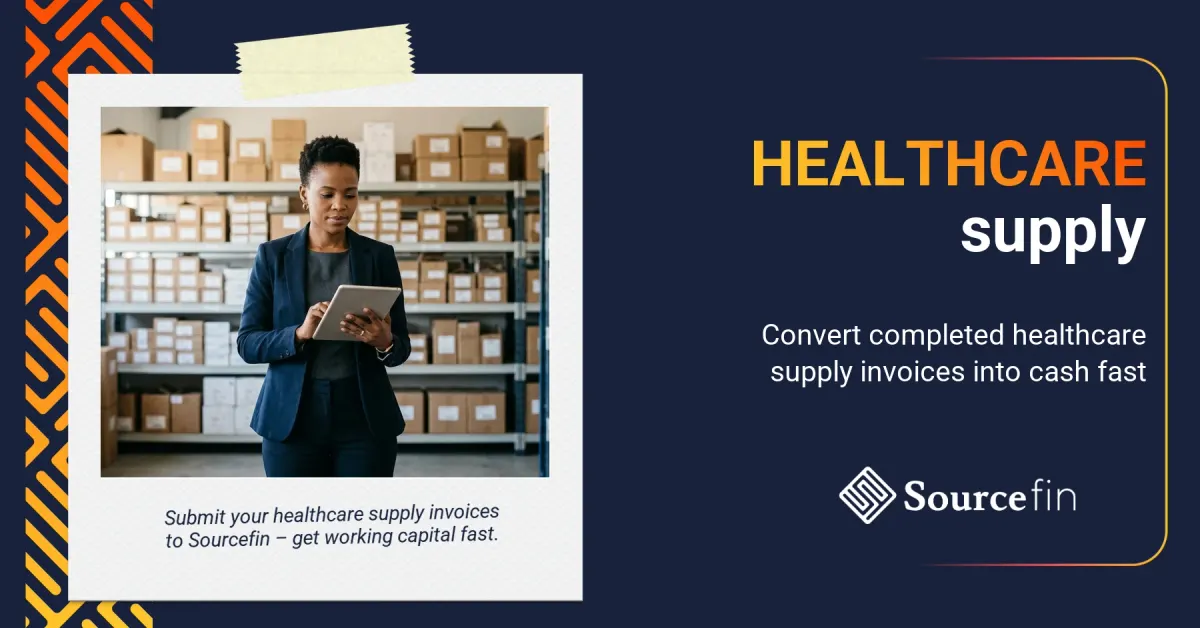
The mechanics of invoice discounting healthcare businesses use follow the same structure as other service and supply applications. You deliver a consignment of medical consumables or pharmaceuticals to a government hospital or provincial department. You issue your invoice for that delivery. You submit the invoice to Sourcefin along with delivery confirmation – typically a signed delivery note or goods received voucher from the facility. Sourcefin advances up to 75% of the invoice value, deployed within 5 to 10 business days on a first deal.
That advance covers your immediate costs: stock replenishment for the next delivery cycle, logistics, staff, and compliance overhead. When the government hospital eventually processes and settles the invoice, the advance and applicable fees are recovered, and you receive the remaining balance. The cycle repeats with each subsequent delivery invoice.
For suppliers holding multiple concurrent government contracts – across hospitals, clinics, or different provincial departments – this process can evolve into a pre-approved working capital facility, where each new invoice drawdown is handled automatically. The regularity of monthly supply invoicing against stable government debtors makes healthcare suppliers well-suited for facility structures over time.
What Healthcare Supply Businesses Need to Qualify
The qualifying requirements for invoice discounting healthcare businesses need to meet are accessible for most established operations. The core criteria are:
- Your business must be CIPC registered and SARS tax compliant
- The goods or services described in the invoice must have been fully delivered for the billing period – confirmed by a signed delivery note or equivalent
- Your client must be a qualifying debtor: a government hospital, provincial Department of Health, municipality, SOE, or established corporate health group
- Relevant sector compliance – such as SAHPRA registration for pharmaceutical products – should be current
You do not need to offer assets as security. You do not need years of audited financials. The strength of your debtor profile is the primary variable, and government health departments – despite their payment delays – are considered low credit-risk debtors. A supplier with consistent invoicing against a provincial DoH or national department is in a strong position to qualify, even if the business is relatively young or does not hold significant fixed assets.
Making Invoice Discounting Part of Your Supply Model
The healthcare suppliers that manage cash flow most effectively are those that treat invoice discounting as a planned operational tool rather than a last resort when stock funding runs out. When you know that a government hospital will invoice monthly and pay 90 days later, the funding cost can be factored into your quote. The advance is deployed within 5 to 10 business days on a first deal, once delivery confirmation is complete. Stock can be replenished. The next delivery cycle runs on schedule. You bid on additional contracts from a position of stability rather than shortage.
If you supply multiple government facilities and want to remove the per-invoice application process, a pre-approved facility may be the right structure. Apply through Sourcefin’s invoice discounting process to find out what your healthcare supply invoices are worth, or submit a funding application to explore all available options for your business.
Sources & References
Daily Maverick. R1 billion in unpaid pharma accounts triggers medicine crisis in Eastern Cape. February 2026. dailymaverick.co.za
Quicknews. Gauteng Department of Health’s non-payment crisis threatens suppliers and healthcare stability. November 2025. quicknews.co.za
Frequently asked questions
Can a healthcare supply business use invoice discounting in South Africa?
Yes. Healthcare supply businesses that invoice government hospitals, provincial departments of health, SOEs, or large corporate health groups are well-suited for invoice discounting. Funding is secured against your outstanding invoices, with approval based on the creditworthiness of your client rather than your company's credit history. Suppliers with consistent delivery records against government health facilities are strong candidates.
How does invoice discounting help a medical supplier cover stock replenishment costs?
Once a delivery invoice is submitted with a signed goods received voucher, Sourcefin advances up to 75% of the invoice value, deployed within 5 to 10 business days on a first deal. That cash is available before the next stock order deadline. You no longer need to use reserves or short-term credit to replenish inventory while waiting 60 to 90 days for a government hospital to process payment.
What documentation does a healthcare supplier need to discount an invoice?
You typically need the invoice itself, proof of delivery – such as a signed delivery note or goods received voucher from the facility – and confirmation the invoice has been submitted to the client. For pharmaceutical or regulated products, current SAHPRA registration or relevant sector compliance documentation may also be reviewed as part of the debtor approval process.
Does SAHPRA registration affect my ability to qualify for invoice discounting?
SAHPRA registration is a legal requirement for pharmaceutical and certain regulated medical product suppliers and will be reviewed as part of the compliance profile. Current registration, combined with CIPC and SARS tax compliance, forms the core qualification profile. Lapsed or missing compliance documentation would need to be resolved before funding could proceed.
Can I use invoice discounting for healthcare supply contracts with private hospital groups?
Yes, provided the private hospital group meets the funder's debtor approval criteria. The approval process assesses the client's creditworthiness and payment history. Large private hospital networks with strong balance sheets can qualify as approved debtors alongside government facilities. A diverse debtor base – mixing government and private clients – can increase the portion of your invoice book eligible for discounting.
How is invoice discounting different from a business loan for a healthcare supply company?
A business loan adds fixed debt to your balance sheet with scheduled repayments and typically requires collateral or a strong credit history. Invoice discounting is not debt – it advances cash against money already owed to you. When your client settles the invoice, the advance and fees are recovered automatically. There are no monthly repayments and no collateral requirements.

Sourcefin is a South African alternative finance provider that offers purchase order funding and invoice discounting to SMMEs, enabling businesses to fulfil confirmed purchase orders or tenders and unlock cash flow without collateral. Unlike traditional lenders or banks, Sourcefin also provides end-to-end support including supplier sourcing, logistics, project management, and risk oversight.