
Invoice Discounting Manufacturers South Africa: Real Guide
SA manufacturer with money tied up in receivables and production costs running ahead of invoice payment? Here's how invoice discounting fits the cycle.
On this page
- Key Takeaways
- Invoice Discounting Manufacturers South Africa: Why the Model Fits
- The Manufacturing Cash Cycle Problem
- Common Manufacturing Scenarios
- What the Funder Looks at for Manufacturing Receivables
- What to Bring to the Application
- How Invoice Discounting Compares to Other Manufacturing Funding
- Why Sector Experience Matters
- The Bigger Picture for SA Manufacturers
- Frequently asked questions
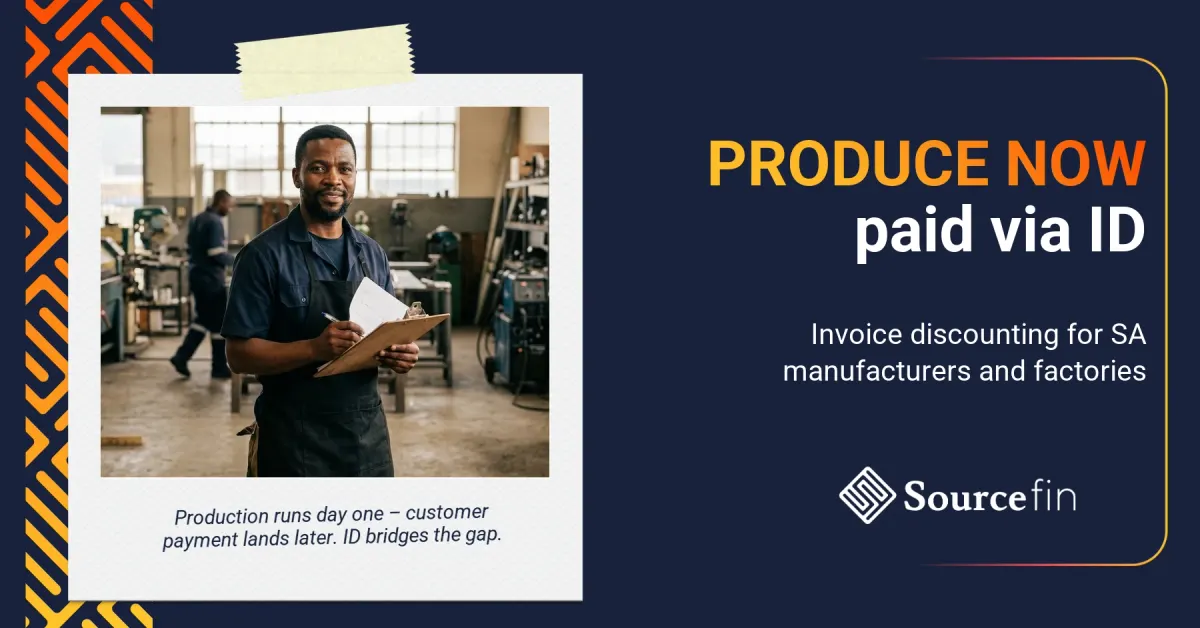
Invoice discounting manufacturers South Africa is the working capital model built for the gap between production cost and customer payment. Manufacturers carry significant cost on day one – materials, labour, overheads – and invoice customers only on delivery. Customer payment then runs 30, 60, or 90 days behind. Invoice discounting advances cash on the invoices already issued, smoothing the cycle.
Key Takeaways
- Manufacturing carries high working-capital intensity – cash goes out before customer cash comes in.
- Invoice discounting bridges the gap between issuing the invoice and customer payment landing.
- SA manufacturers benefit particularly because customer cycles often run 60-90 days, not 30.
- Sourcefin funds invoice discounting facilities for manufacturers from R250,000 upwards.
- Customer creditworthiness drives the facility – major retailers, corporates, and government suppliers all qualify naturally.
- The facility scales with production volume as the receivables book grows.
Invoice Discounting Manufacturers South Africa: Why the Model Fits
Manufacturing is one of the most working-capital-intensive sectors in South Africa. The cost cycle runs front-loaded: raw materials, energy, labour, overhead, and packaging all need paying before the finished product is even invoiced. Once the goods leave the factory, the customer invoice is issued, and the wait for payment begins.
For SA manufacturers supplying retail chains, mid-market corporates, or government, that wait is rarely 30 days in practice. Customer payment cycles routinely stretch to 60, 90 days, or longer. The result is significant cash tied up in receivables while production rolls on. The cash flow shape that defines the entire business.
Invoice discounting manufacturers South Africa exists for that exact pattern. The funder advances cash against the customer invoices already issued, freeing the production line to keep running without absorbing the wait. For broader context on how invoice discounting works, the wider invoice discounting South Africa pillar guide explains the model end to end.
The Manufacturing Cash Cycle Problem
A typical SA manufacturing cycle for an SMME runs something like this:
Day 1. Raw materials are ordered. Suppliers usually want payment in 30 days, sometimes upfront for new accounts.
Day 1-30. Production runs. Labour, energy, and overhead costs all flow out monthly regardless of whether customer invoices are landing.
Day 30-45. Goods are completed and shipped to the customer. Invoices are issued.
Day 60-120. Customer pays. Cash finally lands in the bank, partially covering the costs that flowed out 60 to 120 days earlier.
The gap between cash going out and cash coming in is the entire structural challenge for an SA manufacturing SMME. Without bridging finance, even profitable manufacturers can hit cash flow walls that stop production.
Common Manufacturing Scenarios

Sourcefin sees recurring patterns in manufacturing invoice discounting. Common scenarios include:
- Suppliers to major retailers. SMMEs producing for Pick n Pay, Shoprite, Woolworths, Massmart, and similar. Standard payment terms typically 60 to 90 days from invoice. Retail receivables are high-quality and easily fundable.
- Suppliers to corporates. Mid-market manufacturing for industrial customers, automotive supply chain, or B2B equipment. Established corporate customers with documented payment behaviour.
- Government and SOE manufacturing supply. Producing for state procurement programmes, with PFMA-aligned (but often delayed) payment cycles.
- Export manufacturing. Producing for customers outside SA. The receivables can still be funded, though the structure may need to account for currency or payment-method specifics.
- Contract manufacturing. Producing under long-term supply agreements with creditworthy buyers – the predictability of these cycles makes them ideal for whole-turnover invoice discounting.
Each scenario carries its own customer payment-cycle pattern, and the facility is structured accordingly.
What the Funder Looks at for Manufacturing Receivables
The receivables-book assessment for manufacturers focuses on three areas.
The customer mix. Major retailers, corporates, and government departments are the easiest customers to fund against. Smaller private buyers with no payment history are harder. The funder reviews the customer list to understand who is creditworthy and how reliably they pay.
The invoicing pattern. Steady monthly invoicing supports a smoother facility than sporadic, lumpy invoicing. Many manufacturers fall naturally into the steady pattern because production runs continuously.
The production-to-invoice cycle. The funder needs to understand how long after production the invoice is typically issued, and how reliably customers pay against those invoices. The cleaner the cycle, the easier the facility to structure.
What to Bring to the Application
The standard invoice discounting requirements apply. The invoice discounting requirements South Africa guide covers the full document picture. For manufacturers specifically, the funder will want to see:
- Your current customer list with payment terms.
- Sample recent invoices showing the typical structure and value.
- An aged debtors report showing where invoices sit in the payment cycle.
- Your CIPC, SARS compliance, and recent business bank statements.
- For larger facilities, management accounts and AFS to show the production-cost side of the business.
For a fuller view of the application process, the how to apply for invoice discounting walkthrough explains the steps.
How Invoice Discounting Compares to Other Manufacturing Funding
SA manufacturers use several funding tools. Invoice discounting handles the receivables-driven cash gap. A bank overdraft handles general working capital. Asset finance funds plant and equipment. Trade finance funds raw material imports.
For a manufacturer with a meaningful customer base and ongoing receivables flow, invoice discounting is often the most practical match for the structural cash gap. The facility scales with production volume, the cost is built into the invoice economics, and the structure suits the front-loaded cash cycle.
The invoice discounting vs bank overdraft guide walks through the comparison with bank credit. The invoice discounting company South Africa guide covers what to look for when comparing funders – sector experience matters for manufacturing-heavy receivables books.
Why Sector Experience Matters
Manufacturing has its own rhythms – payment cycle nuances, retention practices in some sub-sectors, returns and credit-note handling, and customer relationship dynamics that differ from services or trading businesses. A funder with deep manufacturing exposure understands these patterns and can structure facilities cleanly. A funder unfamiliar with the sector takes longer to assess and may misprice the deal.
When evaluating funders, ask about their manufacturing book size, the kinds of customers they regularly fund against, and how they handle production-cycle quirks. The conversation is part of the comparison.
The Bigger Picture for SA Manufacturers
South Africa's manufacturing sector remains a substantial share of the economy, and the SMME tier within manufacturing is particularly important for jobs and supply chain capability. The IFC's recent SA SMME finance partnership work highlights the constraint that working-capital access remains for many SA SMMEs, particularly in capital-intensive sectors like manufacturing.
Invoice discounting manufacturers South Africa is one of the practical routes that lets manufacturing SMMEs scale without being constrained by customer payment cycles. To explore an invoice discounting facility against your manufacturing receivables book, the Sourcefin funding application form takes a couple of minutes, and a representative will follow up to walk through the deal. The Sourcefin invoice discounting service page sets out the full process.
Sources & References
Frequently asked questions
Can a South African manufacturer get invoice discounting?
Yes, manufacturing is one of the most natural sectors for invoice discounting. Manufacturers carry significant cost on day one (materials, labour, overhead) and invoice customers only after delivery. Customer payment then runs 30, 60, or 90 days behind. Invoice discounting advances cash on the invoices already issued, smoothing the cycle and freeing the production line to keep running.
What kinds of customers make a manufacturing book easier to fund?
Major retailers (Pick n Pay, Shoprite, Woolworths, Massmart), established corporates, automotive supply chain customers, and government or SOE buyers all make a strong receivables book. Smaller private buyers with no payment history are harder to fund. The customer mix drives much of the facility structure for manufacturing receivables.
How does invoice discounting compare to a bank overdraft for manufacturers?
A bank overdraft is general-purpose, sized to your overall financial profile, and capped by the bank's limit. Invoice discounting is receivables-backed, scaling with your invoice book. For manufacturers with growing receivables, the bank overdraft hits its ceiling quickly. Invoice discounting expands as production volume grows. Many manufacturers use both alongside each other.
Can I use invoice discounting to fund raw material purchases?
Indirectly, yes. Invoice discounting advances cash against existing customer invoices, freeing cash flow that you can then deploy to raw material suppliers. For direct funding of raw materials before any invoice exists, trade finance or PO funding (a different model) is the better tool. Many manufacturers use invoice discounting and trade finance together for complete cycle coverage.
What is the minimum receivables book size for manufacturing invoice discounting?
Sourcefin funds invoice discounting facilities for manufacturers from R250,000 upwards through to multi-million-rand books. Smaller books are usually a poor fit because the operational work involved in setting up the facility makes them unworkable for both sides. For sub-R250,000 needs, an overdraft facility from a commercial bank is usually a better tool.
Does customer concentration affect manufacturing invoice discounting?
Yes. Many SA manufacturing SMMEs supply one or two major retailers or corporates, creating high concentration. The funder accommodates concentration but typically with more conservative facility sizing to absorb the risk. Diversifying the customer book over time naturally lifts the cap. Concentration does not disqualify – it shapes the structure.
Can invoice discounting fund export receivables?
Yes, in many cases. Export invoices to creditworthy international customers can be funded, though the structure may need to account for currency, payment-method specifics, and longer collection cycles. The funder reviews each export customer the same way they would a domestic customer – payment ability and reliability drive the assessment. Discuss export specifics upfront with the prospective funder.

Sourcefin is a South African alternative finance provider that offers purchase order funding and invoice discounting to SMMEs, enabling businesses to fulfil confirmed purchase orders or tenders and unlock cash flow without collateral. Unlike traditional lenders or banks, Sourcefin also provides end-to-end support including supplier sourcing, logistics, project management, and risk oversight.