
Innovative SMME Financing: Smart Models for SA Growth
Innovative SMME financing pairs public stability with private speed. Here's how new funding models help South African businesses scale without collateral.
On this page
- Key Takeaways
- Why the old SMME funding rulebook stopped working
- The new state response: capital paired with capability
- How fintech is rewriting risk for innovative SMME financing
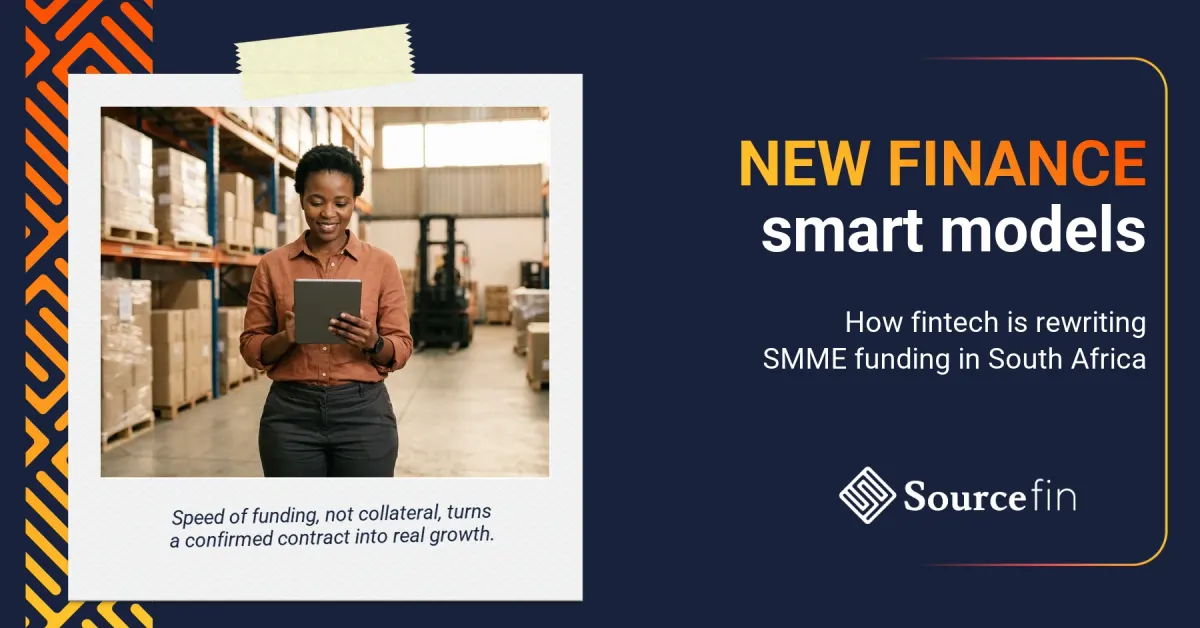
- Why speed of capital matters more than collateral
- Where fintech meets the corporate supply chain
- What it takes to use these tools well
- About the source: Sunday Times Ignite, April 2026
- Frequently asked questions
Innovative SMME financing in South Africa is a new generation of funding that prices risk on real performance data and live contracts, not on hard collateral or formal credit history. It blends public sector stability with private sector speed. For an SMME owner, that means working capital can move at the same pace as a signed purchase order, so a confirmed contract becomes delivered work, paid invoices and a stronger business.
Key Takeaways
- South Africa is assembling a new funding architecture for SMMEs that pairs public sector stability with private sector innovation.
- Fintech models price risk on transaction data, behaviour and supply chain visibility, not only on balance sheet strength.
- Asset-light and black-owned businesses gain the most, because the collateral barrier becomes a smaller part of the decision.
- Speed of capital often decides whether a confirmed contract becomes growth or a missed opportunity.
- Corporate early payment programmes and structured purchase order funding are turning supplier development into real working capital.
- Tools like purchase order funding and invoice discounting let SMMEs scale on confirmed demand, not on assets they don't yet own.
- The Sunday Times Ignite April 2026 feature confirms the shift is structural, not a passing trend.
Why the old SMME funding rulebook stopped working
For decades, an SMME in South Africa has been measured against tools designed for a different kind of business. Hard collateral, audited multi-year financial statements and formal credit history sit at the centre of the standard credit decision. Banks have built that approach for very good reasons. They are built for stability, they protect deposits, and their conservative mandates do exactly what they are supposed to do for the country's financial system.
The problem isn't the bank model. It's the assumption that the same model can serve every kind of business. Most South African entrepreneurs don't operate the way that model rewards. They are asset-light. They are growing on confirmed contracts rather than on property portfolios. Many are first-generation business owners building credit history while they trade, not before. So when a corporate or government buyer issues a real purchase order, the SMME often has the demand but not the working capital to deliver, and the standard credit lens can't see the contract clearly enough to fund it.
That gap is what the Sunday Times Ignite April 2026 feature on innovative SMME financing examines. The piece, written by journalist Tersia Booyzen, argues that South Africa is finally beginning to assemble a financial architecture that fits how SMMEs actually grow. Banks remain essential to the bigger picture. The new layer simply does work that traditional lending was never designed to do.

The new state response: capital paired with capability
The public sector side of the picture has changed materially in the last year. The consolidation of the Small Enterprise Finance Agency, the Small Enterprise Development Agency and the Co-operative Bank Development Agency into the new Small Enterprise Development and Finance Agency is more than a tidy-up of acronyms. It signals a move toward blended finance, where capital and capability sit under one roof. An SMME applying for support can be matched to funding, business development and market access through the same door.
The National Empowerment Fund plays a complementary role. By providing equity and quasi-equity to black-owned businesses, it strengthens balance sheets and helps firms pursue acquisitions, expansions and major contracts that would otherwise be out of reach. Equity is patient capital. It changes how a balance sheet looks to other funders, and it gives owners more flexibility on how they grow.
The Department of Trade, Industry and Competition (dtic) incentives quietly act as non-dilutive capital for machinery, expansion and export development. Used well, they turn ambitious projects into bankable ones. They are not a substitute for working capital, but they are a powerful complement to it.
Together, these public sector tools form a more coherent base. The private sector innovation – fintech-led, data-driven – sits on top of that base. That combination is the architecture the Ignite feature describes. It is also why the conversation has moved beyond "how do we get the bank to say yes" toward "which combination of tools fits this stage of this business".
What this means for your funding application
The practical translation is simple. Match the tool to the moment. If the constraint is equipment or expansion, look first at SEFA-aligned channels and dtic incentives. If the constraint is balance sheet strength, the National Empowerment Fund route is worth exploring. If the constraint is working capital against a confirmed contract or invoice, that is where private sector tools like purchase order funding and invoice discounting open up the picture. For a deeper view of the full menu, our guide to alternative business funding in South Africa sets out how the pieces fit together.
How fintech is rewriting risk for innovative SMME financing
The structural shift Joshua Kadish describes in the Ignite feature is the move from funding balance sheets to funding performance. Fintech changes how risk is understood and priced. It draws on real-time transaction data, behavioural insights and supply chain visibility, and it uses that picture to make a faster, more accurate call. The single biggest barrier for asset-light or black-owned businesses – the requirement for hard collateral – becomes a smaller part of the decision.
That is what makes models like purchase order funding, invoice discounting, asset-backed finance and merchant cash advance work for businesses that wouldn't pass a traditional credit screen. The data tells a story the standard scorecard misses. A consistent receivables pattern, a healthy customer mix, a credible counterparty on the contract – these are signals the new generation of funders can read and price.
It also speeds up decisions. When a funder can see live transaction data and a verified contract, they don't need three months of back-and-forth. They can answer faster, with more confidence. That is the difference between an SMME losing a deal and delivering it. The same logic powers working capital finance structures that sit alongside an SMME's day-to-day cash flow rather than against a personal asset.
None of this replaces good fundamentals. Clean books, registered VAT and CIPC compliance, and a real customer relationship still matter. What it does is shift the weight of the decision onto the things an SMME can actually demonstrate today. For more on how that compares to the wider funding picture, see our overview of SMME funding alternatives in South Africa. Our recent piece on the questions every SMME owner asks about funding walks through the practical "how does this actually work" version of the same shift.

Why speed of capital matters more than collateral
This is the line from the Ignite feature that sticks with most readers. As Joshua Kadish put it, "If funding can be deployed within days, that business can deliver, build a track record and reinvest in capability. If it takes months, the opportunity is lost." That sentence captures the real economics of an SMME. Demand is rarely the problem. Working capital is.
Picture an entrepreneur who has just secured a large corporate contract. The buyer is real, the order is confirmed, the margin is healthy. The only missing piece is the cash to pay suppliers, manufacture the goods or staff the project. If funding lands quickly, the business delivers, gets paid, builds a track record and uses that track record to access bigger work next quarter. If funding lands slowly, the buyer moves on, the SMME's reputation takes a knock, and the next contract is harder to win.
That is why the private sector layer of the new architecture is built around speed and certainty of capital. The forward-looking, collateral-free view of the business is not about taking shortcuts. It is about meeting the SMME where they actually are. Banks are built for stability. Sourcefin is built for speed. Both matter, and the country needs both.
The principle is the same whether the contract is a tender, a supply agreement or a recurring corporate order. Cash flow is the engine. Our recent feature on the funding gap for forgotten SMMEs looks at the human side of this same story – business owners with the contracts, the skill and the team, held back only by the speed at which capital can reach them.
Where fintech meets the corporate supply chain
The most interesting development in the Ignite feature is the convergence between fintech and corporate supply chains. South African corporates are moving beyond compliance-driven supplier development and starting to integrate SMMEs into core procurement pipelines. Fintech platforms provide the liquidity layer that makes those relationships sustainable.
Early payment programmes, structured purchase order funding and data sharing between corporates and funders create a virtuous cycle. The corporate gets a more reliable supplier base. The SMME gets predictable cash flow. The funder gets better data, which sharpens pricing and decisions. Platforms like Addendum, mentioned in the Ignite article, connect supplier, funder and retailer so that early payouts keep cash flowing for the SMME without disrupting the corporate's payment cycle.
Sourcefin's contribution to this picture sits in two places. TenderCentral is the visibility side – a clear, searchable view of verified contracts so that SMMEs can find the work first, then attach funding to a real opportunity. AffiliateHub is the channel for accountants, brokers and business advisors who introduce SMMEs to fintech-style funding and earn for the work they already do, helping clients access capital.
The bigger point Kadish makes in the feature is that true transformation happens when market access and capital move together. Funding without contracts produces idle balance sheets. Contracts without funding produce failed delivery. Supply chain finance is the connective tissue that holds the two sides together.
What it takes to use these tools well
The new architecture rewards readiness. Three things matter most. First, contract documentation. A clean copy of the purchase order or supply agreement, with clear terms, prices and a credible counterparty, makes everything that follows faster. Second, customer concentration. A small number of large buyers can be a strength when those buyers are well known and well rated, and a risk when there is no fallback. Knowing where you sit on that line is useful. Third, recovery process. Confidence that you can produce, deliver and collect on time is a real factor in how a funder reads your application.
Sourcefin's approach is open-minded by design. We assess the opportunity, the contract and the working capital cycle, not only the credit history. That means an SMME with a strong contract and a clean delivery plan can get to "yes" without the asset base a traditional lender would need. The fastest way to find out where you stand is to start a conversation through the funding application page.
About the source: Sunday Times Ignite, April 2026
This article is a Sourcefin response to the "Innovative Financing Models" feature in the Sunday Times Ignite April 2026 edition. The piece was written by journalist Tersia Booyzen and quotes Joshua Kadish, CEO and co-founder of Sourcefin, on the structural shift in SMME finance. We have translated his observations into a practical guide for an SMME owner reading this on a Monday morning. The full digital edition is available through the link above.
Sources & References
- Sunday Times Ignite, April 2026 edition – feature by Tersia Booyzen with Joshua Kadish
- Department of Trade, Industry and Competition (dtic) – SMME incentives
- National Empowerment Fund – equity and quasi-equity for black-owned businesses
- Small Enterprise Finance Agency – public sector SMME finance
Frequently asked questions
What is innovative SMME financing in the South African context?
Innovative SMME financing is a new generation of funding that prices risk on real-time transaction data, contract quality and supply chain performance, instead of relying mainly on hard collateral or long credit history. In South Africa, it includes purchase order funding, invoice discounting, asset-backed finance and merchant cash advance. The shift, highlighted in the Sunday Times Ignite April 2026 feature, lets asset-light and black-owned businesses access working capital tied to confirmed contracts.
How is fintech-driven funding different from a traditional bank loan?
Banks are built for stability. Their conservative mandates protect deposits and the wider financial system, which is essential for the country. Fintech-driven funding sits alongside that, built for speed and tied to confirmed contracts, invoices and real-time business data. A bank loan typically requires hard collateral and a strong balance sheet. Innovative SMME financing assesses the opportunity itself, the contract and the cash flow cycle, so a strong order can move quickly.
Do I need collateral for purchase order funding?
Purchase order funding is built around the contract itself, not around fixed assets. The funder looks at the credibility of the buyer, the strength of the order, the SMME's ability to deliver and the working capital cycle. That means hard collateral is usually not the gating requirement. Sourcefin assesses each opportunity on its own merits, which is why asset-light and growth-stage businesses use this tool to take on contracts they could not otherwise fulfil.
How fast can innovative funding be deployed?
Speed is one of the defining features of innovative SMME financing. For confirmed deals with clear documentation and a credible counterparty, funding can move within days rather than months, which is exactly when working capital matters most. Real timelines depend on how complete the SMME's paperwork is, how clean the customer relationship is, and how the deal is structured. The principle is simple. Faster decisions turn confirmed contracts into delivered work.
Does my B-BBEE level matter for innovative SMME financing?
B-BBEE level matters most when the contract you are funding is itself influenced by transformation criteria, which is common in government and corporate procurement. For the funder, a strong B-BBEE level can open doors to bigger contracts, and certain instruments like the National Empowerment Fund are explicitly aimed at black-owned businesses. For the funding decision itself, the contract, the buyer and the cash flow cycle usually carry more weight than the B-BBEE certificate.
How does Sourcefin assess opportunity instead of balance sheet?
Sourcefin's open-minded approach starts with the contract, the buyer and the working capital cycle. We look at the credibility of the counterparty, the strength of the purchase order or invoice, the SMME's track record on similar work and the realistic delivery plan. Clean books, CIPC and SARS compliance and a clear customer mix all help. The result is a forward-looking view of the opportunity, so a strong contract can fund growth even when the balance sheet is still building.

Sourcefin is a South African alternative finance provider that offers purchase order funding and invoice discounting to SMMEs, enabling businesses to fulfil confirmed purchase orders or tenders and unlock cash flow without collateral. Unlike traditional lenders or banks, Sourcefin also provides end-to-end support including supplier sourcing, logistics, project management, and risk oversight.