
How to Apply for Purchase Order Funding South Africa: Fast
Got a confirmed PO or tender award? Here's the step-by-step on how to apply purchase order funding in SA – documents, timing, and what to expect.
On this page
- Key Takeaways
- How to Apply Purchase Order Funding South Africa: The Short Version
- Before You Start: Are You Eligible?
- The Documents You Will Need
- The Step-by-Step Application
- What Happens After You Send the Documents
- Common Application Mistakes (and How to Avoid Them)
- If Your Tender Is a Government Contract
- How to Apply Purchase Order Funding South Africa: The Bottom Line
- Frequently asked questions
How to apply purchase order funding South Africa is a straightforward process if you bring the right documents and the right deal. You need a confirmed purchase order or tender award, current SARS tax compliance, CIPC registration in good standing, recent business bank statements, and your supplier quote. Submit online, expect a same-day or next-day first response, and a structured proposal once the deal is reviewed.
Key Takeaways
- You need a confirmed purchase order or tender award letter to apply – speculative applications without a real deal are not assessed.
- Core documents: CIPC company registration, SARS tax compliance, recent business bank statements (3 to 6 months), and supplier quote.
- Sourcefin funds deals from R250,000 upwards. Smaller deals are usually better served by other working capital tools.
- The application is online. Expect a first acknowledgement within hours, with a structured proposal following the deal review.
- Honesty about credit history, prior business experience, and supplier relationships speeds up the assessment significantly.
- Sourcefin's three-pillar review checks trust, delivery capability, and end-buyer payment certainty before structuring an offer.
How to Apply Purchase Order Funding South Africa: The Short Version
If you have just won a tender or received a purchase order and need execution capital, the path is short. Pull together your registration, tax, and banking documents. Submit the application online. Wait for the deal review and a structured proposal. The whole sequence takes days, not weeks, when the documentation is ready.
The longer version of how to apply purchase order funding South Africa is in the rest of this guide. Each step has its own detail, and the more prepared you arrive, the faster the funder can move. For broader context on how the model works, the wider purchase order funding South Africa pillar guide explains the funding approach end to end.
Before You Start: Are You Eligible?
Three eligibility tests sit at the front of every application.
First, you need a confirmed contract. A purchase order, a signed tender award letter, or an equivalent document from a credible buyer. PO funding is transaction-specific. Without a real deal, there is nothing to fund. The do I need purchase order funding guide is a useful sanity check if you are uncertain.
Second, the deal needs to be the right size. Sourcefin funds purchase order deals from R250,000 upwards through to multi-million-rand contracts. Below that threshold, an overdraft facility or short-term working capital from a commercial bank is usually a better fit. The wider SMME funding alternatives overview covers the options for smaller deals.
Third, the buyer needs to be the kind of buyer who pays. Government departments, SOEs, and large corporates fit naturally. A small private business with no payment history is a harder fit, regardless of how strong the deal looks on paper.
The Documents You Will Need
Sourcefin's document set sits in two groups: the essentials needed to start, and the documents that move things faster when you send them upfront.
The essentials
- The purchase order, invoice, or award letter. The foundation of the deal. A copy of the signed PO, or the official letter from the awarding department or corporate.
- CIPC company registration certificate. Confirms your legal entity is in order.
To go faster (send these with the application)
- Tax PIN. A current SARS tax compliance status PIN. The SARS tax compliance status guide walks through how to obtain or refresh it.
- Latest 3 months of business bank statements. Shows trading activity and cash flow patterns.
- ID copies for directors and reps. Standard FICA requirement.
- Supplier quote or proforma invoice. The supplier's pricing for the goods or services you need to deliver against the PO. Send this when you have it – if you do not have a supplier yet, sourcing support may be available.
For deals over R1 million
Larger deals need a slightly heavier financial pack:
- Management accounts for the past 3 months
- Annual Financial Statements (no older than 18 months)
- Tax return summaries for the past 2 financial years
You do not need every document in hand to apply. Send what you have, and Sourcefin will help you put the rest together. The detailed purchase order funding requirements South Africa guide covers the full picture.
The Step-by-Step Application

The form itself is short. Most of the work happens in the conversation that follows. Here is how to apply purchase order funding South Africa from start to a structured proposal.
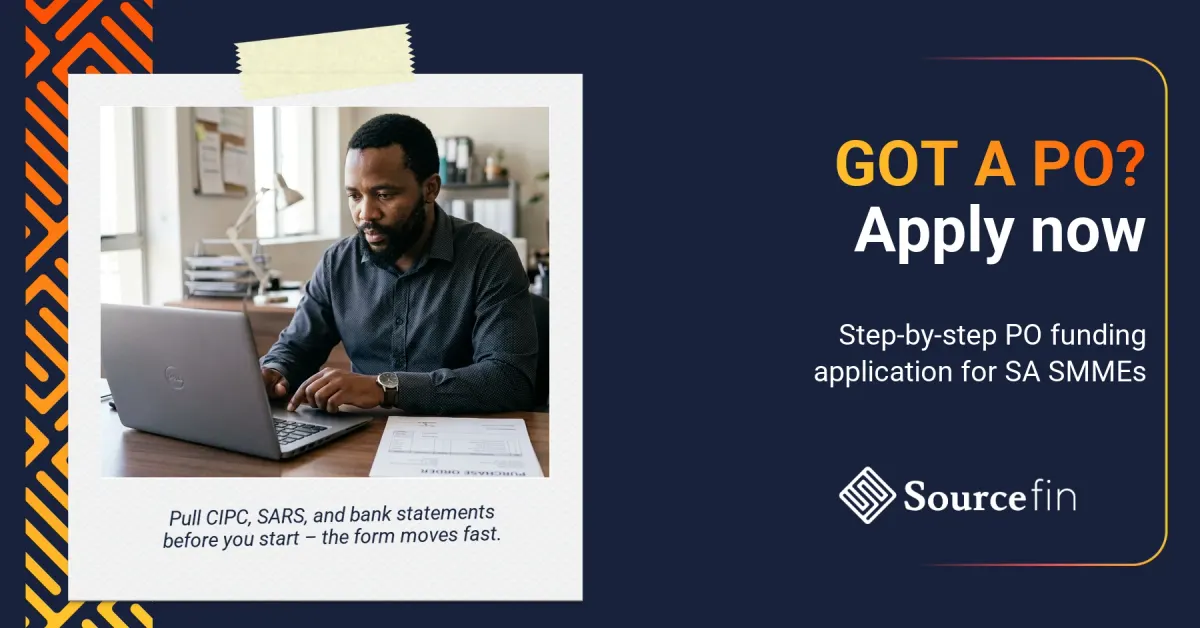
- Fill in the quick application form. Open the Sourcefin funding application page. The form asks for your name, a phone number for calls, your WhatsApp number if different, your email, what kind of funding you need, and how much. It takes a couple of minutes.
- Submit. A confirmation lands in your inbox and the application reaches Sourcefin's team immediately.
- Expect a call from a Sourcefin representative. A real person reads your application and follows up by phone or WhatsApp. They want to understand the deal, the buyer, and your timeline before anything else.
- Send the documents through. The representative will tell you which documents are needed for your specific deal. It usually starts with the purchase order or award letter and your CIPC certificate, with additional documents requested based on deal size and complexity.
- The deal review begins. Once the documents are in, the funder works through them and comes back with a structured proposal that sets out the advance amount, the supplier-payment process, the timing, and the deal structure.
What Happens After You Send the Documents
Once the documents are in, the deal review begins. Sourcefin's three-pillar assessment looks at trust (the SMME owner), delivery capability (the supplier and operational plan), and end-buyer payment certainty (the buyer and the contract).
The trust review covers your business profile: bank statement patterns, credit bureau history, prior business activity, and the honest conversation about anything unusual. The delivery review covers the supplier and the operational plan: can the goods or services actually be sourced, produced, and delivered on time and within budget? The end-buyer review covers the contract and the buyer: is the buyer financially sound, do they have a history of paying suppliers, and is the contract real?
If all three pillars check out, Sourcefin builds a structured proposal. The proposal sets out the advance amount, the supplier-payment process, the timing, and the profit-share structure on the deal. There are no hidden fees baked in. The numbers are based on the actual contract, not a posted percentage.
For a sense of how long the cycle typically takes from application to advance, the purchase order funding timeline guide walks through the realistic schedule.
Common Application Mistakes (and How to Avoid Them)
A few patterns slow applications down or cause unnecessary back-and-forth.
The most common is delaying the application until you have every document collected. The form itself only needs basic contact details and your funding amount – the rep who calls will tell you which documents are needed for your specific deal. Apply early and gather documents in parallel.
The second is vague deal descriptions on the call. "Supplying goods to a government department" is not enough. Which goods, which department, what is the supplier arrangement, what is the timeline? Specifics let the funder assess quickly.
The third is hiding credit issues. The funder will see them in the bureau report regardless. Disclosure with context is a much better signal than silence followed by discovery. If you have a history, write the short summary first. The PO funding bad credit South Africa guide goes into more depth on this scenario.
The fourth is choosing a funder before comparing. Different SA funders have different deal-size sweet spots, supplier support models, and fee structures. The purchase order finance company South Africa guide covers the comparison framework, and the PO funding vs bank loan comparison helps decide between PO funding and traditional bank credit.
If Your Tender Is a Government Contract
Government tenders carry their own application nuances. The buyer's procurement processes, payment cycles (typically 30 days from invoice but often longer in practice), and supplier requirements all shape how the deal needs to be structured. The purchase order funding for government tenders guide adds the tender-specific layer.
Departmental tenders, SOE contracts, and municipal awards each have their own rhythms. Sourcefin's portfolio is roughly 80% public sector, which means the team has seen most of the patterns and can move faster on a deal that fits a familiar shape.
How to Apply Purchase Order Funding South Africa: The Bottom Line
Knowing how to apply purchase order funding South Africa is mostly about preparation. The deal needs to be real and confirmed. The compliance pack needs to be current. The bank statements need to show genuine trading activity. Anything unusual needs to be disclosed honestly. Once those four things are in place, the application itself is a short form, and the response is fast.
South Africa's SMME funding gap is well documented. The IFC's recent SA SMME finance partnership work shows that even traditional lenders are recognising the constraint. Alternative routes – including a well-prepared PO funding application – are how many SMMEs actually access execution capital today.
To start an application, the Sourcefin funding application form takes a couple of minutes – name, contact number, email, what funding you need, and how much. A Sourcefin representative follows up by phone or WhatsApp to walk through the rest. The Sourcefin purchase order funding service page sets out the full process from there.
Sources & References
Frequently asked questions
What documents do I need to apply for purchase order funding in South Africa?
There are two groups. To get started, you need the purchase order, invoice, or award letter and your CIPC company registration certificate. To move faster, send your SARS tax PIN, the latest 3 months of business bank statements, ID copies for directors and reps, and your supplier quote upfront. Deals over R1 million also need recent management accounts, AFS no older than 18 months, and tax return summaries for the past 2 financial years.
How long does a purchase order funding application take in South Africa?
First acknowledgement is usually same-day or next-day. The full deal review and structured proposal follow within a few business days when the documentation is complete and the deal is straightforward. Complex deals involving multi-supplier sourcing or first-time buyer relationships take longer. Speed depends most heavily on document readiness on your side, not on internal funder delay.
Can I apply for PO funding if my business does not have audited financials?
It depends on deal size. For deals below R1 million, AFS are not required – recent business bank statements give the funder enough picture of trading activity. For deals over R1 million, you do need Annual Financial Statements no older than 18 months, plus management accounts for the past 3 months and tax return summaries for the past 2 financial years. The deal itself still does most of the talking.
What is the minimum deal size for purchase order funding in South Africa?
Sourcefin funds purchase order deals from R250,000 upwards through to multi-million-rand contracts. Smaller deals are usually a poor fit because the operational work involved in structuring, supplier vetting, and project management makes them unworkable for both the funder and the SMME. For sub-R250,000 contracts, an overdraft facility or short-term working capital from a commercial bank is usually a better tool.
Do I need to find my own supplier before applying?
Not always. If you already have a supplier and a quote, that strengthens the application. If you do not, Sourcefin can sometimes assist with sourcing through its in-house supply chain function and pre-vetted supplier network. Coming with a credible supplier shows you have done the groundwork, but the absence of one is not a hard blocker if the rest of the deal is sound.
Will applying for PO funding affect my credit record?
PO funding does not show up on your credit record the same way a traditional loan does. The structure is contract-specific rather than a debt obligation against your business. A credit bureau check is part of the assessment, but the application itself does not register as new credit on your profile. That said, transparency about existing credit issues is important and helps the assessor see context.
What happens if my application is declined?
Declines usually happen for one of three reasons: the buyer's payment ability is uncertain, the supplier or delivery plan is not credible, or the SMME owner has unresolved issues that materially affect trust. The funder will explain the reason. In many cases, the deal can be reworked or postponed until the issue is resolved. A decline today does not mean a decline next time on a better-structured deal.

Sourcefin is a South African alternative finance provider that offers purchase order funding and invoice discounting to SMMEs, enabling businesses to fulfil confirmed purchase orders or tenders and unlock cash flow without collateral. Unlike traditional lenders or banks, Sourcefin also provides end-to-end support including supplier sourcing, logistics, project management, and risk oversight.