
SMME Funding Questions: Honest Answers from a Funder
The SMME funding questions South African business owners actually ask – answered straight by a funder who has seen thousands of applications and deals.
On this page
- Key Takeaways
- Why so many SMME funding applications get rejected
- Cash flow versus turnover and profit
- Personal credit score and SMME funding decisions
- Is alternative funding more expensive – or is the question wrong?
- Three things funders are really looking for
- Tools that make answering SMME funding questions easier
- About the source
- Frequently asked questions
SMME funding questions almost always come from the same place – a business owner who is trading, delivering, and growing, but still hearing no. The honest answer from a funder is simple. Most rejections are not a verdict on your business. They are a read on the risk signals a funder can see in your numbers, your contracts, and your cash flow. Once you know what those signals are, the conversation changes.
Key Takeaways
- Most funding rejections are about risk signals, not the quality of your business.
- Bank statements show behaviour, and behaviour is what funders actually fund.
- Cash flow tells the real story – turnover and profit alone will not get you funded.
- Personal credit is one input, not the whole picture, especially for opportunity-led deals.
- Alternative funding pricing only matters if the opportunity it opens is worth more than the cost.
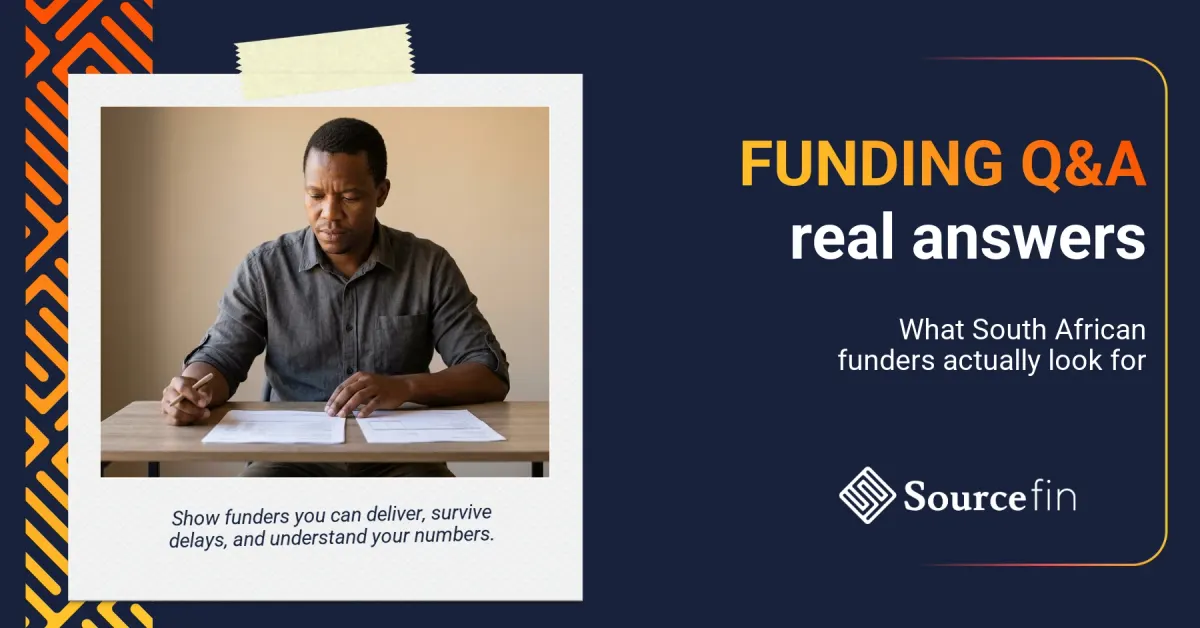
- Funders look for three things: proof you can deliver, survive delays, and understand your numbers.
- The Sunday Times Ignite April 2026 Q&A with Jedd Harris is the source for this piece.
Why so many SMME funding applications get rejected
This is the first of the SMME funding questions almost every South African business owner brings to the table. If you are an SMME owner here, you have probably had a moment where funding felt less like finance and more like a judgement call on your business. You are trading, selling, delivering, growing – and still hearing no. The honest truth, after working with thousands of South African entrepreneurs, is that most declines are not a statement about whether your business is good or bad. They are a statement about what the funder can and cannot see.
When a funder declines an application, the response is often heard as your business is not good enough. More often, it means we cannot get comfortable with the risk signals we can see. There is a big difference between those two sentences. One is a closed door. The other is an invitation to clean up your signals and come back.
Signals show up in patterns. Cash flow that swings hard from month to month. Heavy reliance on one customer. Persistent overdraft use. Debit orders bouncing on payday. Thin margins that leave no room for a single late payment. Repayment capacity that depends on a deal that has not closed yet. None of these patterns are, on their own, reasons to refuse to back a great business. Together, they paint a picture a funder has to read carefully.
That is why bank statements get asked for so often. They show behaviour, not just a spreadsheet story. A polished management account can tell any narrative you want it to. A bank statement tells the funder how the business actually behaves at month-end, when the supplier wants paying, the salaries hit, and the corporate client decides to wait another fortnight. If you want to work out why your last application was declined, that is the page to start on – not the income statement.

Cash flow versus turnover and profit
Of all the SMME funding questions South African owners ask, this is the most common – and it is also the one with the clearest answer. Turnover, profit, and cash flow are three different stories about the same business. Turnover shows demand. Profit shows pricing discipline. Cash flow shows whether you can actually survive the payment terms your customers impose on you.
South African trading conditions make this gap brutal. If you supply a corporate that pays on 60 days, your business can be profitable on paper and still run out of cash in week three. Salaries are due monthly. Suppliers want their money in 7 to 30 days. Rent does not wait. SARS does not wait. Meanwhile, the invoice that justifies all that activity is sitting on someone else's accounts payable schedule.
When you apply for funding, most funders are not really buying your turnover or your profit. They are assessing your ability to stay liquid and repay, even when customers pay late. So yes, turnover and profit matter – they tell the funder there is a real business here. But cash flow is the crux. It tells the funder whether your business can keep operating under real South African trading conditions, not the ideal ones a spreadsheet imagines.
This is exactly the gap that products like invoice discounting are designed to bridge – releasing cash from invoices you have already issued, so the 60-day wait does not strangle a business that is otherwise doing everything right. It is not a magic wand. It is a tool that matches the real timing of South African payment terms.
What to track if you only have time for one number
If you have one hour a week to spend on the numbers, do not spend it staring at turnover. Build a rolling 13-week cash flow forecast. List every Rand you expect in over the next thirteen weeks – by week, by customer, with realistic pay dates not invoice dates. Then list every Rand going out – salaries, suppliers, rent, SARS, debt repayments, the lot. The week-by-week balance is the truth of your business.
The second number worth tracking is days sales outstanding – how long your average invoice takes to actually get paid. If your terms say 30 days and your DSO is 58, you have a payment behaviour problem your funder will see long before you raise it. Fix the visibility first, then have the funding conversation. For a deeper look at the habits that make this easier, the financial confidence guide for South African SMMEs is a useful starting point.
Personal credit score and SMME funding decisions
In South Africa, this question is everywhere because SMME owners and their businesses are usually financially intertwined. My business is my baby is a worn cliche for a reason – the founder's personal balance sheet often props the business up in its early years, and the business cash flow eventually props the family back up.
When it comes to funding, personal credit can be one factor, but it should not be the whole story. A business with strong contracts, consistent trading, and clear affordability should not be treated the same as a business with no track record and the same credit score. Those are two different risk profiles, even if the credit bureau prints the same number on both.
This is where open-minded, future-focused funding earns its place. Whether the capital comes from your own wallet or from an investor, opportunities should be evaluated on just that – the opportunity itself. Is the purchase order legitimate? Is the supplier real? Is the end client creditworthy? Can the SMME owner deliver to spec, on time? Those questions matter far more for a tender or PO-linked deal than the founder's credit utilisation from three years ago.
You do not need a perfect score. You need a foot in the door. Show the funder the deal is real, the suppliers are real, and you will make good on your promises. If you are working through a credit hangover, the practical playbook for getting business funding in South Africa is worth reading alongside this article. And if you want a wider view of why South African SMMEs get pushed out of formal lending in the first place, the piece on the forgotten SMME funding gap sets the context.

Is alternative funding more expensive – or is the question wrong?
This one is worth slowing down on. The honest answer is that pricing depends on three things – the deal, the timing, and the funder you approach. Good alternative funders deal with the expensive perception with transparency, clear fees, and clear timeframes. Great alternative funders go further. They carry the risk for you, fund the deal based on the opportunity itself, and only get paid when you do.
The real question is not is alternative funding more expensive than a bank facility?. Banks are built for stability. Alternative funders are built for speed and for deals that fall outside conservative lending boxes. The two products are not the same product. Comparing them on price alone is like comparing a long-term lease against a same-week hire car. Different jobs, different mechanics, different prices.
The question that actually matters is this: is the opportunity I open with this funding worth more than the cost of capital? If a deal carries a healthy margin and the funding cost is meaningfully smaller than that margin, the deal pays for itself many times over. If the deal is thin and funding eats most of the margin, the honest answer is to walk away from that particular deal, not from alternative funding as a category.
That is also why deal-linked products like purchase order funding tie cost directly to a specific transaction with a specific margin. The funding only exists because the opportunity does, and the cost is sized to the opportunity, not to your balance sheet. Specific pricing always depends on deal size, duration, end-client creditworthiness, and complexity – which is why it is worked out per deal, not posted on a price list.
Three things funders are really looking for
Strip the SMME funding questions back to their core, and a funder looking at your business is asking three things.
First, can you deliver? Can you actually fulfil the purchase order, complete the contract, ship the goods, do the work? This is where track record, supplier relationships, technical capacity, and your team show up. A great deal you cannot deliver on is not a deal – it is a problem in slow motion.
Second, can you survive delays? Late payment is the South African default, not the exception. Government departments pay late. Big corporates pay late. Even good clients sometimes pay late. The funder needs to see that your business will still be standing in week eight if the cheque only arrives in week ten. That is a cash flow question, a working capital question, and a discipline question all at once.
Third, do you understand your own numbers? When the funder asks about margin, DSO, customer concentration, or supplier terms, can you answer without flipping through a folder? Owners who know their numbers get funded faster, on better terms, and with fewer follow-up questions. Owners who do not know their numbers get treated as higher risk – not because the business is worse, but because the picture is harder to read. Keeping your SARS tax compliance in good standing sits inside the same discipline – funders read tax status as a signal of how the business is actually run.
Tools that make answering SMME funding questions easier
None of this is theoretical. There are practical tools that make the funding conversation a lot easier when you walk into it.
If your deal pipeline is the problem – meaning you do not have enough verified opportunities to fund in the first place – TenderCentral is built specifically to surface real, verifiable government and corporate tenders for South African SMMEs. A funder cannot fund an opportunity you cannot see. A visible pipeline of qualified deals is the first half of the funding conversation.
If you work with an accountant, a business advisor, or a development agency that refers SMMEs into the funding system, AffiliateHub is the partner channel for those professionals. It exists so that the trusted advisor walking alongside an SMME has a clean, structured way to bring deals to a funder, with the SMME staying firmly in the driver's seat.
And when you are ready to put a specific deal in front of us, the funding application is the next step. Not a credit check. Not a tick-box questionnaire. A real conversation about a real opportunity – which is exactly the kind of SMME funding conversation, and the kind of practical answer to SMME funding questions, this article has been about all along.
About the source
This article draws on a Q&A feature published in the Sunday Times Ignite April 2026 edition, in the In Partnership with Sourcefin section. The original print piece carried the questions South African SMME owners actually ask about funding, with practical answers from Jedd Harris, Chief Strategy Officer at Sourcefin. The full digital edition is available on issuu, and the Q&A is referenced and expanded throughout this article. Read the original feature in the Sunday Times Ignite April 2026 edition.
Sources & References
- Sunday Times Ignite, April 2026 edition – original Q&A feature with Jedd Harris
- National Small Business Chamber – SMME advocacy and best-practice guidance
- Department of Trade, Industry and Competition (dtic) – SMME incentives and policy
- Statistics South Africa – SMME contribution and trading data
Frequently asked questions
Why was my SMME funding application rejected when my business is trading and delivering?
Most rejections are not a verdict on your business. They are a read on the risk signals a funder can see in your numbers. Cash flow swings, single-customer dependence, persistent overdraft use, and bouncing debit orders all paint a picture. Bank statements show behaviour, and behaviour is what funders fund. Clean up the visible signals, and the conversation usually changes.
What matters more for SMME funding – turnover, profit, or cash flow?
All three matter, but cash flow is the deciding metric. Turnover shows demand. Profit shows pricing discipline. Cash flow shows whether your business survives 30, 60, and 90-day payment terms. South African corporates pay slowly. Salaries and suppliers do not wait. Funders are not buying your turnover. They are assessing whether you can stay liquid and repay when your customers pay late.
How much does my personal credit score affect SMME funding decisions in South Africa?
It is one factor, not the whole story. A business with strong contracts, consistent trading, and a clear deal in front of it should not be treated like a business with no track record and the same score. For deal-linked funding such as purchase order funding, the strength of the opportunity, the supplier, and the end client matters more than a credit number from years ago.
Is alternative funding more expensive than a bank loan?
It is a different product, so a direct price comparison misses the point. Banks are built for stability and conservative lending. Alternative funders carry deal-linked risk and only get paid when you do. The right question is whether the opportunity the funding opens is worth more than the cost of capital. If the deal margin supports the funding cost, the deal funds itself.
What do SMME funders actually look for in an application?
Three things, in this order. First, proof you can deliver – track record, suppliers, technical capacity. Second, proof you can survive payment delays – realistic cash flow, working capital discipline, no over-reliance on one customer. Third, proof you understand your own numbers – margin, days sales outstanding, customer concentration, supplier terms. Owners who know their numbers get funded faster and on better terms.
How long does a Sourcefin funding decision take?
Speed is one of the reasons SMMEs come to alternative funders, and Sourcefin is built for fast decisions on deal-linked funding. The actual timeframe always depends on the size and complexity of the deal, the quality of the documentation provided, and the end client's standing. The honest guidance is to start the funding application as soon as the purchase order or invoice is in hand, so your funder is working in parallel with your delivery, not after it.

Sourcefin is a South African alternative finance provider that offers purchase order funding and invoice discounting to SMMEs, enabling businesses to fulfil confirmed purchase orders or tenders and unlock cash flow without collateral. Unlike traditional lenders or banks, Sourcefin also provides end-to-end support including supplier sourcing, logistics, project management, and risk oversight.