
Invoice Discounting Logistics South Africa: Practical Guide
For South African logistics SMMEs, 90-day government payment cycles create a cash flow gap that invoice discounting can close within days of delivery.
On this page
Invoice discounting logistics businesses use in South Africa converts completed delivery invoices into working capital within days – not the 60 to 90 days government and corporate clients typically take to pay. For transport SMMEs carrying the cost of fuel, driver wages, and fleet maintenance between runs, that gap is not a minor inconvenience. It is often the difference between making payroll or not.
Key Takeaways
- Invoice discounting logistics businesses rely on advances cash against completed delivery invoices – you don’t wait 60 to 90 days for the client to pay.
- Logistics SMMEs face a compounding cash flow problem: fuel and driver costs are paid weekly, but government clients often settle invoices quarterly in practice.
- The funding decision is based on the creditworthiness of your client – government departments, SOEs, and large corporates make strong debtors even if your business is young.
- There are no fixed monthly repayments – the advance is recovered when your client pays the invoice, and the cycle repeats.
- Consistent invoice flow from approved debtors can qualify you for a pre-approved working capital facility over time.
South African logistics SMMEs operate in one of the tightest cash flow environments of any sector. Diesel costs are paid at the pump before a single delivery is made. Driver wages run weekly. Tyre replacements, servicing, and toll fees don’t wait for government to settle an invoice. But the revenue – particularly from government and municipal clients – arrives on government’s schedule, not yours.
Invoice discounting logistics businesses use fills exactly this gap: it converts the invoices you’ve already issued into accessible cash, so your fleet keeps moving regardless of when the client decides to process payment. This article is part of Sourcefin’s guide to cash flow solutions for South African SMMEs – here we focus specifically on how the tool works in the logistics and transport context.
Why Invoice Discounting Logistics Businesses Use Is Not a Loan
The most important thing to understand about invoice discounting is what it is not. It is not a business loan. It does not require collateral, does not add a fixed monthly repayment to your cost structure, and does not depend on your personal credit score or years of trading history.
What it does is convert a specific asset – an outstanding invoice for work already done – into immediate cash. The funding is secured against the invoice itself, and specifically against the creditworthiness of the party who owes the money. For logistics SMMEs with government departments, SOEs, or large corporates as clients, this is a significant advantage: those clients are considered low credit-risk, which makes your invoices strong assets regardless of how long your transport business has been operating.
When your client eventually pays the invoice – 60, 90, or 120 days later – the advance and applicable fees are recovered, and the remaining balance comes to you. There is no outstanding liability. The cycle then starts again with your next delivery invoice. This revolving structure is what makes invoice discounting practical for logistics businesses with ongoing contract work.
The Cash Flow Squeeze Every Logistics SMME Knows
The economics of transport in South Africa create a cash flow equation that is difficult to balance without some form of working capital support. Fuel is the biggest variable, and it moves constantly. In April 2026, diesel increased by R7.37 per litre in a single month – the largest single-month increase on record – leaving transporters operating on fixed-rate government contracts absorbing a cost that their invoices could not yet reflect.
Driver wages, on the other hand, do not flex with the payment cycles of government clients. Staff need to be paid weekly or fortnightly. Fleet maintenance – tyres, oil, brakes, filters – happens on the road’s schedule, not the accounts department’s. And new contracts, when they arrive, require fuel and readiness before a single invoice can be issued.
The result is a business that can be fully operational, delivering government contracts, generating real revenue – and still running dry because the invoices are sitting in a payment queue somewhere in a provincial department. One logistics entrepreneur quoted by Freight News put it directly: on average, government takes 90 days to settle invoices, making it almost impossible to maintain working capital without external support.

How Invoice Discounting Works for Logistics Contracts
The process for using invoice discounting logistics businesses already deal in is straightforward:
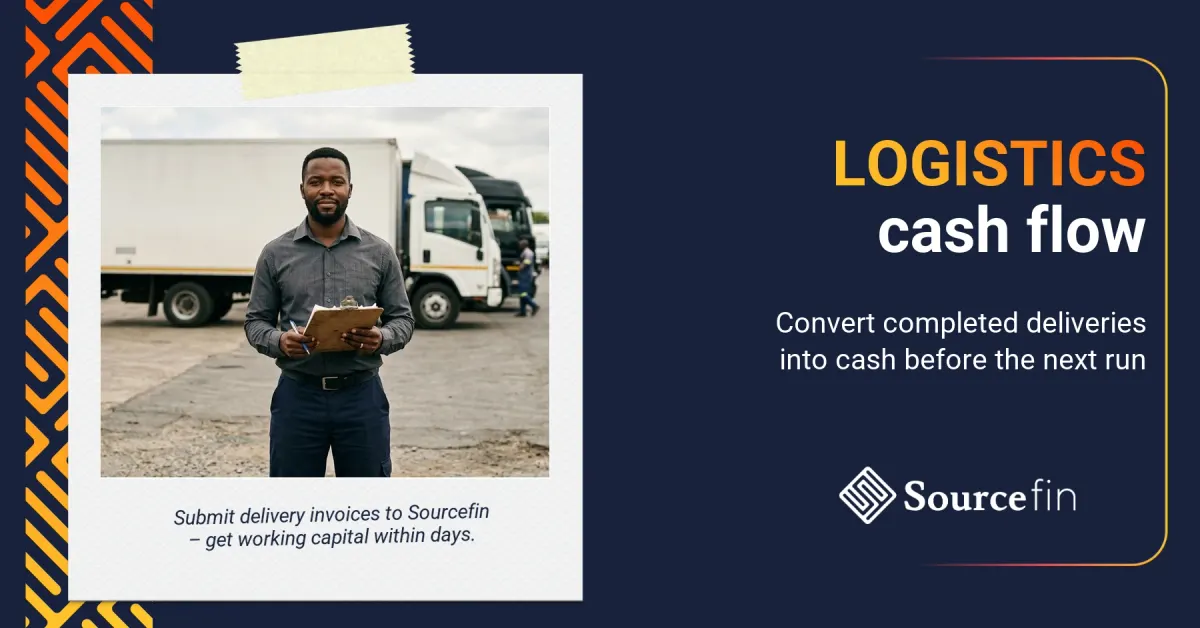
You complete a delivery run or a batch of deliveries against a government or corporate contract. You issue the invoice to your client in the normal way. You then submit that invoice – along with a delivery confirmation or proof of delivery – to Sourcefin. Sourcefin advances a substantial portion of the invoice value, typically within 24 to 48 hours.
That cash lands in your account while the invoice is still outstanding. You use it for fuel for the next run, driver wages, maintenance, or whatever the business needs most. When your client eventually settles the invoice, Sourcefin recovers the advance and applicable fees, and you receive the remaining balance.
You do not wait for the 90-day cycle. You do not go to a bank and explain your balance sheet. You do not pledge your trucks as collateral. You convert completed work into cash, quickly, and move on to the next job.
For logistics SMMEs running multiple contracts simultaneously, this process can be structured as a working capital facility – a pre-approved credit line that draws down against each new invoice automatically, without a separate application per deal. The more consistent your invoice flow and the more credible your clients, the more accessible that facility becomes over time.
Which Logistics SMMEs Qualify
Qualifying for invoice discounting as a logistics SMME is considerably more accessible than applying for a traditional bank overdraft. The core requirements are:
- Your business must be registered with CIPC and your SARS compliance status must be current
- The delivery described in the invoice must have been completed – invoice discounting applies after delivery, not before
- Your client – the party you have invoiced – must be a qualifying debtor: a government department, municipality, SOE, or established corporate
- The invoice must be for services rendered or goods delivered, not for future work
The qualifying bar is lower for businesses with credible government or corporate clients. A logistics SMME that has been operating for 18 months and is delivering for a provincial government department is in a strong position, even without years of audited financials. If you are newer and still building client relationships, our guide to tender funding options covers what is available at different stages of the business journey.
Fuel Tenders and Invoice Discounting
Logistics SMMEs holding fuel supply or fuel distribution tenders face an additional layer of cash flow complexity. Fuel must be purchased upfront before it can be supplied. Payment terms from government clients still apply on the back end. And fuel price movements – particularly in 2025 and 2026 – can shift the cost of a fixed-price tender significantly mid-contract.
Invoice discounting addresses the back end of this equation: once fuel has been delivered and an invoice submitted, advancing against that invoice removes the wait. For the front end – where upfront procurement capital is needed before delivery can happen – purchase order funding may be more appropriate. The distinction matters: invoice discounting logistics businesses use applies after delivery, purchase order funding applies before. Sourcefin’s invoice discounting team can help you work out which tool fits your specific contract structure.
The cash flow challenges facing South African logistics SMMEs are not going away – fuel costs will keep moving, government payment cycles will stay long, and the gap between delivering and getting paid will remain a feature of the sector. The practical move is to stop absorbing that gap and start working around it. Apply through Sourcefin to find out what your delivery invoices are worth today.
Sources & References
Freight News. Government is failing SMMEs – logistics entrepreneur. freightnews.co.za
IT-Online. SMEs bear the brunt of SA’s late payment negligence. March 2026. it-online.co.za
Business Report. Urgent action needed: Late payments threaten South African small businesses. March 2026. businessreport.co.za
Frequently asked questions
Can a transport or logistics company use invoice discounting in South Africa?
Yes. Invoice discounting works well for logistics SMMEs because they regularly issue invoices for completed deliveries against government departments, SOEs, or large corporate clients. These clients are considered credible debtors, which makes logistics invoices strong candidates for discounting regardless of how long the transport business has been operating.
Do I need to put my trucks up as collateral to access invoice discounting?
No. Invoice discounting is secured against the invoice itself – specifically the creditworthiness of the client who owes you money. Your fleet, property, or personal assets are not required as collateral. The funder is assessing whether your client is likely to pay, not whether you have physical assets to recover against.
How quickly can I get funds after submitting a delivery invoice?
Once your debtor is approved and the facility is in place, drawdowns typically settle within 24 to 48 hours of submitting a qualifying invoice and proof of delivery. For ongoing contracts with the same approved clients, the process becomes faster as the relationship and debtor profile are already established.
What if my government client takes longer than 90 days to pay?
Invoice discounting bridges the gap regardless of how long the department takes to pay. You receive the advance within days of submitting the invoice. When the government department eventually settles, the advance and fees are recovered automatically. Extended payment delays affect your cash flow far less when the advance is already in your account.
Is invoice discounting suitable for fuel supply tenders?
Invoice discounting applies after delivery – once fuel has been supplied and an invoice submitted, it can be discounted to unlock cash while waiting for government payment. If you need upfront capital to purchase fuel before delivery, purchase order funding is more appropriate for that stage. The two tools address different parts of the cash flow cycle.
What is the difference between invoice discounting and factoring for logistics businesses?
With invoice discounting, you retain control of your client relationship and manage your own collections. With factoring, the funder takes over debtor management and collects payment directly from your client. For logistics businesses with long-term government or corporate client relationships, invoice discounting is usually preferred as it keeps those relationships intact. Logistics businesses with high fuel exposure should also consider business fuel loans for South African logistics SMMEs alongside their invoice-side facility.

Sourcefin is a South African alternative finance provider that offers purchase order funding and invoice discounting to SMMEs, enabling businesses to fulfil confirmed purchase orders or tenders and unlock cash flow without collateral. Unlike traditional lenders or banks, Sourcefin also provides end-to-end support including supplier sourcing, logistics, project management, and risk oversight.