
Merchant Cash Advance South Africa: Practical Guide
A merchant cash advance gives card-based businesses a lump sum repaid from daily sales. Here's an honest look at how it works, who it suits, and when to avoid it.
On this page
A merchant cash advance South Africa businesses can access is not a traditional loan. It's an upfront lump sum of capital, repaid automatically as a percentage of your daily or weekly card sales. When sales are strong, you repay faster. When they slow, repayment slows with them. It's a flexible funding tool – but one that comes with a higher cost and real risks if your margins are thin.
Key Takeaways
- A merchant cash advance is repaid as a percentage of card sales, not through fixed monthly instalments.
- Repayment is flexible: it speeds up when sales are strong and slows when they dip.
- It suits high-volume, card-based businesses with healthy margins – restaurants, retail shops, salons, and online stores.
- It costs more than most traditional funding types. If your margins are thin, the repayment percentage can put real pressure on the business.
- It's a specialist tool, not a general-purpose solution. The wrong fit can make cash flow harder, not easier.
What Is a Merchant Cash Advance in South Africa?
A merchant cash advance (MCA) is a form of business funding where a funder provides a lump sum upfront, and the business repays it – plus a cost – through an agreed percentage of daily or weekly card sales. It is not a loan. There is no fixed repayment schedule, no collateral required, and no monthly instalment that stays the same regardless of how the business is performing.
The repayment mechanism is what sets it apart. Instead of a fixed monthly deduction, the funder takes a share of card transactions as they happen. This means the repayment amount moves with the business's revenue. In months where trade is strong, more is repaid. In quieter periods, less is taken – because there is less to take.
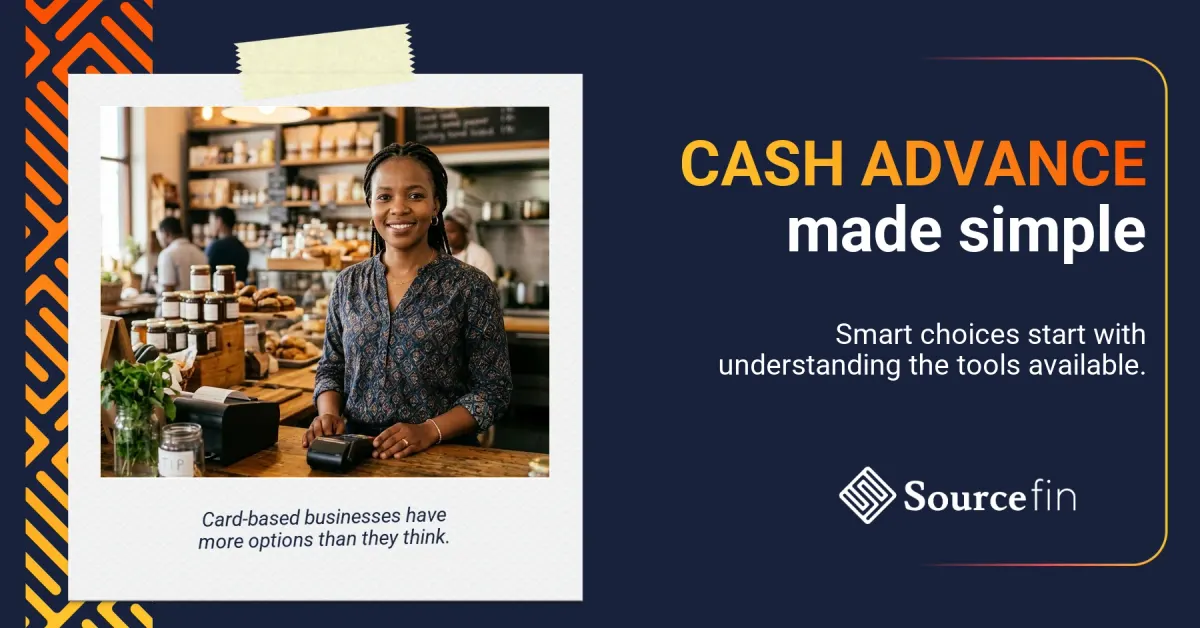
For this reason, MCAs are particularly popular with consumer-facing businesses that process a high volume of card payments: think restaurants, coffee shops, clothing retailers, hair salons, beauty businesses, and online shops. The business's card payment history is essentially the funding criteria – not property, not assets, not a spotless credit record.
Because the funder takes on more risk than a traditional lender – accepting repayment tied to sales performance rather than a guaranteed schedule – the cost of an MCA is typically higher than other funding types. That trade-off is the core of the product. You get speed, accessibility, and flexibility. You pay a premium for it.
For a broader view of how MCA fits within the South African funding landscape, see the SMME Funding Options: Complete Guide.
How Merchant Cash Advance Repayment Works
The repayment structure is simpler than it first sounds. When your business processes a card payment – whether through a point-of-sale terminal, an online store, or a payment gateway – a pre-agreed percentage of that transaction goes toward repaying the advance. This happens automatically, at the point of sale.
The key characteristic is that the repayment amount is never fixed. It rises and falls with your actual revenue. If December is your busiest trading month, more of each rand gets allocated to repayment and you clear the balance faster. If January is quieter, the repayment slows accordingly – the percentage stays the same, but the absolute amount decreases because total card sales are lower.
This is the feature that makes MCAs attractive to seasonal businesses or those with natural trading peaks and troughs. You are never locked into a fixed repayment that continues even when the business is quiet. The obligation scales with performance.
It's worth understanding the terminology clearly. Funders typically quote an MCA using a "factor rate" rather than an interest rate. A factor rate is a multiplier applied to the advance amount to determine the total repayment. The factor rate does not change based on how quickly you repay – unlike a loan with monthly interest, paying faster does not reduce the total you owe. You always repay the same total amount, just over a shorter or longer period depending on your sales volume.
Merchant Cash Advance South Africa: Who It Suits
The businesses best placed to use a merchant cash advance South Africa providers offer are those with consistent, high-volume card transaction activity and healthy operating margins. The product is built around card sales, so if most of your revenue comes through card payments – whether in-store or online – the mechanics work in your favour.
Businesses that tend to be a good fit include:
- Restaurants and food service businesses – high daily transaction volumes, consistent card use, strong peak periods that speed up repayment naturally.
- Retail shops – clothing stores, homeware retailers, gift shops – where customers pay predominantly by card.
- Salons and beauty businesses – regular returning clients, predictable weekly card turnover.
- Online retailers – all revenue comes through card or payment gateway, making the repayment mechanism a direct match for how the business works.
- Service businesses with card payments – gyms, fitness studios, subscription services, and similar businesses with recurring card-based income.
The margins question is critical and worth understanding before applying. The repayment percentage is deducted from revenue, not from profit. If you sell a product for R100 and your cost of goods is R80, your gross margin is R20. If the MCA takes, say, a percentage of that R100 sale, that deduction comes out of gross revenue – directly reducing what you have left to cover costs. A business with tight margins may find that a meaningful chunk of their already-thin margin disappears into repayment, leaving little room for wages, rent, and other fixed costs.
High-volume, high-margin businesses absorb this well. Low-margin businesses feel it sharply.

The Risk – When MCA Works Against You
A merchant cash advance is a specialist funding tool. Used in the right circumstances, it works. Used in the wrong ones, it can accelerate financial pressure rather than relieve it.
The higher cost is the most important factor to sit with honestly. MCAs are generally more expensive than traditional lending, invoice discounting, or working capital facilities structured around invoices. The convenience and flexibility come at a price. If your business is generating strong revenue and has room in its margins, that cost may be manageable. If you're already stretched, it compounds the problem.
Here are the situations where an MCA is likely the wrong choice:
- Thin or declining margins. If the repayment percentage consistently reduces your already-slim margin, you may find it harder to cover fixed costs during slower periods.
- Unpredictable or irregular card sales. The flexibility of MCA repayment only helps if there are enough card sales to draw from. Businesses with erratic revenue may find repayment periods extend uncomfortably, or that the cost of the funding doesn't match the benefit received.
- Structural business problems. An MCA is not a solution to an unviable business. If the core model isn't working, a cash injection – at any cost – doesn't fix it. It delays the reckoning while adding cost.
- Cash flow problems caused by slow-paying B2B clients. If your cash flow gap comes from waiting on invoice payments rather than low sales volume, an MCA is not the right instrument. Invoice discounting is designed for exactly this situation – and is typically lower cost.
The honest question to ask before pursuing an MCA is this: if the funder takes a percentage of every card sale from tomorrow, does the business still work at its current margin? If the answer is yes – comfortably – then MCA may be a viable option. If the answer is "maybe" or "it'll be tight", that's a warning worth heeding.
Merchant Cash Advance vs Other SMME Funding Options
Understanding where a merchant cash advance sits relative to other funding types helps you choose the right tool for your specific situation.
MCA vs working capital finance: Both serve operational needs – covering wages, stock, overheads, or short-term gaps. The difference is in the mechanics. Working capital finance is typically structured around invoices, purchase orders, or a general facility with fixed repayment terms. MCA is specifically tied to card sales volume. If your business doesn't generate significant card revenue, working capital finance is likely the more appropriate route.
MCA vs invoice discounting: These are not comparable products. Invoice discounting is designed for B2B businesses that issue invoices to other businesses and wait 30–90 days to be paid. MCA is for consumer-facing businesses that get paid at the point of sale. If you invoice clients, invoice discounting is almost certainly more suitable – and generally lower cost.
MCA vs alternative funding generally: South Africa's alternative funding market has grown considerably as card payment adoption has increased. There are now specialist MCA providers operating locally. As with all alternative business funding options, the key is matching the product to the business model – not choosing a product because it's accessible or fast.
Getting the Right Fit
If your business runs on card sales, turns over consistent volume, and operates with healthy margins, a merchant cash advance is worth considering as part of your funding toolkit. The flexibility of sales-linked repayment suits businesses that trade through peaks and troughs, and the absence of collateral requirements makes it more accessible than many traditional lending products.
If, on the other hand, your revenue comes from B2B invoices – you supply goods or services to other businesses and wait to be paid – then invoice discounting is almost certainly a better fit. It releases the cash tied up in outstanding invoices at a cost that reflects the lower risk profile of invoice-backed funding. For a wider walk-through of the model, see the SA invoice discounting pillar.
Sourcefin specialises in invoice discounting and purchase order funding for South African SMMEs. We don't offer merchant cash advances, but if you're a B2B business looking to free up working capital tied to invoices or orders, we can help. Submit a funding application and we'll tell you quickly whether your situation is a fit.
Sources & References
Frequently asked questions
What is a merchant cash advance and how does it work in South Africa?
A merchant cash advance is a lump sum of funding provided upfront, repaid as a percentage of daily or weekly card sales. It's not a loan – there's no fixed monthly repayment. Instead, the funder automatically takes an agreed share of card transactions as they happen. When sales are strong, repayment is faster. When sales dip, repayment slows accordingly. It's available in South Africa through specialist alternative funding providers.
Is a merchant cash advance the same as a business loan?
No – a merchant cash advance is structurally different from a business loan. A loan comes with a fixed repayment schedule, interest, and often collateral requirements. A merchant cash advance has no fixed monthly repayment, no collateral, and repayment is tied directly to card sales volume. The cost is expressed as a factor rate rather than an interest rate. Because the funder carries more risk, the overall cost is typically higher than a traditional loan.
What types of businesses qualify for a merchant cash advance in South Africa?
Businesses that qualify typically have consistent, high-volume card payment activity. This includes restaurants, retail shops, hair salons, beauty businesses, online retailers, and service businesses that take card payments regularly. Because repayment is tied to card sales, the funder assesses your card transaction history rather than property or assets. Businesses with irregular card sales or primarily cash-based revenue are generally not a good fit.
How is a merchant cash advance repaid?
Repayment is automatic and tied to your card sales. Each time a customer pays by card, an agreed percentage of that transaction is allocated to repayment. This continues until the full advance – plus the funder's cost – has been repaid. There's no fixed end date: if your sales are strong, you repay quickly. If sales slow, repayment slows with them. The total amount owed doesn't change – only the pace at which you repay it.
Is a merchant cash advance a good option for a restaurant or retail business?
It can be – if your margins are healthy. Restaurants and retailers often suit merchant cash advances because they process high card transaction volumes daily. The repayment structure aligns naturally with trading peaks. The critical question is margin: the repayment percentage is deducted from revenue, not profit. If your gross margins are strong, the deduction is manageable. If margins are already tight, the repayment can put real pressure on the business, particularly during quieter trading periods.
What are the risks of a merchant cash advance for South African SMMEs?
The main risks are cost and margin squeeze. MCAs are typically more expensive than traditional lending or invoice-based funding. If your margins are thin, the repayment percentage can reduce what's left to cover wages, rent, and other fixed costs. They're also not suited to businesses with unpredictable card sales, structural losses, or cash flow problems caused by slow-paying clients. For B2B businesses waiting on invoice payments, invoice discounting is usually a more appropriate and cost-effective alternative.

Sourcefin is a South African alternative finance provider that offers purchase order funding and invoice discounting to SMMEs, enabling businesses to fulfil confirmed purchase orders or tenders and unlock cash flow without collateral. Unlike traditional lenders or banks, Sourcefin also provides end-to-end support including supplier sourcing, logistics, project management, and risk oversight.