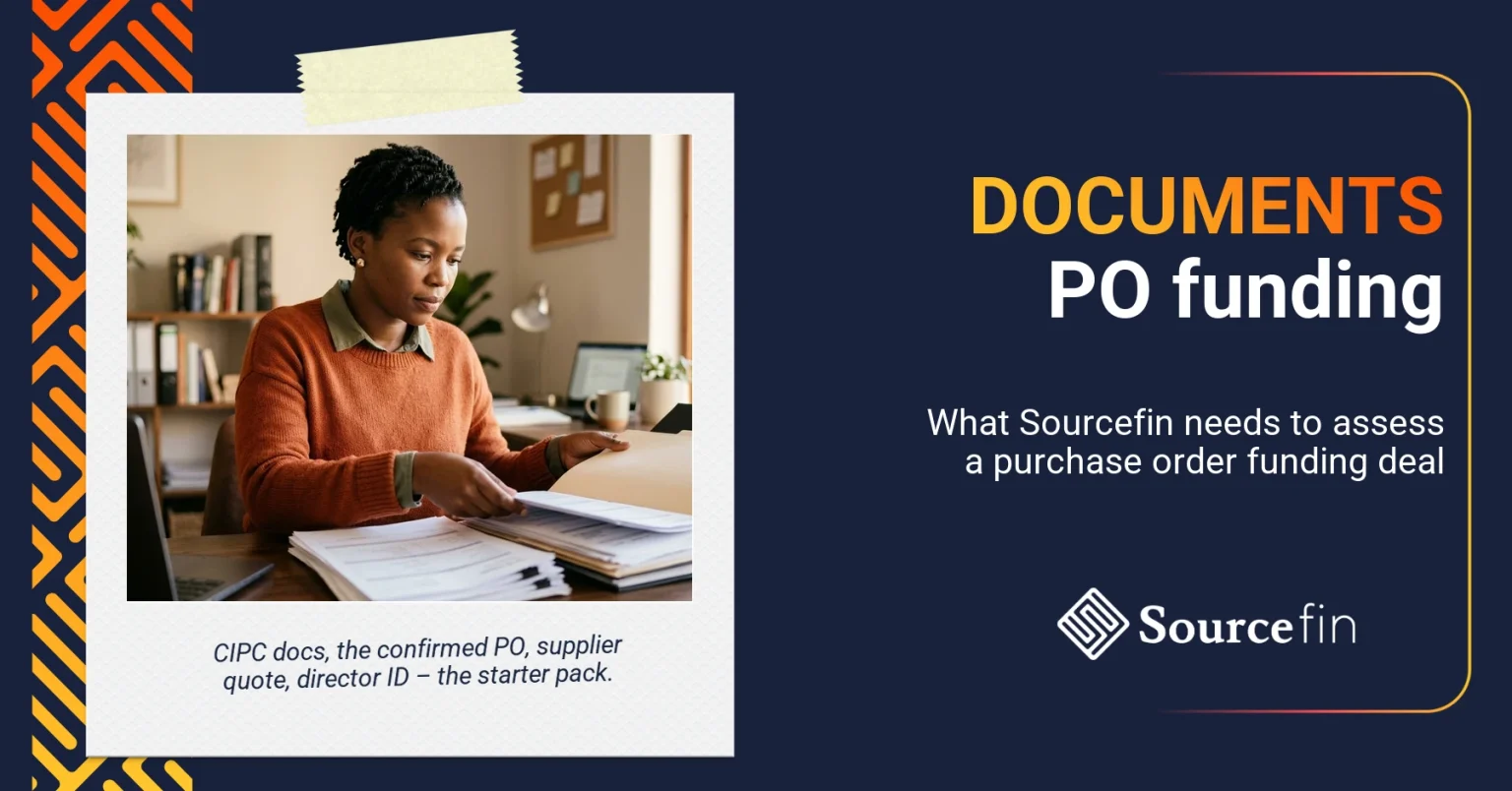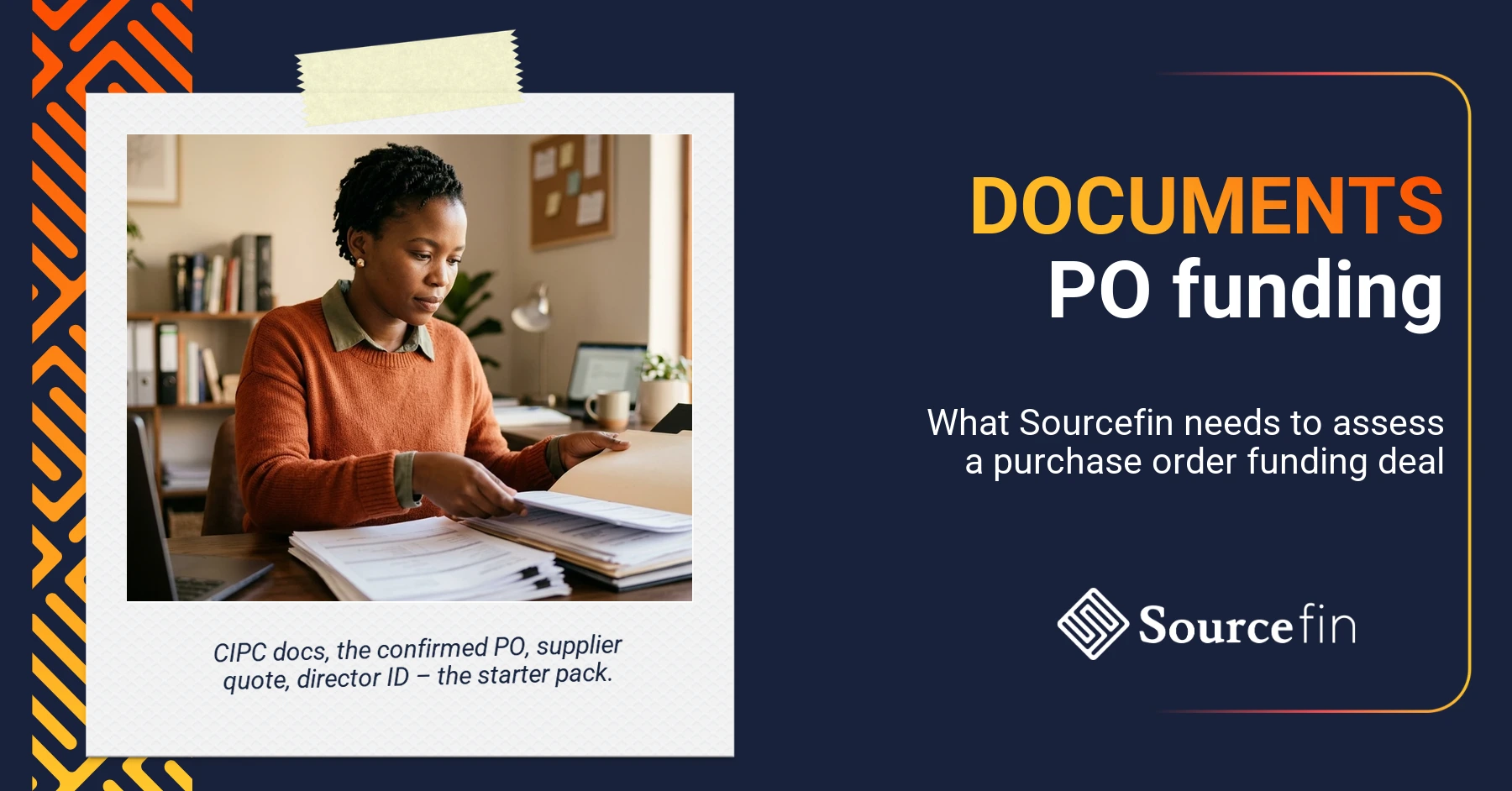

Purchase order funding documents required by Sourcefin for SA SMMEs are practical, focused, and limited to what is actually needed to assess the deal. The core set: business registration documents (CIPC), proof of business address and bank account, the confirmed purchase order or contract, supplier quotation(s), and ID for the company directors. That is the starter pack. Additional documents may be requested depending on the deal complexity, but the application itself starts with these basics.
Key Takeaways
- Purchase order funding documents required for the core Sourcefin application are five practical items: CIPC documents, proof of business address and bank account, the confirmed PO, supplier quotation(s), and director ID.
- The document set is designed for speed and practicality – Sourcefin does not need three years of audited financial statements to fund a confirmed deal.
- Additional documents may be requested for larger or more complex deals, but the application itself starts with the core five.
- Having documents prepared before applying is the single biggest time-saver in a purchase order funding process.
- Apply at the funding application page – upload the core set and Sourcefin’s deal team takes it from there.
The complete purchase order funding documents required checklist
Sourcefin assesses every purchase order funding application against four practical questions: is the order confirmed and verifiable, is the customer credible, is there a clear supplier path Sourcefin can fund directly, and does the SMME have the operational capacity to deliver? The document set supports that assessment. Each item maps to a specific question.
1. Business registration documents (CIPC)
Sourcefin needs to verify that the SMME is a legally registered business. The standard CIPC pack includes:
- Certificate of incorporation (CoR 14.3 or equivalent)
- Updated company information report showing current directors and registered address
The CIPC online portal lets directors download a current company report in minutes. This is typically the fastest item on the list to gather.
2. Proof of business address and bank account
Sourcefin needs to know where the business operates and where the customer payment will be received. Typical proofs:
- Recent municipal utility bill or signed lease showing the business address (not older than three months)
- Recent bank statement or bank confirmation letter for the business bank account (not older than three months)
These items are usually already available – they only need to be located and uploaded.
3. The confirmed purchase order or contract
This is the foundation of the deal. The PO or contract should clearly show:
- The issuing customer (organisation name, contact, purchase officer where applicable)
- The order specification (goods or services, quantities, delivery requirements)
- The order value
- The payment terms (e.g. 30, 60, or 90 days from delivery or invoice date)
- The expected delivery date or schedule
Sourcefin’s deal team verifies the order with the issuing customer as part of the assessment. A clearly documented PO speeds that verification.
4. Supplier quotation(s)
Sourcefin pays suppliers directly. The supplier quotation should show:
- The supplier’s business name and registration details
- The goods or services to be supplied
- The price (and currency, where applicable for imports)
- The payment terms (e.g. upfront deposit, balance on shipping)
- The lead time or delivery schedule
Where the SMME is sourcing from multiple suppliers for one order, a quote from each is needed. Sourcefin’s 2,000+ pre-vetted suppliers worldwide can also be drawn on where the SMME does not have a preferred supplier locked in.
5. Director ID
South African ID document or valid passport for each company director listed on the CIPC report. Standard KYC requirement.

What might be requested in addition to the core purchase order funding documents required
Depending on the deal size, the customer profile, and the complexity of the supplier path, Sourcefin’s deal team may request additional documents. Common follow-ups include:
- SARS tax clearance (where the customer requires it for procurement – distinct from a Sourcefin requirement)
- B-BBEE certificate or affidavit (typically for customer procurement, not for the funding assessment itself)
- Recent management accounts (for larger deals)
- Letters of award or tender confirmation (where the PO is a result of a competitive tender process)
- Import permits or specific compliance documents (for regulated imports)
None of these are required to start the application. The core five are enough to open the conversation. For the broader eligibility view, see Purchase Order Funding Requirements in South Africa.
What is not part of purchase order funding documents required
Some documents traditional lenders ask for are not part of the Sourcefin starter pack:
- Three years of audited financial statements – not required. Sourcefin’s deal-based model assesses the specific deal, not the long-term balance sheet history.
- Personal surety against directors’ personal assets – Sourcefin’s purchase order funding is not collateral-based.
- Detailed business plans – the confirmed PO and supplier quote tell Sourcefin what it needs to know about the deal in front of the business.
This is a structural difference between purchase order funding and traditional business loan applications. The Sourcefin starter pack is built around the specific deal rather than the broader business history.
Practical tips for assembling the documents
- Gather everything before applying. The single biggest delay in any funding application is going back and forth requesting missing items. Sourcefin’s deal team can move quickly when the core pack is complete on day one.
- Make sure documents are current. Bank statements, utility bills, and CIPC reports should be no more than three months old.
- Upload clear, legible scans or photos. Hard-to-read documents slow the assessment. Use a flatbed scanner or good phone-camera scan app.
- Keep a copy of everything submitted. Standard governance hygiene.
For a fuller view on the application journey itself, see How to Apply for Purchase Order Funding in South Africa.
How to apply once your purchase order funding documents required are ready
The path is direct:
- Open the funding application page and complete the online form.
- Upload the five core documents.
- Sourcefin’s deal team will be in touch within a working day to discuss the order and walk through the assessment.
For broader context on the SA SMME funding landscape, the Department of Small Business Development publishes SA small-business policy, and the IFC SME Finance Forum publishes the global MSME Finance Gap database covering emerging markets.
For South African SMMEs holding a confirmed order and ready to move, the purchase order funding documents required by Sourcefin are short, practical, and focused on the deal in front of you. Get the starter pack ready, apply, and let the deal team take it from there.
Sources & References
- CIPC – Companies and Intellectual Property Commission, SA company registration.
- Department of Small Business Development – SA small-business policy and reporting.
- IFC SME Finance Forum – Global MSME Finance Gap database, World Bank Group.
Frequently Asked Questions
What documents are required for purchase order funding in South Africa?
The core Sourcefin purchase order funding documents required are five items: business registration documents from CIPC, proof of business address and bank account, the confirmed purchase order or contract, supplier quotation(s), and ID for the company directors. Additional documents may be requested for larger or more complex deals, but the application starts with these five.
Do I need audited financial statements to apply for PO funding?
No. Sourcefin’s purchase order funding model is deal-based, not balance-sheet-based. Audited financials are not part of the standard application document set. The four-question assessment focuses on the order, the customer, the supplier path, and operational capacity to deliver the specific deal.
Is a B-BBEE certificate required for purchase order funding?
Not for the Sourcefin funding application itself. B-BBEE documentation is typically what the customer’s procurement team needs to award the order in the first place. Once you hold a confirmed order, Sourcefin’s funding assessment focuses on the deal mechanics rather than B-BBEE status.
How current must the documents be?
Bank statements, utility bills proving business address, and the CIPC company report should be no more than three months old. The purchase order and supplier quotation should be the current confirmed versions reflecting the deal being funded. Director ID does not expire for application purposes unless the document itself has expired.
What if I only have one supplier quote – is that enough?
Usually yes, for the application stage. Sourcefin’s deal team may discuss alternative or additional suppliers as part of the assessment, particularly where Sourcefin’s pre-vetted supplier network of 2,000+ worldwide suppliers can offer better pricing or terms. One credible quote is enough to start.
Do I need a SARS tax clearance certificate for PO funding?
Not for the Sourcefin funding application itself in standard cases. SARS tax clearance is typically required by the customer for procurement, particularly on government tenders. Where the customer requires it, the SMME needs it for the tender award – but it is not part of the core Sourcefin document pack.