
Invoice Discounting Without Personal Guarantees: Real Guide
Wondering if invoice discounting always needs a personal guarantee in SA? Here's when PGs apply, when they do not, and what the funder looks at instead.
On this page
- Key Takeaways
- Invoice Discounting Without Personal Guarantees South Africa: How It Works
- Why the Receivables Book Is the Primary Security
- When PGs Apply and When They Do Not
- How a Right-Sized PG Should Look
- What Sourcefin's Approach Looks Like
- Comparing PG Treatment Across Funders
- Other Funding Routes That Avoid PGs
- The Bigger Picture for SA SMMEs
- Frequently asked questions
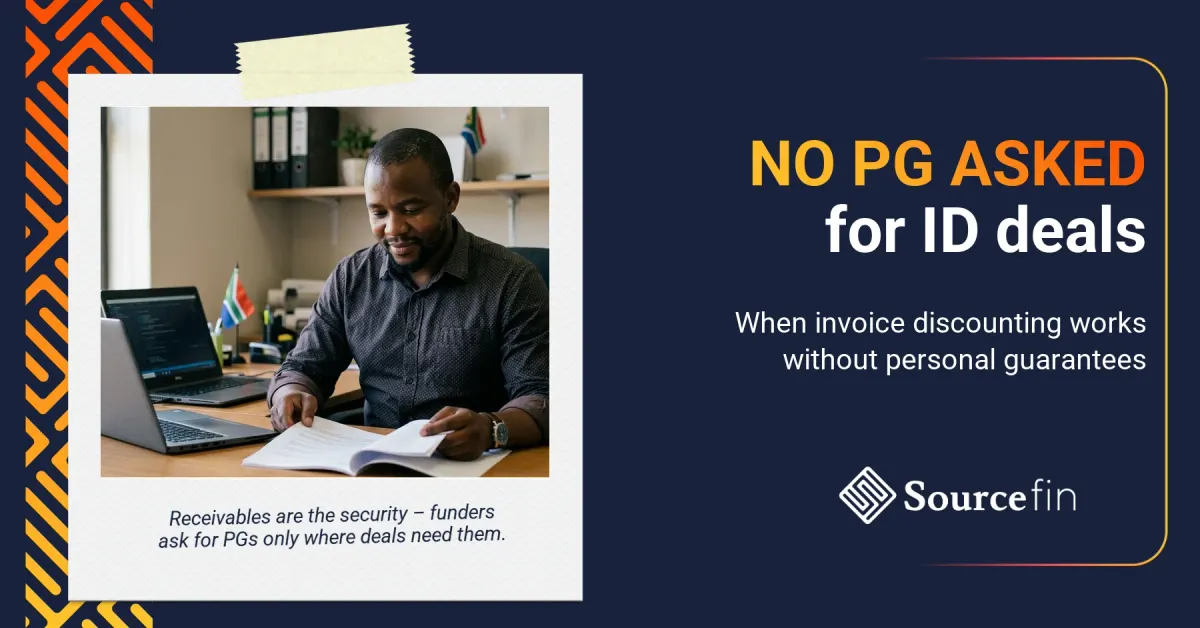
Invoice discounting without personal guarantees South Africa is possible for many deals because the receivables book itself is the structural security. Funders may still request a personal guarantee where the deal carries unusual risk, but the guarantee is sized to the facility rather than to the owner's full personal balance sheet. The receivables do most of the structural work.
Key Takeaways
- Invoice discounting is structurally receivables-backed – the customer invoices serve as the funding's security.
- Personal guarantees may still apply, particularly for newer businesses, concentrated books, or unusual structures.
- Where PGs apply, they should be sized to the deal rather than the owner's full personal balance sheet.
- Government, SOE, and major corporate receivables books are the most likely candidates for facilities without onerous PG terms.
- Honest, upfront discussion of the PG question is part of choosing the right funder.
- Some funders insist on heavy PGs across the board – others structure them carefully or skip them where the deal allows.
Invoice Discounting Without Personal Guarantees South Africa: How It Works
Personal guarantees (PGs) are a common point of friction in SA business funding conversations. Many SMME owners hesitate at signing personal guarantees that pledge their personal balance sheet against business funding, particularly for facilities they expect to use indefinitely.
Invoice discounting is structurally different from a traditional loan, and that structural difference matters for the PG question. The funder advances against the value of outstanding customer invoices. The customer's eventual payment recovers the advance. The receivables book itself is the source of repayment, which means it is also the primary structural security. A personal guarantee, where required, is a secondary protection rather than the primary one.
For broader context on how invoice discounting works, the wider invoice discounting South Africa pillar guide explains the model end to end. The invoice discounting vs bank overdraft guide covers why a bank overdraft typically requires more comprehensive personal security than invoice discounting does.
Why the Receivables Book Is the Primary Security
In a traditional loan, the bank lends against the borrower's general financial profile and recovers from the borrower over time, with security as backup. In invoice discounting, the funder is, in effect, lending against the future payment from your customer. That payment is the natural source of recovery.
This shifts the structural logic. The bank needs to ask: "if the borrower stops paying, what do we recover from?" The invoice discounting funder asks: "will the customer pay this invoice?" The answer comes from the customer's payment record, not the SMME owner's personal balance sheet.
Where the customer is a major government department or SOE, the answer is "almost certainly yes, eventually." That confidence reduces the funder's reliance on personal security. The what invoices qualify guide covers how invoice quality and customer creditworthiness drive the assessment.
When PGs Apply and When They Do Not

The PG question is not binary. Funders typically apply PGs case by case based on the specifics of the facility.
Cases where PGs are less likely. Established SMMEs with a strong, diverse receivables book of high-quality customers (government, SOE, listed corporates) often secure facilities with limited or no PG. The receivables themselves provide enough structural security.
Cases where PGs are more likely. Newer businesses without trading history, books with high customer concentration, sectors the funder is less familiar with, or facilities where the receivables quality is mixed. In these cases, the PG sits as a backup against scenarios the receivables cannot fully cover.
Cases where heavy PGs apply. Some funders insist on comprehensive personal guarantees across all facilities regardless of deal specifics. This is more about funder policy than deal mechanics. The invoice discounting company South Africa guide covers how to evaluate funders – the PG approach is part of that comparison.
How a Right-Sized PG Should Look
When a personal guarantee does apply, the structure matters as much as the existence of one. A well-structured PG is sized to the specific facility risk, with clear scope and clear boundaries on when it would be called.
A poorly-structured PG is open-ended, pledges the owner's full personal balance sheet, and contains broad cross-defaults that effectively make the owner personally liable for risks unrelated to the original facility. Avoid these.
Questions to ask any funder presenting a PG:
- What specific exposure does this guarantee cover?
- How is the guarantee sized – flat amount, percentage of facility, or open-ended?
- Under what specific circumstances would the guarantee be called?
- Are there cross-defaults that make me personally liable for unrelated obligations?
- Can the guarantee be released or renegotiated as the facility matures?
A good funder welcomes these questions openly. Reluctance to answer is itself an answer.
What Sourcefin's Approach Looks Like
Sourcefin assesses every facility against three pillars: trust, the receivables book, and the operational fit. Personal guarantees are part of the trust layer when the deal calls for them, but they are not a default add-on across every facility.
Where a PG applies, Sourcefin sizes it to the specific facility risk and discusses the structure openly upfront. The aim is for the SMME owner to understand exactly what they are signing, why, and what triggers the guarantee. The deal review is a conversation, not a take-it-or-leave-it form filling.
For SMMEs with strong receivables books and creditworthy customers, the PG question often becomes minor. The book itself does most of the structural work. For newer businesses or concentrated books, the PG is more likely – but it should always be sized to the deal, not to the owner's lifetime net worth.
Comparing PG Treatment Across Funders
One of the easiest comparisons between invoice discounting providers in SA is how they handle personal guarantees. Some funders apply heavy PGs across all facilities. Others structure them carefully. A few have moved toward minimal PG facilities for established receivables books.
When evaluating funders, ask early about the PG approach. The invoice discounting company South Africa guide covers the broader funder comparison framework. The invoice discounting requirements South Africa guide covers what funders typically ask for, including security expectations.
Other Funding Routes That Avoid PGs
For SMMEs unable or unwilling to provide any personal guarantee, the funding landscape narrows but does not close. Pure receivables financing structured as invoice purchase (where the funder buys the invoice rather than lending against it) avoids the loan-style guarantee structure entirely. Some grant funding through SEDA or similar government programmes does not require PGs. The wider SMME funding alternatives overview covers the broader landscape.
For most established SMMEs with creditworthy receivables, structured invoice discounting with a right-sized PG is more practical than entirely PG-free funding routes that come with their own constraints (smaller amounts, narrower eligibility, slower processes).
The Bigger Picture for SA SMMEs
South Africa's SMME funding gap is well documented. The IFC's recent SA SMME finance partnership work highlights the constraints around traditional credit access, where PG requirements often weigh heavily. Invoice discounting, structured around the receivables book itself, can sit lighter on the personal security side – particularly for SMMEs supplying creditworthy customers.
The practical takeaway: do not assume invoice discounting always means heavy personal guarantees. Have an open conversation with each prospective funder about how they handle the PG question for your specific receivables book. To explore a facility, the Sourcefin funding application form takes a couple of minutes, and a representative will follow up to discuss the deal. The Sourcefin invoice discounting service page sets out the full process.
Sources & References
Frequently asked questions
Can I get invoice discounting in South Africa without a personal guarantee?
Yes, in many cases. Invoice discounting is structurally receivables-backed – the customer invoices serve as the funding's primary security. For established SMMEs with strong, diverse receivables books of creditworthy customers, facilities can be structured with limited or no personal guarantee. The receivables themselves do most of the structural work.
When does invoice discounting actually require a personal guarantee?
PGs are more likely for newer businesses without trading history, books with high customer concentration, sectors the funder is less familiar with, or facilities where receivables quality is mixed. In these cases, the PG sits as a backup against scenarios the receivables alone cannot fully cover. The PG should be sized to the deal, not to the owner's full personal balance sheet.
How should I evaluate a personal guarantee a funder presents?
Ask what specific exposure the guarantee covers, how it is sized (flat amount, percentage, or open-ended), under what circumstances it would be called, whether there are cross-defaults to unrelated obligations, and whether it can be released or renegotiated as the facility matures. A good funder welcomes these questions openly.
Why does invoice discounting often need less personal security than a bank loan?
A bank loan recovers from the borrower over time, with personal security as backup. Invoice discounting recovers from the customer's eventual invoice payment, with the receivables book as the primary structural security. The structural difference reduces the funder's reliance on personal guarantees, particularly where receivables quality is high.
Do all invoice discounting providers in SA approach personal guarantees the same way?
No. Some funders apply heavy PGs across all facilities regardless of deal specifics. Others structure them carefully based on the receivables book. A few have moved toward minimal PG facilities for established SMMEs with strong customers. Comparing PG approaches across providers is one of the easiest ways to evaluate funders – ask early in the conversation.
What if I genuinely cannot offer any personal guarantee?
Pure receivables purchase facilities (where the funder buys the invoice rather than lending against it) can avoid the loan-style guarantee structure entirely. Some grant funding through SEDA or similar programmes does not require PGs. For most established SMMEs with creditworthy receivables, structured invoice discounting with a right-sized PG is more practical than entirely PG-free routes.
Can a personal guarantee be reduced or removed as the facility matures?
Yes, that is a reasonable conversation to have with the funder. As the facility runs cleanly, the receivables book proves itself, and the SMME builds a track record with the funder, the PG can sometimes be reduced or restructured. Discuss this possibility upfront and revisit it at facility-renewal points. Funders willing to have the conversation are usually the better long-term partners.

Sourcefin is a South African alternative finance provider that offers purchase order funding and invoice discounting to SMMEs, enabling businesses to fulfil confirmed purchase orders or tenders and unlock cash flow without collateral. Unlike traditional lenders or banks, Sourcefin also provides end-to-end support including supplier sourcing, logistics, project management, and risk oversight.