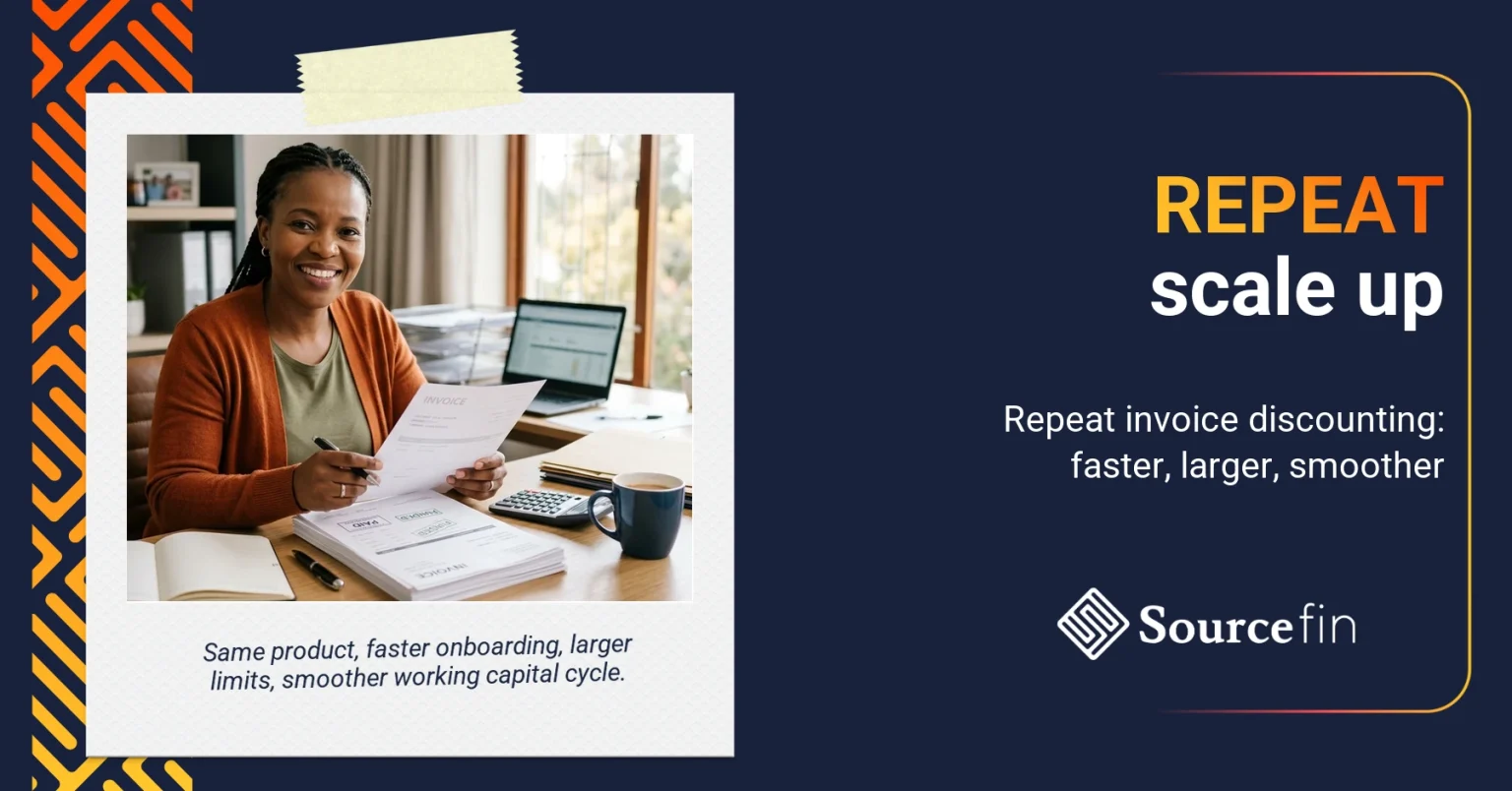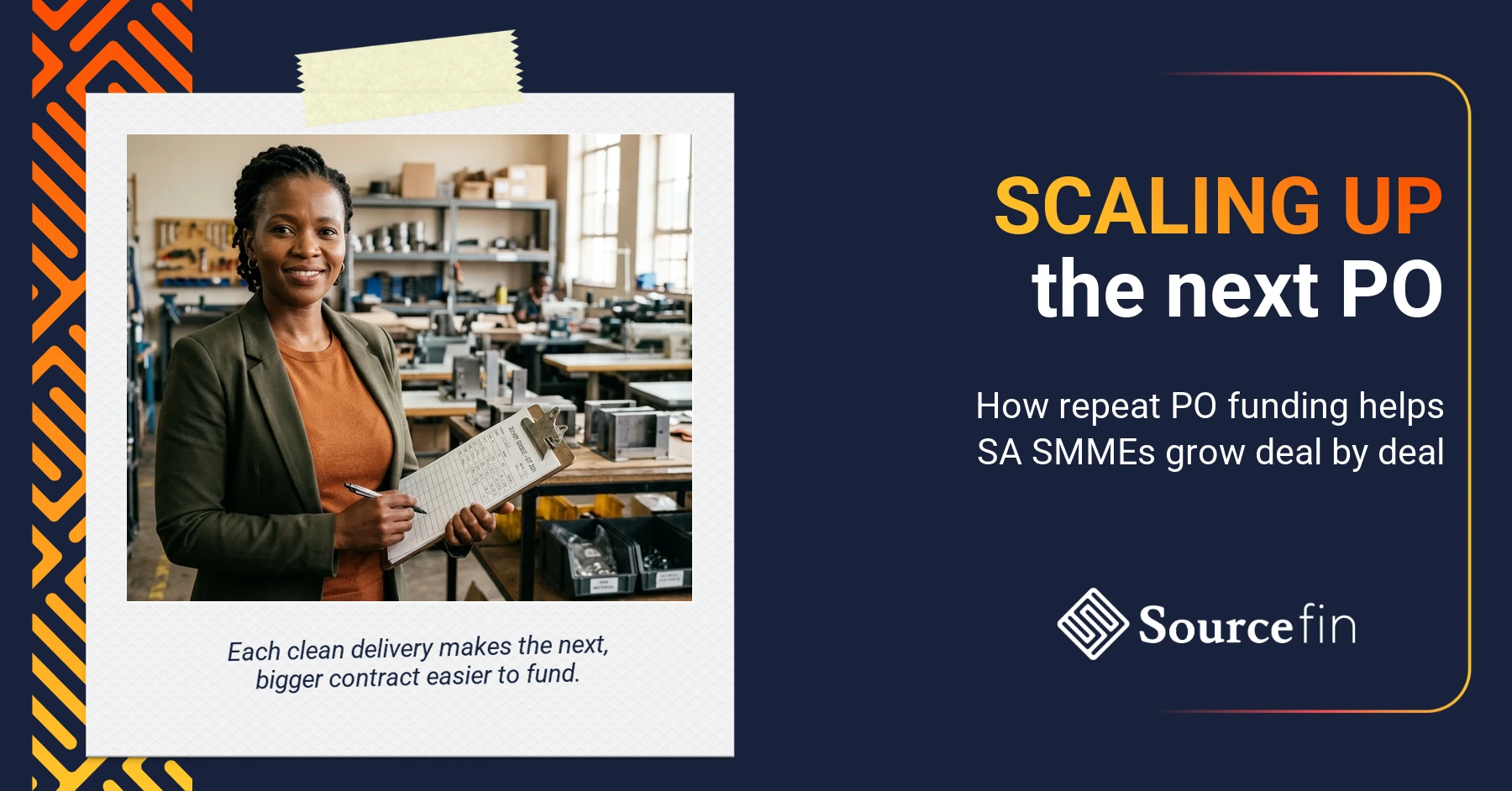

Repeat purchase order funding South Africa is the practical mechanism many SA SMMEs use to scale: a clean first delivery becomes a stronger second deal, which becomes a faster third application, which eventually leads to the bigger contracts the business has been working towards. The model is the same on every deal – four practical questions, deal-based assessment – but the deal history accumulating between Sourcefin and the SMME makes subsequent applications smoother and the conversation more informed.
Key Takeaways
- Repeat purchase order funding South Africa lets SMMEs scale deal by deal, building a track record that supports bigger and faster subsequent applications.
- The four-question assessment is the same on every deal, but the deal history makes the subsequent assessments more informed and typically faster.
- Clean delivery on early deals is the single biggest driver of stronger future funding conversations.
- Sourcefin’s 100% delivery rate on funded deals reflects a discipline that compounds with each successful repeat deal.
- Apply at the funding application page with each new confirmed PO – returning customers are recognised in the system.
What changes between a first PO funding deal and a repeat one
The Sourcefin deal model is the same on every transaction: a confirmed PO, a customer credibility check, a fundable supplier path, and an assessment of capacity to deliver. What changes between a first deal and a repeat is what Sourcefin already knows:
- The SMME’s business is on file. CIPC documents, banking details, director ID, and the broader operating profile are already loaded. Repeat applications start with this baseline rather than rebuilding it.
- The customer relationship may already be established. Where the SMME is delivering more orders to the same customer (or under the same framework), the customer-credibility assessment is faster.
- The supplier path may already be known. Where the SMME uses suppliers Sourcefin has paid before, the supplier-path question moves faster.
- The delivery track record is concrete. Clean delivery on previous deals is the strongest input into the capacity-to-deliver assessment.
The cumulative effect is that a fourth or fifth deal with Sourcefin typically moves more directly than a first cold application. The structure of the assessment is unchanged – the speed of getting through it tends to increase as deal history accumulates.
How repeat purchase order funding deals progress in practice
A common pattern across the 1,000+ SMMEs Sourcefin has supported since 2020 looks something like this:
- Deal 1 – first confirmed PO, often a tender win or a first corporate contract. Sourcefin assesses the deal on the four practical questions, structures the funding, and the SMME delivers.
- Deal 2 – a follow-on order, often slightly larger. The deal team already knows the SMME, the customer relationship may be established, and the supplier path may be familiar. Application moves faster.
- Deal 3 to Deal 5 – the SMME scales the order book. Bigger contracts, sometimes the first framework call-offs, sometimes the first export deal. The deal history supports each new step.
- Deal 6 onwards – the SMME operates with PO funding as a normalised working-capital tool. The SMME plans the business around deal-by-deal funding rather than treating each application as a one-off.
This is not a guarantee – every deal still has to meet the four practical questions on its own merits – but it is the rhythm Sourcefin sees most commonly with SMMEs that scale through repeat PO funding.

What makes repeat applications move faster
Several practical patterns compound on repeat applications:
- Document set is mostly already loaded. CIPC documents, banking proofs, director ID – Sourcefin already has them. The application focuses on the new deal-specific items: confirmed PO, supplier quote, customer details.
- Customer verification cached. Where the same customer is issuing repeat orders to the SMME, verification typically moves faster.
- Supplier path known. Where Sourcefin has paid the same supplier before, the supplier-path question is largely answered.
- Delivery confidence higher. A clean delivery history is the strongest evidence on the capacity-to-deliver question for the specific order pattern.
- Direct line into the deal team. Returning SMMEs have a relationship with the deal team that lets the conversation start at the deal specifics rather than the introduction.
None of this skips the four-question assessment. It just means the assessment has more data to work with on repeat deals.
Scaling deal size on repeat deals
SMMEs scaling through repeat PO funding often move from smaller initial deals to larger subsequent ones. Sourcefin funds deals across the full SMME spectrum from smaller confirmed orders through to multi-million-rand contracts. The structural question on each step up is whether the four practical questions still answer positively:
- Is the bigger PO still confirmed and verifiable? Larger deals sometimes have more complex contract structures – the verification work may be deeper.
- Is the customer credible at the bigger deal size? Customer credibility at R500,000 is not automatically credibility at R5 million – the assessment scales with the exposure.
- Is the supplier path fundable at the bigger scale? Larger orders sometimes need supplier-side scaling that the original supplier cannot match. Sourcefin’s 2,000+ pre-vetted suppliers worldwide can support where a step-up is needed.
- Does the SMME have capacity to deliver at the bigger scale? This is often the live question on a step-up deal – clean delivery history at the previous deal size is the most useful evidence.
For broader scaling context, see Strategies for Scaling Your SMME. For framework-specific repeat patterns, see PO Funding for Framework Contracts.
What clean delivery looks like, and why it matters
The phrase “clean delivery” is concrete: the SMME delivered the order to spec, on time, the customer paid on terms, Sourcefin was repaid as agreed, and there were no avoidable issues along the way. The structural reason this matters for repeat funding is that it is the most direct evidence on the capacity-to-deliver question.
SMMEs scaling through PO funding tend to treat delivery quality on each deal as the input to the next deal’s funding conversation. The order book gets bigger because the delivery record makes it possible. Sourcefin’s NSBC Funder of the Year 2026 recognition reflects, in part, how this discipline is structured across the SMMEs Sourcefin has supported.
The bottom line on repeat purchase order funding South Africa
For South African SMMEs thinking about how to grow with PO funding, the practical message is straightforward: deliver cleanly on each deal, return for the next one, and let the deal history do the compounding. Sourcefin’s deal-based model is built for repeat use, and the cumulative effect is that scaling SMMEs operate the business around confirmed deal flow rather than fighting working-capital constraints. To apply for the next deal, visit the funding application page. For the full product context, see Purchase Order Funding or A quick guide to purchase order funding.
For broader context on the SA SMME landscape, the Department of Small Business Development publishes SA small-business policy, Statistics South Africa publishes SMME statistical releases, and the IFC SME Finance Forum publishes the global MSME Finance Gap database covering emerging markets.
Sources & References
- Department of Small Business Development – SA small-business policy and reporting.
- Statistics South Africa – SMME and small business statistical releases.
- IFC SME Finance Forum – Global MSME Finance Gap database, World Bank Group.
Frequently Asked Questions
What is repeat purchase order funding in South Africa?
Repeat purchase order funding is the same Sourcefin product applied to subsequent deals after a first successful transaction. The assessment uses the same four practical questions – PO confirmed, customer credible, supplier path fundable, and capacity to deliver – but the deal history between Sourcefin and the SMME means subsequent applications typically move faster and the conversation starts at the deal specifics rather than the introduction.
Does Sourcefin remember my business after the first deal?
Yes. Returning SMMEs are recognised in the system. CIPC documents, banking details, director ID, and the broader operating profile are already on file. The application for the next deal focuses on the new deal-specific items: confirmed PO, supplier quote, and customer details for the specific order. The deal team relationship also makes subsequent conversations more efficient.
Can I scale to bigger deals with each repeat application?
Sourcefin funds deals across the full SMME spectrum, including multi-million-rand confirmed orders, and many SMMEs scale deal size over repeat applications. The structural question on each step up is whether the four practical questions still answer positively at the bigger scale – customer credibility, supplier path, and capacity to deliver are reassessed each time. A clean delivery record at previous deal sizes is the strongest evidence for the step-up.
How important is clean delivery on the first deal?
Critical. A clean delivery – order to spec, on time, customer paid on terms, Sourcefin repaid as agreed – is the most direct evidence on the capacity-to-deliver question for subsequent deals. SMMEs scaling through PO funding tend to treat delivery quality on each deal as the input to the next deal’s funding conversation. Sourcefin’s 100% delivery rate on funded deals reflects this discipline.
Does repeat PO funding mean I have a long-term facility?
No. Sourcefin’s model is deal-based, not facility-based, even on repeat deals. Each new confirmed order is assessed and funded on its own merits. The benefit for SMMEs is that funding flexes with actual deal flow – no commitment to a fixed facility, no monthly facility fees on undrawn amounts. Each new PO is its own decision.
What if my next deal is in a different sector or category?
The four practical questions apply regardless of sector. Repeat SMMEs taking on first orders in new categories (a manufacturing SMME taking on a first distribution deal, for example) trigger a slightly fresher assessment on capacity to deliver because the previous deal history does not directly cover the new category. The deal team can walk through what the new category implies for the assessment honestly.