
Invoice Discounting for Women-Owned Businesses: Real Help
Invoice discounting for women-owned businesses in South Africa. A practical guide to how Sourcefin funds the invoice and customer, not the owner profile.
On this page
- Key Takeaways
- How invoice discounting for women-owned businesses actually works
- Where being a women-owned business does move things
- What women-owned SMMEs typically need from invoice discounting
- What is not a barrier for invoice discounting for women-owned businesses
- Practical steps for a women-owned SMME applying for invoice discounting
- Where Sourcefin lands
- Frequently asked questions
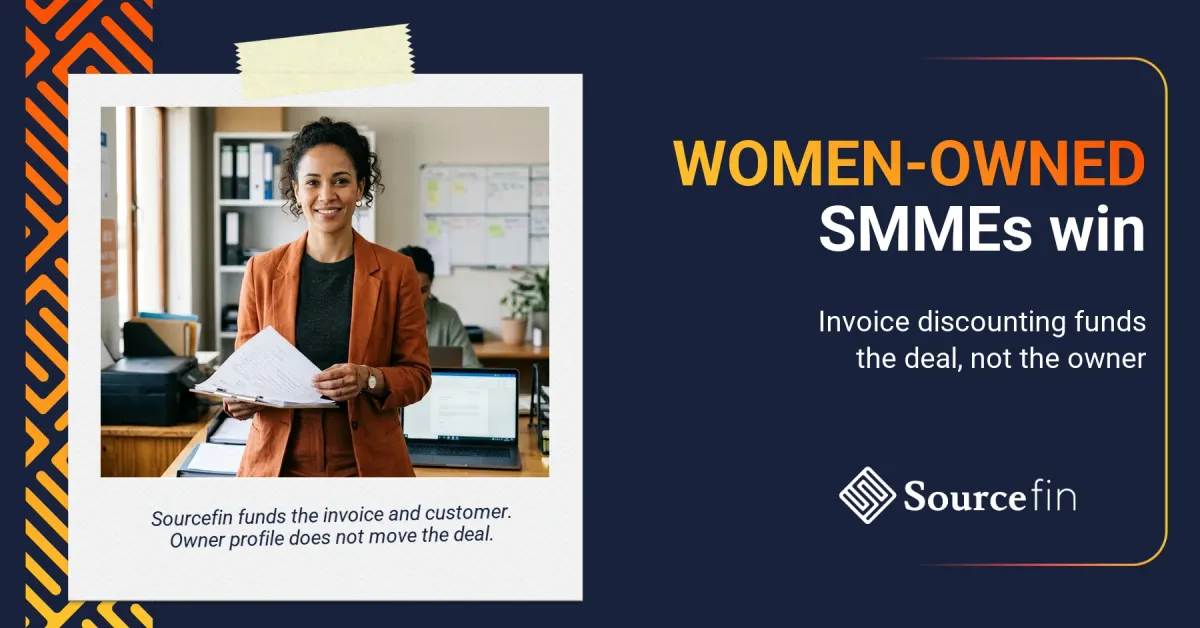
Invoice discounting for women-owned businesses in South Africa works in exactly the same way as invoice discounting for any other SMME. Sourcefin's assessment looks at the invoice, the customer paying it, and the SMME's operational capacity to retain the customer relationship and collections. The gender of the owner is not part of the assessment and never has been. Where being a women-owned business matters is upstream of funding: B-BBEE recognition can help win the work in the first place, and once an invoice is in hand from a credible SA customer, Sourcefin funds the deal.
Key Takeaways
- Invoice discounting for women-owned businesses is funded on the same four-question model Sourcefin uses for every deal: invoice valid, customer credible, deal uncontested, capacity to retain collections.
- Owner profile is not a Sourcefin assessment criterion. What matters is the deal in front of the business.
- B-BBEE recognition (where applicable) can help women-owned SMMEs win contracts upstream of the funding step – particularly on government and listed-corporate procurement.
- Once the invoice is in hand, the product, the documents, and the assessment are the same as for any other SMME.
- Most Sourcefin invoice discounting deals start at around R250,000 – this applies to all SMMEs regardless of ownership profile.
How invoice discounting for women-owned businesses actually works
The Sourcefin assessment for any invoice discounting deal answers four practical questions:
- Is the invoice valid and verifiable with the customer?
- Is the customer paying the invoice credit-credible?
- Is the invoice uncontested and for goods or services already delivered?
- Does the SMME have the operational capacity to retain the customer relationship and the collections process?
When the answer is yes across all four, the deal can be funded. The owner's gender, race, age, or background is not part of any question. This is by design – invoice discounting is a deal-based product, and deal-based assessments stand on the deal in front of the funder.

Where being a women-owned business does move things
Being a women-owned business does not influence the funding assessment, but it does influence what happens before the funding step. Two specific places it matters:
1. B-BBEE recognition and procurement preference
South Africa's B-BBEE framework, published by the Department of Trade, Industry and Competition, includes ownership as a measurement element. Women-owned and black women-owned SMMEs are recognised within the framework and frequently carry strong B-BBEE positioning for procurement purposes.
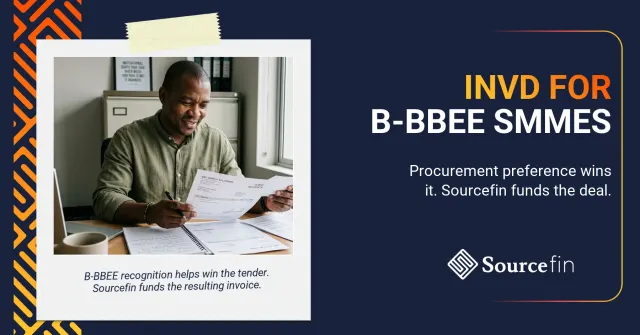
Government and listed-corporate procurement teams apply preference points to bids, with B-BBEE status as one of the criteria. A strong B-BBEE profile helps win the contract. Once the work is delivered and the invoice issued, Sourcefin funds the receivable. See B-BBEE certificates for tenders for the procurement context.
2. Targeted enterprise and supplier development support
Many large SA corporates run dedicated enterprise and supplier development (ESD) programmes with women-owned SMME components. The ESD programme often opens up the procurement channel; once the SMME holds the resulting invoice on the corporate, the funding question is the same as any other.
Sourcefin's invoice discounting fits naturally alongside ESD-driven procurement – the SMME wins the work through the corporate programme, delivers, and the resulting invoice is fundable on standard terms.
What women-owned SMMEs typically need from invoice discounting
The funding need pattern for women-owned SMMEs tends to look identical to any other growing SMME on the system. The most common cases:
- Long customer payment terms – 30, 60, or 90-day terms tie up working capital. Invoice discounting releases the cash earlier so the SMME can fund the next order.
- Single large invoice – a meaningful invoice on a credible customer has stretched the cash cycle. Funding that invoice clears the next-cycle capacity.
- Recently won tender or corporate contract – the work has been delivered, the invoice issued, but the customer term is long enough that the next phase of delivery needs cash now. See invoice discounting for tender winners in South Africa.
- Scaling phase – the order book is growing and working capital needs to grow with it. Invoice discounting scales with the receivables, not with a fixed term.
What is not a barrier for invoice discounting for women-owned businesses
It is worth being explicit about what does not stop a deal:
- The owner's gender. Not a Sourcefin assessment criterion.
- The size of the business in employee terms. Invoice discounting is about the deal, not the headcount.
- The age of the business. Younger businesses with a credible customer and an uncontested invoice can be funded. See invoice discounting requirements in South Africa.
- Whether there is a personal-guarantee structure on the directors. Sourcefin's invoice discounting is not collateral-based against personal assets.
What does matter, for any SMME on any deal, is the four-question framework above.
Practical steps for a women-owned SMME applying for invoice discounting
The path is the standard one:
- Confirm the customer is SA-based and credit-credible.
- Confirm the invoice is processed by the customer's accounts-payable team and uncontested.
- Gather the core document set – CIPC, director ID, proof of delivery, recent bank statements.
- Apply at the funding application page.
- Sourcefin's deal team verifies the invoice with the customer and works through the assessment with the SMME.
If a B-BBEE certificate is in place, it strengthens the procurement story upstream – but it is not what triggers funding. The invoice and the customer trigger funding.
Where Sourcefin lands
Sourcefin has deployed R3 billion-plus in working capital to South African SMMEs since 2020, funded 1,000+ SMMEs across the small-business landscape, and maintained a 100% delivery rate on funded deals. The book includes women-owned businesses in meaningful numbers because, in the deal-based assessment that drives invoice discounting, those businesses bring the same essentials any deal needs: a valid invoice, a credible customer, and operational capacity.
For broader context, the Department of Small Business Development publishes SA small-business policy, and the IFC SME Finance Forum publishes the global MSME Finance Gap database covering emerging markets.
If you run a women-owned SMME with a valid customer invoice in hand, invoice discounting for women-owned businesses works the same way for you as for any other Sourcefin-funded SMME. Start at the funding application page or read more about how invoice discounting works at Sourcefin.
Sources & References
- Department of Trade, Industry and Competition – B-BBEE policy framework and codes of good practice.
- Department of Small Business Development – SA small-business policy and reporting.
- IFC SME Finance Forum – Global MSME Finance Gap database, World Bank Group.
Frequently asked questions
How does invoice discounting for women-owned businesses work in South Africa?
Invoice discounting for women-owned businesses works in exactly the same way as for any other SMME. Sourcefin's deal team verifies the customer invoice, assesses the customer's credibility, confirms the invoice is uncontested and that the goods or services have been delivered, then advances cash against the receivable. The owner's gender is not part of the assessment.
Does Sourcefin give preferential treatment to women-owned SMMEs?
Sourcefin's invoice discounting is deal-based, not owner-profile-based, so there is no preferential funding track. What does matter upstream is procurement: women-owned and black women-owned B-BBEE positioning helps win the contract in the first place. Once the work is delivered and the invoice issued, the funding step assesses the deal on standard terms.
What documents does a women-owned SMME need for invoice discounting?
The standard pack: CIPC company documents, director ID, the invoices being discounted, proof of delivery or service completion, recent business bank statements, and proof of business address. A B-BBEE certificate is not required for the funding assessment itself, but is typically required by the customer for procurement awards.
Can a startup women-owned SMME apply for invoice discounting?
Yes. Younger businesses with a credible SA customer and an uncontested invoice can be funded. Sourcefin's assessment focuses on the invoice and customer rather than years of trading history. The practical floor is deal size – most invoice discounting deals start at around R250,000 because the structure works best at meaningful deal sizes.
Does B-BBEE status affect invoice discounting cost?
B-BBEE status does not change the invoice discounting cost. Pricing is a discount cost on the advance, and that cost moves with the deal – the customer's profile, the invoice value, and the duration of the advance – not with the SMME's ownership profile. B-BBEE matters upstream in procurement, not in the funding assessment.
Where can a women-owned SMME apply for invoice discounting?
Apply at the Sourcefin funding application page. The deal team will work through the core questions with the SMME, verify the invoice with the customer, and walk through the document set. The same process applies whether the SMME is women-owned, black women-owned, or any other ownership profile – the deal in front of the business drives the assessment.
Sourcefin is a South African alternative finance provider that offers purchase order funding and invoice discounting to SMMEs, enabling businesses to fulfil confirmed purchase orders or tenders and unlock cash flow without collateral. Unlike traditional lenders or banks, Sourcefin also provides end-to-end support including supplier sourcing, logistics, project management, and risk oversight.