
Repeat Invoice Discounting South Africa: Proven Scale Up
Repeat invoice discounting South Africa. How SMMEs who funded one invoice scale up to second, third, and rolling Sourcefin deals in 2026 and beyond.
On this page
- Key Takeaways
- Why repeat invoice discounting South Africa moves faster
- How limits scale on repeat invoice discounting South Africa
- The four common repeat patterns Sourcefin sees
- What does and does not carry forward between deals
- When to move from selective to a rolling or multi-debtor structure
- Documents for repeat invoice discounting South Africa
- What stays the same on every repeat deal
- Where Sourcefin lands
- Frequently asked questions
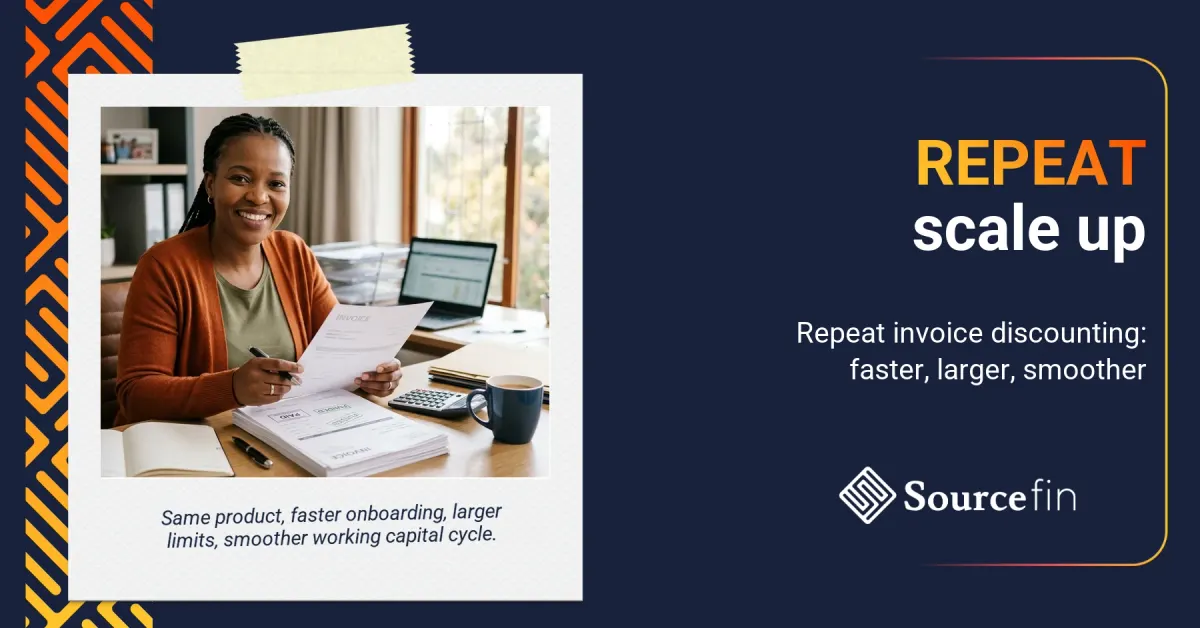
Repeat invoice discounting South Africa is where the product really earns its place in an SMME's working capital toolkit. The first deal teaches the SMME and Sourcefin how each side works. The second, third, and ongoing deals run faster, smoother, and typically larger. Customer credibility data is already in Sourcefin's system. The SMME knows the document flow. The verification step is shorter. Limits can scale with the trading history. Repeat users are the ones who use invoice discounting as designed: a continuous tool that funds the next phase of growth, not a one-off rescue.
Key Takeaways
- Repeat invoice discounting South Africa runs faster than first-time deals because customer credibility data and document flow are already established.
- Limits typically scale with trading history – consistent, on-time customer payments on the first deals build the case for larger drawdowns.
- Many SMMEs move from selective per-deal discounting on the first one or two deals to a rolling or multi-debtor facility as their book matures.
- The four-question framework still applies to every deal, but on a repeat customer, the verification step typically compresses from days to hours.
- Repeat invoice discounting is the right pattern for SMMEs using the product as continuous working capital rather than a one-off solution.
Why repeat invoice discounting South Africa moves faster
The first invoice discounting deal carries a one-off operational set-up. Sourcefin's deal team:
- Verifies the SMME's company structure and director information
- Runs first-time credit and credibility checks on the customer paying the invoice
- Verifies the specific invoice with the customer's accounts-payable team
- Walks through the deal mechanics with the SMME for the first time
On the second deal with the same SMME and customer, most of that work is already done. The standing customer credit data sits in Sourcefin's system. The SMME's document baseline is on file. The deal team can move straight to verifying the specific new invoice. The result is a meaningfully shorter cycle from application to funding.

How limits scale on repeat invoice discounting South Africa
Sourcefin sets limits per customer based on customer credibility, invoice value, and the SMME's operational capacity to retain the relationship. As repeat deals settle on-time, the limit picture evolves:
- Deal 1. Conservative limit while the customer payment behaviour is being established.
- Deals 2–3. Limit can step up if the customer paid the first invoice cleanly on its standard term.
- Established repeat customer. The customer's pattern is known, and limits can scale up to support the SMME's monthly invoicing run on that customer.
- Multi-debtor evolution. If the SMME is invoicing several customers consistently, the next step is a multi-debtor facility against a basket of pre-approved customer credit lines.
The full limits framework lives in invoice discounting limits in South Africa.
The four common repeat patterns Sourcefin sees
1. The repeat single-customer SMME
The SMME has one or two main corporate customers and invoices each one monthly. The first deal funded month one's invoice. Month two settles into a rolling pattern – discount each month's invoice as it issues, repay when the previous month settles. The cash cycle stabilises.
2. The growing diversified SMME
The SMME started with one customer, won a second and third, and now invoices four to eight corporate customers consistently. Each customer is added to the discountable book one at a time. The repeat pattern evolves into a multi-debtor view.
3. The seasonal SMME
Some SMMEs have a strong seasonal invoice profile – education-sector training providers, summer-season agricultural traders, December retail-corporate suppliers. Repeat invoice discounting kicks in each season as the invoices issue, then quietens between seasons. The product fits the rhythm.
4. The scaling project-based SMME
Construction sub-contractors, engineering consultancies, or major-project specialists running long programmes with milestone invoicing. The repeat pattern is invoice-by-invoice on each certified milestone. As the firm wins additional projects on similar customers, the repeat-deal cadence accelerates.
What does and does not carry forward between deals
Useful detail for SMMEs preparing to apply for their second or third deal:
Carries forward:
- Sourcefin's standing customer credibility data and credit profile
- The SMME's company information (CIPC, director details)
- The familiarity with how Sourcefin's process works
- Standing scopes-of-work or master services agreements with the customer
Refreshed each deal:
- The specific new invoice being discounted
- Customer verification of that specific invoice
- The SMME's recent business bank statements (typically three months)
- Confirmation that the work is delivered and the invoice uncontested
This is what makes repeat invoice discounting South Africa significantly faster than the first deal without skipping any of the discipline that protects both sides.
When to move from selective to a rolling or multi-debtor structure
Repeat SMMEs often grow into a different structure as the book matures. Practical triggers:
- Move to rolling. When the SMME is invoicing the same customer (or small set) monthly with predictable values – the operational simplicity of a rolling pattern outweighs the deal-by-deal model.
- Move to multi-debtor. When the SMME has a stable book of 5+ credit-credible customers being invoiced regularly – pre-approving the basket of customer credit lines enables faster drawdowns.
- Stay selective. When customers are irregular, deal sizes vary widely, or the SMME values the deal-by-deal control – there is no obligation to evolve structures if selective fits the business.
For the deeper structural comparison, see selective vs whole-turnover invoice discounting in South Africa.
Documents for repeat invoice discounting South Africa
The standard pack still applies – see invoice discounting requirements in South Africa – but for repeat deals, several items can be refreshed rather than reproduced:
- Recent bank statements (rolling three-month update)
- The specific new invoice and proof of delivery
- Customer acknowledgement of the new invoice
- Updated aged debtor report (where relevant for multi-debtor structures)
The CIPC documents, director ID, and standing customer contracts do not need to be redone unless something has materially changed.
What stays the same on every repeat deal
- The four-question framework. Every invoice, every customer, every deal goes through the same assessment. Repeat status accelerates the work – it does not skip it.
- The R250,000 floor on meaningful deal size. Repeat deals can be smaller in aggregate, but the meaningful-deal-size question still applies.
- The product structure. Discount on the advance, no separate service fee, customer pays the SMME directly, SMME retains collections.
- The discipline on uncontested invoices. A repeat customer with a contested invoice still cannot have that specific deal funded.
Where Sourcefin lands
Sourcefin has deployed R3 billion-plus in working capital to South African SMMEs since 2020 and funded 1,000+ SMMEs, with a substantial portion of the volume coming from repeat customers scaling up the product. The 100% delivery rate on funded deals reflects the discipline that runs from first deal through every repeat thereafter.
For broader context, Stats SA publishes SA economic statistics, the Department of Small Business Development publishes SA small-business policy, and the IFC SME Finance Forum publishes the global MSME Finance Gap database covering emerging markets.
If you funded one invoice through Sourcefin and the cash cycle worked, repeat invoice discounting South Africa is the next phase. Start at the funding application page or read more about how invoice discounting works at Sourcefin.
Sources & References
- Statistics South Africa – Official SA economic statistics.
- Department of Small Business Development – SA small-business policy and reporting.
- IFC SME Finance Forum – Global MSME Finance Gap database, World Bank Group.
Frequently asked questions
How does repeat invoice discounting South Africa work?
Repeat invoice discounting South Africa is the same Sourcefin product applied to SMMEs who have already funded one or more deals. The standing customer credibility data is in Sourcefin's system, the SMME's document baseline is on file, and the verification step compresses from days to hours. The four-question framework still applies on every new invoice, but the cycle from application to funding is significantly shorter.
Do repeat deals get larger limits?
Limits typically scale with trading history. On the first deal, Sourcefin sets a conservative limit while the customer's payment behaviour is being established. As repeat deals settle on-time, the limit can step up to support the SMME's monthly invoicing run on that customer. The detail lives in the Sourcefin guide on invoice discounting limits in South Africa.
When does a repeat customer move to a multi-debtor facility?
Typically when the SMME has a stable book of around 5 or more credit-credible customers being invoiced regularly. Pre-approving the basket of customer credit lines unlocks faster drawdowns and removes the need to set up each new customer one deal at a time. Selective discounting remains valid for SMMEs with irregular customers or widely varying deal sizes.
What documents do I need for a second or third invoice discounting deal?
The CIPC documents, director ID, and standing customer contracts on file do not need to be redone unless something has materially changed. The refreshed items are: recent bank statements (rolling three months), the specific new invoice, proof of delivery for that invoice, customer acknowledgement of the new invoice, and an updated aged debtor report where relevant for multi-debtor structures.
Can the discount cost get cheaper on repeat deals?
Pricing on every deal reflects the customer profile, the invoice value, and the duration of the advance. Repeat-customer status itself does not directly change pricing, but the operational efficiency on a repeat deal means the deal team can move faster, which can affect the duration of the advance and therefore the total cost. The only meaningful cost comparison is the actual quote on the actual deal.
What if a repeat customer's profile changes between deals?
If the customer's payment behaviour changes – longer settlements, new disputes, financial stress signals – Sourcefin re-evaluates the customer's credit position before funding the next deal. The standing data on file is a starting point, not a permanent stamp of approval. The same applies in reverse: a customer who improves their payment record can support a step-up in limits.

Sourcefin is a South African alternative finance provider that offers purchase order funding and invoice discounting to SMMEs, enabling businesses to fulfil confirmed purchase orders or tenders and unlock cash flow without collateral. Unlike traditional lenders or banks, Sourcefin also provides end-to-end support including supplier sourcing, logistics, project management, and risk oversight.