
Invoice Discounting for Multiple Customers: Smart Spread
Invoice discounting for multiple customers in South Africa. How SMMEs with spread receivables structure deals, and why customer concentration matters.
On this page
- Key Takeaways
- Why invoice discounting for multiple customers works well
- The three main ways to structure invoice discounting for multiple customers
- How customer-concentration risk is assessed
- Common multi-customer patterns Sourcefin sees
- Documents for invoice discounting for multiple customers
- What does not change because there are multiple customers
- Where Sourcefin lands
- Frequently asked questions
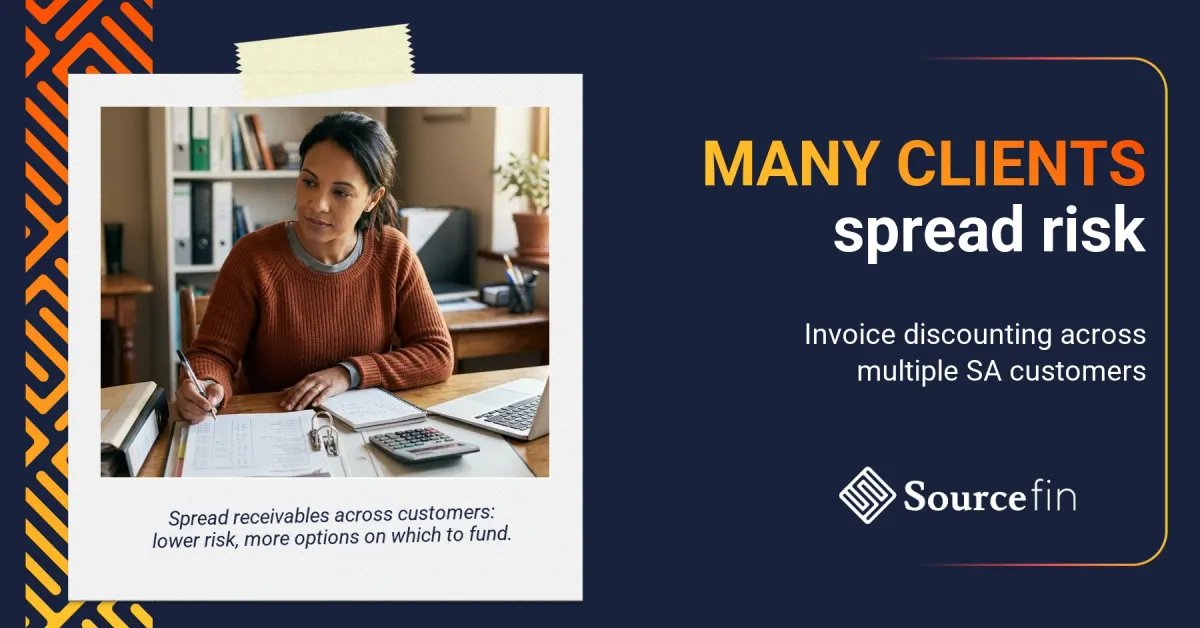
Invoice discounting for multiple customers in South Africa works in Sourcefin's favour and the SMME's favour at the same time. A diversified customer book reduces customer-concentration risk – the funder is not betting on a single payment from a single counterparty. The SMME has more flexibility on which invoices to discount and when. Sourcefin can structure as selective (deal-by-deal across the book), a rolling pattern (every month's invoices in turn), or a multi-debtor facility (a working credit against a basket of approved customer invoices). The starting point is the same four-question assessment, applied to each customer.
Key Takeaways
- Invoice discounting for multiple customers is structurally favourable – diversified receivables reduce concentration risk for both Sourcefin and the SMME.
- Sourcefin can fund selectively (one invoice at a time), rolling (every monthly invoice in turn), or via a multi-debtor facility against a basket of pre-approved customer invoices.
- Each customer in the book has to clear the same credibility test independently – there is no group customer rating.
- SMMEs with one customer that represents more than 50 to 60% of revenue carry customer-concentration risk and benefit most from diversifying before scaling funding.
- Most Sourcefin-funded deals start at around R250,000, scaling with the value and quality of the receivables in the book.
Why invoice discounting for multiple customers works well
A diversified customer book changes the maths in three useful ways:
- Risk is spread across counterparties. If one customer goes slow on payment, the SMME has other receivables still moving. The funding is not hostage to a single payment cycle.
- The SMME has options. Different customers settle on different cycles. The SMME can choose which invoices to discount and when, optimising cash inflow.
- The book scales naturally. Adding customers grows the discountable base without changing the underlying product – more invoices on more customers, same assessment per deal.
For Sourcefin's deal team, a spread book is also a positive signal: it suggests the SMME has solved the customer-acquisition problem and is operating a real business rather than a single-contract exposure.

The three main ways to structure invoice discounting for multiple customers
1. Selective invoice discounting (deal-by-deal)
The SMME picks specific invoices on specific customers to discount, one at a time. Each invoice is its own deal. The customer is verified per invoice. The SMME has full control over which invoices enter the funding queue.
Selective suits:
- SMMEs with a mix of customers on different payment cycles
- SMMEs that prefer to discount only the largest or longest-tenor invoices
- SMMEs at the start of using invoice discounting who want to learn the model with a few deals before scaling
2. Rolling invoice discounting (every monthly invoice in turn)
The SMME discounts each month's invoices in a rolling pattern – month one funded, month two delivered, month two funded when month one settles. Suits firms with steady recurring monthly billing on a stable customer set.
Rolling suits:
- MSPs, retainer-based consultancies, and other recurring-revenue businesses
- SMMEs with a stable monthly invoice value on a known set of corporate customers
- Businesses building a predictable cash-flow pattern around the funding
3. Multi-debtor facility (basket against pre-approved customers)
Sourcefin pre-approves a basket of customer credit lines, and the SMME draws against the basket as invoices on those customers come through. The facility scales as the customer book grows. The most flexible structure but requires a meaningful book to make the operational set-up worthwhile.
Multi-debtor suits:
- Established SMMEs with a steady book of credit-credible customers
- Businesses that want flexibility on which invoices to draw against at any moment
- Firms whose customer book has scaled past a meaningful threshold
For the deeper comparison between selective and whole-turnover/multi-debtor structures, see selective vs whole-turnover invoice discounting in South Africa.
How customer-concentration risk is assessed
Sourcefin's four-question framework applies per customer, but concentration is part of the operational-capacity question. Practical thresholds the deal team thinks about:
- Healthy diversification. No single customer above ~30 to 40% of total receivables. The book has organic spread.
- Watch zone. One customer at 50 to 60% of revenue. Manageable but the SMME and Sourcefin both watch that customer's behaviour closely.
- Concentration risk. One customer above 70% of revenue. The SMME is structurally exposed – if that customer goes slow, the entire receivables book is affected. Invoice discounting still works on the deals, but the SMME's broader cash-flow plan needs to account for the exposure.
None of these thresholds are hard cut-offs – Sourcefin assesses concentration alongside customer quality, contract structure, and the SMME's operational discipline. Detailed limits guidance lives in invoice discounting limits in South Africa.
Common multi-customer patterns Sourcefin sees
Three patterns that show up regularly:
- The diversified contractor. A construction or services SMME with 8 to 15 active customers across government, parastatals, and corporates. Each invoice is its own deal. Selective discounting on the largest or longest-tenor invoices works cleanly.
- The MSP with 10 to 30 corporate retainers. Steady monthly billing across a known basket. A rolling or multi-debtor structure smooths the cash cycle across the whole book.
- The wholesale or distribution SMME. 20-plus customers on 30 to 60-day terms. Each monthly billing run generates dozens of invoices on the same set of customers. Multi-debtor facility fits well once the book is large enough.
Documents for invoice discounting for multiple customers
The standard pack from invoice discounting requirements in South Africa applies. Useful additional items when the deal involves multiple customers:
- A schedule of the customer book showing customer name, contact, average invoice value, and average payment term
- An aged debtor report (where applicable) showing the current status of each customer's invoices
- Customer concentration analysis – percentage of total receivables per top customer
- The signed scopes of work, contracts, or master services agreements for the top customers
These extras help Sourcefin's deal team move from a single-deal assessment to a multi-customer view efficiently.
What does not change because there are multiple customers
- The four-question framework still applies per customer. A spread book is positive, but each customer in the book still has to pass the verification, credibility, uncontested-invoice, and capacity tests independently.
- International customers still do not fit. Sourcefin's invoice discounting funds SA-based customer receivables only. A book that includes international customers can discount only the SA portion.
- Cost is still a discount cost on the advance. No separate service fee on Sourcefin's pricing model. The cost on each deal depends on the customer and the term.
- The R250,000 floor still applies. Whether a single invoice or an aggregated draw from a multi-debtor facility, the meaningful-deal-size question is the same.
Where Sourcefin lands
Sourcefin has deployed R3 billion-plus in working capital to South African SMMEs since 2020, funded 1,000+ SMMEs across diversified and concentrated customer books, and maintained a 100% delivery rate on funded deals. The same four-question assessment scales from a single deal to a multi-customer book – the framework holds.
For broader context, Stats SA publishes SA economic statistics, the Department of Small Business Development publishes SA small-business policy, and the IFC SME Finance Forum publishes the global MSME Finance Gap database covering emerging markets.
If your SMME is invoicing several credible SA customers, invoice discounting for multiple customers can be structured selective, rolling, or as a multi-debtor facility. Start at the funding application page or read more about how invoice discounting works at Sourcefin.
Sources & References
- Statistics South Africa – Official SA economic statistics.
- Department of Small Business Development – SA small-business policy and reporting.
- IFC SME Finance Forum – Global MSME Finance Gap database, World Bank Group.
Frequently asked questions
How does invoice discounting for multiple customers work in South Africa?
Sourcefin assesses each customer in the book against the same four-question framework: is the invoice valid and verifiable, is the customer credible, is the deal uncontested, does the SMME have operational capacity to retain collections. The SMME can discount selectively (one invoice at a time), in a rolling pattern (every month's invoices in turn), or via a multi-debtor facility against a basket of pre-approved customer credit lines.
Is invoice discounting for multiple customers easier than for a single customer?
Generally yes, from a structural risk standpoint. A diversified customer book reduces customer-concentration risk – Sourcefin is not betting on a single payment from a single counterparty, and the SMME has options if one customer goes slow. That said, each customer still has to clear its own credibility test, so a spread book of weak customers does not become fundable through diversification alone.
What is a multi-debtor facility and when does it make sense?
A multi-debtor facility pre-approves a basket of customer credit lines, and the SMME draws against the basket as invoices on those customers come through. It suits established SMMEs with a steady book of credit-credible customers who want flexibility on which invoices fund at any moment. It requires a meaningful customer book to make the operational set-up worthwhile.
What customer concentration is acceptable for invoice discounting?
Healthy diversification is no single customer above 30 to 40% of revenue. The watch zone is 50 to 60% on one customer – manageable but watched closely. Above 70% is structural concentration risk. None are hard cut-offs – Sourcefin assesses concentration alongside customer quality, contract structure, and operational discipline. The detail lives in the Sourcefin guide on invoice discounting limits in South Africa.
Can I include international customers in a multi-customer invoice discounting deal?
Sourcefin's invoice discounting funds SA-based customer receivables only. A book that includes international customers can discount only the SA portion. The offshore portion sits in cross-border trade finance, typically bank-issued letters of credit or specialist export finance. The SA-customer portion of the book is fundable on standard invoice discounting terms.
What documents do I need for invoice discounting for multiple customers?
The standard pack – CIPC documents, director ID, proof of business address and bank account, recent bank statements – plus a schedule of the customer book showing customer name, average invoice value, and average payment term. An aged debtor report and a customer-concentration analysis help Sourcefin assess the book efficiently. Signed contracts or scopes of work for the top customers strengthen the verification step.

Sourcefin is a South African alternative finance provider that offers purchase order funding and invoice discounting to SMMEs, enabling businesses to fulfil confirmed purchase orders or tenders and unlock cash flow without collateral. Unlike traditional lenders or banks, Sourcefin also provides end-to-end support including supplier sourcing, logistics, project management, and risk oversight.