
Invoice Discounting for B-BBEE Compliant SMMEs: Proven Fit
Invoice discounting for B-BBEE compliant SMMEs in South Africa. How procurement preference wins the work, then Sourcefin funds the receivables.
On this page
- Key Takeaways
- How invoice discounting for B-BBEE compliant SMMEs fits in the procurement cycle
- What Sourcefin's assessment actually looks at
- Why this combination works so well for SA SMMEs
- Document requirements: what is and is not needed
- Common scenarios where the combination works
- What does not change because of B-BBEE compliance
- Where Sourcefin lands
- Frequently asked questions
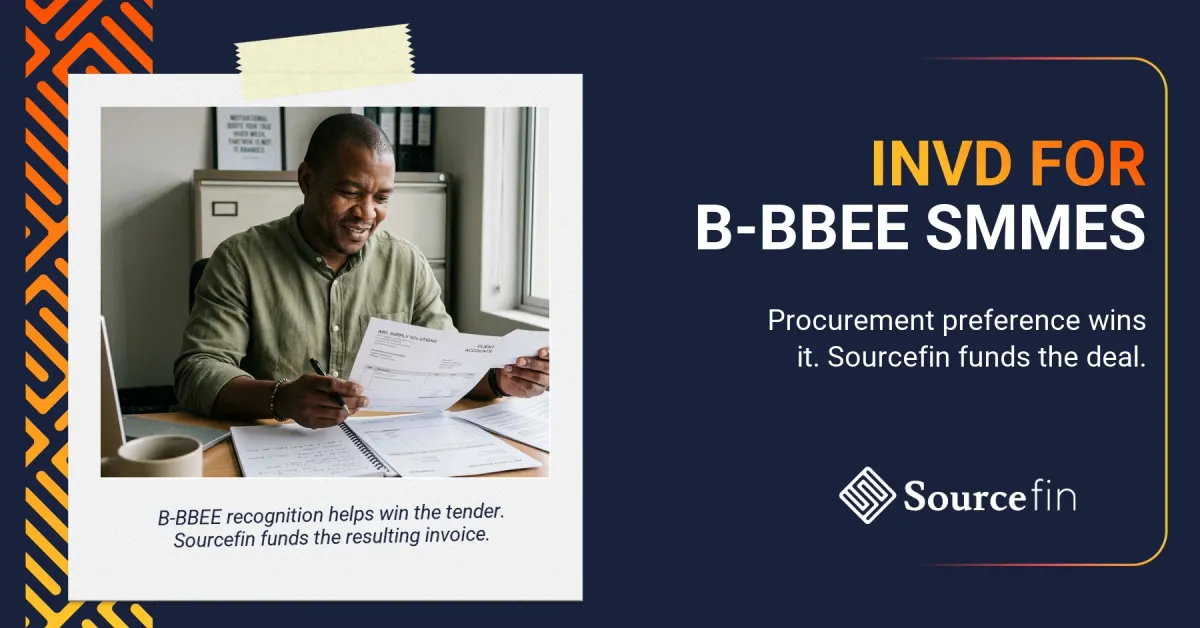
Invoice discounting for B-BBEE compliant SMMEs in South Africa is not a different product – it is the same Sourcefin invoice discounting model applied to SMMEs whose B-BBEE positioning has helped them win the work in the first place. B-BBEE recognition gives qualifying SMMEs procurement preference under the codes published by the Department of Trade, Industry and Competition, particularly on government tenders and large-corporate supplier panels. Once the contract is awarded, the SMME delivers and invoices the customer. Sourcefin then funds the receivable on standard deal-based terms.
Key Takeaways
- Invoice discounting for B-BBEE compliant SMMEs uses the same Sourcefin deal-based assessment as any other invoice discounting deal – there is no separate product or track.
- B-BBEE recognition operates upstream of funding: it influences who wins the procurement award, not who qualifies for invoice discounting.
- Once the work is delivered and the invoice raised, Sourcefin assesses the deal on four questions: invoice valid, customer credible, deal uncontested, capacity to retain collections.
- For government tenders and large-corporate procurement, B-BBEE level and ownership profile materially affect the preference points score that decides the award.
- Most Sourcefin invoice discounting deals start at around R250,000 – this applies equally to B-BBEE compliant SMMEs and any other ownership profile.
How invoice discounting for B-BBEE compliant SMMEs fits in the procurement cycle
South Africa's B-BBEE framework, administered through the Department of Trade, Industry and Competition, sets out the scorecard elements that measure broad-based black economic empowerment. The codes apply across most of the SA economy and feed directly into procurement decisions by the public sector and most listed corporates.
In practical terms for an SMME, the cycle works like this:
- The SMME gets a B-BBEE affidavit (for EMEs and QSEs) or full verification certificate (for larger entities).
- The SMME submits the certificate or affidavit as part of bids on government tenders or corporate supplier registrations.
- The procuring entity applies the preference-point scoring – B-BBEE level is one component, price is the other. See the 80/20 preference points system in South Africa for the technical mechanics.
- The SMME wins the contract – at this point, B-BBEE has done its job upstream of funding.
- The SMME delivers and invoices the customer on standard terms (often 30, 60, or 90 days).
- Sourcefin funds the resulting invoice on deal-based assessment.

What Sourcefin's assessment actually looks at
The assessment for invoice discounting is independent of B-BBEE status. Sourcefin asks four practical questions on every deal:
- Is the invoice valid and verifiable with the customer?
- Is the customer paying the invoice credit-credible?
- Is the invoice uncontested and for goods or services already delivered?
- Does the SMME have the operational capacity to retain the customer relationship and the collections process?
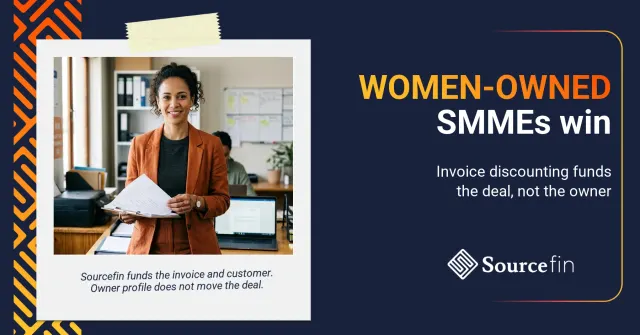
B-BBEE status is not one of the questions. That is by design – invoice discounting is a deal-based product, and the deal has to stand on its own merits.
Why this combination works so well for SA SMMEs
B-BBEE-led procurement and invoice discounting solve complementary problems for SMMEs:
- B-BBEE helps win the contract. Without procurement preference, SMMEs would struggle against established suppliers on price alone. The preference-point system levels the field.
- Long customer payment terms create the cash-flow gap. Government and large-corporate buyers typically pay on 30, 60, or 90-day terms. Many SMMEs cannot fund delivery and the next contract simultaneously while waiting for payment.
- Invoice discounting closes that gap. Funding the receivable releases the cash earlier, so the SMME can take the next order without running out of working capital.
The result is a working pattern: win on B-BBEE, deliver to standard, fund the invoice, repeat.
Document requirements: what is and is not needed
The document set for invoice discounting for B-BBEE compliant SMMEs is the standard pack. Specifically:
- CIPC business registration documents
- Director ID
- Proof of business address and bank account
- The invoices to be discounted
- Proof of delivery or service completion
- Recent business bank statements
The B-BBEE certificate or affidavit is not required for Sourcefin's funding assessment, but is typically required by the customer for the procurement award itself. See B-BBEE certificates for tenders in South Africa for the procurement-side detail, and invoice discounting requirements in South Africa for the funding-side detail.
Common scenarios where the combination works
Three typical patterns for B-BBEE compliant SMMEs that pair well with invoice discounting:
- Recently won government tender. The SMME has delivered the first phase, invoiced on a 60-day term, and needs to fund production for phase two before payment lands. Invoice discounting on the phase-one invoice releases the cash. See invoice discounting for tender winners.
- Listed-corporate supplier panel placement. The SMME is now registered as a Level 1 or Level 2 supplier to a JSE-listed buyer with consistent monthly order flow. Invoice discounting on the rolling invoices funds the next month's delivery.
- Enterprise and Supplier Development (ESD) programme. The SMME is supported through a corporate's ESD pipeline and has been awarded a contract. Once delivery happens and invoices issue, the receivables-finance step is invoice discounting.
What does not change because of B-BBEE compliance
It is worth being explicit. Being B-BBEE compliant does not:
- Reduce the invoice discounting cost. Pricing is a discount cost on the advance, driven by the deal economics, not by ownership profile.
- Lower the document threshold. The standard pack is still the standard pack.
- Override the four-question framework. A B-BBEE compliant SMME with a contested invoice on a stressed customer still cannot have that specific deal funded.
- Replace operational capacity. The SMME still needs to retain collections and keep accurate records of customer payments.
Where Sourcefin lands
Sourcefin has deployed R3 billion-plus in working capital to South African SMMEs since 2020, funded 1,000+ SMMEs, and maintained a 100% delivery rate on funded deals. The book includes a substantial cohort of B-BBEE compliant SMMEs – not because the product favours them, but because the procurement environment puts them in front of credible customers with fundable invoices.
For broader context, the Department of Small Business Development publishes SA small-business policy, and the IFC SME Finance Forum publishes the global MSME Finance Gap database covering emerging markets.
If your B-BBEE compliant SMME has delivered on a contract and is sitting on a customer invoice, invoice discounting for B-BBEE compliant SMMEs is a standard Sourcefin deal. Start at the funding application page or read more about how invoice discounting works at Sourcefin.
Sources & References
- Department of Trade, Industry and Competition – B-BBEE policy framework and codes of good practice.
- Department of Small Business Development – SA small-business policy and reporting.
- IFC SME Finance Forum – Global MSME Finance Gap database, World Bank Group.
Frequently asked questions
How does invoice discounting for B-BBEE compliant SMMEs work in South Africa?
Invoice discounting for B-BBEE compliant SMMEs is the same Sourcefin product applied to SMMEs whose B-BBEE positioning has helped them win the work. B-BBEE recognition operates upstream of funding – it influences who wins the procurement award. Once the SMME has delivered and issued an invoice, Sourcefin funds the receivable on standard deal-based terms, assessing the invoice, the customer, and operational capacity.
Is B-BBEE level part of Sourcefin's invoice discounting assessment?
No. Sourcefin's invoice discounting is a deal-based product. The four assessment questions look at the invoice, the customer paying it, whether the deal is uncontested, and the SMME's capacity to retain collections. B-BBEE level is not one of those questions. Where it matters is upstream – in the customer's procurement decision to award the contract in the first place.
Does a B-BBEE certificate or affidavit get me cheaper invoice discounting?
No. Invoice discounting cost is a discount cost on the advance, driven by the deal economics – customer profile, invoice value, duration of the advance. Ownership profile, including B-BBEE level, does not change the cost. Where the certificate helps is upstream of funding, in winning the procurement award.
Can a Level 1 B-BBEE EME apply for Sourcefin invoice discounting?
Yes. The B-BBEE level does not gate access to invoice discounting. The gating questions are deal-based: is the invoice valid and verifiable, is the customer credible, is the deal uncontested, and does the SMME have the capacity to retain the customer relationship. Level 1 EMEs and QSEs are funded on the same model as any other SMME.
Where does B-BBEE compliance interact with the procurement award itself?
Under the 80/20 and 90/10 preference points systems, the procuring entity scores bids on price plus B-BBEE level. A strong B-BBEE profile materially affects who wins the contract on government tenders and large-corporate procurement. The Sourcefin cluster article on the 80/20 preference points system covers the technical mechanics.
What documents do B-BBEE compliant SMMEs need for invoice discounting?
The standard Sourcefin pack: CIPC documents, director ID, proof of business address and bank account, the invoices being discounted, proof of delivery or service completion, and recent business bank statements. The B-BBEE certificate or affidavit is not required for the funding assessment itself, but is typically required by the customer's procurement team to award the contract.

Sourcefin is a South African alternative finance provider that offers purchase order funding and invoice discounting to SMMEs, enabling businesses to fulfil confirmed purchase orders or tenders and unlock cash flow without collateral. Unlike traditional lenders or banks, Sourcefin also provides end-to-end support including supplier sourcing, logistics, project management, and risk oversight.