
Business Fuel Loans vs Fuel Cards South Africa: Smart Guide
Business fuel loans vs fuel cards South Africa: how each product works, when to use which, and how SMMEs combine them for steady fleet cash flow.
On this page
- Key Takeaways
- What a Fuel Card Facility Actually Is
- What a Working-Capital Line for Fuel Actually Is
- Business Fuel Loans vs Fuel Cards South Africa: When to Use Each
- A Worked Example: Fleet Operator on a Logistics Contract
- The Tradeoffs, Honestly
- How the Two Products Stack Together
- Compliance and Application Notes
- Frequently asked questions
Business fuel loans vs fuel cards South Africa is a comparison every fleet-running SMME ends up making, because the two products solve different problems. A fuel card facility smooths weekly fuel purchases into a single monthly settlement, with discounts at participating sites and tighter reporting. A working-capital line such as invoice discounting or purchase order funding advances cash against approved invoices or verified contracts, giving the SMME the rand-value it needs to keep operating between buying fuel and being paid by the customer. For most fleet operators the cleanest answer is not one or the other. It is both, used together, with each product solving the part of the cash-flow picture it is built for.
Key Takeaways
- Fuel cards are a payments and reporting product. They smooth weekly fuel into a single monthly settlement and often carry discounts at participating sites, but the SMME settles the full balance every month from its own cash.
- Invoice discounting and purchase order funding are working-capital products. They advance cash against approved invoices or verified contracts so the SMME can pay for fuel, payroll and materials without waiting 30 to 90 days for the customer to settle.
- A fuel card on its own does not fix a cash-flow gap caused by long customer payment terms. A working-capital line on its own does not give a fleet the daily payments tooling, controls or pump-side discounts a fuel card facility carries.
- The blended setup most fleet SMMEs end up with is a fuel card facility for daily refuelling, invoice discounting against monthly customer billing, and purchase order funding for fuel-heavy contract awards.
- The right starting question is not which product is cheaper. It is what part of the cash-flow picture each product is built to handle, and where the SMME currently has a gap.
What a Fuel Card Facility Actually Is
A fuel card facility is a monthly credit line issued by an oil major or specialist fuel-card provider. The SMME is given cards, one per driver or vehicle, that pay for fuel and often oil, AdBlue and basic consumables at participating forecourts. Every transaction is captured on a central statement covering date, site, vehicle, driver, litres, rand value and (where supported) the odometer reading at the pump.
The SMME does not pay at the pump. The provider pays the forecourt, then issues a single consolidated invoice at the end of the cycle, usually monthly. That settlement is paid in full from the SMME's own bank account on the agreed date. A fuel card is therefore a payments product layered with reporting tooling, not a working-capital product. The credit line is short, settled monthly, and sized against account history rather than approved invoices or verified contracts.
Three features make fuel cards useful for fleet operators. Pump-side discounts at participating sites compound across a fleet over a year. Driver and vehicle controls remove a meaningful slice of fuel-related fraud risk. Centralised reporting replaces paper slips with a single monthly statement that exports cleanly into accounting and fleet-management systems and keeps the SARS audit trail tidy.
What a fuel card does not do is bridge a cash-flow gap. The full monthly balance still has to be settled from the SMME's own cash on the agreed date. If the customer being invoiced for the work that consumed that fuel is on a 60 or 90 day payment term, the fuel card has not helped with the timing problem.
What a Working-Capital Line for Fuel Actually Is
The working-capital products most relevant to fuel-heavy SMMEs are invoice discounting and purchase order funding. Both sit inside the wider category of business fuel loans South Africa options that fleet operators, contractors and tenderpreneurs ask about when fuel costs rise faster than customer payments arrive.
Invoice discounting is the cleaner fit when the work has already been done. The SMME has delivered, issued an invoice to a creditworthy buyer, and is waiting for payment on the buyer's normal term. The funder advances most of the invoice value within days. Repayment is taken from the customer's payment when it lands. The advance can be used for any operating expense, including the next round of fuel. The mechanics are on the invoice discounting service page, with a worked fuel example in the invoice discounting for fuel price hedging cluster article.
Purchase order funding sits before the work is done. The SMME has won a contract or order, the buyer has been verified, and the work requires upfront spend on stock, materials, sub-contractors and fuel. Sourcefin pays the supplier directly so the SMME can mobilise without depleting its own cash. Repayment is taken from the customer's payment after delivery. The mechanics are on the purchase order funding service page, and the bidder's view is in the purchase order funding for fuel tenders cluster article.
Working-capital lines do not give the SMME a payments card at the pump or forecourt discounts. What they do is convert an invoice or contract into cash within days, so fuel, payroll and materials can be paid without waiting on the customer's full payment term.
Business Fuel Loans vs Fuel Cards South Africa: When to Use Each
The decision starts with one question: where is the gap in the SMME's cash flow? The honest answer is usually that there is more than one gap, and the products solve different ones.

Use a Fuel Card When
- The fleet has more than two vehicles and weekly fuel spend is becoming difficult to track manually.
- Fuel-related fraud, fuel theft or out-of-route refuelling has been an issue and tighter controls would pay for themselves quickly.
- The cash position is healthy enough to settle the monthly fuel balance in full from current operating cash.
Use Invoice Discounting When
- The work has been done, an invoice has been issued to a creditworthy buyer, and the customer payment term sits at 30, 60 or 90 days.
- The cash gap between buying the fuel and being paid by the customer is producing real timing pain in the operating account.
- Monthly customer billing is recurring and predictable, so the facility can be drawn against repeatedly each month.
Use Purchase Order Funding When
- A new contract or tender has been awarded, but mobilisation requires upfront spend on stock, fuel, sub-contractors or materials.
- The buyer is creditworthy and the order is verified, but the SMME does not want to deplete its operating reserves to fulfil the work.
- The contract is fuel-heavy enough that paying for fuel out of cash would compromise other delivery requirements.
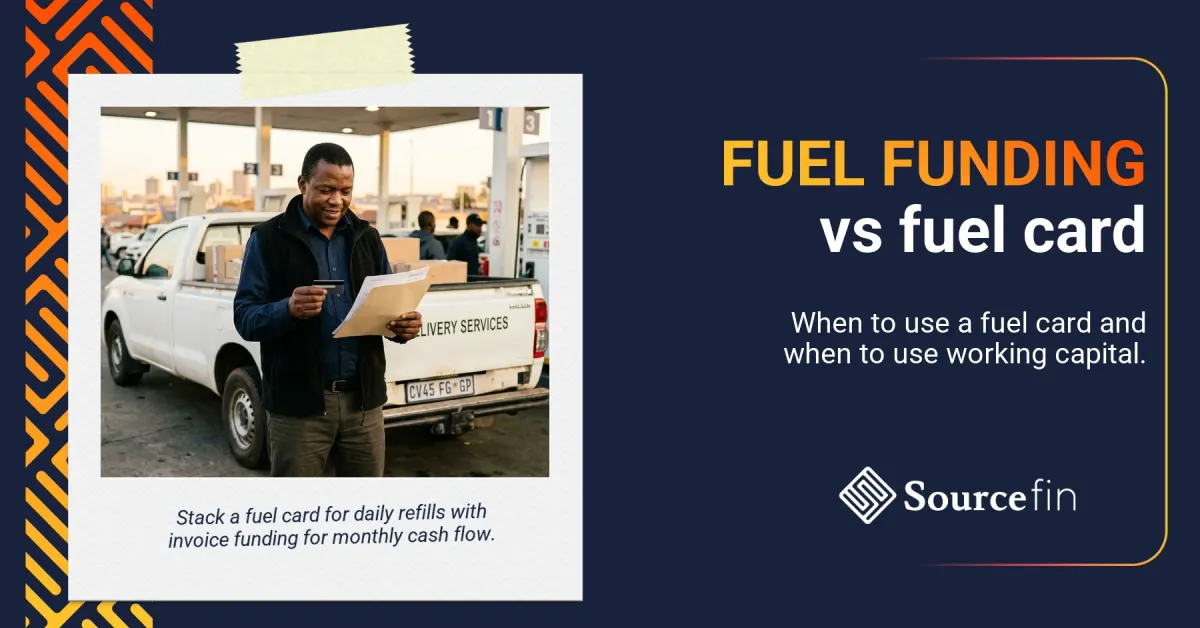
The pattern most fleet SMMEs end up with is not a choice but a stack. A fuel card facility for daily refuelling, an invoice discounting line against monthly customer invoices, and a purchase order funding facility called on for larger contract awards.
A Worked Example: Fleet Operator on a Logistics Contract
Consider a logistics SMME with eight delivery vehicles on a 12 month contract for a corporate retailer. Monthly diesel spend across the fleet is approximately R280,000. Monthly invoice value to the retailer is approximately R650,000, paid on day-60. Other operating costs sit at roughly R220,000 a month.
The fuel-side question splits cleanly. A fuel card facility handles the eight vehicles' daily refuelling, locked to diesel only and capped at a sensible daily rand value per vehicle. The provider settles forecourts directly. The SMME settles a single consolidated invoice on the agreed monthly date.
The fuel card does not solve the problem of paying that monthly fuel balance, plus drivers, plus maintenance, when the retailer's payment is still 30 to 60 days away. Invoice discounting against the monthly invoice advances most of the R650,000 within days of issue. The advance covers fuel, payroll and other operating costs through the month. Repayment is taken when the retailer's payment lands on day-60.
Six months in, the SMME wins a smaller fuel-heavy delivery tender from a public-sector buyer. Mobilisation requires a bulk diesel order and a short-term hire of two extra vehicles. Purchase order funding pays the suppliers directly so the SMME can mobilise without dipping into reserves. Repayment is taken when the public-sector buyer pays after delivery sign-off. The three products run side by side, each handling the part of the picture it was built for.
The Tradeoffs, Honestly
Neither product family is free, and neither is the right answer in every situation. A short view of the tradeoffs:
- Fuel cards have settlement risk. The full monthly balance is due on a fixed date. Late settlement triggers penalty interest, account suspension and reputational damage with the provider.
- Fuel cards are sized against history. A young or fast-growing SMME may find the credit line is smaller than operational reality requires.
- Invoice discounting depends on the buyer's creditworthiness. A buyer with a thin credit profile may limit the facility's availability or pricing.
- Purchase order funding requires verified contracts and active compliance. SARS, CIPC and CSD standing where applicable need to be current. Both gates are non-negotiable.
- Working-capital products carry a cost of funds. Fuel-card discounts at the pump can offset a portion of that cost, which is one practical reason the two products work well together.
Fuel cards and working-capital lines are not in competition. They occupy different rooms in the same house. The mistake to avoid is using one to do the other's job.
How the Two Products Stack Together
The fuel card facility runs every day. Drivers refuel at participating sites, the provider pays the forecourt, and a consolidated statement is issued at the end of the cycle. The SMME settles that statement from its operating account.
The working-capital line runs against billing and contract events. When a customer invoice is issued, invoice discounting advances the bulk of its value within days, putting cash into the operating account. That cash funds the fuel card settlement, payroll and other operating costs through the month. When the customer's payment arrives, the facility self-clears.
For fuel-heavy contract mobilisations, purchase order funding sits in front of both. The funder pays suppliers directly, the SMME delivers, the customer is invoiced, and the customer's payment retires the facility. Once delivery is complete, recurring monthly billing rolls back into the invoice-discounting facility for the remainder of the contract. The wider transport fleet fuel cost management guide and the fuel tender cash flow management cluster article walk this pattern through in operational detail.
Compliance and Application Notes
Both fuel cards and Sourcefin working-capital facilities have a compliance-and-documentation layer. The fuel-card application typically requires CIPC documents, recent bank statements, financial statements and a director suretyship. Approvals are usually quick, but the credit line is normally modest relative to a fleet operator's broader funding needs.
For invoice discounting, the funder needs the contract or master service agreement underpinning the invoices, recent invoices and proof of payment, and confirmation that the buyer is creditworthy. For purchase order funding, the contract, the buyer's verification and the supplier quotes are the central documents. Active SARS, CIPC and CSD standing apply across both products. The SARS tax compliance guide covers the practical steps for keeping that standing current.
For SMMEs ready to discuss which combination of products fits their situation, the Sourcefin funding application form is the right starting point. A team member follows up directly to walk through the contracts, invoices and current funding setup, and to design the right stack across fuel card, invoice discounting and purchase order funding.
Sources & References
- Ministers Godongwana and Mantashe: short-term relief measures on fuel price increases – South African Government, March 2026.
- Fuel Price Media Statement – Department of Mineral Resources and Energy.
- Diesel refunds – South African Revenue Service.
- Government cuts fuel levy by R3 to curb price shock – Moneyweb.
- Consumer Price Index – Statistics South Africa monthly CPI release.
Frequently asked questions
Is a fuel card a loan?
A fuel card is not a working-capital loan. It is a monthly credit line issued by an oil major or specialist provider that lets fleet drivers refuel at participating sites and consolidates every transaction into a single monthly statement. The full balance is settled by the SMME from its own cash on the agreed monthly date. A fuel card simplifies fuel payments and reporting, and may carry pump-side discounts, but it does not bridge the cash-flow gap between buying fuel and being paid by the customer.
Can invoice discounting be used to pay for fuel in South Africa?
Yes. Invoice discounting advances most of the value of an approved customer invoice within days of approval. The advance can be used for any operating expense, including the next round of fuel, payroll and maintenance. Repayment is taken from the customer's payment when it lands on its normal term, often 30 to 90 days. For fleet SMMEs this is a common way to keep refuelling while waiting for monthly customer billing to clear.
Should I choose between a fuel card and invoice discounting?
For most fleet-running SMMEs the answer is to use both rather than choose. A fuel card facility handles daily refuelling, driver controls and pump-side discounts. An invoice discounting facility handles the cash-flow gap between issuing a customer invoice and being paid 30 to 90 days later. The two products solve different problems and run in parallel. The Sourcefin funding application form is the right starting point for designing the right stack.
When does purchase order funding fit better than invoice discounting?
Purchase order funding fits when a contract or tender has been awarded but mobilisation requires upfront spend on stock, fuel, sub-contractors or materials before the work can be delivered. The funder pays the supplier directly so the SMME can mobilise without depleting reserves. Invoice discounting fits after delivery, once the customer has been invoiced and the SMME is waiting for payment. On longer contracts the two products are often used in sequence, with PO funding on mobilisation and invoice discounting on monthly billing.
What documents are needed to apply for a Sourcefin fuel funding facility?
An applicant typically needs the contract, purchase order or invoice the facility would be drawn against, with the expected payment date, plus a view of the buyer's profile and creditworthiness. Active SARS, CIPC and (where applicable) CSD compliance is non-negotiable. A short business background covering trading history, sector and typical contract size is helpful. The starting point is the Sourcefin funding application form, after which a team member follows up directly to walk through the situation.
Do fuel card balances appear on the credit bureau?
Fuel card facilities are typically structured as monthly trade credit rather than long-term consumer or business loans, so they do not always appear on the credit bureau in the same way a term loan does. Late settlements affect the SMME's standing with the provider directly and can affect wider lending relationships once they cascade into other late payments. Working-capital facilities such as invoice discounting and purchase order funding are sized against the underlying invoice or contract rather than against the SMME owner's personal credit profile.

Sourcefin is a South African alternative finance provider that offers purchase order funding and invoice discounting to SMMEs, enabling businesses to fulfil confirmed purchase orders or tenders and unlock cash flow without collateral. Unlike traditional lenders or banks, Sourcefin also provides end-to-end support including supplier sourcing, logistics, project management, and risk oversight.